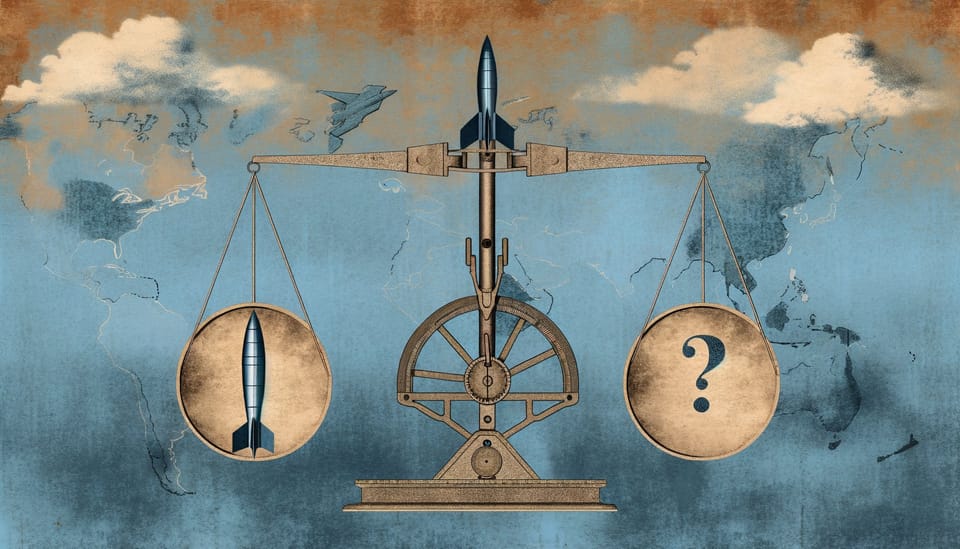
Will Trump's security doctrine push Japan, South Korea, and Poland toward nuclear weapons?
The Pentagon's 2025 strategy tells allies to handle their own defense. For three countries living under nuclear-armed adversaries, this creates a calculation that diplomatic frameworks may be too slow to constrain.
🎧 Listen to this article
The Umbrella’s Fraying Edge
When Donald Trump’s Pentagon released its 2025 National Defense Strategy, the message to allies was blunt: handle your own security. European allies “must assume primary conventional defense roles.” South Korea should deter North Korea “using limited U.S. support.” The document read less like a strategy than a termination notice.
For three countries—Japan, South Korea, and Poland—this presents an existential calculation. Each sits in the shadow of nuclear-armed adversaries. Each has relied for decades on America’s promise to defend them with nuclear weapons if necessary. Each now confronts the same question: what happens when the guarantor signals it may not guarantee?
The conventional answer invokes diplomatic frameworks. The Nuclear Non-Proliferation Treaty binds 191 states. The International Atomic Energy Agency monitors compliance. Sanctions regimes punish violators. These mechanisms have prevented dozens of potential nuclear states from crossing the threshold.
But frameworks operate on institutional time—years of negotiation, decades of norm-building, generations of trust accumulation. Proliferation operates on crisis time. When a state concludes its survival depends on nuclear weapons, the decision collapses from theoretical to operational in months. The question is not whether Japan, South Korea, or Poland want nuclear weapons. It is whether the gap between American withdrawal and diplomatic response creates a window through which they could—and would—walk.
The Doctrine’s Architecture
Trump’s approach to alliances follows a consistent logic: relationships are transactions, leverage matters more than commitment, and exposure should be minimized. His administration’s National Defense Strategy “chastised U.S. allies to take control of their own security and reasserted the Trump administration’s focus on dominance in the Western Hemisphere.”
This is not rhetorical flourish. The Pentagon’s strategic reorientation prioritizes the Western Hemisphere and great-power competition with China. European and Northeast Asian commitments become costs to be reduced, not investments to be maintained. The 2025 “Trump Corollary” explicitly denies “non-Hemispheric competitors the ability to position forces or other threatening capabilities” in the Americas—a Monroe Doctrine for the twenty-first century that implicitly downgrades commitments elsewhere.
For allies, the implications cut deep. Extended deterrence—the promise that America will defend allies with nuclear weapons—requires continuous credibility. As the Congressional Research Service defines it, extended deterrence covers “over 30 U.S. allies and partners” with the commitment that the U.S. will “come to their aid, including potentially by using U.S. nuclear weapons, if they are attacked.” This commitment demands constant reinforcement: military exercises, forward deployments, presidential statements, alliance consultations.
Credibility is not binary. It exists on a spectrum, and allies read every signal. When an American president suggests allies should “handle their own security,” the message registers not as encouragement toward burden-sharing but as advance notice of abandonment.
Japan’s Quiet Preparations
Japan presents the most paradoxical case. Its constitution’s Article 9 renounces war. Its public carries the memory of Hiroshima and Nagasaki. Polls consistently show majorities opposing nuclear weapons. Yet Japan possesses the technical capacity for rapid nuclearization that no diplomatic framework could meaningfully constrain.
The numbers tell the story. Japan holds approximately 46 tons of separated plutonium—enough for thousands of warheads. Its space program has mastered the rocket technology necessary for delivery systems. Its electronics industry could produce sophisticated guidance systems. Experts estimate Japan’s “breakout time”—the period required to assemble a functional nuclear weapon—at six to twelve months.
Prime Minister Sanae Takaichi has spent her career arguing that Japan’s postwar pacifist framework is “strategically obsolete.” Her mentor, the late Shinzo Abe, reinterpreted Article 9 to permit collective self-defense. Takaichi has gone further, calling for revision of the constitution itself and explicit discussion of nuclear options. Her political base views China as an existential threat requiring confrontational response.
The Japanese public’s “nuclear allergy” remains real. But it coexists with something else: a technological infrastructure that blurs civilian and military applications. Japan’s nuclear fuel cycle, justified for energy security, provides the fissile material. Its advanced manufacturing provides the engineering capability. The allergy constrains political rhetoric. It does not constrain technical capacity.
What triggers the shift from latent capability to active program? Historical precedent suggests the answer: perceived abandonment. South Korea pursued nuclear weapons in the 1970s precisely because the Nixon Doctrine signaled American retrenchment from Asia. Japan’s calculation follows similar logic. If American credibility collapses suddenly rather than gradually, the political constraints that have held for eighty years could evaporate in months.
Seoul’s Nuclear Sovereignty
South Korea’s nuclear debate has already moved from theoretical to practical. Public opinion polls show 70% support for an indigenous nuclear capability. The concept of “nuclear sovereignty”—taking control of security decisions from an unreliable patron—has entered mainstream political discourse.
President Lee Jae-myung embodies the tensions. A pragmatist who adapts positions based on popular sentiment, Lee faces a public increasingly skeptical of American reliability. His survival instincts—honed through childhood poverty, self-made legal career, and a 2024 assassination attempt that left him campaigning behind bulletproof glass—orient him toward whatever position maximizes political support. If that position becomes nuclear acquisition, Lee will follow the public rather than lead it.
The 2023 Washington Declaration created a Nuclear Consultative Group, giving Seoul greater visibility into American nuclear planning. The Biden administration intended this as reassurance. Under Trump’s doctrine, it looks more like a transition mechanism—training wheels before Seoul rides alone.
South Korea’s technical pathway differs from Japan’s. It lacks Japan’s plutonium stockpile but possesses advanced nuclear engineering capabilities and a robust defense industrial base. The constraint is not technical but legal: 123 Agreements with the United States require American consent for enrichment and reprocessing of nuclear material. These agreements function as what analysts call “vendor lock-in”—the United States maintains consent rights that constrain South Korean autonomy.
But vendor lock-in works only when the vendor remains engaged. If America signals disengagement, the agreements become paper obligations without enforcement mechanisms. Seoul could withdraw from the NPT under Article X, which permits exit with three months’ notice if “extraordinary events… have jeopardized the supreme interests of its country.” American abandonment would qualify.
The chaebol—South Korea’s industrial conglomerates—add another dimension. These entities can internalize nuclear development costs and socialize sanctions pain domestically. Samsung, Hyundai, and their peers possess the manufacturing sophistication and financial depth to absorb the economic consequences of proliferation. American sanctions would hurt. They would not be fatal.
Poland’s Different Calculation
Poland occupies a distinct strategic position. Unlike Japan and South Korea, it relies on multilateral rather than bilateral guarantees. NATO’s Article 5 commits all members to collective defense. Poland’s security depends not on American credibility alone but on the alliance’s collective credibility.
Yet Polish strategic culture carries deep trauma. The country has been invaded, partitioned, and abandoned repeatedly. The 1939 British and French guarantees proved worthless when Germany attacked. The 1945 Yalta agreement delivered Poland to Soviet domination despite Western promises. This frontier memory shapes how Warsaw interprets American signals.
Poland has pushed aggressively for NATO nuclear sharing arrangements—hosting American nuclear weapons on Polish soil under dual-key arrangements. Officially, this represents alliance burden-sharing. Unofficially, it builds the infrastructure and expertise for independent capability. The line between legitimate cooperation and proto-proliferation capacity-building blurs.
Poland lacks Japan’s technical head start. It has no plutonium stockpile, no indigenous enrichment capability, no advanced rocket program. But it has something else: European Union membership and access to continental industrial capacity. A Polish nuclear program would not develop in isolation. It would draw on French nuclear expertise, German engineering, and pan-European supply chains.
The constraint on Poland is not technical but political. Nuclear acquisition would rupture EU membership, trigger Article 7 proceedings, and isolate Warsaw from its primary economic partners. The trade-off calculus differs fundamentally from Japan or South Korea. For Poland, the question is whether Russian threat perception outweighs European integration benefits.
Under current conditions, it does not. But “current conditions” assumes continued American commitment to NATO. If Trump’s doctrine translates into reduced American force presence in Europe, the calculus shifts. Poland would face the choice between European economic integration and physical survival. History suggests which Poland would choose.
The Cascade Dynamics
Proliferation does not occur in isolation. One country’s decision triggers others. If Japan nuclearizes, South Korea’s domestic pressure becomes irresistible—Seoul cannot accept strategic inferiority to Tokyo given historical animosities rooted in Japanese colonization. If South Korea nuclearizes, Taiwan’s calculus changes. If multiple American allies acquire nuclear weapons, the NPT’s normative framework collapses entirely.
The diplomatic frameworks designed to prevent this operate on fundamentally different timescales. The NPT took years to negotiate and decades to establish as international norm. IAEA safeguards require sustained cooperation and trust-building. Sanctions regimes demand multilateral coordination that Trump’s transactional approach actively undermines.
These mechanisms resemble what ecologists call mycorrhizal networks—slow, invisible systems that trade resources through underground connections established over generations. Proliferation cascades operate like crown fires—rapid, visible, jumping from canopy to canopy once ignited. The mismatch in velocity is structural, not accidental.
The NPT’s Article X withdrawal provision creates a specific vulnerability. Any state can exit with three months’ notice by claiming “extraordinary events” threaten its “supreme interests.” The withdrawing state has sole discretion to determine what constitutes extraordinary events. No international review mechanism exists to challenge this judgment. North Korea demonstrated the pathway in 2003. Others have studied it carefully.
Three months is not enough time for diplomatic intervention. By the time withdrawal becomes public, the decision has already been made. The technical preparations have already begun. The political die has already been cast. Diplomatic frameworks cannot contain what they cannot anticipate.
What Breaks First
The default trajectory leads somewhere specific. American credibility erodes gradually, then suddenly. Allied hedging accelerates. Technical preparations advance under civilian cover. A crisis—Chinese aggression toward Taiwan, North Korean provocation, Russian pressure on NATO’s eastern flank—forces the latent to become kinetic.
Japan moves first. Its technical capacity is most advanced, its breakout time shortest, its industrial base most capable of rapid mobilization. Takaichi’s government frames the decision as defensive necessity, not aggressive intent. The constitutional revision that seemed impossible becomes inevitable.
South Korea follows within months. Lee Jae-myung, ever the pragmatist, reads public opinion and acts accordingly. The Nuclear Consultative Group becomes a coordination mechanism for transition rather than reassurance. American sanctions arrive but lack enforcement teeth—Washington cannot simultaneously disengage and punish disengagement.
Poland’s path takes longer. European constraints bind more tightly. But the precedent established in Asia changes the normative environment. If American allies can nuclearize without catastrophic consequence, the prohibition weakens. Poland begins technical preparations while maintaining diplomatic ambiguity.
The NPT does not formally collapse. It becomes irrelevant. States remain nominal members while pursuing capabilities the treaty was designed to prevent. The IAEA continues inspections that no longer constrain. The framework persists as institutional corpse, animated by bureaucratic momentum rather than normative force.
Intervention Points
Three leverage points exist. None is easy. All involve trade-offs.
First, credibility restoration. The Trump doctrine could be reversed by a subsequent administration. American force posture could be reinforced rather than reduced. Extended deterrence could be reaffirmed through concrete actions—increased exercises, forward deployments, explicit nuclear guarantees—rather than mere statements.
The cost: domestic political capital. American publics have grown skeptical of overseas commitments. The fiscal burden of maintaining extended deterrence competes with domestic priorities. Any administration choosing credibility restoration faces the charge of prioritizing foreign allies over American citizens.
Second, alliance restructuring. Rather than bilateral American guarantees, security could be multilateralized. Japan, South Korea, and Australia could develop integrated conventional capabilities that reduce dependence on American nuclear weapons. NATO could accelerate European defense integration, reducing reliance on American commitment.
The cost: sovereignty. Multilateral arrangements require surrendering national autonomy to collective decision-making. Japan and South Korea’s historical animosities—rooted in colonization and unresolved grievances—make military integration politically explosive. European defense integration threatens national defense industries and strategic autonomy.
Third, managed proliferation. If proliferation becomes inevitable, it could be channeled rather than resisted. Allies could develop nuclear capabilities within alliance frameworks, maintaining American oversight and integration rather than independent arsenals. This would formalize what nuclear sharing arrangements already imply.
The cost: NPT destruction. Managed proliferation among allies legitimizes proliferation generally. If Japan can have nuclear weapons within an American framework, why not Saudi Arabia? Why not Turkey? The precedent, once established, cannot be contained to allies Washington trusts.
The Most Likely Outcome
None of these interventions will occur in time. The Trump administration shows no interest in credibility restoration. Alliance restructuring requires years of negotiation that crisis timelines will not permit. Managed proliferation remains ideologically unacceptable to nonproliferation establishments in Washington and beyond.
The most likely outcome is muddled: partial American disengagement, accelerated allied hedging, technical preparations that stop short of overt weaponization, and diplomatic frameworks that persist in form while failing in function. Japan maintains its plutonium stockpile while officially opposing nuclear weapons. South Korea develops “civil” nuclear capabilities with obvious military applications. Poland hosts American weapons while building indigenous expertise.
This equilibrium is unstable. It requires that no crisis force the latent into the open. It requires that domestic politics in all three countries remain manageable. It requires that adversaries—China, North Korea, Russia—not test the ambiguity through aggression.
History suggests such requirements eventually fail. The question is not whether the equilibrium breaks but when. And when it breaks, the diplomatic frameworks designed to prevent proliferation will discover they were built for a world that no longer exists.
FAQ: Key Questions Answered
Q: Can Japan legally develop nuclear weapons under its current constitution? A: Article 9 renounces war and “war potential,” but successive governments have reinterpreted this to permit self-defense capabilities. A nuclear deterrent framed as purely defensive could survive legal challenge, particularly under a government committed to constitutional revision.
Q: How quickly could South Korea build a nuclear weapon if it decided to? A: Estimates range from 18 months to three years, depending on the pathway chosen. South Korea lacks Japan’s plutonium stockpile but possesses advanced nuclear engineering and could pursue enrichment relatively quickly. The primary constraint is political, not technical.
Q: Would the United States sanction allies who pursue nuclear weapons? A: Legally, yes—American law requires sanctions against states that proliferate. Practically, sanctioning Japan or South Korea would devastate economic relationships worth hundreds of billions annually. Enforcement would likely be selective and symbolic rather than comprehensive.
Q: What happens to NATO if Poland pursues nuclear weapons? A: Poland would face Article 7 proceedings from the EU and potential NATO suspension. However, if American commitment to Article 5 has already eroded, NATO’s value to Poland diminishes correspondingly. The alliance might fracture rather than expel a member responding to perceived abandonment.
The Inheritance of Doubt
Extended deterrence always contained a fundamental tension: would America really trade Los Angeles for Tokyo, Seattle for Seoul, Chicago for Warsaw? The question was never answerable with certainty. The genius of the Cold War arrangement was that adversaries could not be certain America would not intervene, and that uncertainty sufficed.
Trump’s doctrine does not answer the question differently. It makes the question louder. It transforms background uncertainty into foreground doubt. And doubt, once planted, grows according to its own logic.
The allies now calculating their options are not irrational actors seeking unnecessary weapons. They are rational actors responding to changed circumstances. The frameworks designed to constrain them assumed American commitment would remain constant. That assumption no longer holds.
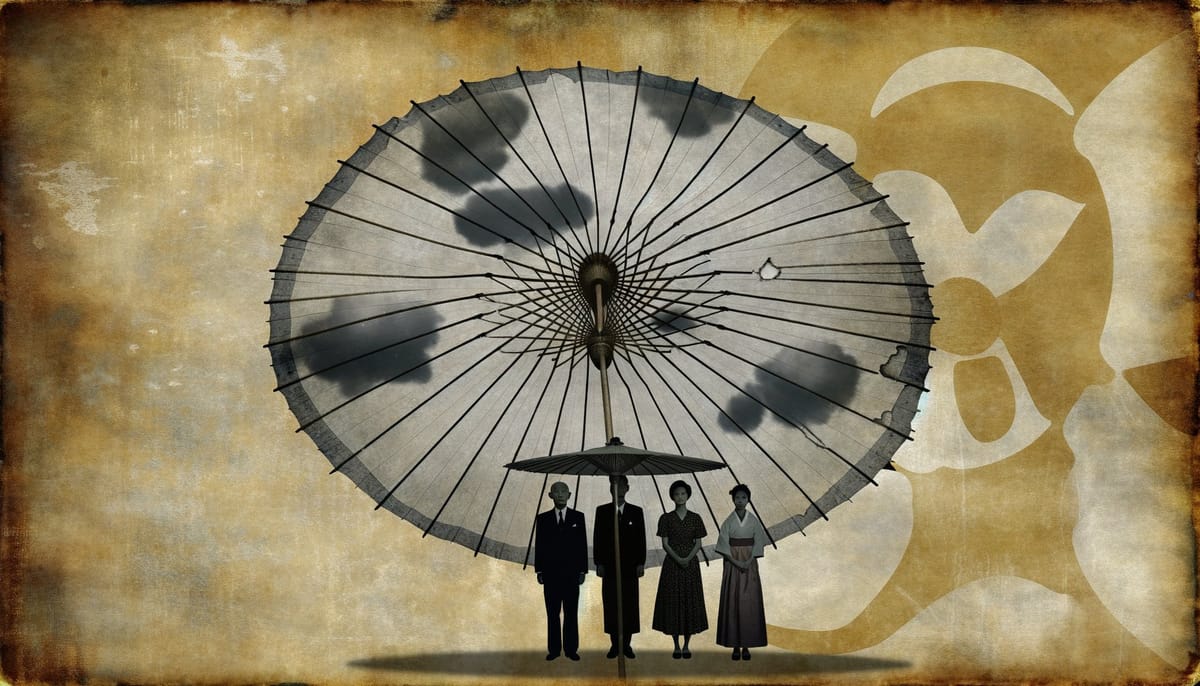
What emerges from this period will not be determined by treaties signed decades ago or institutions built for different threats. It will be determined by calculations made in Tokyo, Seoul, and Warsaw about whether the umbrella still exists—and whether, if it does not, they can build their own shelter before the storm arrives.
Sources & Further Reading
The analysis in this article draws on research and reporting from:
- Trump administration’s defense strategy tells allies to handle their own security - Primary source on the 2025 National Defense Strategy’s approach to allies
- Congressional Research Service on Extended Deterrence - Authoritative definition of U.S. nuclear commitments to allies
- NPT Withdrawal Provisions - Legal analysis of Article X withdrawal rights
- South Korea’s Search for Nuclear Sovereignty - Academic analysis of South Korean nuclear debate
- South Korea’s Anticipated Nuclear Proliferation - Research on public opinion and technical pathways
- Japan’s Ministry of Foreign Affairs on U.S.-Japan Security - Official Japanese government position on alliance commitments
- Sarmatism and European Culture - Historical context for Polish strategic culture
- Addressing Growing Risks of Nuclear Use in East Asia - Contemporary analysis of regional nuclear dynamics