Why the US cannot match China's ground station expansion—and what fails first in a space war
China has built a global network of satellite ground stations across the Global South while American interagency processes grind slowly. The infrastructure gap reveals which systems would collapse first in orbital conflict.

🎧 Listen to this article
The Stations America Cannot Build
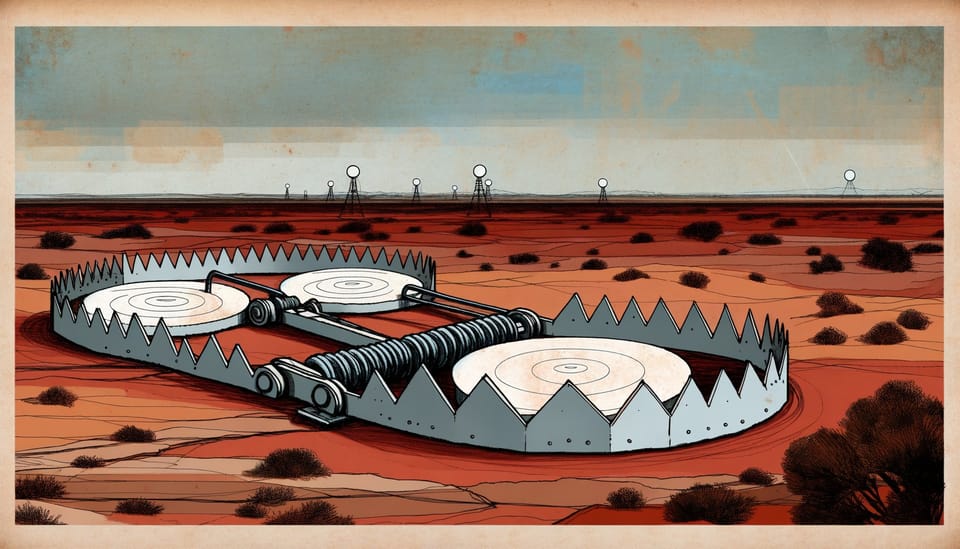
China’s Espacio Lejano deep space tracking station sits in the Patagonian steppe, 1,200 kilometers southwest of Buenos Aires. Its 35-meter antenna, operated by the People’s Liberation Army’s Strategic Support Force, can track satellites, communicate with lunar missions, and—according to Argentine officials who have never been permitted inside—serve purposes unknown to its host government. The facility opened in 2017. Eight years later, the United States has built nothing comparable in the region.
This is not for lack of trying, exactly. It is for lack of a system capable of trying effectively. The United States cannot counter China’s ground station expansion in the Global South because the American apparatus for projecting infrastructure influence was designed for a different era and a different competition. The machinery grinds slowly. The approvals stack. The interagency process consumes years while China breaks ground in months. By the time Washington agrees on a proposal, Beijing has already locked in the maintenance contracts.
The question of what breaks first in a space conflict follows directly from this asymmetry. American space architecture assumes global access to ground infrastructure that increasingly exists at China’s pleasure—or doesn’t exist at all.
Why Washington Watches
The conventional explanation for American inaction centers on money. China spends lavishly through the Belt and Road Initiative; the United States cannot match those sums. This is true but insufficient. The deeper problem is structural.
Consider the pathway a proposed American ground station must travel. The State Department must approve diplomatic engagement. The Commerce Department weighs export control implications. The Defense Department assesses security risks. The intelligence community evaluates counterintelligence exposure. NASA considers scientific cooperation frameworks. Each agency operates on its own timeline, with its own risk calculus, and its own institutional memory of past failures that make caution the default.
A CSIS report on China’s space diplomacy found that Beijing has positioned itself as a “gateway to orbit” for countries lacking independent space capabilities. Pakistan, Egypt, Ethiopia, Venezuela, Argentina, Namibia—the list grows annually. These partnerships offer satellite services, training programs, and infrastructure investment as a package. The United States offers none of these things as a package. It offers them as separate initiatives requiring separate approvals from separate agencies with separate congressional oversight.
The Wolf Amendment, passed in 2011, prohibits NASA from bilateral cooperation with China. It was designed to protect American technology. Its secondary effect has been to prevent the United States from offering joint ventures that might compete with Chinese alternatives. Countries seeking space partnerships face a binary choice: work with China, which offers everything, or work with America, which offers restrictions.
This creates what analysts call behavioral lock-in. Once a country accepts Chinese ground infrastructure, it accepts Chinese technical standards, Chinese training programs, Chinese maintenance contracts, and Chinese financing terms. The infrastructure actively excludes alternatives. A ground station built to Chinese specifications cannot easily integrate American equipment. The gauge is wrong. The protocols are wrong. The debt is denominated in yuan.
The Geometry of Disadvantage
China’s ground station network solves a specific military problem: orbital blind spots. Satellites in low Earth orbit pass over any given ground station for only minutes at a time. A single station in China cannot maintain continuous contact with assets orbiting the planet. But a network spanning multiple continents can.
The Neuquén facility in Argentina covers the Southern Hemisphere. Stations in Namibia and Pakistan extend coverage across Africa and South Asia. A facility in the Arctic—under negotiation—would complete the picture. The network enables real-time communication with reconnaissance satellites, navigation constellations, and eventually, weapons systems.
The United States maintains its own global network through allies and partners. Diego Garcia, Guam, Australia, Europe. But these relationships required decades to build and depend on formal alliance structures that do not extend to the Global South. America has no equivalent to the Neuquén station in Latin America. It has no equivalent in Africa. The geographic coverage gap is not hypothetical. It exists now.
This matters because ground stations are not merely receivers. They are command nodes. A satellite without ground contact cannot be tasked, cannot be updated, cannot be controlled. In peacetime, this is an inconvenience. In conflict, it becomes decisive.
Space Force General B. Chance Saltzman has warned that China’s growing arsenal threatens American ability to rely on satellites for targeting, communications, and surveillance. The US-China Economic and Security Review Commission’s 2025 annual report described China’s space expansion as entering a “new phase” that American military leaders characterize as “mind-boggling.” The commission’s 745 pages document capability growth that Washington’s procurement cycles cannot match.
Yet the American response remains fragmented. The Space Force focuses on orbital assets. The State Department handles diplomatic relationships. USAID manages development assistance. No single authority can assemble the package—financing, technology transfer, training, maintenance—that China offers as standard.
What Global South Partners Actually Want
The conventional American assumption holds that developing countries accept Chinese infrastructure because they have no choice. This flatters Washington and misreads the situation.
Countries like Argentina, Ethiopia, and Pakistan are not passive recipients. They are strategic actors hedging between great powers. Chinese ground stations offer tangible benefits: jobs during construction, technology transfer (however limited), prestige projects that politicians can claim credit for, and access to satellite services that would otherwise require expensive imports.
The Neuquén facility employs Argentine technicians. It provides data to Argentine scientists. It represents, in the words of Argentine officials, a partnership rather than an imposition. That the partnership serves Chinese military interests is understood. It is also considered someone else’s problem.
American alternatives, when they exist, come with conditions. Human rights requirements. Transparency demands. Environmental assessments. These are not unreasonable in principle. They are deal-breakers in practice. A government seeking quick delivery of visible infrastructure will choose the partner that delivers quickly and visibly.
China’s approach also exploits a structural asymmetry in how democracies and autocracies make decisions. Beijing can commit to a 30-year partnership because the Chinese Communist Party expects to govern for 30 years. Washington cannot make equivalent commitments because administrations change every four to eight years, and each new administration reviews its predecessor’s initiatives with suspicion.
This temporal mismatch compounds the approval-process problem. Even if the State Department, Commerce Department, Defense Department, and intelligence community all agreed on a ground station proposal today, the next administration might cancel it. Partner countries know this. They discount American promises accordingly.
The Architecture of Fragility
The question of what breaks first in a space conflict requires understanding what “breaking” means in this context.
Kinetic attacks—missiles destroying satellites—receive the most attention. China demonstrated this capability in 2007, when it destroyed one of its own weather satellites and created a debris field that still threatens other spacecraft. The United States has equivalent capabilities. Russia has demonstrated them. India joined the club in 2019.
But kinetic attacks are the least likely first move. They are attributable, escalatory, and self-defeating. Destroy enough satellites and you trigger Kessler syndrome—a cascade of collisions that renders entire orbital bands unusable for everyone, including the attacker.
Non-kinetic attacks are cheaper, deniable, and reversible. Jamming disrupts signals without destroying hardware. Cyber intrusions compromise software without leaving debris. Laser dazzling blinds sensors without kinetic impact. These methods can be calibrated, tested, and withdrawn if escalation becomes undesirable.
Research on space conflict dynamics suggests that 95% of possible space attacks could be completed within 24 hours—before ground-based responses can be implemented. The attacker chooses the time, the target, and the method. The defender reacts.
This favors the side with better situational awareness. And situational awareness depends on ground infrastructure.
Here the American vulnerability becomes acute. U.S. military satellites rely on ground stations for tasking, data downlink, and command updates. Many of these stations are located in allied territory—secure, but geographically constrained. A conflict in the Western Pacific would stress communication links across the Pacific Ocean. A conflict involving Russia would stress links across the Atlantic and Arctic.
China’s distributed ground network provides redundancy that the American network lacks. If one station is jammed or destroyed, others can compensate. The Neuquén facility can communicate with Chinese satellites when stations in Asia are compromised. The network architecture assumes conflict. American architecture assumes peace.
The Insurance Collapse
A less obvious vulnerability lies in the commercial space sector that the United States increasingly depends upon.
The Space Force Commercial Space Strategy explicitly calls for integrating commercial capabilities with military and allied systems into “hybrid architectures.” This makes strategic sense: commercial constellations like Starlink provide bandwidth and resilience that government-only systems cannot match. But it also creates dependencies.
Commercial satellites operate under different insurance regimes than military assets. Lloyd’s of London requires exclusions for “state-backed” cyber-attacks, creating a paradox: insurers must determine state attribution to deny claims, but attribution in space is notoriously difficult. A satellite that stops functioning might have been attacked, might have malfunctioned, or might have been hit by debris. Proving which occurred—and whether a state was responsible—can take months or years.
This ambiguity benefits attackers. A campaign of low-level interference against commercial satellites could degrade American military capability without triggering clear escalation thresholds. The insurance market would face claims it cannot adjudicate. Satellite operators would face losses they cannot recover. The hybrid architecture that provides resilience in peacetime becomes a vector for coercion in crisis.
The constructive total loss clause in satellite insurance creates additional fragility. If repair costs exceed a threshold, insurers write off the asset entirely. An attacker need not destroy a satellite—merely damage it enough to trigger the clause. The economic warfare potential is significant.
What Breaks First
In a conflict between the United States and China, the most likely first casualty is not a satellite. It is confidence.
Space systems depend on trust: trust that signals are authentic, that data is accurate, that commands will be executed. Cyber intrusions can compromise this trust without destroying anything. A navigation satellite that might be spoofed is less useful than one known to be secure. A communication link that might be intercepted is less valuable than one known to be private.
The ground segment is where this trust is most vulnerable. Satellites are hardened against radiation and debris. Ground stations are buildings with antennas, connected to power grids and data networks that can be disrupted by means far simpler than anti-satellite missiles.
China’s distributed network provides redundancy. America’s concentrated network provides efficiency—until a single point of failure cascades through the system. The same interagency coordination problems that prevent the United States from building ground stations in the Global South also complicate the defense of existing stations. Whose responsibility is a cyber attack on a commercial ground station that supports military operations? The answer depends on which agency you ask.
The most dangerous scenario is not a dramatic Pearl Harbor in space. It is a slow degradation of capability that never crosses a clear threshold. Jamming that might be interference. Cyber intrusions that might be espionage. Satellite anomalies that might be malfunctions. Each incident ambiguous, each response delayed by the need to coordinate across agencies, each delay allowing the next incident.
What Would Change the Trajectory
The United States could compete more effectively in ground infrastructure. This would require accepting trade-offs that Washington has historically rejected.
First, streamline approvals. A single authority—perhaps within the National Space Council—could be empowered to approve ground station partnerships without the current interagency gauntlet. This would sacrifice deliberation for speed. Some bad decisions would result. The alternative is no decisions at all.
Second, offer packages. Combine financing, technology, training, and maintenance into integrated proposals that compete with Chinese offerings. This would require relaxing export controls and accepting technology transfer that makes security officials uncomfortable. The alternative is watching partners choose China because America offers nothing.
Third, make long-term commitments credible. Multi-administration agreements, treaty-level partnerships, or financing structures that survive political transitions could address the temporal mismatch. This would constrain future administrations. The alternative is partners who discount American promises.
None of these changes are likely. Each requires sacrificing something that powerful constituencies value. The interagency process protects equities. Export controls protect technology. Political flexibility protects sovereignty. The system is designed to prevent exactly the kind of rapid, committed, package-deal competition that China excels at.
The most probable trajectory, therefore, is continuation of current trends. China builds. America studies. The ground segment gap widens. And when conflict comes—if conflict comes—the United States discovers that the infrastructure it needed was never built, because the system that would have built it was optimized for a competition that ended thirty years ago.
Frequently Asked Questions
Q: Why doesn’t the US just build its own ground stations in the Global South? A: The American interagency approval process requires coordination across State, Commerce, Defense, and intelligence agencies—a process that takes years while China breaks ground in months. By the time Washington agrees on a proposal, Beijing has often already locked in maintenance contracts and technical standards that exclude American alternatives.
Q: Could China actually disable US satellites in a conflict? A: China has demonstrated anti-satellite missile capability and possesses jamming, cyber, and laser-dazzling technologies. Research suggests 95% of possible space attacks could be completed within 24 hours. The greater risk is not dramatic destruction but gradual degradation through ambiguous attacks that never cross clear escalation thresholds.
Q: What does China gain from ground stations in places like Argentina? A: The stations eliminate orbital blind spots, enabling continuous communication with satellites that pass over the Southern Hemisphere. This supports reconnaissance, navigation, and potentially weapons systems. The Neuquén facility, operated by PLA-linked entities, can track Chinese assets when stations in Asia are unavailable.
Q: Are commercial satellites like Starlink vulnerable in a space conflict? A: Yes. The US military increasingly depends on commercial constellations, but these operate under insurance regimes that exclude state-backed attacks. Ambiguous interference could degrade capability without triggering clear responses, and the hybrid civil-military architecture creates coercion vectors that purely military systems would not face.
The Quiet Surrender
China’s 2022 space white paper declared that building China into a space power is an “eternal dream.” The document emphasized that “the space industry is a critical element of the overall national strategy.” These are not aspirations. They are descriptions of ongoing programs.
The United States still possesses superior space technology. Its satellites are more capable. Its commercial sector is more innovative. Its alliance network is more extensive. But technology without infrastructure is potential without power. Alliances without presence are commitments without credibility.
The ground stations rising across the Global South represent something more significant than individual facilities. They represent a theory of competition that Washington has not yet answered—perhaps cannot answer with its current institutions. China builds the physical infrastructure of influence while America debates the procedures for considering proposals.
What breaks first in a space conflict may not be a satellite or a ground station. It may be the assumption, held for three decades, that American technological superiority would always compensate for institutional sclerosis. That assumption is being tested now, in Patagonia and Namibia and Pakistan, one antenna at a time.
Sources & Further Reading
The analysis in this article draws on research and reporting from:
- CSIS: In China’s Orbit - Beijing’s Space Diplomacy in the Global South - Comprehensive index ranking 64 countries’ space engagement with China
- The Diplomat: The Patagonian Enigma - Investigation of the Neuquén deep space station
- US Space Force Commercial Space Strategy - Official doctrine on hybrid architectures
- Space News: China’s Space Ambitions Hit a New Gear - Coverage of the 2025 US-China Economic and Security Review Commission report
- SatNews: Commercial Satellite Ground Stations in Defense Missions - Analysis of ground segment vulnerabilities
- Strategic Studies Institute: China-Argentina Space Engagement - Military assessment of bilateral space cooperation
- China’s 2022 Space White Paper - Official statement of space program objectives