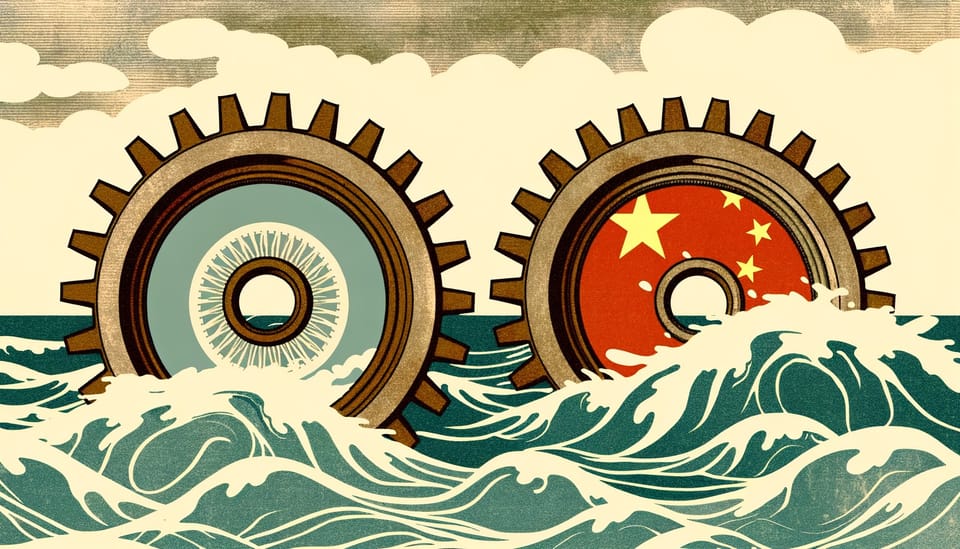
Why middle powers are building tech security pacts without America—and whether it will work
Australia, Japan, South Korea, and Canada are forging bilateral agreements on semiconductors, critical minerals, and cyber defense that bypass traditional alliances. These minilateral arrangements aim to reduce China dependency, but success requires decades of investment that democratic...

🎧 Listen to this article
The Minilateral Moment
In December 2021, Australia and South Korea signed a critical minerals partnership that barely made headlines. The agreement committed both nations to supply chain mapping, joint research, and trade cooperation in rare earths and battery materials—the unglamorous inputs that make electric vehicles and smartphones possible. No troops were pledged. No mutual defense clauses invoked. The document read like a trade memo, not a security pact.
Yet this quiet arrangement represents something more consequential than its bureaucratic prose suggests. Middle powers—states with enough heft to matter but not enough to dominate—are building a new architecture of technological security outside the alliance structures that have governed the post-war order. Australia, Japan, South Korea, Canada, and others are forging bilateral deals on semiconductors, critical minerals, cyber defense, and artificial intelligence that bypass the hub-and-spoke arrangements centered on Washington. The question is whether this minilateral scramble can actually accomplish what it implicitly promises: reducing dependence on China.
The answer is more complicated than either enthusiasts or skeptics admit.
Why Alliances Aren’t Enough
The conventional wisdom holds that middle powers shelter under American security guarantees and coordinate through established frameworks like NATO, the Quad, or AUKUS. This understanding is incomplete. Traditional alliances were built for territorial defense and nuclear deterrence, not for the granular work of securing semiconductor supply chains or rare earth processing facilities. NATO’s Article 5 may cover severe cyberattacks on a case-by-case basis, but its application to technology security remains ambiguous, with no predefined thresholds for what constitutes an attack worthy of collective response.
This creates a gap. When China banned rare earth exports to Japan in 2010 during a territorial dispute, no alliance mechanism triggered. When South Korea faced Chinese economic retaliation over the THAAD missile deployment in 2017, its allies offered sympathy but no coordinated response. When Australia’s barley, wine, and coal exports were effectively blocked by Beijing in 2020, the Five Eyes intelligence partnership provided no commercial remedy.
Middle powers learned a lesson: economic coercion operates in spaces where security alliances don’t reach.
The bilateral tech pacts emerging since 2020 attempt to fill this void. The Australia-Japan Joint Declaration on Security Cooperation, signed in October 2022, commits both nations to “resilient supply chains for clean energy technologies, protection of critical infrastructure, resistance to forced technology transfers and economic coercion, cyber defense enhancement, space cooperation, and a ‘free, safe, and secure technology environment.’” This language would have been unthinkable in the 2007 predecessor agreement. The threat it addresses isn’t invasion—it’s dependency.
Japan’s motivations are particularly revealing. Tokyo has watched its semiconductor industry decline from global dominance to marginal player while China’s share of rare earth processing climbed to approximately 90% globally. The Economic Security Promotion Act of 2022 gave the Japanese government new powers to screen foreign investment, restrict technology transfers, and support domestic production of critical goods. But legislation alone cannot conjure supply chains into existence. Japan needs partners with complementary resources and aligned interests.
Australia offers both. It holds significant deposits of lithium, cobalt, and rare earths—the minerals China has weaponized as leverage. South Korea brings semiconductor manufacturing expertise and a corporate sector desperate to reduce its exposure to Chinese supply disruptions. Canada contributes critical minerals and a trusted regulatory environment. These are not alliances of sentiment. They are marriages of mutual vulnerability.
The Arithmetic of Dependency
Can bilateral pacts actually reduce China dependency? The honest answer requires confronting uncomfortable numbers.
China controls roughly 70% of global rare earth mining and 90% of processing. This dominance didn’t emerge from geological luck—rare earths exist in commercially viable quantities in Australia, the United States, Brazil, and elsewhere. China’s monopoly was built through three decades of industrial policy that accepted environmental costs Western democracies would not tolerate. The toxic tailings and polluted groundwater in Jiangxi and Fujian provinces are not externalities of Chinese rare earth production; they are its competitive moat.
Breaking this dependency requires either matching China’s willingness to accept environmental damage or developing cleaner processing technologies that don’t yet exist at commercial scale. Bilateral pacts can accelerate the second option through joint R&D funding and shared intellectual property frameworks. They cannot wish away the first problem.
The semiconductor picture is slightly more encouraging. Taiwan’s TSMC dominates advanced chip manufacturing, but Japan’s Rapidus consortium is attempting to enter the 2nm chip market by 2027—a timeline that would have seemed fantastical five years ago. South Korea’s Samsung and SK Hynix remain globally competitive in memory chips. Australia contributes little to chip fabrication but offers critical minerals essential for semiconductor production.
The June 2024 US-Japan-South Korea trilateral commerce meeting committed all three nations to cooperation on AI safety, export controls, clean energy, and semiconductor supply chains. This represents genuine coordination, but coordination is not substitution. Even optimistic projections suggest that non-Chinese rare earth processing capacity will remain below 30% of global demand through 2030.
Middle powers face a temporal mismatch. Building alternative supply chains requires 5-10 years of sustained investment. Political cycles in democracies reset every 3-4 years. China’s strategic planning operates on generational timescales. The bilateral pacts signed today may not survive the governments that created them.
What the Pacts Actually Do
If bilateral tech pacts cannot eliminate China dependency, what do they accomplish? Three functions emerge from the evidence.
First, they create information-sharing mechanisms that traditional alliances lack. The Australia-Japan Reciprocal Access Agreement, which entered into force in August 2023, establishes legal frameworks for military access but also enables broader cooperation through “separate bilateral agreements and initiatives,” including information security arrangements and joint research programs. These channels allow faster coordination on export controls, investment screening, and technology transfer restrictions than multilateral bodies can achieve.
Second, bilateral pacts enable supply chain mapping that reveals hidden vulnerabilities. The Australia-Korea critical minerals partnership specifically prioritizes mapping “to increase certainty of supply to the renewable energy and advanced manufacturing sectors.” This diagnostic function matters because many firms don’t know the origin of their third-tier suppliers. A Japanese electronics company may source components from a Taiwanese manufacturer that relies on a Chinese rare earth processor that depends on Mongolian mining operations. Bilateral agreements create frameworks for tracing these chains.
Third, the pacts serve as signaling devices—both to China and to domestic constituencies. When Australia and Japan announce joint commitments to resist “economic coercion,” they communicate to Beijing that future pressure campaigns will face coordinated responses. Simultaneously, they signal to domestic industries that government support for diversification is credible. This signaling function may be the pacts’ most immediate effect, even if the underlying supply chain shifts take years to materialize.
What bilateral pacts do not do is solve the collective action problem at the heart of dependency reduction. Each middle power benefits if others bear the costs of diversification. Australia profits from selling rare earths to China while Japan and Korea bear the expense of building alternative processing facilities. Japan gains from South Korean semiconductor investment while maintaining its own firms’ access to Chinese markets. The bilateral format allows each party to negotiate terms that maximize its own advantage—which may not align with the collective goal of reducing dependency.
The Legitimacy Problem
A deeper tension runs through the minilateral project. Middle powers pursuing bilateral tech pacts are not simply hedging against China; they are navigating between two hegemonic powers whose technology governance visions are incompatible.
The United States demands that allies restrict technology transfers to China, screen Chinese investment, and exclude Chinese firms from critical infrastructure. China demands continued market access, protection for its overseas investments, and rejection of what it calls “technological decoupling.” Middle powers cannot fully satisfy both.
This creates what scholars call a “hedging strategy”—maintaining relationships with both major powers while committing fully to neither. The bilateral pacts represent an attempt to build autonomous capacity that reduces the costs of choosing sides if forced to do so. But hedging has limits. As US-China rivalry intensifies, the space for middle-ground positions shrinks.
Japan discovered this in 2019 when it imposed export controls on semiconductor materials to South Korea, ostensibly over historical disputes but widely interpreted as pressure related to South Korean court rulings on wartime forced labor. The episode revealed how quickly bilateral relationships can sour when historical grievances intersect with contemporary economic competition. Technology cooperation requires what one analyst called “friction-less, history-less supply chains”—a condition that Japan-Korea relations spectacularly fail to meet.
The historical trauma of comfort women and forced labor continues to poison Japan-South Korea relations despite shared strategic interests. South Korean domestic politics rewards politicians who take hard lines against Japan. Japanese conservatives resist apologies they consider already given. Bilateral tech pacts cannot paper over these wounds; they must work around them.
This suggests that the most durable minilateral arrangements will form between states without historical baggage. Australia-Japan cooperation faces fewer obstacles than Japan-Korea cooperation. Canada-Australia ties are uncomplicated by colonial memory. The geometry of bilateral pacts reflects not just economic complementarity but historical compatibility.
The Default Trajectory
If current trends continue, what emerges is not a coherent alternative to Chinese supply chains but a patchwork of partial arrangements. Some critical minerals will diversify; most rare earth processing will not. Some semiconductor production will relocate; advanced packaging will remain concentrated in Taiwan. Some cyber defense cooperation will deepen; data governance standards will remain fragmented.
This patchwork offers modest resilience improvements at significant cost. Diversified supply chains are inherently less efficient than optimized ones. Building parallel processing facilities requires capital that could fund other priorities. Coordinating export controls across multiple bilateral arrangements creates compliance burdens that fall disproportionately on smaller firms.
The greatest risk is not that bilateral pacts fail but that they succeed partially—creating enough friction with China to provoke retaliation without enough resilience to withstand it. China’s 2023 export controls on gallium and germanium demonstrated Beijing’s willingness to weaponize its supply chain position. A middle power that has invested in diversification but not completed it faces the worst of both worlds: Chinese hostility without Chinese alternatives.
The Rhodium Group’s analysis of US-China decoupling found that bilateral trade between the two economies declined from $656 billion in 2022 to $575 billion in 2023—a significant drop but far from the “hard decoupling” that some hawks advocate. Similar patterns appear in middle-power trade with China. Rhetoric runs ahead of reality.
What Would Actually Work
Three conditions would transform bilateral tech pacts from symbolic gestures into effective dependency reduction.
First, sustained political commitment across electoral cycles. Japan’s Economic Security Promotion Act includes phased implementation schedules extending to 2027 and beyond. Australia’s critical minerals strategy projects investment needs through 2040. These timelines require bipartisan consensus that neither country has fully achieved. Political leaders who sign bilateral pacts must also build domestic coalitions that outlast their governments.
Second, acceptance of efficiency losses. Diversified supply chains cost more than optimized ones. Consumers will pay higher prices for electronics, vehicles, and renewable energy equipment if production shifts away from Chinese suppliers. Governments must either subsidize these costs or persuade voters to accept them. Neither option is politically easy.
Third, coordination mechanisms that bridge bilateral arrangements. The current landscape features Australia-Japan pacts, Japan-Korea agreements, US-Japan-Korea trilaterals, and Quad consultations operating in parallel without systematic integration. A middle power that commits to one arrangement may find its obligations conflict with another. The minilateral approach requires multilateral coordination to avoid fragmentation.
None of these conditions is impossible. None is guaranteed.
The Honest Assessment
Middle powers are forming bilateral tech security pacts because traditional alliances don’t address economic coercion, because American security guarantees feel less reliable than they once did, and because China’s supply chain dominance creates vulnerabilities that individual states cannot resolve alone. These motivations are rational and the pacts that emerge from them are substantive.
But bilateral arrangements cannot substitute for what they actually require: decades of patient investment, political continuity across administrations, public willingness to bear higher costs, and coordination among partners whose interests align imperfectly. The pacts are necessary but insufficient.
Can they actually reduce China dependency? Yes, at the margins, over time, with sustained effort. The Australia-Korea critical minerals partnership may eventually yield processing facilities that reduce rare earth reliance. Japan-Australia semiconductor cooperation may accelerate Rapidus’s entry into advanced chip production. These are real gains.
They are also modest gains relative to the scale of the dependency problem. China’s 90% share of rare earth processing will not fall to 50% by 2030 regardless of how many bilateral pacts middle powers sign. The honest answer is that dependency reduction is possible but dependency elimination is not—at least not within the timeframes that political leaders typically consider.
The minilateral moment represents middle powers doing what they can with the tools they have. It is neither the strategic masterstroke that enthusiasts claim nor the empty symbolism that skeptics dismiss. It is the beginning of a long, expensive, uncertain project whose success depends on variables that bilateral pacts cannot control.
The question is not whether these arrangements matter. They do. The question is whether the states signing them understand what they have actually committed to—and whether their successors will honor those commitments when the costs become clear.
FAQ: Key Questions Answered
Q: Why can’t NATO or existing alliances handle technology security threats? A: Traditional alliances were designed for territorial defense and nuclear deterrence, not economic coercion or supply chain disruption. NATO’s Article 5 may cover severe cyberattacks, but lacks predefined thresholds and has never been invoked for economic pressure campaigns like China’s trade restrictions on Australia or South Korea.
Q: How much of the global rare earth supply does China actually control? A: China controls approximately 70% of rare earth mining and 90% of global processing capacity. This dominance results from three decades of industrial policy that accepted environmental costs—toxic tailings and groundwater pollution—that Western democracies have been unwilling to bear.
Q: What’s the difference between bilateral tech pacts and arrangements like AUKUS or the Quad? A: AUKUS and the Quad include the United States as a central partner, maintaining the traditional hub-and-spoke alliance structure. Bilateral tech pacts between middle powers (like Australia-Japan or Australia-Korea) create direct relationships that don’t depend on American participation, giving middle powers more autonomous capacity.
Q: How long would it take to significantly reduce dependency on Chinese supply chains? A: Most analysts project 5-10 years of sustained investment to build meaningful alternative capacity in critical minerals processing and advanced semiconductor manufacturing. Political cycles in democracies reset every 3-4 years, creating a fundamental mismatch between the timeline required and the political commitment available.
The Long Game
The bilateral tech pacts proliferating among middle powers are neither revolution nor theater. They are the visible surface of a deeper shift—states recognizing that economic security requires capabilities their traditional alliances never provided.
Whether these arrangements mature into genuine alternatives to Chinese supply chains or remain aspirational frameworks depends on choices not yet made: budget allocations, regulatory harmonization, corporate investment decisions, and electoral outcomes across multiple democracies. The pacts create possibilities. They do not guarantee results.
What they do guarantee is that the conversation has changed. Middle powers no longer assume that American protection extends to economic coercion. They no longer trust that market efficiency will deliver strategic security. They are building, slowly and imperfectly, the infrastructure of technological autonomy.
The project may fail. It will certainly cost more and take longer than its architects admit. But the alternative—continued dependence on supply chains that adversaries can weaponize—has costs of its own. Middle powers have decided those costs are no longer acceptable.
Now comes the hard part: paying for what they’ve promised.
Sources & Further Reading
The analysis in this article draws on research and reporting from:
- Australia-Japan Joint Declaration on Security Cooperation - Primary text establishing bilateral tech security commitments
- NATO and Article 5 in Cyberspace - Analysis of alliance limitations in technology security
- China’s Export Controls: Critical Implications for US Businesses - Data on China’s rare earth dominance
- Understanding US-China Decoupling - Rhodium Group analysis of trade patterns
- Australia-Japan Reciprocal Access Agreement - Legal framework for bilateral cooperation
- Japanese and Korean Perspectives on Forced Labor - Historical context for Japan-Korea relations
- The High Costs of Hard Decoupling from China - Economic analysis of dependency reduction
- Calculating the Costs of Decoupling - European perspective on supply chain restructuring