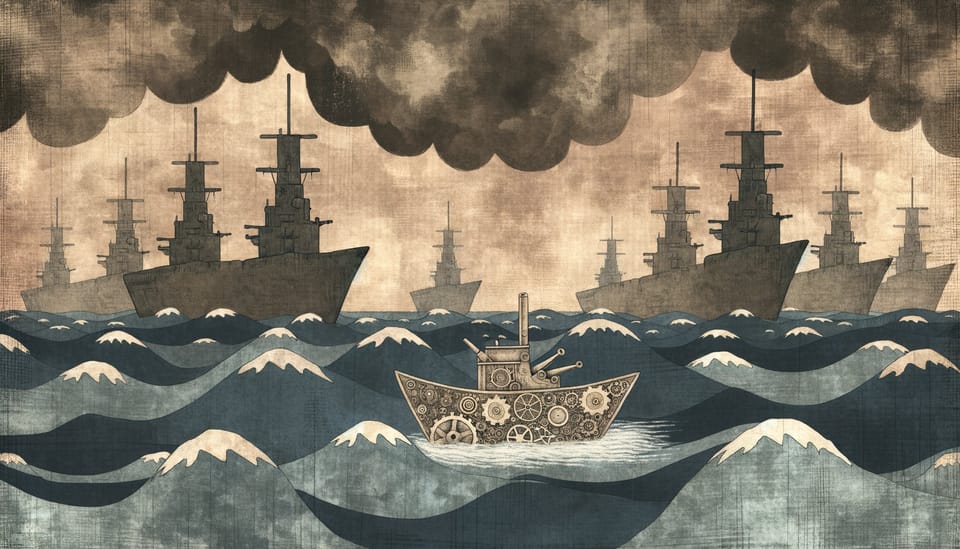
Why HMAS Stirling cannot yet replace Guam as America's Pacific naval hub
Australia's largest naval base is being upgraded to host nuclear submarines under AUKUS. But the infrastructure, workforce, and political frameworks needed to sustain US combat operations in a Taiwan crisis remain years away from reality.
🎧 Listen to this article
The Harbour That Isn’t Ready
Garden Island sits in the Indian Ocean, 60 kilometres south of Perth, in waters so calm they mock the strategic burden now being loaded onto them. HMAS Stirling, Australia’s largest naval base, was built to house diesel-electric submarines and frigates. Within two years, it will be asked to berth nuclear-powered attack submarines under the AUKUS agreement. Within five, it may be asked to do something vastly more demanding: serve as the primary sustainment hub for American naval power in the western Pacific, should China’s missile forces render Guam unusable.
That “should” deserves scrutiny. It is not speculative. The PLA Rocket Force fields roughly 300 launchers for its DF-26 intermediate-range ballistic missile, a weapon nicknamed the “Guam Killer” for the simple reason that its 4,000–5,000 kilometre range places every American military facility on the island inside a reliable kill chain. Pentagon modelling suggests these missiles could crater runways and close Guam’s air operations for two days or longer. Sustained salvos would degrade the island’s submarine tenders, fuel storage, and port facilities—the entire ecosystem that allows American attack submarines to cycle rapidly into patrol boxes near Taiwan.
Washington’s planners know this. They have been hedging for a decade. Stirling is their hedge. But hedges work only if someone waters them.
What Guam Actually Does
To understand what Stirling would need to replace, start with what Guam provides. Naval Base Guam at Apra Harbor is home to Submarine Squadron 15 and two submarine tenders—USS Frank Cable and USS Emory S. Land—floating repair yards that deliver fuel, ammunition, spare parts, medical services, and the thousand small interventions that keep a nuclear submarine operational. The base sits roughly 2,800 kilometres from Taiwan. A Los Angeles-class SSN departing Apra Harbor can reach a patrol station in the Taiwan Strait in three to four days at a moderate transit speed.
Stirling sits roughly 5,500 kilometres from the same waters. Double the distance. Double the transit time. Half the time on station for any given deployment cycle.
This is not a minor logistical adjustment. It is a structural transformation of how the US Navy would fight. Every submarine sortie from Stirling rather than Guam burns an additional week of transit—a week during which the boat consumes fuel and food, wears down machinery, and exhausts its crew, all without contributing to the fight. A submarine force that generated, say, four boats on station from Guam might sustain two from Stirling, assuming identical maintenance tempos. In practice, the number would be worse, because Stirling lacks the repair infrastructure to maintain that tempo.
The US 7th Fleet’s sustainment model depends on short cycling: submarines deploy, patrol, return to a forward base for rapid replenishment—fuel, stores, torpedo reloads, minor repairs—and deploy again. Guam’s tenders and shipyard compress these turnarounds to days. Stirling has no submarine tenders. It has no torpedo-handling facility rated for the weapons US SSNs carry. Its sole deep-water wharf, the 314-metre Diamantina pier, is being upgraded at a cost of $738.1 million to handle nuclear-powered submarines—but “handle” means berth them safely, provide shore power, and manage radiological emergencies. It does not mean arm them, repair them at scale, or sustain a wartime tempo.
Losing Guam collapses the short-cycling model. What remains is a long-haul logistics chain stretched across an ocean, feeding submarines through a base designed for peacetime rotations of four boats, not wartime surges of a dozen.
Concrete, Cranes, and the Clock
The infrastructure gap is not theoretical. It is measurable in metres of wharf space, tonnage of ordnance storage, and the number of qualified workers who can weld reactor-grade steel.
Stirling’s Submarine Rotational Force-West priority works, now under construction, will deliver operational berths on the existing Diamantina pier, enhanced emergency-response capacity, shore-power connections, and a training centre. Main construction began in August 2025. These works prepare the base for peacetime rotational deployments of up to four US and one UK nuclear-powered submarines starting in 2027.
Peacetime rotation is not wartime sustainment. The distinction matters enormously. A rotational deployment means one or two submarines visit, conduct exercises, depart. Sustainment means continuous repair, rearmament, provisioning, and rapid turnaround of multiple boats under operational pressure. The difference is the gap between a hotel and a hospital.
What would wartime sustainment require? Start with ammunition. US attack submarines carry Mk 48 torpedoes and Tomahawk cruise missiles loaded through weapons-shipping hatches using specialised handling equipment. Stirling has none of this infrastructure, and Australian explosive-ordnance regulations—governed by AS 2187—impose safety engineering constraints that would limit any rapid build-out of magazine capacity. Vertical Launch System cells on surface combatants present an even harder problem: VLS reloading requires calm seas, specialised cranes, and exacting safety tolerances that the Southern Ocean’s notorious weather systems routinely violate.
Then consider repair. The Henderson Naval Precinct, adjacent to Stirling, houses ASC West and several commercial shipyards. These facilities maintain Collins-class submarines and Anzac-class frigates. They do not maintain Virginia-class nuclear submarines. The reactor-compartment work, the combat-system diagnostics, the hull-integrity certification—all of these demand tooling, training, and security clearances that do not yet exist in Western Australia. The US Navy’s own maintenance data suggests that compressing a submarine’s five-year maintenance cycle produces cascading failures elsewhere in the fleet schedule. You cannot accelerate reactor work by throwing bodies at it.
And bodies are precisely what Western Australia lacks. The state faces an acute skilled-trade shortage across welding, electrical, and marine-engineering disciplines. AUKUS submarine construction at Osborne in South Australia is already competing with Henderson shipyard projects for the same depleted labour pool. Australia’s Jobs and Skills roadmap identifies marine trades among the nation’s most persistent shortfalls. Adding wartime surge demand to a workforce already stretched by peacetime construction is not a plan. It is a wish.
Distance as Strategy, Distance as Prison
China’s anti-access strategy does not merely threaten Guam. It reshapes the entire geography of American naval operations.
Stirling’s appeal to US planners rests on a single fact: it sits outside the PLA’s conventional strike envelope. No Chinese ballistic missile can reach Perth. No bomber can loiter within strike range without aerial refuelling that would expose it to interception. Stirling is safe.
But safety and utility are not the same thing. A base that cannot be hit but cannot sustain the fight is a refuge, not a fulcrum. The operational calculus is pitiless: every nautical mile between the sustainment hub and the theatre of operations degrades combat power. Submarines spend more time in transit. Surface combatants burn more fuel. Logistics ships—the unglamorous tankers, ammunition vessels, and stores ships of the Military Sealift Command—must traverse longer, more exposed routes.
Those routes introduce their own vulnerabilities. Resupply convoys from Stirling to the South China Sea must transit the Indonesian archipelago, likely through the Lombok or Sunda Straits—chokepoints where Chinese submarines and maritime-surveillance networks could exact a toll. Research published in Nature on systemic disruptions at maritime chokepoints demonstrates that even modest interference at these narrow passages cascades through supply chains with disproportionate effect. A single submarine lurking near Lombok could force convoys into longer, fuel-burning detours through the Timor Sea or south of Australia entirely.
The PLA Rocket Force’s doctrine is instructive here. China’s long-range precision fires are not designed solely to destroy bases. They are designed to reshape American logistical behaviour—to push sustainment hubs further from the fight, stretching supply lines until they become brittle. Stirling, from Beijing’s perspective, represents a success: the Americans have already retreated 2,700 kilometres further from the battlefield before the first missile flies.
Japan’s basing network—Yokosuka, Sasebo, and the expanding roster of EDCA sites in the Philippines—offers closer alternatives. But these sit well within PLA strike range, raising the same vulnerability that afflicts Guam. The basing dilemma is structural: forward bases are useful but targetable; rear bases are safe but distant. No single facility resolves this tension. Only a distributed network can manage it, and networks demand coordination, redundancy, and pre-positioned stocks at every node.
Stirling is one node. It is not the network.
Sovereignty’s Quiet Friction
Even if Stirling’s infrastructure matched wartime requirements—and it does not—a political constraint would remain. Australia is a sovereign nation, not a client state, and the legal framework governing American use of Australian facilities contains friction that peacetime exercises do not reveal.
The 2014 US-Australia Force Posture Agreement permits rotational deployments and joint exercises. It does not grant the United States blanket authority to conduct combat operations from Australian soil. Any American use of Stirling for offensive strikes against Chinese targets would require Australian governmental consent—consent that would make Australia a co-belligerent in a war with its largest trading partner.
This is not an abstract diplomatic nicety. Australia exports more than A$200 billion annually to China, primarily in iron ore, coal, and natural gas. A decision to support US combat operations from Stirling would invite Chinese economic retaliation on a scale that would dwarf the trade disruptions of 2020–21. The Carnegie Endowment has documented the quiet tensions simmering beneath the alliance’s surface—tensions that a shooting war would supercharge. Australia’s Westminster parliamentary system, with its deliberative pace and cabinet-level war powers, would impose its own timeline on decisions that the US military needs made in hours, not days.
The AUKUS framework compounds this ambiguity. Nuclear-submarine technology transfer binds Australia more tightly to American and British military ecosystems, creating what critics describe as sovereign capability purchased at the price of permanent technological dependence. Australia gains nuclear submarines it cannot fuel, maintain, or arm without foreign support. In a crisis, this dependence becomes a lever: Washington can condition access to reactor servicing on Australian political compliance. Canberra may find that the submarine deal it celebrated as a strategic upgrade functions, under pressure, as a strategic constraint.
The Albanese government’s recent decision to sell historic defence sites near Perth, including the Irwin and Leeuwin Barracks, to fund housing construction illustrates a domestic political reality: Australians care more about housing affordability than about hosting foreign submarines. Any government that visibly subordinated domestic priorities to American warfighting needs would pay a steep electoral price. The alliance is popular in the abstract. Its concrete demands are not.
What Breaks First
Project the current trajectory forward. China’s DF-26 inventory grows. Guam’s defences harden but remain contestable. Stirling’s SRF-West infrastructure reaches initial operating capability in 2027, designed for peacetime rotations. A Taiwan crisis erupts in 2028 or 2029.
The US Navy dispatches four SSNs to Stirling. They arrive to find a base with upgraded berths but no torpedo-handling facilities, no Tomahawk reloading capacity, no submarine tenders, and a workforce trained for Collins-class diesel boats, not Virginia-class nuclear reactors. The boats can refuel and resupply at the pier. They cannot rearm. They cannot conduct anything beyond basic hull maintenance.
Each submarine sortie to the Taiwan theatre consumes seven to eight days of transit each way. On-station time drops to perhaps twelve days per cycle before the boat must return for reprovisioning. Two submarines on station at any given time, if the turnaround at Stirling is fast—which it will not be, because nothing at Stirling is fast when it comes to nuclear-submarine support.
Meanwhile, the logistics chain from Stirling to the South China Sea runs through straits that Chinese intelligence monitors continuously. Resupply vessels telegraph their intentions by their very routes. The convoy problem returns, a century after the Battle of the Atlantic, in tropical waters with different adversaries and the same brutal arithmetic of interdiction.
The thing that breaks first is not a wharf or a crane. It is time. The US Navy’s operational tempo—its ability to keep enough combat power in the right water at the right moment—collapses under the weight of distance, inadequate infrastructure, and the political friction of operating from a sovereign ally’s territory during a war that ally may not fully endorse.
What Would Actually Help
Three interventions could shift the calculus. None is cheap. None is politically easy.
Pre-position submarine tenders at Stirling. The US Navy’s two active submarine tenders, Frank Cable and Emory S. Land, are both homeported at Guam. Relocating one to Stirling permanently—or building a third—would transplant the floating repair-yard capability that makes short-cycling possible. Cost: roughly US$2–3 billion for a new tender, plus the crew and family-support infrastructure that Western Australia does not currently provide. Timeline: five to seven years from authorisation to delivery. The US Navy should request funding in its FY2027 budget submission.
Build a combined ammunition depot and weapons-handling facility at Henderson. Without the ability to reload torpedoes and cruise missiles, Stirling is a refuelling stop, not a sustainment base. The Australian Department of Defence should commission this facility under the AUKUS advanced-capability pillar, with US co-funding and shared operational control. Estimated cost: A$1.5–2 billion. The explosives-safety regulations governing AS 2187 would need revision—a bureaucratic fight, but a winnable one if Defence commits political capital. Timeline: three to four years.
Negotiate pre-authorised access protocols. The current Force Posture Agreement requires case-by-case governmental consent for combat-related activities. In a fast-moving crisis, this consent loop could cost days that the military cannot spare. Canberra and Washington should negotiate a classified annex specifying pre-authorised conditions under which US forces may conduct specified operations from Stirling without additional political approval. This is the hardest intervention, because it requires Australia to pre-commit to belligerency under defined scenarios—a step no Australian government has taken since 1942. Political feasibility: LOW. Necessity: absolute.
Each intervention demands that Australia accept something uncomfortable. The tender means a permanent American naval presence in Perth, with all the community friction that implies. The ammunition depot means storing foreign weapons on Australian soil. The access protocol means surrendering a measure of sovereign discretion. These are costs. The alternative cost—discovering in a crisis that Stirling cannot do what Washington assumes it will do—is higher.
FAQ: Key Questions Answered
Q: Could China strike HMAS Stirling directly? A: Not with current conventional capabilities. Stirling sits roughly 8,000 kilometres from mainland China, well beyond the range of the DF-26 and any other deployed Chinese ballistic missile. Only intercontinental ballistic missiles could reach Perth, and their use would signal nuclear escalation—a threshold China is unlikely to cross over a conventional conflict.
Q: How many US submarines can Stirling currently support? A: The SRF-West infrastructure under construction will support rotational deployments of up to four US and one UK nuclear-powered submarines beginning in 2027. This is a peacetime capacity for port visits and exercises, not a wartime surge capacity for continuous combat operations.
Q: What alternatives exist if both Guam and Stirling prove inadequate? A: Japan’s bases at Yokosuka and Sasebo offer the closest full-service submarine support, but they sit within PLA strike range. The Philippines’ EDCA sites provide access but minimal infrastructure. Diego Garcia offers distance from Chinese missiles but is even further from Taiwan than Stirling. The realistic answer is a distributed network using all of these facilities, with no single base carrying Guam’s former load.
Q: Does AUKUS solve the sustainment problem? A: AUKUS addresses Australia’s own submarine capability, not American sustainment logistics. The agreement’s infrastructure investments at Stirling improve berthing and safety systems for nuclear submarines, but do not include weapons handling, large-scale repair facilities, or the pre-positioned stocks needed for wartime operations.
The Unwatered Hedge
American war planners have spent a decade pointing at Stirling on a map and drawing confident arrows from Perth to the South China Sea. The arrows look persuasive in PowerPoint. They look less persuasive when measured against wharf capacity, torpedo-storage regulations, workforce availability, and the quiet but irreducible sovereignty of the nation that owns the base.
Stirling can host American submarines. It cannot yet sustain American naval operations at wartime tempo, and nothing in the current construction pipeline will change that before the window of greatest danger opens. The base is being prepared for a world in which AUKUS submarines visit in peacetime. It is not being prepared for a world in which Guam burns and the US 7th Fleet needs a new home.
The alliance between Australia and the United States remains the most capable military partnership in the Indo-Pacific. But capability on paper is not capacity in concrete. If Washington wants Stirling to serve as its fallback in the western Pacific, it must invest as though it means it—and Canberra must decide, before the crisis arrives, whether it is willing to accept what that investment demands. Neither capital has yet made that choice. The clock set by China’s missile production lines does not pause for deliberation.
Sources & Further Reading
The analysis in this article draws on research and reporting from:
- DF-26 Missile Profile, CSIS Missile Threat Project – Technical specifications and inventory estimates for China’s intermediate-range ballistic missiles
- Cratering Effects: Chinese Missile Threats to US Air Bases – Pentagon assessment of runway denial from PLA missile strikes
- SRF-West Infrastructure Project, Australian Department of Defence – Official scope and timeline for Stirling nuclear-submarine upgrades
- Parliamentary Standing Committee on Public Works Statement of Evidence – Cost and construction details for SRF-West priority works
- Beneath the Mateship: A Quiet Crisis in the US-Australia Alliance – Carnegie Endowment assessment of alliance tensions
- The AUKUS Stress Test, Lowy Institute – Debate on AUKUS and Australian strategic autonomy
- Systemic Impacts of Disruptions at Maritime Chokepoints – Modelling of cascading supply-chain effects from chokepoint interference
- The Skilled Trade Shortage in 2026 – Workforce constraints affecting Australian defence construction
- Sale of Perth Defence Sites – Domestic political pressures competing with defence priorities