
When the Network Goes Dark: Starlink's Vulnerability and the Future of Western Military Power
Russia's growing ability to jam SpaceX's satellite constellation threatens not just Ukraine's battlefield communications but the entire architecture of American and NATO military operations from Eastern Europe to the Pacific.
The Signal That Wasn’t There
On a frozen morning in eastern Ukraine, a drone operator taps his screen and waits. The Starlink terminal beside him shows four bars. His quadcopter feeds live video to an artillery battery twelve kilometres away. The Russian position appears in crosshairs. He marks the coordinates. Thirty seconds later, shells land.
This choreography of precision has defined Ukrainian warfare since 2022. Starlink terminals—over 50,000 supplied by international partners—transformed a conventional conflict into something new: networked, dispersed, lethally accurate. Ukrainian forces fire 6,000 artillery rounds daily. Russian forces fire 20,000. The gap in volume should have been decisive. Starlink closed it.
Now imagine the screen goes dark. Not from a power failure or equipment malfunction, but from something deliberate—a Russian electronic warfare system that has learned to blind the constellation at will. The drone hovers, suddenly deaf. The artillery battery waits for coordinates that never arrive. The shells in their tubes become expensive guesses.
This scenario has moved from speculation to operational reality. Ukrainian military units began experiencing systematic Starlink outages in May 2024, attributed to Russia “testing different mechanisms” with electronic warfare systems. The Kalinka system—dubbed the “Starlink killer”—now targets signals to and from Starlink satellites. What happens when Russia perfects this capability determines not just Ukraine’s fate, but the architecture of American power across two oceans.
The Infrastructure of Dependence
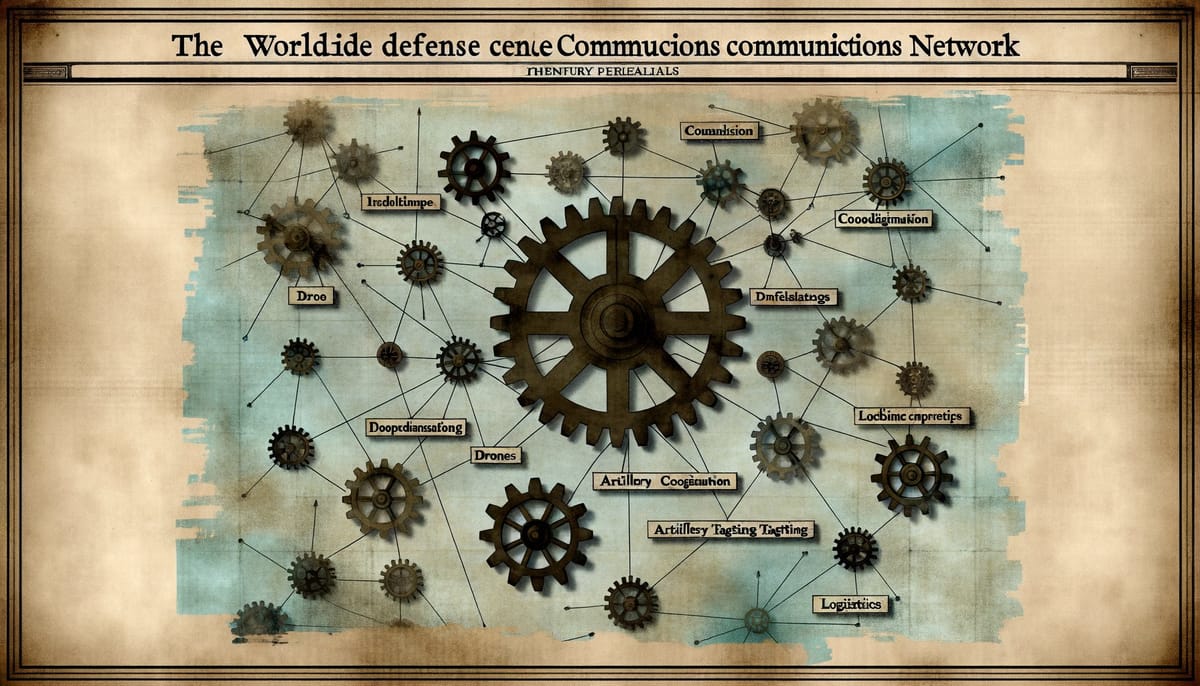
The conventional wisdom treats Starlink as a communications enhancement—useful, but replaceable. This fundamentally misreads what has occurred. Starlink has become the nervous system of Ukrainian military operations. Command and control, drone warfare, artillery targeting, intelligence distribution, logistics coordination: all flow through SpaceX’s constellation. The system processes information at speeds that make alternatives feel archaeological.
Consider what Starlink actually does. A Ukrainian infantry unit spots a Russian armoured column. Within seconds, that information reaches brigade headquarters, air defence coordinators, artillery batteries, and drone operators simultaneously. Targeting data flows back. Multiple weapons systems converge on the same grid square within minutes. This tempo—what military theorists call “decision advantage”—depends entirely on persistent, high-bandwidth connectivity.
Traditional military satellite communications cannot replicate this. The US military’s legacy SATCOM systems were designed for different physics: fewer satellites, higher orbits, lower bandwidth, scheduled access windows. A Ukrainian commander requesting fire support through traditional channels would wait hours, not seconds. The war would be fought at Russian tempo, not Ukrainian.
NATO’s support architecture has embedded this dependency. The NATO Security Assistance and Training for Ukraine (NSATU), established in 2024-2025, operates logistics hubs at Rzeszów-Jasionka Airport in Poland and Câmpia Turzii in Romania, processing over 18,000 tons of materiel monthly. These hubs coordinate through digital systems that assume persistent connectivity. Training standardises Starlink-dependent tactics. Doctrine codifies network-centric warfare. Each month of operations deepens the structural reliance.
The Pentagon’s Commercial Space Integration Strategy, released in 2024, explicitly embraced this dependence. “Integrating commercial solutions, as opposed to merely augmenting existing government systems, will require a shift in approach within the Department,” it declared. The shift has occurred. The approach assumed the commercial solutions would remain available.
The Physics of Vulnerability
Starlink’s architecture creates its strength and its weakness. The constellation operates through three components: satellites in low Earth orbit, ground stations distributed globally, and user terminals in the field. Each presents distinct attack surfaces.
The satellites themselves prove difficult to target individually. Over 7,000 now orbit Earth. Destroying them kinetically would require more missiles than any arsenal contains and would generate debris fields that threaten all space operations—including Russia’s own satellites. SpaceX can launch replacements faster than adversaries can destroy them. This redundancy was deliberate.
But redundancy against kinetic attack offers limited protection against electronic warfare. Russian systems like Krasukha-4, Krasukha-2, and R-330Zh Zhitel don’t destroy satellites. They contaminate the electromagnetic environment through which satellites communicate. Jamming the downlink—the signal from satellite to terminal—requires overwhelming power across wide areas. Jamming the uplink—the signal from terminal to satellite—proves easier. Spoofing attacks inject false signals. Cyber intrusions target the software that coordinates the constellation.
The ground stations present a different vulnerability. Starlink requires terrestrial infrastructure to route traffic between satellites and the broader internet. These stations exist in specific locations, subject to host nation territorial control. A ground station in Poland operates under Polish sovereignty. One in Japan operates under Japanese sovereignty. This geographic distribution creates resilience against single points of failure but also multiplies the jurisdictions where disruption becomes possible.
Russian electronic warfare has progressed from nuisance to operational threat. The Tobol installations—at least three deployed—specifically target Starlink signals over eastern Ukraine. Early attempts achieved intermittent disruption. Recent operations suggest more systematic capability. The question is no longer whether Russia can degrade Starlink, but whether it can do so reliably, predictably, and at times of its choosing.
“At will” capability transforms the strategic equation. Intermittent disruption forces adaptation. Reliable disruption enables planning. An adversary who can blind Starlink whenever needed possesses something more valuable than the ability to destroy it: the ability to control the tempo of information warfare.
The Pacific Mirror
Eight thousand kilometres east, American strategists face the same dependency in different geography. The US Air Force uses Starlink satellites to communicate with airmen dispersed across the Indo-Pacific. The 730th Air Mobility Squadron has installed Starlink terminals on C-130J aircraft at Yokota Air Base, Japan. The Navy’s VX-30 “Bloodhounds” equipped KC-130T aircraft with Starlink for Pacific missile tests. Agile Combat Employment—the doctrine of dispersing forces across multiple austere locations to complicate Chinese targeting—assumes persistent connectivity between dispersed units and central command.
The assumption deserves scrutiny. China has observed Russian electronic warfare operations against Starlink with professional interest. Space News reports that both nations now target SpaceX’s constellation in escalating electronic warfare campaigns. What Russia learns in Ukraine, China can apply in the Taiwan Strait.
The Pacific operational environment differs from Ukraine in ways that amplify vulnerability. Ukrainian forces operate within range of NATO logistics hubs. Pacific operations occur across vast oceanic distances where alternative communications prove scarcer. A Marine expeditionary unit on a contested island cannot fall back on landlines. An Air Force squadron dispersed to a remote airstrip cannot rely on fibre optic cables.
Agile Combat Employment doctrine explicitly requires what Starlink provides: the ability to coordinate dispersed forces without centralized infrastructure that adversaries can target. The hub-and-spoke architecture exponentially increases the communication pathways required to maintain coordination. Each additional contingency location adds combinatorial complexity. Remove the communications backbone, and dispersed forces become isolated forces—easier to defeat in detail.
The RAND Corporation’s analysis of space activities in Ukraine identified this dynamic: “Diversifying options has allowed Ukrainian forces to maintain crucial satellite communications and intelligence, surveillance, and reconnaissance capabilities.” Diversification implies alternatives. In the Pacific, alternatives remain underdeveloped. Military SATCOM systems lack the bandwidth. Other commercial constellations lack the coverage. HF radio—the fallback of last resort—cannot support the data rates that networked warfare demands.
The Sovereignty Paradox
Starlink’s ownership structure creates complications that pure military systems avoid. SpaceX is a private company. Elon Musk is its controlling shareholder. His decisions about service provision, geographic coverage, and cooperation with government requests reflect corporate interests, personal beliefs, and political relationships—not national security imperatives.
This arrangement worked when interests aligned. Musk provided terminals to Ukraine. The US government subsidised the service. Ukrainian forces achieved battlefield advantages. Everyone benefited.
Alignment has frayed. Musk’s acquisition of Twitter (now X), his political positioning, and his business relationships with multiple governments have introduced variables that military planners cannot control. Reports of Starlink service limitations near Crimea raised questions about whether corporate decisions constrained military options. The Pentagon’s strategy document acknowledged the challenge: integrating commercial solutions requires accepting that commercial providers make commercial decisions.
Shareholder primacy doctrine compounds the problem. SpaceX operates under legal obligations to maximise shareholder value. Expensive hardening investments against Russian electronic warfare capabilities—investments that might preserve military utility but reduce commercial profitability—require someone to pay. The Department of Defence can fund specific enhancements. It cannot compel a private company to prioritise military resilience over commercial efficiency.
NATO allies face their own version of this paradox. European dependence on an American commercial system controlled by a politically unpredictable billionaire has accelerated discussions about sovereign alternatives. IRIS², the European Union’s planned satellite constellation, would provide 264 satellites plus 18 for military-only use, with 60% public funding. The timeline extends to the late 2020s. Ukraine’s war continues now.
The ITU’s regulatory framework offers limited help. Military radio installations enjoy exemption from harmful interference rules under Article 48, but this exemption was designed for discrete, identifiable military systems. Dual-use constellations serving both civilian and military users fall into a governance void. The rules assume categories—military or civilian, government or commercial—that Starlink’s architecture deliberately blurs.
The Adaptation Race
Ukrainian forces have not waited passively for Russian electronic warfare to mature. The return to HF radio technology represents what Chinese strategists might call wu wei—accomplishing more by accepting apparent limitations. Lower bandwidth, older design, but reduced detectability and satellite independence. The “inferior” technology provides strategic advantage precisely because it operates outside the contested domain.
This adaptation carries costs. HF radio cannot support the data rates that networked warfare demands. Drone operators cannot stream video over high frequency. Artillery batteries cannot receive real-time targeting updates. The tempo advantage that Starlink provides disappears. Ukrainian forces would fight at a pace their equipment and doctrine were not designed for.
NATO training programs face a doctrinal dilemma. NSATU standardises tactics that assume persistent connectivity. These tactics work brilliantly when connectivity persists. They fail catastrophically when it doesn’t. Training for degraded operations means training for slower, less precise, more casualty-intensive warfare—the opposite of what Western military doctrine has optimised for over three decades.
The RAND report documented how Ukrainian forces maintained capabilities through diversification. Multiple satellite providers, multiple communication pathways, multiple fallback options. This resilience emerged from necessity, not design. American forces in the Pacific have not yet faced that necessity. Their diversification remains theoretical.
Military organisations exhibit 10-20 year stability periods between doctrinal revisions. NSATU is institutionalising Starlink-dependent tactics during what may prove a temporary window of connectivity advantage. The doctrine being standardised assumes conditions that Russian electronic warfare is actively working to eliminate.
The Escalation Calculus
NATO’s overarching space policy, adopted in 2019, recognises that “attacks to, from, or within space present a clear challenge to the security of the Alliance” and “could lead to the invocation of Article 5.” The policy notes that “potential adversaries are pursuing the development of a wide range of capabilities from non-kinetic (such as dazzling, blinding and jamming of space assets) to kinetic destructive systems.”
The language is precise. “Could lead to” is not “will lead to.” The threshold for Article 5 invocation remains deliberately ambiguous. This ambiguity serves deterrence when adversaries cannot predict consequences. It undermines deterrence when adversaries conclude that consequences are unlikely.
Electronic warfare against Starlink occupies a grey zone that existing frameworks struggle to address. Jamming is not destruction. Temporary degradation is not permanent denial. Commercial systems serving military purposes complicate attribution of hostile intent. Russia can plausibly claim interference with civilian communications infrastructure, not attack on military assets.
The compelled speech doctrine from US constitutional law creates additional complications. First Amendment protections prevent the government from forcing private entities to speak—or to remain silent. When SpaceX cannot be legally compelled to maintain service in contested areas, the attribution chain required under international law for state responsibility may break. Russia attacks Starlink. SpaceX decides to limit service. Ukraine loses capability. Who bears responsibility?
International space law provides limited guidance. The Outer Space Treaty prohibits weapons of mass destruction in space and military installations on celestial bodies. It says nothing about electronic warfare against commercial satellites in Earth orbit. The legal architecture assumed conflicts between states over territory, not conflicts between states and corporations over electromagnetic spectrum.
What Actually Changes
If Russia demonstrates reliable capability to blind Starlink at will, several consequences follow.
Ukrainian military effectiveness degrades substantially. Not to zero—forces adapt, alternatives exist, HF radio works—but to levels that shift the battlefield calculus. The precision that has allowed Ukraine to compete against larger Russian forces depends on information advantage. Remove the information advantage, and the arithmetic of attrition reasserts itself. Russia fires 20,000 rounds daily. Ukraine fires 6,000. Without networked targeting, those 6,000 rounds hit fewer targets.
NATO logistics coordination slows. The hubs at Rzeszów-Jasionka and Câmpia Turzii can operate without Starlink, but at reduced tempo. Materiel flows continue; coordination degrades. The difference between 18,000 tons monthly processed efficiently and 18,000 tons processed with friction compounds over time.
American Pacific strategy requires fundamental reconsideration. Agile Combat Employment assumes what may not exist: persistent connectivity enabling dispersed forces to operate as a coherent whole. If that connectivity proves contestable, the doctrine either needs hardened alternatives or doctrinal revision. Neither happens quickly.
Commercial space integration faces a credibility crisis. The Pentagon’s 2024 strategy embraced commercial solutions. If those solutions prove vulnerable to adversary electronic warfare, the strategy’s premises collapse. The alternative—rebuilding government-owned, military-hardened satellite constellations—requires years and billions of dollars. The interim period leaves capability gaps.
Alliance politics grow more contentious. European nations already uncomfortable with dependence on American commercial systems gain ammunition for sovereign alternatives. IRIS² timelines accelerate, but not fast enough to matter for current operations. The burden-sharing debates that have plagued NATO for decades acquire new dimensions: who pays for resilience against vulnerabilities that American commercial decisions created?
The Paths Not Taken
Three intervention points remain available, each with costs.
First, the Department of Defence could fund substantial hardening of Starlink against electronic warfare. This requires SpaceX cooperation, significant expenditure, and acceptance that commercial providers will expect compensation for military-grade resilience. The trade-off: taxpayers subsidise a private company’s infrastructure improvements that also benefit commercial customers. The benefit: maintained capability in contested environments.
Second, NATO could accelerate development of alternative communications architectures. Military SATCOM modernisation, other commercial LEO constellations, mesh networks that don’t depend on any single provider. The trade-off: years of development time, billions in investment, uncertain technological outcomes. The benefit: reduced single-point-of-failure risk.
Third, doctrine could adapt to assume degraded connectivity as the baseline rather than the exception. Train for HF radio. Develop tactics that work at slower tempo. Accept that network-centric warfare may prove a fair-weather capability. The trade-off: abandoning thirty years of doctrinal development premised on information advantage. The benefit: forces that function when the network doesn’t.
The most likely outcome involves none of these pursued systematically. Partial hardening, partial alternatives, partial doctrinal adaptation—enough to claim progress, insufficient to solve the problem. This is how institutions typically respond to challenges that require painful choices: they avoid choosing until events force their hand.
FAQ: Key Questions Answered
Q: Can Russia actually disable Starlink completely? A: Complete, permanent disabling remains unlikely given the constellation’s 7,000+ satellites and SpaceX’s rapid replacement capability. However, Russia has demonstrated ability to degrade service in specific geographic areas at specific times—sufficient to disrupt military operations without destroying the system entirely.
Q: Would jamming Starlink trigger NATO’s Article 5? A: NATO’s 2019 space policy states attacks on space assets “could lead to” Article 5 invocation, but the threshold remains deliberately ambiguous. Electronic warfare against a commercial dual-use system occupies a grey zone that existing frameworks don’t clearly address, making invocation politically difficult.
Q: What alternatives exist if Starlink becomes unreliable? A: Ukrainian forces have returned to HF radio as a fallback, and military SATCOM systems provide some capability. However, no current alternative matches Starlink’s bandwidth and coverage. European IRIS² constellation won’t be operational until the late 2020s.
Q: How does this affect US operations in the Pacific? A: US Indo-Pacific Command has integrated Starlink into aircraft communications and dispersed operations concepts. If the system proves vulnerable to Chinese electronic warfare—which has observed Russian techniques—the Agile Combat Employment doctrine that depends on persistent connectivity would require fundamental revision.
The Screen Goes Dark
The drone operator in eastern Ukraine will face this moment eventually. Perhaps tomorrow, perhaps next year, but eventually. The screen will show four bars, then none. The video feed will freeze. The coordinates will not transmit. The shells will wait in their tubes.
What happens next depends on decisions being made now—or not made, which amounts to the same thing. The infrastructure of networked warfare that seemed so transformative in 2022 has revealed itself as infrastructure: dependent on physical systems, subject to physical attack, controlled by actors whose interests may diverge from those who depend on it.
Russia has learned something in Ukraine. The lesson will not stay in Ukraine. The constellation that connects Ukrainian artillery to its targets also connects American aircraft to their commanders, NATO logistics to their destinations, allied forces to each other. The same vulnerability propagates across every network that shares the architecture.
The question is not whether adversaries will exploit this vulnerability. They already are. The question is whether the institutions that created the dependency will adapt before the adaptation is forced upon them—in circumstances far less forgiving than a policy debate.
The screen is still lit. For now.
Sources & Further Reading
The analysis in this article draws on research and reporting from:
- Space News: Russia, China Target SpaceX’s Starlink - Reporting on escalating electronic warfare campaigns against commercial satellite systems
- DoD Commercial Space Integration Strategy (2024) - Pentagon’s first comprehensive strategy for integrating commercial space solutions
- RAND Corporation: Lessons from the War in Ukraine for Space - Comprehensive analysis of space activities throughout the Ukraine conflict
- NATO’s Overarching Space Policy - Foundational document recognising space as an operational domain
- IBM: What Is the CAP Theorem? - Technical background on distributed systems trade-offs relevant to network architecture
- Stars and Stripes: Air Force Starlink Communications - Reporting on US military integration of Starlink in the Indo-Pacific
- NATO Security Assistance and Training for Ukraine - Official documentation of NATO’s Ukraine support mechanisms