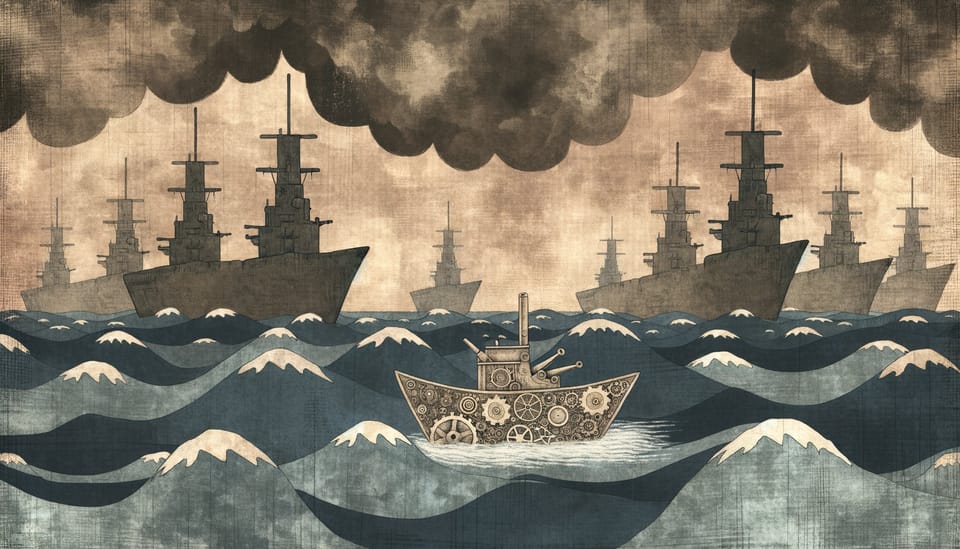
What breaks first in a three-way nuclear arms race: budgets, alliances, or the taboo against use?
With New START expired and China sprinting toward nuclear parity, the United States faces two peer arsenals for the first time. Three structural fragilities—fiscal strain, alliance erosion, and the thinning norm against nuclear use—now feed a cascade where each failure accelerates the others.

🎧 Listen to this article
Three Clocks, One Midnight
For more than fifty years, treaties kept nuclear competition bilateral, bounded, and boring. That era ended on February 5, 2026, when New START expired and left the United States and Russia without binding limits on strategic arsenals for the first time in five decades. China, meanwhile, has been sprinting. The Pentagon estimates its stockpile surpassed 600 operational warheads by mid-2024 and will exceed 1,000 by 2030, the most rapid nuclear expansion in any country’s history. Three nuclear powers, no constraints, and a stability architecture designed for two players now asked to manage three.
Something will give. The question is whether budgets crack under the weight of simultaneous modernisation, whether alliances splinter as allies lose faith in extended deterrence, or whether the taboo against nuclear use—the single norm that has held since Nagasaki—erodes until a weapon is used. Each failure mode feeds the others. But they do not break at the same speed or in the same way, and understanding their distinct fragilities matters for what comes next.
The Ledger Nobody Can Close
Start with money. The Congressional Budget Office projects American nuclear forces will cost $946 billion over 2025–2034, averaging $95 billion a year—a 25% increase from its previous estimate just two years earlier. That figure covers the Sentinel intercontinental ballistic missile, the Columbia-class submarine, the B-21 bomber, and the refurbished warheads they will carry. It does not include the conventional forces that give nuclear posture its strategic context. And it assumes no further expansion.
A three-way competition demolishes that assumption. When the 2022 Nuclear Posture Review acknowledged for the first time that America faces “two nuclear-armed strategic competitors”, it opened a fiscal door that no subsequent budget can close. If China reaches numerical parity with the United States and Russia by the mid-2030s—as some Pentagon projections suggest is possible—the logic of assured destruction demands a response. Build more warheads, or accept that deterrence ratios have fundamentally changed.
Russia faces a grimmer version of the same bind. Its economy, roughly the size of Italy’s at market exchange rates, sustains a nuclear arsenal of approximately 5,580 warheads through a combination of Soviet-era infrastructure, command-economy mobilisation, and brutal fiscal discipline. Conventional forces in Ukraine consume resources that would otherwise flow to strategic modernisation. Moscow can maintain its arsenal or rebuild its army. Doing both strains a system already running on institutional memory and deferred maintenance. Deteriorating Russian early-warning systems are not a hypothetical concern; they are a measured fact that compounds every budget shortfall into accident risk.
China operates under different constraints. Its defence budget, though opaque, benefits from an economy fifteen times Russia’s size and a manufacturing base unmatched in human history. Beijing can afford nuclear expansion in ways Moscow cannot. But affordability is not the same as sustainability. Every yuan directed toward nuclear forces is a yuan diverted from the semiconductor self-sufficiency, artificial intelligence, and naval programmes that Xi Jinping has designated as existential priorities. China’s nuclear buildup is cheap relative to its GDP. Relative to its ambitions, it is one more claim on a treasury already stretched across an economic slowdown and a property crisis that refuses to resolve.
None of the three players faces imminent fiscal collapse from nuclear spending alone. The budgets bend before they break. But bending changes behaviour. It forces choices—between nuclear and conventional forces, between offence and defence, between readiness and modernisation—that degrade the overall strategic posture even as individual weapons programmes proceed. The U.S. defence industrial base cannot surge production fast enough to sustain both nuclear modernisation and the conventional munitions that NATO allies increasingly demand. The bottleneck is not dollars. It is shipyard capacity, skilled labour, and the years required to rebuild industrial lines that were allowed to atrophy after the Cold War.
Budgets, in short, do not snap. They impose slow, invisible trade-offs that weaken deterrence without producing a single dramatic headline. That makes them dangerous precisely because the damage is cumulative and deniable until it is too late.
The Umbrella Frays at the Edges
Alliances are more brittle than budgets because they depend on belief—and belief, unlike steel, cannot be stockpiled.
The American nuclear umbrella covers NATO’s thirty-two members, Japan, South Korea, and Australia. Its credibility rests on a proposition that has always required a certain willing suspension of disbelief: that Washington would risk Los Angeles to save Seoul, or Chicago to defend Tallinn. During the Cold War, forward-deployed nuclear weapons and elaborate war plans made this credible enough. American superiority over Russia was so overwhelming that extended deterrence looked less like a suicide pact and more like a rational calculation.
Tripolarity shatters that calculus. When the United States must deter two near-peer nuclear arsenals simultaneously, the credibility of its guarantee to any single ally dilutes. This is not abstract theorising. South Korean polling consistently shows majority public support for an independent nuclear capability, driven by compounding North Korean provocations and growing doubt that America would trade Seattle for Busan in a crisis where China might intervene. Japan, constitutionally committed to non-nuclear status, has begun debating what was once unthinkable. When allies start hedging, the umbrella has already torn.
The gift-economy logic of extended deterrence compounds the problem. America provides the nuclear guarantee. In return, allies provide basing rights, interoperability, and political solidarity. But this exchange operates on Maussian reciprocity: the gift of protection creates an obligation that must be continuously acknowledged. When American presidents—of either party—question whether allies contribute enough, they do not merely renegotiate terms. They corrode the social fabric that makes the alliance function. NATO’s nuclear burden-sharing arrangements work only if every member believes the others will show up. That belief is a public good, and public goods are notoriously vulnerable to free-riding and doubt.
The three-way dynamic makes this worse in a specific, structural way. In a bilateral nuclear standoff, Washington’s allies could be confident that American strategic attention was focused on a single adversary. In a trilateral world, allies must compete for American attention. European members of NATO worry that the Indo-Pacific theatre will absorb American resources and political bandwidth. Asian allies worry that European crises—another Russian escalation, a Baltic provocation—will pull American focus westward precisely when China moves. Both fears are rational. Both are corrosive.
Electoral cycles accelerate the corrosion. American strategy resets every four years when governments change. Allied governments, planning on longer timescales, cannot build durable security architectures on commitments that expire with each presidential term. Putin plans in decades. Xi plans in five-year increments with a lifelong horizon. American allies plan between elections—their own and America’s. The temporal mismatch alone would strain credibility. Add nuclear tripolarity and the strain becomes structural.
Where Norms Go to Thin
The nuclear taboo is the most consequential norm in modern history. Since August 9, 1945, no nuclear weapon has been used in conflict. Thomas Schelling, accepting his Nobel Prize in 2005, observed that nuclear weapons remain “under a curse”, their uniqueness deriving not from their destructive power alone but from being perceived as categorically different from all other weapons. That perception is a social construction. It can be deconstructed.
Russia’s nuclear threats during the Ukraine war have already begun the work. When a sitting president repeatedly invokes nuclear weapons as instruments of coercion—not in the abstract language of deterrence doctrine but in the concrete context of an ongoing war—he normalises what was abnormal. Each threat that goes unanswered teaches a lesson: nuclear brandishing works, and the cost is rhetorical, not strategic. Other states observe. Other leaders learn.
But the taboo’s erosion runs deeper than Russian bluster. Three developments are thinning the norm from within.
First, the integration of artificial intelligence into nuclear command-and-control systems is creating decision architectures where the taboo may not operate. The taboo is a human norm. It works because human decision-makers—raised in cultures that treat nuclear use as unthinkable—hesitate at the threshold. AI decision-support systems embed this norm as an implicit prior, penalising nuclear options in their recommendation algorithms. But the weight assigned to that prior is a design choice, adjustable by whoever controls the system. And as hypersonic missiles compress decision timelines from minutes to seconds, the pressure to remove human deliberation from the loop intensifies. A taboo that exists only in human consciousness offers no protection in a system where humans have been sidelined.
Second, nuclear wargames are subtly reshaping perceptions of controllability. Repeated simulation of limited nuclear strikes—tactical weapons used against military targets, with calibrated yields designed to minimise civilian casualties—creates a cognitive category that did not exist in Cold War thinking. The taboo depends on treating nuclear weapons as a single, undifferentiated category of horror. Low-yield warheads, precision delivery, and “escalate to de-escalate” doctrines break that category into gradations. Once you can imagine a “small” nuclear use, the taboo has already weakened.
Third, the sheer number of nuclear-armed states and aspiring nuclear powers is diffusing the taboo’s enforcement. Nine states now possess nuclear weapons. Several more could acquire them within years if political decisions changed. The taboo was maintained, in part, by a small club of responsible custodians who shared an interest in keeping the norm intact. A proliferated world offers more potential norm-breakers and fewer enforcers.
The taboo does not collapse in a single moment. It attenuates through accumulated small transgressions, each one expanding the space of the thinkable. A nuclear threat that draws no consequences. A doctrine that imagines limited use. A decision system that removes the human who would hesitate. Individually, none of these breaks the taboo. Collectively, they hollow it out until the shell cracks under pressure it once could have withstood.
The Cascade Sequence
These three fragilities—fiscal strain, alliance erosion, and taboo attenuation—do not fail independently. They form a cascade where each failure accelerates the others.
The most likely sequence runs as follows. Budget pressure forces trade-offs between nuclear modernisation and conventional capability. Conventional weakness makes extended deterrence less credible, because allies know that America’s nuclear guarantee means nothing if it cannot fight a conventional war first. Alliance erosion follows: Japan hedges, South Korea accelerates its nuclear research programme under civilian cover, NATO’s eastern members explore bilateral nuclear-sharing arrangements outside the formal alliance framework. Each act of hedging signals doubt, and doubt compounds. Meanwhile, states that perceive the alliance structure weakening face stronger incentives to develop independent deterrents, which in turn weakens the non-proliferation regime—the institutional backbone of the nuclear taboo.
The taboo, starved of institutional support and corroded by doctrinal innovation, becomes vulnerable to a crisis that in an earlier era would have been contained by the combination of norms, treaties, and alliance solidarity. Without treaties to verify arsenals, suspicion replaces confidence. Without alliance cohesion, escalation management loses its multilateral character. Without the taboo, the final restraint is individual judgment under extreme pressure.
Individual judgment is not a reliable strategic asset.
The most dangerous feature of this cascade is its irreversibility. Once an ally acquires an independent nuclear capability, it does not give it up because alliance credibility is restored. Once the taboo is broken by use, no subsequent norm can recreate seventy-five years of accumulated restraint. And once budget trade-offs have hollowed out the industrial base, rebuilding takes a decade. Each failure locks in consequences that persist long after the conditions that caused them have changed.
What Might Arrest the Fall
Three intervention points exist. None is easy. Each demands sacrifice.
The first is a trilateral arms-control framework—not a treaty in the Cold War mould, but a set of transparency measures and confidence-building mechanisms adapted to three-party competition. Demonstrative verification, where states voluntarily display compliance without formal treaty obligations, offers one model. China would need to accept some form of arsenal transparency, which it has historically refused, arguing that its smaller arsenal makes disclosure a strategic disadvantage. Washington would need to decouple arms control from broader geopolitical competition with Beijing—treating nuclear stability as a shared interest even amid rivalry over Taiwan, semiconductors, and influence. Moscow would need to believe that arms control serves its interests despite the strategic utility of nuclear ambiguity.
The cost: each side surrenders information advantage and accepts constraints on programmes that domestic constituencies support. The likelihood: low in the current political environment, but crises have a way of concentrating minds. The window for negotiation exists before arsenals reach new equilibria that make future reductions harder.
The second intervention point is alliance reinforcement through capability rather than rhetoric. This means not reassuring allies with words but providing them with the means of conventional defence credible enough that nuclear escalation becomes unnecessary. For NATO, it means European defence-industrial capacity that can produce munitions at scale without depending on American production lines already committed to the Pacific. For Asian allies, it means integrated missile-defence and strike architectures that reduce the salience of nuclear threats. The American defence industrial base must be revitalised not to build more nuclear weapons but to produce enough conventional capability that nuclear escalation is no longer the first rung on the ladder.
The cost: hundreds of billions in sustained investment over a decade, and the political will to maintain it across electoral cycles that reward short-term spending on domestic priorities. European allies would need to accept defence budgets that crowd out social spending. Asian allies would need deeper military integration with the United States—and with each other—that strains domestic politics.
The third intervention is the hardest: reinforcing the taboo itself. This requires treating nuclear norms as a public good worth investing in, not a relic of Cold War idealism. Concrete measures include maintaining no-first-use conversations even without formal adoption, resisting doctrinal innovations that normalise limited nuclear use, and embedding human decision-making in nuclear command and control despite the speed advantages of automation. The Islamic Republic of Iran’s supreme leader has issued a fatwa against nuclear weapons; whatever one thinks of its sincerity, it demonstrates that normative frameworks against nuclear use can take diverse cultural forms. Reinforcing the taboo means expanding the constituency that considers nuclear use unthinkable, not shrinking it to the handful of strategists who war-game limited strikes.
The cost: accepting slower decision-making in an era of hypersonic threats, and forgoing doctrinal flexibility that military planners consider valuable. The cost of not reinforcing the taboo is higher—but it is paid later, and democracies discount the future at ruinous rates.
FAQ: Key Questions Answered
Q: Why can’t Cold War arms control simply be extended to include China? A: Cold War treaties were bilateral and built on decades of negotiation between two parties with roughly equal arsenals. China’s stockpile is still a fraction of American and Russian levels, which makes Beijing resist any framework that would lock in inferiority. A trilateral agreement requires new architectures—possibly asymmetric limits or transparency-for-restraint bargains—that have no precedent.
Q: How close is South Korea to developing its own nuclear weapons? A: South Korea has the technical capacity—advanced nuclear energy infrastructure, missile technology, and scientific expertise—to develop a weapon within one to two years of a political decision. Public opinion polls consistently show majority support. The constraint is political, not technical: Seoul’s alliance with Washington and its commitments under the Non-Proliferation Treaty. If either weakens further, the political calculus shifts.
Q: Could AI launch a nuclear weapon without human approval? A: No current nuclear-armed state has delegated launch authority to an autonomous system. But the integration of AI into early-warning and decision-support systems is compressing the time available for human review. As hypersonic weapons reduce warning times to minutes, the pressure to pre-delegate authority to automated systems grows. The risk is less a rogue AI than a human rubber-stamping a machine recommendation under extreme time pressure.
Q: What happens to the global economy if the nuclear taboo breaks? A: Even a limited nuclear exchange—say, two low-yield weapons used against military targets—would trigger immediate financial panic, supply-chain disruption, and a repricing of sovereign risk for every state within range of a nuclear power. The economic shock would dwarf the 2008 financial crisis. Insurance markets would struggle to price nuclear risk, rendering large categories of investment uninsurable overnight.
The Last Seventy-Five Years Were the Exception
The most dangerous assumption in strategic affairs is that what has held will continue to hold. The nuclear taboo, the alliance system, and the fiscal capacity for strategic competition are not natural features of the international landscape. They were built, maintained, and defended by specific people making specific choices under specific conditions. Those conditions are changing faster than the institutions meant to manage them.
Of the three fragilities, the taboo is the most valuable and the most vulnerable—valuable because it cannot be rebuilt once broken, vulnerable because it depends on the very alliance cohesion and fiscal discipline that are simultaneously eroding. Budgets will bend. Alliances will strain. Both can, in principle, be repaired. A broken taboo cannot. The generation that remembers Hiroshima is gone. The generation that grew up under the threat of mutual annihilation is ageing. What remains is a norm sustained by institutional memory in institutions that are themselves under stress.
Seventy-five years without nuclear use is not a law. It is an achievement—and achievements require continuous effort to sustain. The three-way race makes that effort harder, more expensive, and more politically fraught than at any point since the first weapon was tested in the New Mexico desert. The clock is not ticking toward midnight. Three clocks are ticking at different speeds, and nobody is watching all of them at once.
Sources & Further Reading
- CBO: Projected Costs of U.S. Nuclear Forces, 2025 to 2034 - Authoritative U.S. government projection of nuclear modernisation costs
- Pentagon China Military Power Report 2024 - Annual assessment of China’s nuclear expansion
- ISAB Report on Deterrence in Nuclear Multipolarity - State Department advisory board analysis of trilateral dynamics
- CGSR: Two Nuclear Peers - Lawrence Livermore analysis of simultaneous deterrence challenges
- Heritage Foundation: The U.S. Defense Industrial Base - Assessment of industrial capacity constraints
- CNAS: Revitalizing the U.S. Defense Industrial Base - Policy recommendations for production capacity
- Thomas Schelling Nobel Lecture - Foundational analysis of the nuclear taboo
- ELN: How Wargames Map AI-Nuclear Dangers - Research on AI integration into nuclear decision-making
- CSBA: Rethinking Armageddon - Nuclear scenario analysis and wargaming findings