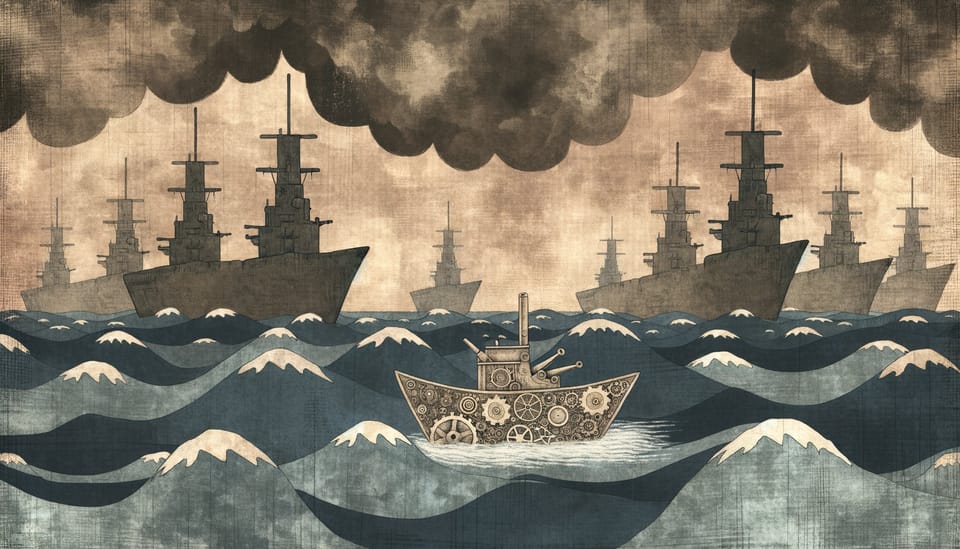
The Wires Beneath the Waves: How Submarine Cables Became the Pacific's Contested Terrain
Taiwan experiences seven to eight cable breaks annually, most linked to China. The pattern reveals how submarine cables have transformed from neutral infrastructure into strategic terrain where great powers contest the physical substrate of the digital world.
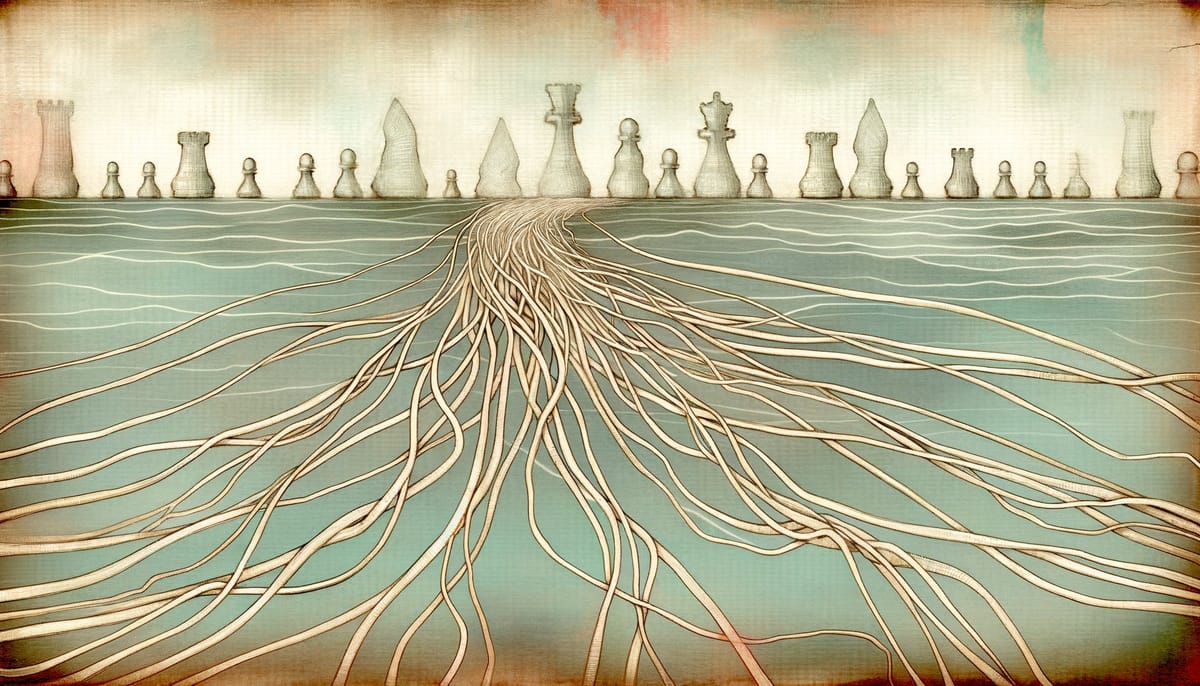
The Wires Beneath the Waves
In January 2025, a cargo ship dragged its anchor across a submarine cable connecting Taiwan to the Penghu Islands. Within hours, Taiwanese authorities had identified the vessel—a Cameroon-flagged ship with a Chinese captain, owned by a Hong Kong company. The incident joined a lengthening list: Taiwan now experiences seven to eight cable breaks annually, most “linked to China,” according to its digital ministry. Each break is plausibly deniable. Each break is strategically eloquent.
The pattern reveals something more consequential than sabotage. Submarine cables—those fiber-optic threads carrying 95% of international data—have become terrain, not merely tools. The distinction matters. A tool serves its user’s purposes. Terrain shapes the contest itself, constraining what is possible, rewarding those who know its contours, punishing those who do not. In the Pacific, great powers are no longer simply using infrastructure to project influence. They are fighting over who controls the physical substrate of the digital world.
When Pipes Become Battlefields
The conventional understanding of infrastructure competition focuses on investment. China builds cables; America blocks them. Beijing offers financing to Pacific Island nations; Washington counters with Quad initiatives. This framing captures something real but misses the deeper transformation.
Consider the numbers. Chinese firms built or repaired nearly 100 of the world’s 400 submarine cables by 2021. The Digital Silk Road extends fiber-optic connectivity across Southeast Asia, the Pacific, and beyond. Yet in 2019, Huawei Marine—then a significant player—exited the undersea cable business entirely, selling its stake to Hengtong Optic-Electric. The Clean Network initiative, launched by the Trump administration in 2020, explicitly targeted “untrusted vendors” in undersea cable construction. American pressure worked. Chinese companies retreated from the most visible segments of the market.
But retreat is not defeat. The competition has shifted from who builds cables to who controls the chokepoints, the landing stations, the repair capabilities, and the regulatory frameworks that determine which cables can land where. Japan hosts 20 international cable landing stations. Singapore connects to nearly 40 undersea cables. These nodes matter more than the cables themselves. Control a landing station, and you control what data enters and exits a nation’s digital territory.
The Pacific presents a particular challenge. Island nations lack the technical capacity to maintain their own infrastructure. A CSIS analysis notes that cables have become “a highly consequential theater of great power competition between the United States, China, and other state actors such as Russia.” But the theater’s architecture favors the patient. Cables last 25 years. Decisions made today constrain options for a generation.
Here lies the transformation: infrastructure has acquired what strategists call “positional value.” A cable route chosen in 2025 determines data flows in 2050. A landing station permitted in Palau shapes intelligence access across Micronesia. The terrain is being terraformed, and the terraforming is irreversible.
The Grammar of Gray Zones
Taiwan’s cable breaks illuminate a grammar of coercion that operates below the threshold of armed conflict. The incidents share a pattern: commercial vessels, unclear ownership chains, plausible mechanical explanations. Proving intent is nearly impossible. Yet the cumulative effect is unmistakable.
This is gray zone warfare applied to infrastructure. The legal architecture cannot distinguish between criminal negligence and state sabotage. At high geopolitical tension, the boundary between accident and attack becomes a “critical point”—a thermodynamic term for when phase boundaries vanish entirely. Was the anchor drag an accident? Sabotage? A signal? All three simultaneously?
The ambiguity is the weapon. Taiwan must invest in redundancy without being able to name the threat. Insurance premiums rise. Repair costs accumulate. The psychological burden of constant vigilance compounds. Each incident that fails to trigger a response emboldens the next.
The frequency is accelerating. Three cable incidents in 2023-2024. Four to five projected for 2025. The pacing follows theatrical logic: each “performance” must occur before the previous one exits public consciousness. Normalization is the objective. When cable breaks become routine, they cease to be news. When they cease to be news, they cease to generate pressure for response.
China’s timing of Nauru’s diplomatic switch from Taiwan immediately after the January 2024 election demonstrates similar precision. The measurement doesn’t just record Taiwan’s diminished state—it forces Taiwan to observe its isolation at the moment of democratic renewal. Infrastructure competition and diplomatic competition share a grammar: both exploit the gap between action and attribution.
Sovereignty by the Meter
The Quad Partnership for Cable Connectivity and Resilience, launched in 2023, represents America’s attempt to contest terrain rather than merely deploy tools. Australia, India, Japan, and the United States now coordinate on cybersecurity standards and incident response across critical infrastructure sectors. The initiative acknowledges what one Jackson School analysis calls the transformation of cables from “neutral infrastructure” to “strategic assets that underpin the global economy, international security, and digital sovereignty.”
Digital sovereignty. The phrase appears increasingly in policy documents, yet its meaning remains contested. For Washington, sovereignty means excluding untrusted vendors. For Beijing, sovereignty means building alternatives to American-dominated internet architecture. For Pacific Island nations, sovereignty means something simpler: not being forced to choose.
The local content requirements emerging in Pacific procurement reveal the tension. Bid evaluations now include “explicit local content nonprice and capacity criteria”—elaborate procedural performances that mirror, in structure if not intent, cargo cult rituals. Documentation, evaluation committees, probity audits: the forms of sovereignty without its substance. The infrastructure arrives. The capacity to maintain it does not.
Huawei’s training programs for Pacific telecommunications technicians illustrate the mechanism. The programs build technical competence while creating dependency. Graduates can operate Chinese equipment. They cannot design alternatives. The training functions as what one might call “regulatory network modification”—shaping human capital in ways that constrain future choices without appearing coercive.
The rhetoric of “mutual connectivity” (互联互通) in Chinese official documents functions as the modern equivalent of tributary system logic. Connection is framed as a gift. Acceptance creates obligation. The infrastructure itself becomes a relationship, not merely a transaction.
The Geometry of Vulnerability
Submarine cables concentrate risk in ways that defy intuition. A single ship anchor can sever communications for millions. A cable landing station occupies a few acres but controls data flows across ocean basins. The geometry is inherently asymmetric: defense requires protecting everything, attack requires disrupting anything.
The Federal Communications Commission’s 2025 review of submarine cable licensing attempts to address this asymmetry through regulatory architecture. Landing licenses now face heightened scrutiny for national security implications. The review process has become, in effect, a sovereignty checkpoint—each application forcing a decision about which connections to permit and which to deny.
But regulatory architecture creates its own vulnerabilities. The multi-layered permit structure—federal, state, county—mirrors biological checkpoint cascades. Each layer must independently verify different parameters. Each layer can fail. Hawaii’s cable landing process requires sign-offs at three governmental levels, each with different timelines, different priorities, different political pressures. The system prevents reckless approval. It also prevents rapid response.
The economics compound the geometry. TeleGeography’s analysis reveals that cable construction costs have declined while capacity has exploded. A modern trans-Pacific cable costs roughly $300 million and carries traffic that would have required dozens of cables a generation ago. Concentration follows cost efficiency. Fewer cables carry more data. Each cable matters more.
Repair capacity matters even more. The global fleet of cable repair ships numbers fewer than 60. Most are committed to specific regions or operators. Average repair times stretch to weeks. In contested waters, repair ships become targets—not for destruction, but for delay. A vessel that cannot reach a damaged cable extends the outage indefinitely.
The Encryption Paradox
End-to-end encryption offers one response to infrastructure vulnerability. If adversaries cannot read intercepted data, control of the physical layer matters less. IBM’s technical documentation describes encryption that protects data from origin to destination, rendering intermediate access meaningless.
But encryption solves the wrong problem. The threat is not interception. The threat is disruption.
Encrypted data traveling over a severed cable arrives nowhere. Encryption protects confidentiality, not availability. The distinction reveals a deeper truth about infrastructure competition: the goal is not to read adversaries’ communications but to shape the conditions under which communication occurs. Control the terrain, and you control the options.
The proof-of-life analogy illuminates the mechanism. Hostage negotiators use authentication protocols to confirm the hostage is alive and the kidnapper controls communication. The protocol says nothing about whether ransom payment will secure release. Similarly, encryption verifies the channel’s integrity while remaining agnostic about endpoint intent. The infrastructure layer operates beneath encryption’s protections.
State-mandated encryption backdoors—proposed in various jurisdictions—would convert security architecture into vulnerability architecture. Platforms forced to weaken encryption bear protection costs that their users cannot see. The parallel to cable routing is exact: both create exploitable weaknesses disguised as regulatory compliance.
Pacific Island Calculus
For Pacific Island nations, the submarine cable competition presents an impossible choice. Accept Chinese infrastructure and risk American displeasure. Accept American infrastructure and risk Chinese alternatives. Attempt neutrality and receive neither.
Remittances complicate the calculus. World Bank data shows that Pacific Island economies depend heavily on diaspora transfers. Digital connectivity enables remittance flows. Cable disruption severs financial lifelines. The stakes are not abstract.
The Samoan concept of teu le va—maintaining relational space—offers a framework that neither great power employs. Research on Samoan relational ethics describes relationships as requiring active maintenance, not transactional exchange. Infrastructure built without relational maintenance becomes extraction. The cable carries data out. What flows back?
Pacific Island procurement frameworks increasingly demand local content, local training, local ownership stakes. The requirements acknowledge that infrastructure without capacity transfer is dependency with better marketing. But the requirements also create friction that delays projects, raises costs, and opens opportunities for competitors willing to skip the formalities.
The UNDP’s horizon scan of Pacific migration and funding flows notes convergence between labor mobility, remittances, and digital infrastructure. Workers abroad need connectivity to families at home. Families at home need connectivity to financial systems abroad. The cable is not merely infrastructure. It is kinship architecture.
Environmental Entanglement
Submarine cables interact with marine ecosystems in ways that create unexpected strategic implications. Electromagnetic fields from cables affect species behavior. Research on cable EMF effects documents attraction and repulsion patterns that effectively partition marine space. Some species cluster near cables. Others avoid them. The cable creates invisible territorial boundaries with no physical substrate.
Climate change amplifies the entanglement. Submarine Thermocline Water layers—stable “foundation layers” for sound propagation—are thinning and deepening. Acoustic surveillance that relied on predictable propagation patterns becomes unreliable. The ocean itself is changing in ways that destabilize military assumptions about underwater monitoring.
Environmental review requirements create regulatory chokepoints. Projects that might proceed rapidly on technical and commercial merits stall in environmental impact assessments. The assessments serve legitimate purposes. They also serve strategic purposes for actors willing to weaponize delay.
Cable recovery and removal present their own complications. Decommissioning costs range from €2 billion to 16.5 billion RMB depending on route and conditions. The asymmetry between installation and removal costs functions like ritual scarification: the cost to “unmarry” from a technical standard reveals it was never a neutral choice. Infrastructure decisions are permanent in ways their proponents rarely acknowledge.
The Default Trajectory
Without intervention, current dynamics lead to predictable outcomes.
Taiwan’s cable connections become progressively less reliable. Each incident that fails to generate international response emboldens the next. Normalization proceeds until cable disruption becomes background noise—a cost of doing business in contested waters.
Pacific Island nations fragment into spheres of digital influence. Those who accept Chinese infrastructure find themselves in Chinese information ecosystems. Those who accept American infrastructure find themselves dependent on American maintenance capacity. The middle path narrows until it vanishes.
Repair capacity concentrates in the hands of those who control the ships. The global fleet of cable repair vessels becomes a strategic asset, deployed or withheld based on geopolitical alignment. Average repair times extend. Insurance costs rise. Redundancy becomes mandatory but unaffordable for smaller nations.
The terrain hardens. Decisions made in the 2020s constrain options in the 2050s. The submarine cable map of 2050 is being drawn now, and the cartographers are not neutral.
Intervention Points
Three leverage points exist, though none is costless.
First, repair capacity. The United States and its allies could invest in cable repair vessels positioned in the Pacific, reducing response times and denying adversaries the ability to weaponize delay. The cost: hundreds of millions of dollars annually, plus the diplomatic complexity of basing arrangements. The benefit: converting a vulnerability into a capability.
Second, redundancy by design. New cable projects could be required to include alternative routing, diverse landing stations, and distributed ownership. The cost: higher construction expenses, longer permitting timelines, and reduced commercial efficiency. The benefit: resilience that survives individual cable cuts.
Third, attribution architecture. International frameworks could establish standards for investigating cable incidents, sharing forensic evidence, and assigning responsibility. The cost: diplomatic friction with nations that benefit from ambiguity. The benefit: raising the cost of gray zone operations by reducing plausible deniability.
Each intervention requires trade-offs. Repair capacity investment diverts resources from other priorities. Redundancy requirements slow deployment. Attribution frameworks antagonize adversaries. The question is not whether to pay costs but which costs to accept.
FAQ: Key Questions Answered
Q: How vulnerable are submarine cables to deliberate attack? A: Extremely. Cables lie on the ocean floor, often in international waters beyond national jurisdiction. A single ship anchor can sever a cable, and proving intent is nearly impossible. The global repair fleet numbers fewer than 60 vessels, meaning disruptions can persist for weeks.
Q: Why can’t satellites replace submarine cables? A: Capacity and latency. Submarine cables carry over 95% of international data because fiber optics offer bandwidth that satellites cannot match. Low-earth orbit constellations like Starlink improve latency but cannot approach cable capacity. For high-volume data flows, cables remain irreplaceable.
Q: What happens to internet traffic when a cable breaks? A: Traffic reroutes through alternative cables, if they exist. For well-connected regions, users notice slowdowns but not outages. For Pacific Island nations with limited redundancy, a single cable break can sever international connectivity entirely until repairs complete.
Q: Are there international laws protecting submarine cables? A: The 1884 Convention for the Protection of Submarine Cables and the 1982 UN Convention on the Law of the Sea provide some protections, but enforcement mechanisms are weak. Intentional damage is prohibited; proving intention is another matter entirely.
The Cartography of Constraint
The submarine cable competition in the Pacific reveals a truth that extends beyond telecommunications. Infrastructure is never neutral. The physical layer of connectivity shapes what is possible, who can participate, and on whose terms. Those who control the terrain control the contest.
Great powers have always fought over territory. The novelty is not competition but its substrate. The ocean floor has become as contested as any land border, and the cables that cross it carry not just data but the architecture of future dependencies. Every landing station permitted, every repair ship positioned, every cable route selected—each decision forecloses alternatives and opens others.
The Pacific’s submarine cables are being laid now. The map they create will constrain choices for a generation. The question is not whether infrastructure becomes terrain. It already has. The question is who will hold the high ground.
Sources & Further Reading
The analysis in this article draws on research and reporting from:
- CSIS Analysis on Subsea Cable Security - Comprehensive assessment of cable infrastructure as a theater of great power competition
- Jackson School of International Studies - Analysis of US-Japan undersea cable cooperation and security frameworks
- Congressional Research Service Report R47237 - Technical and policy overview of undersea telecommunications cables
- FCC Submarine Cable Review - 2025 regulatory framework for cable licensing and national security review
- TeleGeography Cable Economics - Industry analysis of construction costs and capacity trends
- UNDP Pacific Horizon Scan - Assessment of migration, remittances, and connectivity in Pacific Island nations
- All Research Journal Infrastructure Analysis - Academic examination of submarine networks and strategic competition