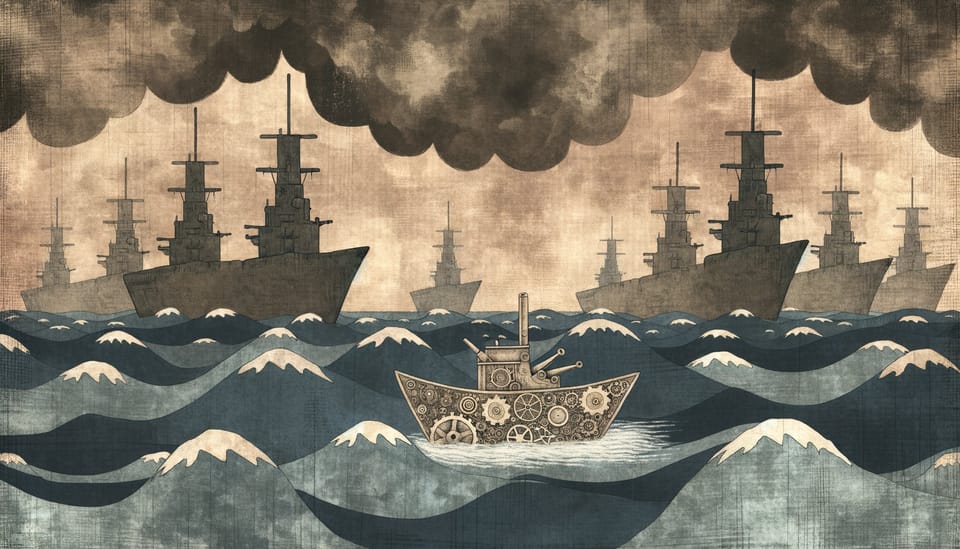
The Venezuela Deployment: Why America's Mismatch Is the Message
The USS Gerald R. Ford sits off Venezuela with enough firepower to destroy but not enough forces to occupy. This gap between capability and intent reveals Washington's true objectives—and their limits.

The Mismatch That Reveals Everything
The USS Gerald R. Ford sits off Venezuela’s coast with more firepower than most nations possess. Three destroyers, guided-missile cruisers, an attack submarine, the Iwo Jima Amphibious Ready Group, the 22nd Marine Expeditionary Unit, and over 15,000 personnel. Enough to devastate Venezuela’s military in days. Not nearly enough to occupy a nation of 28 million.
This gap between what is deployed and what would be required tells the real story. The Trump administration calls it a blockade. The Pentagon prefers “quarantine.” Neither word quite fits. Under international law, a blockade constitutes an act of war requiring formal declaration and enforcement against all traffic. What the United States is actually doing exists in a deliberate gray zone—too aggressive for sanctions enforcement, too restrained for war.
The questions swirling around this deployment—Chinese underwater drones, secret technology tests, imminent invasion—miss the more interesting truth. The asset-mission mismatch is the mission. Washington is conducting an elaborate strategic communication where what is not deployed matters as much as what is.
The Arithmetic of Presence
Military deployments speak a language of numbers. An invasion of Venezuela would require at least 50,000 ground troops for initial operations, likely far more for occupation. The current deployment of 15,000 personnel, mostly aboard ships, cannot take and hold territory. Defense analysts at CSIS have noted that while the Ford strike group possesses “sufficient firepower to launch immediate strikes,” it lacks the force structure for ground operations.
This is not an oversight. The deployment is calibrated to achieve specific effects without triggering specific consequences.
Consider what the carrier group can do: enforce maritime exclusion zones, intercept tankers, conduct airstrikes against fixed targets, destroy Venezuela’s modest air force and navy within hours. Now consider what it cannot do: occupy Caracas, control the Orinoco oil fields, prevent guerrilla resistance, or manage the humanitarian catastrophe that would follow regime collapse.
The gap creates a peculiar form of coercive leverage. The threat is credible enough to constrain Maduro’s options but limited enough to avoid forcing him into desperate measures. Venezuela cannot ignore fifteen thousand American military personnel off its coast. But Maduro can calculate that invasion remains unlikely precisely because the deployed force cannot achieve occupation.
This is compellence without commitment—a posture that maximizes pressure while preserving optionality.
What the Deployment Actually Targets
Operation Southern Spear, announced by Defense Secretary Pete Hegseth in November 2025, frames the mission as counter-narcotics. The stated targets are “narco-terrorist organizations” disrupting illegal drug trafficking in the Western Hemisphere. This framing serves multiple purposes simultaneously.
First, it provides legal cover. Counter-narcotics operations fall into a gray zone between Title 10 military authority and Title 50 intelligence authority, allowing activities that would require congressional authorization if classified as combat operations. The “other-than-routine support” designation permits sustained presence without triggering the War Powers Resolution’s clock.
Second, it builds domestic political support. Fentanyl deaths have become a potent political issue. Framing Venezuela as a narco-state rather than an oil dictatorship connects the deployment to kitchen-table concerns about drug overdoses rather than abstract geopolitical competition.
Third, it tests Venezuelan and Russian responses. The Maduro government has deployed Russian-supplied systems including S-300 air defense batteries. Whether these systems would be activated against American aircraft conducting “counter-narcotics surveillance” remains unknown. The deployment probes these red lines without crossing them.
The oil blockade component—Trump’s “TOTAL AND COMPLETE BLOCKADE OF ALL SANCTIONED OIL TANKERS”—adds economic warfare to military presence. Venezuela’s economy depends on oil exports, increasingly shipped to China through a “shadow fleet” of tankers that disable tracking systems to evade sanctions. Interdicting these vessels strangles the regime’s revenue while demonstrating American maritime dominance in waters China considers part of its global energy supply chain.
The China Question
The speculation about Chinese underwater drones deployed through Venezuela into American waters reflects genuine strategic anxieties, even if evidence for this specific scenario remains absent.
China has developed sophisticated unmanned underwater vehicles. The “Sea Whale 2000” measures three meters long, displaces 200 kilograms, and can cruise at two knots—specifications suitable for long-duration intelligence gathering. Chinese UUV development has accelerated dramatically, with systems designed for both reconnaissance and potential offensive operations.
Venezuela offers theoretical advantages for such deployments. The Orinoco Delta’s massive freshwater plume creates acoustic masking conditions. Sediment-laden waters interfere with sonar detection. The “uneven distribution of water and sediment discharge” through multiple distributaries produces persistent opacity that could conceal underwater activity.
But theory differs from practice. No confirmed reports document Chinese UUV operations through Venezuelan waters. The infrastructure required—maintenance facilities, recovery operations, data transmission—would be difficult to conceal. More importantly, such operations would represent a dramatic escalation that China has shown little appetite for while its economy remains intertwined with American markets.
The more plausible Chinese concern is economic, not military. Venezuela owes China billions in oil-backed loans. The repayment mechanism—oil deliveries rather than cash—requires vessels to reach Chinese ports. American interdiction of these tankers threatens not just Venezuelan revenue but Chinese energy security and the credibility of Beijing’s lending model across the developing world.
The carrier deployment sends China a message: the Western Hemisphere remains an American sphere of influence, and Chinese economic penetration will not be permitted to mature into strategic presence.
Technology Tests in Hostile Waters
The question of whether the United States is testing sensitive new technology deserves serious consideration. Carrier strike groups have historically served as platforms for operational evaluation of systems that cannot be adequately tested in exercises.
The Ford-class carriers themselves represent revolutionary technology. Electromagnetic launch systems replaced steam catapults. Advanced arresting gear uses electromagnetic motors rather than hydraulic systems. These systems have experienced developmental problems, and sustained operations in a semi-hostile environment provide data that simulations cannot.
More intriguingly, the deployment creates conditions for testing anti-submarine warfare capabilities against potential adversaries. Venezuela operates Kilo-class submarines purchased from Russia—the same submarine class that has challenged American detection systems in multiple theaters. Tracking these vessels in real-world conditions validates sonar systems and tactical procedures.
The legal ambiguity of the “quarantine” may itself serve testing purposes. Department of Defense testing policy mandates evaluation under “realistic combat conditions” that cannot be replicated in exercises. A blockade that exists in the gray zone between peace and war creates precisely such conditions—operational tempo and threat environment without the legal status of armed conflict.
Distributed acoustic sensing systems, which use fiber optic cables to detect underwater movement, have been deployed experimentally in various maritime environments. The Caribbean’s relatively shallow waters and heavy commercial traffic would test such systems under challenging conditions.
None of this requires the deployment to be primarily about technology testing. But military operations routinely serve multiple purposes, and the opportunity to evaluate sensitive systems in operational conditions would not be wasted.
Invasion Calculus
Would the United States actually invade Venezuela? The question requires distinguishing between capability, intent, and probability.
Capability exists, with caveats. American military power could destroy Venezuelan conventional forces within days. The Maduro government’s S-300 batteries, Su-30 fighters, and coastal defense missiles would delay but not prevent American air superiority. Naval forces would be eliminated in the opening hours.
But occupation is not conquest. Venezuela’s geography—Andean mountains, Amazon jungle, Caribbean coast, vast llanos plains—would challenge any occupying force. The population, however disaffected from Maduro, has shown limited enthusiasm for American intervention. Chavismo retains genuine support among significant portions of the population. Armed colectivos loyal to the regime would transition to insurgency.
The Iraq comparison looms. American forces conquered Baghdad in three weeks. The occupation lasted eight years, cost trillions of dollars, and killed hundreds of thousands. Venezuela’s population is smaller but its geography is equally challenging, and the political costs of another failed occupation would be catastrophic.
Intent remains opaque. Trump has stated “I don’t rule out anything,” which is precisely the ambiguity the deployment is designed to create. Hegseth’s background—a Fox News host who built his brand defending accused war criminals—suggests comfort with military action. Secretary of State Marco Rubio, whose family fled Cuba, brings personal investment in Latin American regime change.
Yet the administration’s actions suggest something other than invasion preparation. The force structure is wrong. The diplomatic groundwork is absent. Regional allies have not been prepared. Brazil, the regional power whose cooperation would be essential, has explicitly opposed intervention.
The most likely interpretation: invasion rhetoric serves domestic political purposes while the deployment achieves more limited objectives. Squeeze Maduro’s revenue. Demonstrate resolve. Test Chinese responses. Create conditions for regime collapse without American fingerprints.
The Maduro Calculation
Understanding the deployment requires understanding its target. Nicolás Maduro has survived assassination attempts, coup plots, international isolation, hyperinflation, and mass emigration. His survival instincts are finely tuned.
Maduro’s power rests on three pillars: the military’s loyalty, secured through corruption networks that make defection costly; control of the security apparatus, which has proven willing to fire on protesters; and external support from Russia, China, and Cuba.
The American deployment threatens all three. Military officers watching their retirement funds evaporate as oil revenue dries up may recalculate loyalty. Security forces seeing American aircraft overhead may wonder about their personal exposure to future prosecution. External patrons may decide Venezuela is not worth confrontation with Washington.
Yet Maduro has navigated such pressures before. In 2019, Juan Guaidó declared himself interim president with American recognition and explicit calls for military defection. The military held. Maduro remained.
The difference now is economic. In 2019, Venezuelan oil still flowed to markets through various channels. The current blockade, if sustained, genuinely threatens regime survival. The question is whether Maduro can outlast American attention—a bet that has paid off for authoritarian survivors from Castro to Assad.
His response has been characteristic: mass military promotions (16,900 soldiers elevated, forcing public loyalty declarations), rhetorical escalation, and quiet outreach to intermediaries. The promotions function as a distributed sensor network—accepting advancement under these conditions signals commitment, while hesitation identifies potential defectors.
The Shadow Fleet Problem
Enforcing an oil blockade against Venezuela requires solving the shadow fleet problem. Hundreds of tankers operate with falsified registrations, disabled tracking systems, and shell company ownership specifically to evade sanctions. These vessels load Venezuelan crude, often conducting ship-to-ship transfers in international waters, then deliver to Chinese refineries.
The legal complexities are formidable. Under international law, warships may board vessels only with flag state consent or under specific treaty provisions. Shadow fleet tankers fly flags of convenience from states unlikely to cooperate with American requests. Boarding without consent risks escalation with the flag state and establishes precedents that could constrain American shipping.
The practical complexities are equally daunting. The Caribbean contains thousands of vessels at any moment. Identifying which tankers carry sanctioned Venezuelan crude requires intelligence that may not be available in real-time. False positives—interdicting legitimate cargo—create diplomatic incidents and legal liability.
The Ford strike group can certainly interdict individual vessels. Whether it can sustain a “total and complete blockade” against determined evasion remains doubtful. The shadow fleet’s business model assumes some losses; operators price interdiction risk into their fees. Stopping enough tankers to genuinely strangle Venezuelan exports would require either dramatically expanded naval presence or escalation to measures—such as attacking vessels in port—that cross clear legal lines.
This suggests the blockade is designed to raise costs rather than achieve complete interdiction. Every tanker that turns back, every insurance premium that rises, every delivery that is delayed represents pressure on the Maduro regime. Perfect enforcement is unnecessary if imperfect enforcement achieves political objectives.
What Happens Next
The deployment has entered a phase where time works against Washington. Carrier strike groups cannot remain on station indefinitely. Maintenance requirements, crew fatigue, and competing global commitments will eventually force rotation or withdrawal. Maduro knows this. His strategy is survival through endurance.
Three scenarios merit consideration.
The first: negotiated de-escalation. Maduro offers concessions—perhaps releasing political prisoners, permitting opposition candidates, or accepting international election monitoring—in exchange for sanctions relief. The administration declares victory and withdraws. This outcome requires Maduro to believe the alternative is worse, which the current deployment may not credibly threaten.
The second: regime fracture. Economic pressure triggers military defection, popular uprising, or elite coup. The administration did not cause the collapse but benefits from it. This outcome depends on internal Venezuelan dynamics that American pressure influences but does not control. Maduro has survived similar pressures before.
The third: prolonged standoff. Neither side achieves its objectives. The deployment continues in some form, costs accumulate, and Venezuela joins the list of unresolved American confrontations. This is the most likely outcome—not because it serves anyone’s interests, but because it requires no decisive action from any party.
The asset-mission mismatch reveals itself as strategic ambiguity rather than operational error. The deployment is precisely calibrated to achieve effects short of war while preserving the option of escalation. Whether this ambiguity serves American interests depends on whether Maduro blinks—and on whether Washington has a plan for what happens if he doesn’t.
FAQ: Key Questions Answered
Q: Is the US actually conducting a blockade of Venezuela? A: The legal status remains deliberately ambiguous. While President Trump announced a “total and complete blockade,” Pentagon officials use the term “quarantine.” Under international law, a blockade constitutes an act of war; the current operations appear designed to achieve blockade effects while avoiding that legal classification.
Q: Could the current US forces invade Venezuela? A: The deployed forces—approximately 15,000 personnel, mostly naval—could destroy Venezuelan military capabilities but cannot occupy the country. Military analysts estimate at least 50,000 ground troops would be required for initial invasion operations, with far more needed for sustained occupation.
Q: Has China deployed military assets through Venezuela? A: No confirmed evidence exists of Chinese underwater drones or other military systems deployed through Venezuela into American waters. While China has developed sophisticated UUV technology and maintains economic interests in Venezuela, documented military presence remains limited to arms sales and occasional naval visits.
Q: What is Operation Southern Spear? A: Announced in November 2025 by Defense Secretary Pete Hegseth, Operation Southern Spear is officially a counter-narcotics mission targeting “narco-terrorist organizations” in the Western Hemisphere. The framing provides legal cover for sustained military presence while connecting the deployment to domestic concerns about fentanyl trafficking.
The Choreography Continues
The Ford strike group will eventually sail home. The question is what it leaves behind—a chastened Maduro, a collapsed regime, or simply another chapter in the long history of American military demonstrations that changed less than they promised.
The deployment’s true significance may lie not in Venezuela but in Beijing. China has watched American carriers enforce exclusion zones against a nation that owes it billions, interdicting vessels that carry oil China needs. The message is unmistakable: economic penetration of the Western Hemisphere will not be permitted to mature into strategic presence.
Whether that message is received as intended, or whether it accelerates Chinese efforts to develop military options that can challenge American maritime dominance, remains to be seen. The Ford carries enough firepower to devastate Venezuela. It cannot, by itself, reshape the global order that makes such deployments necessary.
The asset-mission mismatch, in the end, reflects a deeper mismatch: between American ambitions and American means, between the desire to shape outcomes and the costs of doing so, between the world Washington wants and the world that exists. The carrier group off Venezuela is not the answer to that mismatch. It is, at best, a very expensive way of asking the question.
Sources & Further Reading
The analysis in this article draws on research and reporting from:
- PBS NewsHour: Trump’s blockade of sanctioned Venezuelan oil raises new questions about legality - Legal analysis of blockade vs. quarantine distinction
- CSIS: Trump Has Sufficient Firepower to Launch Immediate Strikes on Venezuela - Force structure analysis and invasion feasibility assessment
- CFR: Operation Southern Spear - Official framing and stated objectives of the military campaign
- Janes: China advances unmanned underwater capabilities - Technical specifications of Chinese UUV development
- SOUTHCOM 2024 Posture Statement - Official military assessment of Venezuelan threat
- OFAC Venezuela Sanctions Framework - Legal structure of oil sanctions and licensing
- ABC Australia: USS Gerald R. Ford near Venezuela - Current deployment details and force composition
- Lloyd’s Market Association Joint War Committee - Maritime insurance and risk assessment for the region