
The Temple and the Trap
A leaked phone call, a disputed cliff-top temple, and two nations' domestic politics collided in 2025 to produce Southeast Asia's bloodiest conflict in decades. The Thailand-Cambodia crisis reveals how ancient grievances become modern catastrophes—and why neither side can afford to stop fighting.
The Choreography of Collapse
On the morning of May 28, 2025, Thai and Cambodian soldiers exchanged fire in the Emerald Triangle—a scrap of jungle where three borders meet and nobody quite knows whose soil they’re standing on. Eleven soldiers died. The skirmish lasted forty minutes.
What followed lasted seven months.
The conventional explanation for the 2025 Thailand-Cambodia crisis points to Preah Vihear, the eleventh-century Hindu temple perched on a 525-metre cliff that the International Court of Justice awarded to Cambodia in 1962. This explanation is not wrong. It is merely insufficient. Preah Vihear has been contested for sixty years without producing sustained warfare. Something else broke in 2025.
That something was the domestic political architecture in both countries—simultaneously. Thailand’s Prime Minister Paetongtarn Shinawatra faced constitutional suspension by a court hostile to her family’s political dynasty. Cambodia’s Hun Sen, nominally retired but operationally supreme, saw his leaked phone call to Paetongtarn expose the theatrical nature of the succession to his son Hun Manet. Both leaders needed the border crisis more than they needed peace.
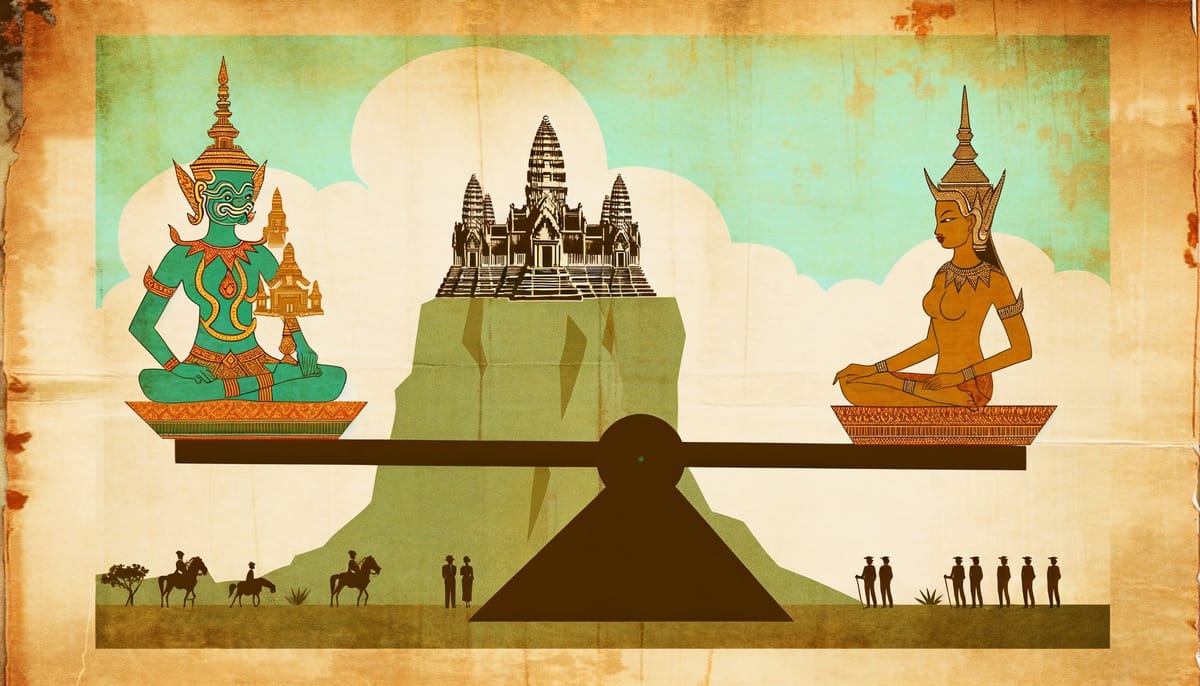
The temple became a trap. Not because of what it is—a magnificent ruin where Khmer kings once worshipped Shiva—but because of what it does. Preah Vihear functions as a machine for converting domestic political weakness into nationalist legitimacy. The mechanism is simple. When leaders falter at home, they point to the cliff. The cliff never disappoints.
The Map That Speaks Through Silence
Understanding why the crisis erupted requires understanding why it hadn’t erupted sooner. The border between Thailand and Cambodia runs for 803 kilometres, and approximately 270 of those kilometres remain undemarcated. Colonial cartographers drew lines through jungle they never visited. The International Court of Justice, ruling twice on Preah Vihear, managed to award the temple to Cambodia while leaving the surrounding promontory in legal limbo. The 1962 judgment gave Cambodia the temple. The 2013 judgment gave Cambodia the “vicinity.” Neither defined what “vicinity” means.
Here lies the first structural cause: the border is not merely disputed but undisputable. The Joint Boundary Commission, established to resolve demarcation, has met for decades without completing its work. This is not failure. This is function. The commission’s purpose is to meet, not to decide. Each session progresses “smoothly” toward outcomes that place neither side at advantage or disadvantage. The ambiguity is load-bearing.
The ICJ’s interpretation of Siam’s historical silence illustrates the deeper problem. When France presented maps in 1908 showing Preah Vihear on the Cambodian side, Siam failed to object. The court transformed this bureaucratic non-response into legal consent. The map became binding not through agreement but through the absence of disagreement. Silence spoke. But what it said remained contested.
Thailand has never accepted this interpretation. Thai nationalists argue that the maps were imposed by colonial power, that the natural watershed boundary should govern, that the court was deceived. These arguments have legal merit and political utility. They also ensure that every Thai government can revisit the question whenever domestic circumstances demand.
Cambodia, for its part, treats Preah Vihear as the crown jewel of national identity—proof that Khmer civilization predates and exceeds Thai claims to regional supremacy. The temple’s UNESCO World Heritage listing in 2008 triggered the previous round of border clashes. Hun Sen’s government invested heavily in infrastructure connecting Preah Vihear to Cambodia’s road network. By 2025, National Route 62 was 95 percent complete. Thailand’s competing route sat at 60 percent.
The asymmetric completion rates created urgency. Infrastructure that reaches the border first establishes facts on the ground. Thailand faced a closing window.
The Call That Changed Everything
On April 3, 2025, Hun Sen telephoned Paetongtarn Shinawatra. The conversation was private, between two leaders whose families had maintained back-channel relations for years. Hun Sen, the former prime minister who had ruled Cambodia for nearly four decades before installing his son, was offering guidance to a young prime minister whose own father, Thaksin Shinawatra, remained the power behind Thailand’s ruling coalition.
Someone recorded the call. Someone leaked it.
The nine minutes that reached the public revealed Hun Sen advising Paetongtarn on managing military relationships, suggesting that her family’s survival depended on accommodating certain factions while marginalizing others. The content was damaging. The fact of the conversation was devastating.
Thai nationalists erupted. Here was proof that their prime minister took instructions from Cambodia’s strongman. The constitutional court, already considering a case against Paetongtarn’s party, accelerated its proceedings. By May, she faced suspension. By July, she was out.
The leak’s timing was not accidental. Hun Sen distributed the recording to eighty officials before releasing nine minutes publicly—a controlled demolition designed to destabilize Thailand while demonstrating that Cambodia possessed leverage. The same digital infrastructure that enabled real-time coordination between the two dynasties created involuntary transparency that delegitimized the coordination itself.
Acting Prime Minister Phumtham Chaicharoen, thrust into office by the constitutional crisis, lacked Paetongtarn’s political base and her family’s relationships with the military. When border tensions escalated in July, he rubber-stamped military decisions without the accountability constraints that might have restrained them. The constitutional suspension created what scholars call a “necropolitical gap”—a space where death-making authority could be exercised by an acting leader who owed his position to the crisis itself.
Cambodia’s domestic politics proved equally combustible. Hun Manet, the nominal prime minister, needed to demonstrate that he was more than his father’s placeholder. The border conflict offered an opportunity. So did the highway.
The Road to Trump
In the weeks following the July clashes, Cambodian authorities announced that a major highway would be renamed for Donald Trump. The gesture appeared spontaneous—a grassroots expression of gratitude for the American president’s “mediation” efforts. It was nothing of the sort.
The highway renaming followed Hun Manet’s nomination for a Nobel Peace Prize in perfect sequence. Both events were orchestrated to court American favor at a moment when Cambodia desperately needed external validation. The ritual had to appear spontaneous to work. Governments cannot command authenticity. They can only manufacture its appearance.
Trump’s involvement in the crisis deserves scrutiny. The American president announced a ceasefire on July 28, claiming credit for ending hostilities. The ceasefire was real. Its terms were not. What Thailand and Cambodia achieved was a “common understanding”—diplomatic language for an agreement to stop shooting without agreeing on why they had been shooting or what would prevent them from shooting again.
The ceasefire’s deliberate vagueness served all parties. Trump could claim a diplomatic victory. Thailand could regroup. Cambodia could consolidate territorial gains. The absence of resolution created performative space. Like Schubert’s Unfinished Symphony, the ceasefire achieved perfection through incompleteness.
But ceasefires require maintenance. The July understanding held for three months. Then came the landmine.
The Wound That Would Not Close
On November 12, 2025, a landmine detonated near Ta Krabey temple, killing four Thai soldiers on what Thailand insisted was Thai soil. Cambodia denied responsibility. The explosion functioned as wound dehiscence—a premature reopening of tissue that had barely begun to heal.
The response was disproportionate by design. Operation Sattawa, launched in December, sent Thai F-16s across the border. The aircraft were American-supplied, their deployment a kinetic invocation that kept the U.S. alliance spiritually alive. Thailand’s explicit citation of “international rules of engagement” enabled rather than constrained military action. The rules functioned not as restraints but as the chord changes that made violent improvisation legible and therefore permissible.
Cambodia requested an emergency UN Security Council session. The request functioned as diplomatic theater—a frozen moment of stylized outrage that preceded rather than initiated negotiation. The Security Council convened. It did not resolve. Emergency sessions, it turns out, operate as permanent liminal spaces that never complete the ritual transition to a new stable state.
By December’s end, the Five-Day War of July had metastasized into something longer and uglier. Over 300,000 civilians had fled their homes. Cross-border trade, which had exceeded $12 billion annually, collapsed by 99.9 percent. The Thai-Cambodian border, once among Southeast Asia’s most porous, became a wound that neither country could afford to close.
The Economics of Enmity
The trade collapse deserves examination because it reveals how economic interdependence can accelerate rather than prevent conflict. Conventional wisdom holds that countries deeply integrated through trade have too much to lose from war. The 2025 crisis inverts this logic.
Thailand and Cambodia had developed extensive cross-border economic ties. Approximately 780,000 Cambodian workers labored in Thailand, sending remittances that constituted a significant portion of Cambodia’s GDP. Thai investment in Cambodian manufacturing, agriculture, and energy represented billions in sunk costs. The PTTEP gas development project alone involved $21 billion in planned investment.
When the crisis erupted, these ties became weapons. Thailand expelled Cambodian workers. Cambodia seized Thai assets. Both countries imposed customs requirements so onerous that legitimate trade became impossible. The economic pain was not collateral damage. It was the point.
The repatriation of 780,000 workers functioned as economic endocrine disruption—not destroying Cambodia’s economy but corrupting its information processing. The workers remained physically present in Cambodia but functionally misaligned with the economy’s needs. They had skills suited to Thai factories, networks oriented toward Thai employers, expectations calibrated to Thai wages. Their sudden return created unemployment without creating productivity.
Thai businesses that had profited from Cambodian labor and markets lobbied intensely for resolution. Their advocacy achieved nothing. The cortical remapping that occurs after amputation does not eliminate phantom pain but rather preserves and intensifies it through preserved function. Cross-border business networks did not adapt to market loss through diversification. They amplified their demands for restoration of the status quo ante—demands that neither government could satisfy without appearing to capitulate.
The economic warfare served domestic political purposes. Nationalist boycotts of Cambodian goods in Thailand and Thai goods in Cambodia hyperactivated economic nationalism, causing overproduction of patriotic consumer behavior that politicians could harvest. The boycotts functioned like autoantibodies that mimic hormone stimulation—not blocking economic activity but redirecting it toward nationalist performance.
Why Peace Cannot Hold
The structural dynamics of the 2025 crisis explain why successive ceasefires failed and why future agreements remain fragile. Three factors dominate.
First, the information environment has become irreversibly polarized. Thai and Cambodian media narratives about the border conflict resist collapse into shared factual basis—not because of propaganda distortion but because each country’s media ecosystem has evolved to process the same events through incompatible interpretive frameworks. Social media platforms optimized for emotional engagement amplified the most inflammatory content. Ordinary citizens participated in online exchanges that mocked the other country’s royal family, celebrated natural disasters, and transformed from elite-controlled theater into a binding chorus that constrained what leaders could accept.
The toxicity created a ratchet. Each escalation of online nationalist performance raised the minimum acceptable outcome for both governments. Leaders who might have preferred de-escalation found themselves trapped by the very sentiments they had encouraged.
Second, the military establishments in both countries developed institutional interests in continued tension. Thailand’s October 2025 military reshuffle placed officers with royalist affiliations in key positions. The border crisis provided these newly positioned commanders their first operational test. Standing down meant squandering the opportunity. Cambodia’s military, long subordinate to Hun Sen’s personal control, gained autonomy and resources as the conflict intensified. Peace threatened budgets.
Third, and most importantly, neither government could survive the political costs of appearing to lose. Paetongtarn’s suspension had already demonstrated that Thai leaders who seemed soft on Cambodia faced constitutional destruction. Hun Manet’s legitimacy depended on proving he could defend Cambodian sovereignty as effectively as his father. The conflict had become a test that both leaders had to pass and neither could afford to fail.
The mathematics are brutal. Two leaders who need nationalist credentials. One temple that provides them. Zero-sum competition for a prize that cannot be divided.
What Breaks First
The default trajectory leads to frozen conflict—not resolution but exhaustion. Neither country possesses the military capacity for decisive victory. Thailand’s superior air power cannot occupy jungle terrain. Cambodia’s defensive advantages cannot project force into Thailand. The conflict will continue until both sides lack the resources to sustain it.
The humanitarian costs will compound. Landmine contamination already affects the border region, creating what researchers call an allelopathic mechanism—persistent chemicals that prevent the establishment of normal economic and social activity. Displaced populations will not return while the border remains militarized. The 300,000 refugees will become a permanent feature of the regional landscape.
ASEAN, the regional organization theoretically responsible for managing such conflicts, has proven ineffective. Malaysia’s mediation efforts produced meetings but not outcomes. The organization’s consensus requirement—its strength in normal times—becomes an exploitable weakness when members prefer managed instability to imposed solutions.
China, the region’s dominant external power, has interests in both countries and incentives to prolong rather than resolve the crisis. A weakened Thailand and a dependent Cambodia serve Beijing’s strategic purposes. Chinese infrastructure investments in both countries create leverage without creating pressure for peace.
The United States, under Trump’s transactional approach, treated the crisis as an opportunity for theatrical diplomacy rather than sustained engagement. The July ceasefire announcement earned headlines. The follow-through required effort that was not forthcoming.
The Narrow Path
Resolution remains possible but requires conditions that do not currently exist. Three intervention points offer theoretical leverage.
The first is economic. Both countries depend on foreign investment and export markets that conflict jeopardizes. Coordinated pressure from major trading partners—Japan, South Korea, the European Union—could raise the costs of continued hostilities above the political benefits. This would require those partners to prioritize regional stability over commercial relationships, a trade-off they have historically been unwilling to make.
The second is legal. The International Court of Justice could, in theory, issue an advisory opinion clarifying the border in the disputed areas. This would require both countries to accept the court’s jurisdiction—something Thailand has refused since the 1962 ruling. Cambodia might accept, believing the court would favor its claims. Thailand would not, believing the opposite. The legal path is blocked by the very dispute it would resolve.
The third is domestic. Political change in either country could alter the incentive structure. A Thai government secure enough to absorb nationalist criticism might accept territorial compromise. A Cambodian government confident enough in its legitimacy might reduce the symbolic importance of Preah Vihear. Neither condition appears imminent.
The most likely scenario is therefore continuation: periodic flare-ups, temporary ceasefires, gradual normalization of abnormal conditions. The border will remain militarized. Trade will remain suppressed. Refugees will remain displaced. The temple will remain contested.
The Cliff’s Edge
Preah Vihear sits on its cliff, indifferent to the claims made in its name. The temple was built to honor Shiva, the destroyer and transformer. The irony is not lost on those who study the region.
What the 2025 crisis reveals is not the power of ancient grievances but their utility. The border dispute did not cause the conflict. Domestic political weakness in both countries caused the conflict. The border dispute merely provided the instrument.
This distinction matters because it determines what resolution requires. Demarcating the border would not end the dynamic that produced the crisis. As long as Thai and Cambodian leaders can convert domestic failure into nationalist legitimacy by pointing at the cliff, they will point at the cliff. The temple is not the problem. The temple is the symptom.
The disease is a political economy in both countries that rewards confrontation and punishes compromise. Until that changes, the cliff will continue to claim its sacrifices. The view from the top remains spectacular. The cost of enjoying it continues to rise.