The Submarine That Bends Everything
North Korea's first nuclear-powered submarine sits at Sinpo, its reactor status unknown and missiles untested. Yet the strategic calculations it forces in Seoul, Tokyo, and Washington reveal that regional stability, extended deterrence, and the nonproliferation regime were never as separate as...
The Ghost Beneath the Waves
North Korea unveiled an 8,700-ton nuclear-powered submarine in December 2024. The vessel sat pierside at Sinpo, cameras capturing its bulk for state media. Kim Jong Un smiled. Western analysts squinted at satellite imagery. And in Seoul, Tokyo, and Washington, strategists confronted an uncomfortable question: what exactly breaks when a pariah state acquires the ultimate second-strike platform?
The conventional answer proceeds through escalation ladders. Regional stability cracks first, as arms races accelerate. Then extended deterrence credibility wobbles, as allies doubt American resolve. Finally, the Non-Proliferation Treaty regime buckles under the weight of its own contradictions. Neat. Sequential. Wrong.
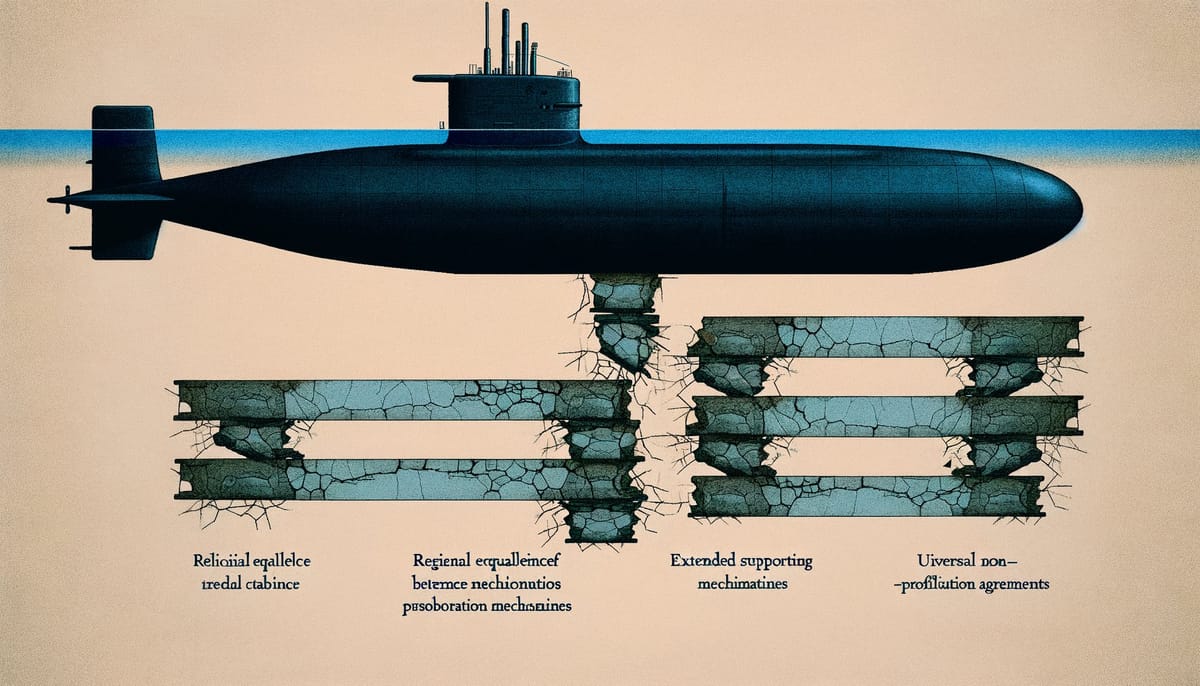
The reality is messier. These three systems are not dominoes waiting to fall in order—they are load-bearing walls in a structure already showing cracks. A North Korean nuclear-powered ballistic missile submarine does not topple them sequentially. It reveals that they were never as separate as we pretended.
What Floats and What Doesn’t
Begin with what we know. Naval News reported that the hull’s completion suggests a reactor may already be installed, though Pyongyang has disclosed no operational timeline. The best current candidate for deployment, according to 38 North, is the Pukguksong-6—paraded in April 2022 but never flight-tested.
This matters. North Korea has shown a submarine. It has not demonstrated a survivable second-strike capability. The gap between the two is measured in years, possibly decades. Nuclear submarine operations require not just a reactor and a hull, but trained crews who can operate both without killing themselves. The US Navy requires two years of training on operational nuclear platforms before qualifying reactor operators. North Korea cannot train operators without an operational reactor. It cannot safely operate a reactor without trained operators.
The chicken-egg problem compounds. Submarine reactors demand metallurgical precision that North Korea’s industrial base cannot guarantee. Indigenous steel production depends on Chinese coking coal, which means Pyongyang cannot control alloy composition from the feedstock level. Acoustic signatures—the submarine’s survival currency—depend on hull metallurgy, propulsion engineering, and machining tolerances that take decades to master. The Soviet Union’s early nuclear submarines were catastrophically loud. North Korea starts further behind.
Yet capability assessment misses the point. Deterrence operates through perception, not physics. The submarine exists. Kim stood beside it. That image now circulates through South Korean newspapers and Japanese defense ministry briefings. The hull is real even if the reactor is suspect and the missiles untested.
The Credibility Paradox
Extended deterrence rests on a simple proposition: America will risk Los Angeles to save Seoul. This was always a psychological claim dressed in strategic clothing. The nuclear umbrella works because allies believe it works and adversaries believe allies believe it works. Recursive confidence, all the way down.
A North Korean SSBN—even a questionable one—attacks this recursion at its weakest point. Land-mobile missiles can be hunted. Fixed sites can be targeted. But a submarine at sea, even a noisy one, introduces uncertainty that compounds through every layer of the deterrence calculation.
Consider the view from the Blue House. South Korean planners have long maintained a “decapitation strategy” targeting Kim Jong Un personally. This approach assumes that eliminating leadership prevents nuclear use. But submarines invert the logic. If Kim delegates launch authority to an SSBN commander—precisely because decapitation threats make centralized control dangerous—then the very strategy designed to prevent nuclear use makes nuclear use more likely.
The US-ROK Nuclear Consultative Group, established in January 2025, was meant to strengthen extended deterrence by improving consultation on nuclear planning. But consultation mechanisms designed for deliberate escalation scenarios perform poorly when submarines introduce “use it or lose it” dynamics. The NCG’s procedural ambiguity on SSBN detection red lines can be read two ways: either wise flexibility preserving presidential discretion, or dangerous vagueness that adversaries will exploit.
Japanese strategists face a different calculus. The three non-nuclear principles—not possessing, not producing, not permitting introduction of nuclear weapons—have structured Japanese security policy for decades. The 1991-92 US withdrawal of sea-based tactical nuclear weapons made the third principle moot; no American ships carried weapons that might need port access. But a DPRK SSBN changes the threat environment in ways that may force Japan to reconsider. The prohibition on bringing nuclear weapons into Japan pushes deterrence infrastructure to remain mobile and oceanic, creating structural dependency on sea-based platforms that paradoxically increases Japan’s need for autonomous capability.
Research published in the Pacific Review documents what it calls “convergent evolution” in South Korean and Japanese nuclear thinking—both moving toward threshold capabilities through different domestic political pathways. South Korean support for indigenous nuclear weapons reached 34.8% by 2024. This is not majority support, but it represents a constituency that did not exist a decade ago.
The NPT’s Structural Flaw
The Non-Proliferation Treaty was never designed to handle a state that withdrew, developed nuclear weapons, and then acquired delivery systems that other treaty members explicitly exempted from safeguards.
This is not a hypothetical contradiction. It is the current situation.
Article XIV of the IAEA safeguards framework permits states to withdraw nuclear material from inspection for “non-proscribed military activity”—specifically, naval nuclear propulsion. This exemption exists because the United States, Britain, France, Russia, and China all operate nuclear-powered submarines and refused to submit reactor fuel to international verification. The loophole was tolerable when only nuclear-weapon states exploited it.
Then came AUKUS. Australia—a non-nuclear-weapon state—will receive nuclear-powered submarines with highly enriched uranium fuel. The legal architecture permitting this transfer is structurally identical to the mechanism North Korea could invoke for its own naval propulsion program. Paragraph 14 creates no textual distinction between “responsible” and “irresponsible” states. It distinguishes only between declared and undeclared programs.
North Korea withdrew from the NPT in 2003. It is not bound by the treaty’s obligations. But its submarine program exposes the treaty’s internal contradictions in ways that affect states still inside the regime. If Australia can receive safeguards-exempt HEU for submarines, why can’t South Korea? The US 123 Agreement explicitly prohibits Seoul from using American-sourced nuclear materials for naval propulsion. Washington simultaneously creates an unprecedented NPT exemption for AUKUS partners while denying the same pathway to its East Asian ally.
The 2026 NPT Review Conference approaches against this backdrop. The third preparatory session failed to agree on consensus recommendations, described as painting “a gloomy prognosis” for the conference itself. The treaty’s traditional success metric—unanimous adoption of final documents—has become an incantatory ritual rather than a governance mechanism. States declare consensus. Nothing changes. The declaration itself is the product.
China’s Uncomfortable Position
Beijing faces a dilemma it cannot acknowledge. North Korea’s nuclear program threatens Chinese interests—a nuclear accident near the Yalu River would contaminate Chinese territory, and Chinese netizens have expressed radiation fears after every DPRK nuclear test. Yet China consistently shields Pyongyang at the UN Security Council, vetoing sanctions enforcement and providing the economic lifeline that sustains Kim’s regime.
The SSBN intensifies this contradiction. A survivable North Korean second-strike capability reduces Chinese leverage over Pyongyang while increasing the risk of regional nuclearization that would directly threaten Chinese security. South Korea and Japan with nuclear weapons would be catastrophic for Beijing’s strategic position. But Chinese behavior makes that outcome more likely.
Russia and China have conducted joint naval exercises off the North Korean coast. The symbolic alignment is unmistakable. More substantively, reporting suggests Russian and Chinese assistance in North Korea’s submarine program—technology transfers that Beijing officially denies but that satellite imagery and defector testimony make difficult to dismiss.
The tributary system logic that historically governed Chinese relations with Korea creates a structural vulnerability. The hegemon’s superior position justified hierarchical management. But when the subordinate acquires capabilities that can force the hegemon into confrontation with the United States, the hierarchy inverts. Kim can drag Xi into conflicts Beijing does not want. The SSBN is an entrapment device as much as a deterrent.
The Sea of Japan as Contested Space
Geography constrains North Korean submarine operations in ways that land-mobile missiles avoid. The Sea of Japan is not the Atlantic. It is a semi-enclosed body of water ringed by hostile powers with sophisticated anti-submarine warfare capabilities.
The density of multinational ASW cooperation in these waters—Australia, India, Japan, South Korea, the United States, plus Russian and Chinese exercises—transforms the DPRK submarine from a strategic asset into a structural trap. The regime has committed to a capability that requires it to operate in the most surveilled waters on Earth.
Soviet submarines during the Cold War required “bastion defense”—surface ships, aircraft, and attack submarines protecting ballistic missile submarines in designated patrol areas. North Korea lacks the naval forces for bastion operations. Its submarine will either hide in coastal waters (limiting range and survivability) or venture into open ocean (where it becomes vulnerable to detection).
Commercial fishing operations add an unintended detection layer. The 1998 Sokcho incident demonstrated that driftnets function as passive tracking mechanisms—a North Korean submarine became entangled in South Korean fishing nets, exposing its presence through physical contact rather than sophisticated sensors. The Sea of Japan’s fishing density creates distributed detection that Pyongyang cannot suppress without revealing its submarines’ patrol areas.
Advanced ocean transparency technology compounds the problem. P-8 Poseidon maritime patrol aircraft, seabed sensor networks, and AI-enhanced acoustic classification are making the oceans increasingly transparent. This creates a paradox: successful detection capability forces peacetime military postures to become more escalatory. As tracking improves, operational doctrine shifts from “find-fix-finish” in wartime to continuous peacetime tracking with pre-delegated strike options. Hair-trigger ASW rules of engagement increase crisis instability even as they improve detection.
What Actually Breaks
The question assumes sequential failure. Reality suggests simultaneous stress across interconnected systems, with the weakest link determined by contingent factors rather than structural necessity.
Regional stability is already degraded. Arms racing is underway. South Korea’s military spending has increased steadily; Japan has committed to doubling defense budgets; Australia is acquiring nuclear-powered submarines. The DPRK SSBN accelerates existing trends rather than initiating new ones.
Extended deterrence credibility was always contested. American allies have doubted US resolve since the 1960s. The SSBN adds another variable to calculations that were already uncertain. But credibility is not binary—it can erode without collapsing.
The NPT regime shows the most visible cracks because it depends on formal consensus that the SSBN renders impossible. You cannot maintain a nonproliferation treaty when a withdrawn state operates nuclear submarines while treaty members argue about whether allies can receive the same technology. The contradiction is not resolvable through diplomatic language.
Yet “breaking” overstates the likely outcome. The NPT will not be formally abandoned. States will continue participating in review conferences that produce no agreements. The regime will hollow out rather than shatter—maintaining institutional form while losing substantive function.
This is the most dangerous scenario. A collapsed treaty would force renegotiation. A zombie treaty prevents adaptation while providing false reassurance. States will hedge against NPT failure while officially supporting NPT success, creating a two-track system where declared policy diverges from actual behavior.
The Path Not Taken
Three intervention points exist, each with costs that explain why they remain unexploited.
First, the United States could offer North Korea a security guarantee in exchange for verifiable limits on delivery systems. This would require accepting DPRK nuclear status—anathema to nonproliferation orthodoxy—while providing something Pyongyang has demanded for decades. The cost: legitimizing nuclear breakout as a successful strategy, encouraging other states to follow the same path.
Second, China could impose genuine economic pressure on North Korea, conditioning trade access on submarine program constraints. Beijing has leverage it refuses to use. The cost: risking regime collapse that would flood China with refugees and potentially place US forces on the Yalu River.
Third, South Korea and Japan could pursue coordinated nuclear hedging—developing threshold capabilities within alliance frameworks rather than through independent programs. This would require US acquiescence to allied nuclearization it has spent decades preventing. The cost: accelerating the very proliferation cascade that extended deterrence was designed to prevent.
None of these options will be chosen. The first requires American concessions that no administration can politically survive. The second requires Chinese strategic sacrifice for uncertain gain. The third requires abandoning the foundational logic of postwar US alliance policy.
The default trajectory is therefore continued drift: North Korea incrementally improving submarine capabilities, regional states incrementally hedging against extended deterrence failure, the NPT incrementally losing relevance. No dramatic collapse. No decisive moment. Just the slow accumulation of facts on the water.
Frequently Asked Questions
Q: Can North Korea actually operate a nuclear-powered submarine? A: The hull exists and a reactor may be installed, but operational capability requires trained crews, reliable propulsion, and survivable patrol patterns—none of which Pyongyang has demonstrated. Technical mastery typically takes decades; North Korea is attempting to compress that timeline with uncertain results.
Q: Does this mean South Korea or Japan will develop nuclear weapons? A: Not immediately, but threshold capabilities are increasingly attractive. South Korean public support for indigenous nuclear weapons has grown significantly, and both countries possess the technical capacity for rapid development. The trajectory points toward hedging rather than immediate breakout.
Q: Why can’t the UN Security Council stop North Korea’s submarine program? A: China and Russia consistently block meaningful sanctions enforcement, providing economic lifelines and potentially technical assistance to Pyongyang. The Security Council’s veto structure means that great power competition paralyzes multilateral responses.
Q: What happens if North Korea’s submarine has an accident? A: A reactor incident in the Sea of Japan would contaminate waters shared by multiple countries, potentially including Chinese territory. Environmental catastrophe could force regional cooperation that political dynamics currently prevent—or trigger nationalist responses that make cooperation impossible.
The Quiet Accumulation
Kim Jong Un’s submarine sits at Sinpo. Its reactor status is unknown. Its missiles are untested. Its crew’s competence is unverifiable. By every technical measure, it represents aspiration more than achievement.
None of that matters for the strategic calculations now underway in allied capitals. The submarine exists as an object of perception, and perception drives policy. South Korean defense planners must assume the worst case. Japanese strategists must hedge against American unreliability. Chinese officials must manage a client state they cannot control. American policymakers must balance alliance reassurance against proliferation precedent.
The question was what breaks first. The answer is that everything bends together, each stress reinforcing the others until the system finds a new equilibrium—one where nuclear submarines patrol contested waters, where allies maintain independent hedging capabilities, where the NPT governs states that no longer believe in it.
This is not collapse. It is adaptation to a world where a pariah state can acquire what was once reserved for great powers. The rules did not break. They simply stopped applying to the players who matter most.
Sources & Further Reading
The analysis in this article draws on research and reporting from:
- Naval News - Primary reporting on North Korea’s December 2024 submarine unveiling and technical specifications
- 38 North - Technical analysis of DPRK submarine capabilities and missile deployment options
- The Pacific Review - Academic research on convergent nuclear evolution in South Korea and Japan
- InDepthNews - Analysis of IAEA safeguards and naval nuclear propulsion exemptions
- US State Department - Official documentation on US-ROK Nuclear Consultative Group establishment
- Reaching Critical Will - NPT Review Conference preparatory committee outcomes and analysis
- Voice of America - Chinese public opinion on North Korean nuclear activities
- Newsweek - Reporting on Russia-China naval exercises near North Korea