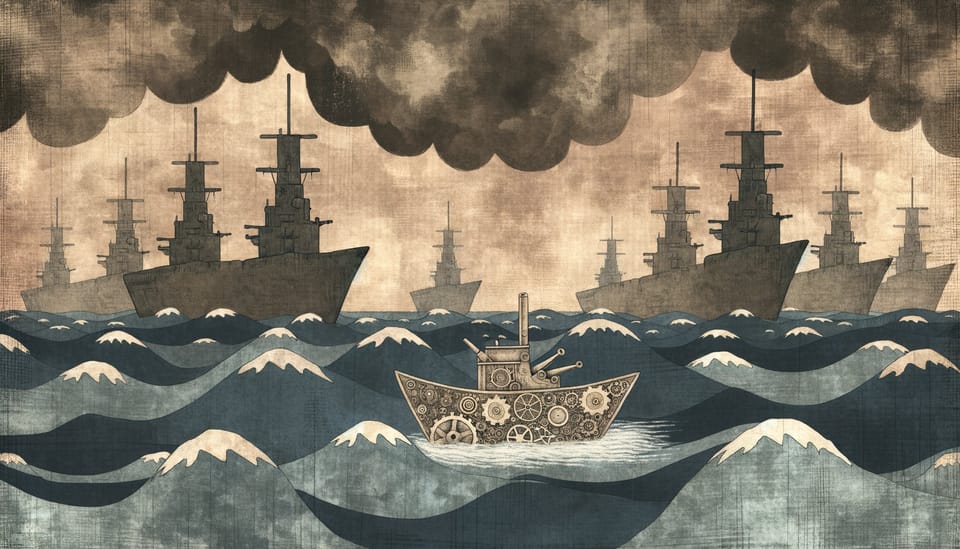
The Shadow War Everyone Fights, Nobody Declares
Nuclear weapons made great power war unthinkable but not great power competition impossible. Grey zone warfare—cyber attacks, economic coercion, information operations—has become the default grammar of rivalry between states that cannot afford to fight directly.

The Shadow War Everyone Fights, Nobody Declares
In March 2024, a Chinese coast guard vessel rammed a Philippine supply boat in the South China Sea. No shots were fired. No war was declared. Manila filed a diplomatic protest; Beijing denied wrongdoing. The incident lasted minutes. Its strategic effects compound daily.
This is grey zone warfare—and it has become the grammar of great power competition. Not because states prefer ambiguity over clarity, but because the alternative has become unthinkable. Nuclear weapons did not abolish conflict between major powers. They displaced it into a twilight realm where violence is constant, deniable, and calibrated to remain just beneath the threshold that would trigger catastrophic escalation.
The pattern repeats across domains. Russian “little green men” seize Crimea without insignia. Chinese fishing militias swarm disputed reefs. American cyber operations disable Iranian centrifuges. Each action is significant enough to shift strategic balances, yet ambiguous enough to deny adversaries a clear casus belli. This is not a bug in the international system. It is the system—reconfigured by the physics of nuclear deterrence and the mathematics of escalation risk.
The Stability-Instability Paradox Made Flesh
The conventional explanation for grey zone warfare emphasizes opportunity: states exploit legal ambiguities and attribution difficulties because they can. This account is true but insufficient. It mistakes the enabling conditions for the driving force.
The deeper logic is structural. Nuclear weapons created what strategists call the stability-instability paradox: mutual assured destruction stabilizes relations at the strategic level while destabilizing them at lower levels. When major powers cannot fight directly without risking annihilation, they must fight indirectly. Grey zone operations are not a choice. They are a thermodynamic necessity—the only outlet for competitive pressure in a system where the conventional release valve has been welded shut.
Consider the physics. The Taylor limit establishes a yield-to-weight ratio of roughly six kilotons per kilogram for nuclear weapons—an engineering constraint that also marks a phase boundary in strategic competition. Beyond this threshold lies territory so catastrophic that rational actors avoid it absolutely. Below it lies everything else: cyber attacks, economic coercion, information operations, proxy conflicts, maritime harassment. The space between peace and nuclear war has become the only space where great powers can maneuver.
This creates a peculiar ecology. Like organisms adapting to a climax ecosystem where the dominant species have already occupied every major niche, states develop grey zone capabilities precisely because conventional military superiority no longer translates into usable power against nuclear-armed adversaries. Russia cannot defeat NATO in a conventional war and survive. China cannot seize Taiwan without risking American nuclear involvement. America cannot prevent either from pursuing their objectives through force alone. All three have therefore become grey zone specialists—not by preference, but by elimination of alternatives.
The mathematics are brutal. Each great power maintains thousands of nuclear warheads capable of ending civilization. Each also maintains elaborate grey zone apparatuses: Russia’s Internet Research Agency and GRU hackers, China’s maritime militia and United Front Work Department, America’s Cyber Command and economic sanctions architecture. The ratio of investment tells the story. Nuclear arsenals deter. Grey zone capabilities actually get used.
The Attribution Trap
International law evolved for a world of clear boundaries and identifiable actors. Grey zone warfare exploits the gap between this legal architecture and contemporary reality.
The problem is not merely technical. Attribution—determining who did what—has become a strategic weapon in itself. When Russia deployed soldiers without insignia to Crimea in 2014, the Kremlin did not expect to fool Western intelligence services. It expected to create sufficient ambiguity to paralyze collective response. NATO’s Article 5 requires identifying an “armed attack.” Unmarked soldiers conducting what Moscow called a “local self-defense operation” fell into a definitional void.
The same dynamic plays out in cyberspace, but with additional complexity. Cyber operations leave digital forensic traces that skilled investigators can follow—eventually. The lag between action and attribution creates a temporal trap. The more sophisticated the forensic capability, the longer it takes to produce legally defensible conclusions. But strategic response windows are short. By the time attribution is certain, the moment for effective response has often passed.
Adversaries understand this. They design operations to exploit the evidentiary demands of international law. When the United States publicly attributes a cyber attack to China or Russia, it must reveal intelligence sources and methods. This creates a prosecutor’s dilemma: prove the case and compromise capabilities, or protect capabilities and accept impunity. Sophisticated actors demand proof they know cannot be provided without cost.
The result resembles what Talmudic scholars call “compound ambiguities”—situations where each definitional term itself requires interpretation, creating infinite regress. What constitutes a cyber “attack” under international humanitarian law? The International Committee of the Red Cross suggests operations that disable computers or delete data might qualify. But each word—disable, delete, data—opens new interpretive questions. Grey zone actors operate in this hermeneutical space, performing actions that exist in the gap between what law prohibits and what it clearly permits.
This is not mere exploitation of loopholes. It is a systematic assault on the possibility of legal clarity itself. When states deliberately fragment their actions across domains—combining cyber intrusions with economic pressure with information operations with proxy violence—they create attribution problems that exceed any single legal framework’s capacity to address. International law has fragmented into specialized regimes (humanitarian law, law of the sea, cyber norms) that cannot speak to each other. Grey zone strategists exploit precisely this incoherence.
The Temporal Asymmetry
Great powers do not experience time identically. This mismatch has become a decisive variable in grey zone competition.
American strategic culture operates on electoral cycles. Every four years, administrations change. Policies reverse. Attention shifts. The median congressional planning horizon extends perhaps two years—until the next election. Corporate quarterly reporting compounds the effect. American strategy optimizes for visible results within timeframes that voters and shareholders can evaluate.
Chinese strategic culture operates on generational cycles. The “hundred-year marathon” toward 2049—the centennial of the People’s Republic—represents not metaphor but operational planning framework. Xi Jinping’s government can pursue objectives that yield returns decades hence, absorbing short-term costs that would be politically fatal in Washington. The seven-generation principle embedded in some Indigenous governance traditions finds its echo in Beijing’s willingness to plant trees whose shade future leaders will enjoy.
Russian strategic culture operates on imperial memory cycles. Moscow’s grievances stretch back centuries; its patience for revenge is correspondingly long. The 2014 seizure of Crimea reversed a transfer that occurred in 1954. Russian strategists think in terms of historical vindication, not quarterly results.
This temporal incommensurability creates structural advantages for patient actors. Grey zone campaigns are designed for cumulative effect—each individual action insignificant, their aggregate transformative. China’s island-building in the South China Sea proceeded reef by reef, none triggering military response, all collectively shifting the regional balance. Russia’s information operations erode Western institutional trust incrementally, each intervention deniable, their cumulative impact corrosive.
Democracies struggle to respond because their political systems cannot sustain attention across the timescales grey zone campaigns require. By the time the pattern becomes undeniable, the strategic landscape has already shifted. The American public, asked to care about Chinese fishing boats harassing Philippine vessels, reasonably wonders why this matters. The answer—that each incident establishes precedent, normalizes coercion, and incrementally redraws the boundaries of acceptable behavior—requires temporal horizons that democratic politics rarely permits.
The Cold War demonstrated that America can sustain strategic patience when sufficiently motivated. Containment persisted across administrations for four decades. But this capacity appears to have atrophied. The institutional muscles required for multi-generational competition have weakened from disuse. Grey zone adversaries exploit this degradation, designing campaigns calibrated to outlast American attention spans.
The Domestic Attack Surface
Grey zone warfare’s most insidious innovation is its exploitation of target societies’ internal features. Open information ecosystems, political polarization, economic interdependence, infrastructure vulnerabilities—these are not incidental weaknesses but designed attack surfaces.
Democratic societies face a structural dilemma. The openness that makes them resilient and innovative also makes them penetrable. Russia’s Internet Research Agency did not create American political polarization; it amplified existing divisions. Chinese influence operations in Australia did not invent corruption; they exploited existing channels. The attack surface is native to the target.
This creates asymmetric vulnerability. Authoritarian states can restrict information flows, control economic actors, and suppress internal dissent. Democratic states cannot—or rather, cannot without becoming something other than democracies. The very features that make open societies worth defending make them difficult to defend.
Consider the information domain. Russian disinformation campaigns succeed not because they are sophisticated—often they are crude—but because they exploit the structure of social media algorithms optimized for engagement. Outrage spreads faster than accuracy. Tribal identity trumps factual correction. The attack vector is the business model of American technology companies.
Economic interdependence creates similar vulnerabilities. China’s informal trade restrictions against Australia—blocking coal, wine, barley imports after Canberra called for COVID-19 origin investigations—demonstrated how economic integration becomes a coercion mechanism. The same supply chains that deliver efficiency in peacetime deliver leverage in competition. Decoupling is expensive. Remaining coupled is dangerous. There is no cost-free option.
Infrastructure dependencies compound the problem. Critical systems—power grids, financial networks, water treatment, telecommunications—were designed for efficiency, not resilience against state-level adversaries. The Colonial Pipeline ransomware attack of 2021, conducted by a Russian criminal group operating with Kremlin tolerance, demonstrated how a single intrusion could disrupt fuel supplies across the American East Coast. Grey zone actors need not attack military targets. Civilian infrastructure offers softer targets with comparable strategic effects.
The Girardian Dimension
A deeper pattern underlies these tactical observations. Grey zone warfare functions as a system for containing violence through ritualized substitution—channeling competitive aggression into forms that avoid catastrophic escalation.
The anthropologist René Girard argued that human societies manage endemic violence through sacrificial mechanisms. Communities redirect aggression onto designated victims, preventing the all-against-all conflict that would otherwise destroy social order. The scapegoat absorbs violence that might otherwise spread without limit.
Grey zone operations perform an analogous function in the international system. They redirect great power competition into controlled channels—cyber intrusions rather than bombing campaigns, economic coercion rather than blockades, information operations rather than invasions. Each grey zone action is a substitute for the conventional military operation that nuclear deterrence prohibits.
This is not metaphor but mechanism. Nuclear weapons created a sacred boundary—a threshold whose crossing would end civilization. Grey zone warfare exists because that boundary must be respected but competitive pressure must find release. The elaborate rituals of attribution denial, proportional response, and escalation management are the liturgy of a system designed to permit conflict while preventing apocalypse.
The parallel illuminates why grey zone warfare feels simultaneously dangerous and restrained. It is dangerous because it represents genuine competition between states with incompatible interests. It is restrained because all participants understand the alternative. The nuclear sublime—the psychological unbearability of contemplating civilizational extinction—drives actors toward grey zone substitutes not through conscious calculation but through something closer to instinct. The banality of grey zone operations (bureaucratic cyber intrusions, tedious information campaigns, incremental territorial nibbling) is itself a defense mechanism against the terror of what lies beyond.
The Cost-Benefit Calculus
Grey zone warfare persists because it works—or at least, because it appears to work better than alternatives.
The direct costs are modest. Cyber operations require skilled personnel and computing infrastructure, not aircraft carriers. Information campaigns cost millions, not billions. Economic coercion leverages existing trade relationships. Maritime militia vessels are fishing boats with strategic assignments. Compared to conventional military power projection, grey zone capabilities offer remarkable return on investment.
The indirect costs are harder to calculate but equally favorable. Grey zone operations rarely trigger alliance commitments. NATO’s Article 5 has never been invoked for a cyber attack. Sanctions responses to economic coercion are slow and often ineffective. Diplomatic protests accomplish little. The international system has not developed effective countermeasures because it has not developed consensus on what grey zone actions actually are.
Risk profiles favor grey zone approaches. Conventional military operations against nuclear-armed adversaries carry escalation risks that rational actors avoid. Grey zone operations carry escalation risks too, but they are distributed across many small actions rather than concentrated in single decisive moments. The probability that any individual grey zone operation triggers catastrophic escalation is low. The cumulative probability across thousands of operations is higher but remains acceptable compared to conventional alternatives.
The strategic returns can be substantial. Russia’s grey zone campaign in Ukraine (2014-2022) achieved territorial gains, destabilized a neighboring state, and tested Western resolve—all without triggering NATO military intervention. China’s South China Sea operations have established effective control over disputed waters, created military infrastructure on artificial islands, and normalized Chinese presence in areas previously contested. These are not trivial accomplishments.
Yet the calculus is not uniformly positive. Russia’s 2022 escalation from grey zone to conventional warfare in Ukraine demonstrated the limits of below-threshold operations. When grey zone pressure failed to achieve regime change in Kyiv, Moscow resorted to invasion—and discovered that conventional operations against determined resistance, backed by Western support, produce grinding attrition rather than quick victory. The grey zone worked until it didn’t.
The Institutional Lag
International institutions were designed for a different world. Their adaptation to grey zone realities has been slow, incomplete, and often counterproductive.
The United Nations Security Council cannot address grey zone competition because the principal grey zone actors hold vetoes. NATO has developed hybrid warfare concepts but struggles to translate them into operational responses. The World Trade Organization lacks mechanisms to address economic coercion disguised as legitimate trade policy. International law provides frameworks that grey zone operations are specifically designed to circumvent.
This institutional inadequacy is not accidental. Grey zone strategies deliberately exploit the gap between institutional design assumptions and contemporary reality. When China deploys coast guard vessels rather than naval warships to disputed waters, it exploits the legal distinction between military and law enforcement actions. When Russia uses private military contractors rather than uniformed soldiers, it exploits the state responsibility framework’s focus on official organs. When either uses cyber operations, they exploit the absence of agreed norms governing state behavior in cyberspace.
Institutional reform faces collective action problems. States benefiting from grey zone ambiguity have no incentive to clarify rules. States suffering from grey zone operations cannot achieve consensus on responses. The result is institutional paralysis punctuated by ad hoc reactions that rarely establish useful precedent.
Some adaptation has occurred. NATO’s 2022 Strategic Concept explicitly addresses hybrid threats. The European Union has developed economic coercion response mechanisms. The United States has expanded cyber authorities and sanctions capabilities. But these adaptations remain reactive—responding to grey zone innovations after they occur rather than anticipating them.
The deeper problem is conceptual. International institutions assume clear distinctions between war and peace, military and civilian, state and non-state. Grey zone warfare dissolves these categories. Effective institutional response would require reconceptualizing the foundations of international order—a project no state has the incentive or capacity to lead.
What Comes Next
Grey zone warfare will intensify. The structural conditions driving it—nuclear deterrence, temporal asymmetries, domestic vulnerabilities, institutional inadequacy—show no signs of changing. If anything, they are strengthening.
Technological trends favor grey zone approaches. Artificial intelligence will enhance information operations, making synthetic media more convincing and targeting more precise. Cyber capabilities will grow more sophisticated and more accessible. Space-based systems will provide new domains for below-threshold competition. Each technological advance creates new grey zone possibilities.
The most likely trajectory is normalization. Grey zone operations will become accepted features of great power relations—not welcomed, but tolerated as the cost of avoiding worse alternatives. States will develop more sophisticated defensive capabilities and more elaborate offensive repertoires. The competition will continue, managed but unresolved.
The dangerous trajectory is escalation. Grey zone operations can spiral. Miscalculation is possible. An action intended as below-threshold might be perceived as crossing red lines. Cumulative grey zone pressure might eventually trigger conventional responses, as occurred in Ukraine. The system’s safety mechanisms are not guaranteed to hold.
The optimistic trajectory—negotiated limits on grey zone competition—appears unlikely. It would require great powers to agree on definitions they have strong incentives to keep ambiguous, accept constraints on capabilities they find useful, and trust verification mechanisms in domains where verification is technically difficult. None of these conditions currently obtain.
What would change the trajectory? Three intervention points exist, each with costs.
First, democracies could develop strategic patience. This would require institutional reforms that insulate long-term strategy from electoral cycles—difficult in systems designed for accountability. The cost is democratic responsiveness.
Second, international institutions could develop grey zone-specific frameworks. This would require great power consensus that does not exist. The cost is accepting that some grey zone activities will be legitimized in exchange for constraining others.
Third, target societies could harden their attack surfaces. This would require reducing openness, accepting economic inefficiency, and limiting freedoms that grey zone operations exploit. The cost is becoming more like the adversaries being defended against.
None of these options is attractive. All involve trade-offs that democratic publics may reject. The most probable outcome is therefore continued adaptation without transformation—grey zone competition as permanent condition rather than transitional phase.
FAQ: Key Questions Answered
Q: What distinguishes grey zone warfare from traditional espionage or covert operations? A: Scale, integration, and strategic purpose. Traditional espionage gathers information; grey zone warfare seeks to shift strategic balances through coordinated campaigns across multiple domains—cyber, economic, informational, and paramilitary—each action deniable but collectively transformative.
Q: Can grey zone warfare actually achieve strategic objectives, or is it just harassment? A: It can achieve significant objectives when patient and cumulative. China’s South China Sea operations established effective control over disputed waters. Russia’s information campaigns have measurably increased polarization in target societies. The limitation is that grey zone approaches struggle to achieve rapid, decisive results—hence Russia’s eventual escalation to conventional war in Ukraine.
Q: Why don’t targeted states simply respond with overwhelming conventional force? A: Nuclear deterrence. Responding to grey zone operations with conventional military force against nuclear-armed adversaries risks escalation to catastrophic levels. Grey zone strategies are specifically designed to stay below thresholds that would justify such responses, exploiting the gap between provocation and the level of harm that warrants major war.
Q: Is there any prospect for international rules governing grey zone competition? A: Limited. Effective rules would require agreement on definitions that states prefer to keep ambiguous, constraints on useful capabilities, and verification in technically difficult domains. Some progress has occurred in specific areas—cyber norms discussions, for instance—but comprehensive frameworks remain unlikely while grey zone ambiguity benefits major powers.
The Grammar of Constraint
Grey zone warfare is not an aberration in the international system. It is the system revealing its constraints. Nuclear weapons made great power war unthinkable. They did not make great power competition impossible. The space between peace and apocalypse had to be filled with something. Grey zone operations are that something.
This is neither cause for despair nor complacency. The system is dangerous—miscalculation remains possible, escalation is not impossible, and cumulative grey zone pressure can produce strategic shifts as consequential as any war. But the system also reflects a kind of learning. Great powers have found ways to compete without destroying each other. The methods are ugly, the outcomes often unjust, the process corrosive to international order. Yet the alternative—the conventional great power wars that characterized earlier eras—was worse.
The question is not whether grey zone warfare will continue. It will. The question is whether the implicit rules constraining it will hold, whether the boundaries separating grey zone from conventional conflict will remain respected, whether the sacrificial logic channeling violence into manageable forms will continue to function. On these questions, the evidence permits no confident prediction. The system has held so far. So far is not forever.