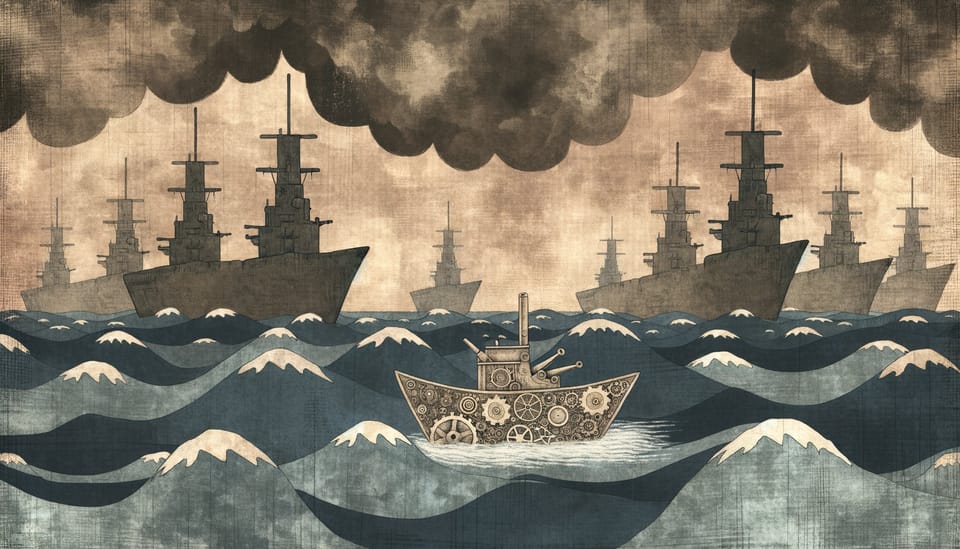
The Sahel's Hollow Alliance: Why Russian Backing Cannot Save Africa's Juntas
Mali, Burkina Faso, and Niger expelled Western forces and embraced Moscow's Africa Corps. Eighteen months later, jihadist violence has surged 190% since 2021. The juntas may survive. Their states may not.

The Desert’s New Patrons
When Mali’s military junta expelled French forces in August 2022, Colonel Assimi Goïta declared it a “second independence.” Burkina Faso and Niger followed with their own coups and ejections. By September 2023, the three nations had formalized their defiance through the Alliance of Sahel States, a mutual defense pact that treats an attack on one as aggression against all. The message to Paris, Brussels, and Washington was unambiguous: the era of Western tutelage was over.
Moscow was delighted to fill the void. Russian military instructors arrived with surface-to-air missiles. Wagner mercenaries—rebranded as the Africa Corps after Yevgeny Prigozhin’s convenient death—fanned out across the region. The Kremlin pledged to arm a 5,000-strong joint force. For the juntas, this looked like liberation from conditional aid and human rights lectures. For Russia, it represented a low-cost opportunity to expand influence while the West was distracted by Ukraine.
But liberation has a price. Eighteen months into this experiment, the jihadists are winning.
The Arithmetic of Attrition
The numbers tell a brutal story. According to the Security Council Report, fatalities across the three AES countries reached 7,620 in the first half of 2024 alone—up 9% from 2023, 37% from 2022, and a staggering 190% from 2021. This acceleration occurred precisely as Russian support intensified and Western presence evaporated. Correlation is not causation, but the trajectory is damning.
The insurgents—primarily al-Qaeda’s Sahelian affiliate JNIM and the Islamic State Sahel Province—have not merely survived the transition from Western to Russian counterinsurgency. They have thrived. JNIM now operates what amounts to a parallel state across vast swathes of Mali and Burkina Faso, collecting taxes from artisanal gold miners who perceive Salafist governance as “more liberal, more inclusive, and economically advantageous” than state-led formalization. The insurgents gain legitimacy not by offering better services but by offering less regulatory interference.
This creates a perverse dynamic. The juntas need revenue to fight. Gold provides it. But gold mining in contested areas means either accommodating insurgent taxation or attempting to formalize operations that miners prefer to keep informal. The state loses either way.
Russia’s military contribution, meanwhile, has proven tactically impressive but strategically hollow. CNN reported that 100 Russian instructors arrived in Niger in April 2024 with “latest generation anti-aircraft defense systems.” Useful against a conventional air force. Less useful against motorcycle-mounted insurgents who melt into villages after ambushes.
The Africa Corps brings brutality that French forces—constrained by human rights concerns and domestic opinion—would not deploy. Villages suspected of insurgent sympathies have been razed. Civilian casualties have mounted. Yet brutality without intelligence is merely violence. And here lies the fundamental asymmetry: insurgents swim in a sea of local knowledge accumulated over decades. Russian mercenaries, rotating through six-month deployments, drown in it.
The Dependency Trap
Western counterinsurgency in the Sahel was expensive, conditional, and ultimately unsuccessful. But it came with infrastructure that the juntas now desperately miss.
Consider logistics. Operation Barkhane maintained aerial resupply networks, medical evacuation capabilities, and intelligence-sharing arrangements that allowed Sahelian armies to operate beyond their organic capacity. When France withdrew, these systems collapsed. Russia has neither the airlift capacity nor the inclination to replace them. The Africa Corps operates on a commercial model—payment for services rendered—not a state-building one.
The equipment problem runs deeper still. Soviet-era design philosophy, as demonstrated in Afghanistan, produces machines engineered for European theaters that suffer cascading maintenance collapse in desert conditions. Sand infiltrates engines. Heat degrades electronics. Distance from supply depots transforms minor repairs into major operations. The USSR lost over 300 helicopters in Afghanistan, primarily to maintenance failures and terrain rather than enemy action. The Sahel’s conditions are worse.
This creates what might be called the prosthetic trap. The juntas cannot remove the exoskeleton of external military support without collapse. Yet they cannot afford to maintain it. Security spending in fragile states already consumes a disproportionate share of GDP—Liberia spends 4.9%, compared to 1.4% for the fragile-state average—while public debt trajectories spiral upward. The AES states are simultaneously too dependent on external support to function and too poor to pay for it.
Russia’s solution is extraction. Wagner’s successor entities have secured mining concessions across the region, trading security services for resource access. This arrangement works for Moscow: low cash outlay, strategic presence, and mineral wealth. It works less well for the juntas, who have exchanged one form of dependency for another. The French demanded democratic transitions and human rights compliance. The Russians demand gold.
The Alliance That Isn’t
The Charter of Liptako-Gourma, signed in September 2023, reads impressively on paper. Article 6 invokes collective self-defense. Article 4 commits members to combat terrorism. Article 9 requires unanimous decisions. In July 2024, the alliance upgraded to a Confederation of Sahel States with a planned 5,000-strong joint force.
Impressive on paper. Less so in practice.
The 5,000-troop ceiling functions as a deliberate constraint. Each junta contributes roughly 1,667 troops—enough to be strategically exposed but insufficient to achieve operational independence. This is not a NATO-style alliance where members pool overwhelming force. It is a mutual hostage arrangement where defection carries existential risk.
Byzantine fault tolerance theory illuminates the problem. In a three-node system with unanimity requirements, you achieve maximum resistance to external manipulation—no outside actor can compromise decisions—but minimum availability. Any single node failure means total system halt. If one junta falls, the alliance collapses. If one junta defects to a better offer, the others are exposed.
The juntas know this. Their response has been performative solidarity rather than operational integration. Joint patrols make excellent propaganda. Shared intelligence remains scarce. Each leader watches the others for signs of separate accommodation with external powers—or with the insurgents themselves.
This fragility matters because the jihadists understand it perfectly. JNIM and IS Sahel compete viciously with each other but coordinate implicitly against the states. They probe borders, exploit jurisdictional gaps, and retreat across lines that mean nothing to them and everything to their adversaries. The AES exists to project unity. The insurgency exists to exploit its absence.
The Humanitarian Multiplier
Displacement has reached catastrophic proportions. Burkina Faso alone hosts over two million internally displaced persons. Across the three countries, the ICRC warns that a food crisis fueled by conflict will worsen during the lean season. Agricultural land abandonment in conflict zones has reached 30-50% in some areas, breaking the traditional rhythm of feast and famine that communities had learned to navigate.
This creates a recruitment multiplier for the insurgents. Young men without land, without prospects, and without protection become available for mobilization. JNIM offers wages, purpose, and—crucially—a governance structure that actually functions. The state offers conscription into an army that cannot protect its own bases.
The forced sedentarization of Fulani pastoralists compounds the crisis. Climate variability and insecurity have disrupted transhumance routes that communities navigated for centuries. Herders pushed into fixed locations become visible targets for both state forces—who associate Fulani ethnicity with insurgency—and insurgents seeking recruits or resources. The mobility that once provided resilience becomes impossible. The legibility that states require becomes a death sentence.
Counterinsurgency doctrine holds that population control is essential to victory. The juntas have achieved population displacement instead. Every village abandoned is territory ceded. Every family in a camp is a family not farming, not producing, not paying taxes. The humanitarian crisis is not a side effect of the conflict. It is the conflict’s strategic logic made manifest.
The Information Terrain
Russia’s most effective contribution may be neither weapons nor mercenaries but narrative. Anti-French sentiment in the Sahel runs deep—rooted in colonial memory, nurtured by decades of perceived condescension, and inflamed by social media campaigns that Moscow has enthusiastically amplified.
The juntas have expelled Western journalists and restricted local media, creating an information environment where Russian state outlets face little competition. Disinformation campaigns portraying Western powers as neocolonial exploiters while celebrating Russian partnership as genuine solidarity have proven remarkably effective.
But narrative cannot substitute for results indefinitely. The juntas promised security and sovereignty. They have delivered neither. Sovereignty means little when insurgents control rural areas. Security means less when casualty rates climb annually.
The information advantage is also asymmetric in ways that favor insurgents. JNIM operates through networks that predate the nation-state—Sufi orders, kinship ties, market relationships—while the juntas rely on broadcast media that reaches urban populations already under state control. WhatsApp messages mutate as they spread, adapting to local contexts in ways that centralized propaganda cannot match. The griot tradition of adaptive storytelling has found a digital successor.
What Survival Requires
Can the alliance survive? The question admits no simple answer, because survival means different things to different actors.
For the juntas themselves, survival means remaining in power. This they may achieve. Military governments in Africa have proven durable when external pressure is absent and internal rivals are suppressed. The AES leaders face no credible domestic opposition, no meaningful international sanctions with teeth, and no obvious alternative to their current arrangement.
For the states as functioning entities, survival is more doubtful. Territorial control continues to erode. Revenue bases shrink as formal economies contract and informal ones escape taxation. The capacity to deliver services—already minimal—deteriorates further. What remains is a flag, a seat at the United Nations, and a capital city under nominal control.
For the populations, survival is the daily question. It has no strategic dimension, only immediate urgency.
Russian backing will prove insufficient against the insurgencies because Russia is not trying to defeat them. Moscow seeks presence, influence, and resources. A low-level conflict that justifies continued engagement serves these interests better than victory. The Africa Corps is not failing at counterinsurgency; it is succeeding at extraction.
The Paths Not Taken
Three alternative trajectories remain theoretically possible, though none appears likely.
First, the juntas could seek rapprochement with ECOWAS and, through it, with Western partners. This would require accepting conditions—transition timelines, human rights monitoring, civilian oversight—that the current leaders have explicitly rejected. It would also require ECOWAS to offer terms that save face for regimes that have staked legitimacy on anti-Western defiance. Neither side shows appetite for such accommodation.
Second, regional powers could fill the gap. Algeria has historical ties and geographic proximity. Morocco seeks expanded influence. Neither has demonstrated willingness to commit the resources that effective counterinsurgency would require. Turkey has sold drones to various African governments, but Turkish defense exports follow commercial rather than strategic logic—weapons without the training, maintenance, and intelligence infrastructure that make them effective.
Third, the insurgents could overreach, unifying the population against them through atrocities that exceed even the juntas’ brutality. This has happened elsewhere. But JNIM in particular has learned from al-Qaeda’s mistakes in Iraq. Its governance is harsh but predictable. Its violence is targeted rather than indiscriminate. It offers an alternative order, not merely destruction.
The most likely trajectory is therefore continuation: gradual state erosion, expanding insurgent control, periodic Russian-assisted offensives that recapture territory without holding it, and mounting humanitarian catastrophe. The juntas will survive as governments. The states will hollow out beneath them.
FAQ: Key Questions Answered
Q: Why did the Sahel juntas expel French forces if they needed military support? A: Anti-French sentiment runs deep in former colonies, and the juntas rode popular anger to legitimacy. France’s decade-long Operation Barkhane had failed to defeat the insurgency while imposing conditions the military leaders resented. Expelling the French was politically necessary even if strategically costly.
Q: How is Russia’s Africa Corps different from the Wagner Group? A: The Africa Corps operates under direct Russian Ministry of Defense control rather than as a nominally private company. This provides Moscow with better command authority but also clearer state responsibility. Operationally, the personnel and methods remain similar—many Africa Corps members served previously with Wagner.
Q: Could China replace Russia as the juntas’ primary external partner? A: China has significant economic interests in African mining but has avoided security commitments that might entangle it in counterinsurgency operations. Beijing prefers stable environments for resource extraction. The Sahel’s instability makes it an unattractive venue for Chinese military involvement, though economic engagement continues.
Q: What would it take for the insurgencies to be defeated? A: Historical counterinsurgency success requires either overwhelming force sustained over decades or political accommodation that addresses underlying grievances. Neither appears available. The juntas lack resources for the former; their legitimacy depends on rejecting the latter. The most realistic near-term outcome is managed stalemate rather than victory.
The Long Retreat
In Bamako, Ouagadougou, and Niamey, the generals speak of sovereignty reclaimed and dignity restored. The rhetoric resonates because it contains a truth: Western partnership was never partnership between equals. France treated the Sahel as a security problem to be managed, not a region to be developed. The conditionality attached to aid felt like colonialism with better marketing.
But sovereignty without capacity is merely isolation. The juntas have traded one dependency for another, exchanging demanding partners for extractive ones. Russia wants what it has always wanted from Africa: resources and influence at minimal cost. The insurgents want what they have always wanted: territory and legitimacy. The populations want what they have always wanted: security and livelihood.
Of these four parties, only the insurgents are getting what they seek. The alliance of Sahel states will survive because survival is cheap when expectations are low. Whether the states themselves survive—as functioning entities capable of protecting their citizens and controlling their territory—is another question entirely.
The desert has seen many patrons come and go. The French replaced the Ottomans who replaced the Songhai. Now the Russians replace the French. The sand remains. So do the grievances that feed the insurgency. So does the poverty that makes young men available for recruitment. So does the weakness that makes states prey rather than predator.
Moscow’s backing will prove insufficient not because Russia lacks capability but because Russia lacks interest in the outcome the juntas need. A stable Sahel serves no Russian purpose. An unstable one, dependent on Russian protection, serves many. The juntas have made their choice. Their populations will live—and die—with the consequences.
Sources & Further Reading
The analysis in this article draws on research and reporting from:
- Security Council Report on West Africa and the Sahel - Provided fatality statistics and conflict trajectory data for AES countries
- CNN Investigation on Russian Military Presence in Niger - Documented arrival of Russian instructors and air defense systems
- ACLED Conflict Watchlist 2024: The Sahel - Comprehensive analysis of insurgent operations and conflict dynamics
- Africa Center for Strategic Studies - Assessment of counterinsurgency effectiveness and regional security architecture
- Oxford Academic: Counter-insurgency Governance in the Sahel - Historical analysis of counterinsurgency approaches and their limitations
- Middle East Institute: Rural Distress and Militancy - Examination of insurgent governance and economic factors driving recruitment
- ICRC: Sahel Food Crisis - Humanitarian assessment of displacement and food security
- Frontiers: Herder Sedentarization in Northern Sahel - Analysis of pastoralist displacement and its security implications