The Rehearsal That Never Ends
China's surprise military drills around Taiwan aren't preparing for a blockade—they are the blockade, executed in installments. As exercises blur into operations, the invasion may have already begun at a tempo too slow for democracies to recognize.
The Rehearsal That Never Ends
On December 29, 2025, the People’s Liberation Army announced “Justice Mission 2025” less than one hour before Chinese warships, aircraft, and coast guard vessels began encircling Taiwan. The exercise simulated port blockades, precision strikes, and “seizing comprehensive superiority.” It lasted two days. Then the ships dispersed. Then they returned. Then they left again.
This is the new normal. Not crisis, not peace—something in between that Western strategic vocabulary struggles to name. China conducted named military exercises around Taiwan four times in 2024 alone. The PLA crossed Taiwan’s median line on 313 separate days that year, dispatching over 3,000 aircraft into Taiwan’s Air Defense Identification Zone. Each incursion triggers scrambled jets, depleted maintenance budgets, and exhausted pilots. Each withdrawal invites relief. The cycle repeats.
The question haunting defense planners from Washington to Tokyo is whether this rhythm serves a purpose beyond harassment. Is Beijing normalizing blockade tactics specifically to make actual invasion preparations indistinguishable from routine exercises? The evidence suggests something more sophisticated: China is conducting the invasion in slow motion, achieving strategic objectives through simulation while preserving the option for kinetic action if simulation proves insufficient.
The Grammar of Encirclement
The PLA’s exercise architecture has evolved with disturbing precision since August 2022, when Nancy Pelosi’s Taiwan visit triggered the first large-scale encirclement drills. That exercise established six live-fire zones around Taiwan, some overlapping Taiwan’s claimed territorial waters. The message was clear: we can close these waters whenever we choose.
Subsequent exercises refined the grammar. Joint Sword-2024A, conducted three days after President Lai Ching-te’s inauguration in May 2024, tested “blockading key ports” while demonstrating improved coordination between naval, air, and rocket forces. Joint Sword-2024B in October added coast guard integration. Justice Mission 2025 introduced the surprise element—minimal warning, rapid deployment, immediate dispersal.
Each iteration adds vocabulary. The coast guard now conducts “rescue drills” at Taiwan Strait chokepoints, establishing humanitarian pretexts for routine presence. Sand dredgers operate in contested waters, creating facts on the seabed. According to Reuters, these civilian vessels have become weapons of gray-zone warfare, their mundane operations slowly reshaping the maritime environment.
The pattern reveals doctrinal intent. China’s National Defense University defines joint blockade campaigns as operations “implemented by Navy-, Air Force-, Second Artillery- and Army campaign large formations” to achieve maritime control. CSIS analysis confirms that recent exercises have rehearsed precisely these components. The PLA isn’t practicing for a hypothetical blockade. It is practicing the blockade itself, in installments.
This creates what might be called the performative blockade paradox. When military exercises achieve strategic effects—disrupted shipping, elevated insurance premiums, exhausted defenders—they cease to be mere exercises. The simulation becomes the operation. The rehearsal is the performance.
The Indications Problem
Intelligence analysts face an epistemological trap. Traditional warning indicators assume that military mobilization precedes conflict: troops mass, supplies stockpile, communications surge. The analyst’s task is detecting these signatures early enough for policymakers to respond.
China’s exercise strategy inverts this model. By conducting blockade rehearsals continuously, Beijing creates a baseline of military activity against which genuine invasion preparations become invisible. The 2025 Pentagon China Military Power Report noted that “the PLA tested essential components” of Taiwan invasion options through exercises—meaning the components that would signal impending attack are now routine features of peacetime operations.
Consider the logistics signature. Military planners know that large-scale amphibious operations require massive fuel stockpiling, ammunition prepositioning, and medical supply caching. These activities should be detectable. But China’s annual Lunar New Year shipping surge creates a recurring “noise window” where abnormal civilian ferry movements, roll-on/roll-off vessel positioning, and fuel stockpiling become statistically indistinguishable from commercial logistics. The PLA doesn’t need to hide mobilization. It needs only to time it with seasonal patterns already present in the data.
The problem compounds through habituation. Taiwan’s defense ministry has tracked median line crossings since the 1990s. Before 2020, such crossings were rare enough to trigger immediate alerts. By 2025, they occur almost daily. The threshold for alarm has shifted. What once signaled imminent crisis now signals Tuesday.
Cognitive science illuminates the mechanism. Flexible threshold theory demonstrates that change perception depends on context-dependent baselines, not absolute differences. An 80% annual growth rate in bilateral exercises doesn’t trigger alarm if each individual exercise resembles its predecessor. The PLA exploits this by maintaining exercise intensity while varying timing, location, and announced purpose. Each drill seems routine. The aggregate pattern is anything but.
The institutional dimension makes this worse. Intelligence organizations develop warning frameworks based on historical precedent. The 1995-96 Taiwan Strait Crisis, when Chinese missile tests accompanied Taiwan’s first free presidential election, calibrated a generation of analysts to treat large-scale exercises as extraordinary events requiring urgent response. As that generation retires, institutional memory recalibrates. The new baseline includes what the old baseline would have flagged as crisis.
Markets as Coercion Infrastructure
The strategic genius of exercise normalization lies in its economic architecture. China doesn’t need to enforce a blockade. It needs only to create conditions where markets enforce the blockade for it.
Lloyd’s List reported that PLA drills forced over 200 vessels to reroute during a single exercise period. Insurance premiums for Taiwan Strait transit spike during announced military activities. The Joint War Committee’s Listed Areas designation—a private regulatory mechanism maintained by Lloyd’s Market Association—can trigger force majeure clauses without any state declaration of blockade or war.
The mechanism is elegant. PLA drills create posted live-fire timing windows. Vessels self-exclude from zones during announced periods, bunching at the edges and waiting for clearance. This achieves de facto maritime control without formal interdiction. No shots fired. No international law violated. Just commercial actors making rational decisions based on risk.
Insurance pricing amplifies the effect. Actuaries price Taiwan Strait risk by aggregating data across the entire industry, not individual incidents. This means drill-induced premium increases reflect collective pattern recognition rather than isolated events. Each exercise raises the baseline. Each premium increase makes Taiwan trade marginally less competitive. The strangulation is gradual, deniable, and largely self-executing.
Taiwan’s semiconductor industry—which controls approximately 90% of advanced chip production—faces particular vulnerability. TSMC has acknowledged that currency volatility from geopolitical risk is “something we cannot control.” The world’s most systemically important chipmaker is a price-taker in the very risk markets that Chinese exercises manipulate. Each drill creates hedging costs. Each cost erodes margins. The economic warfare proceeds without economic sanctions.
The Daoist concept of wu wei—achieving outcomes through non-action—captures the strategy precisely. China removes its own kinetic action while market actors perform the actual strangulation. Insurers raise premiums. Shippers reroute. Airlines cancel flights. The blockade materializes through commercial decisions Beijing never formally commanded.
The Legal Gray Zone
International law provides no clear framework for exercise-as-blockade operations. UNCLOS guarantees freedom of navigation through international straits, but China has never formally acknowledged the Taiwan Strait as an international waterway. Beijing’s position—that Taiwan is Chinese territory and the strait therefore internal waters—creates deliberate legal ambiguity.
The 2021 Coast Guard Law empowers Chinese vessels to “detain foreign ships” without defining the waters where such authority applies. Air University analysis notes this allows China to invoke domestic enforcement authority while preemptively delegitimizing UNCLOS-based challenges. The law doesn’t claim specific territorial waters. It claims the right to enforce without specifying where.
This matters because traditional blockade law requires formal declaration. A blockade must be announced, effective, and impartially enforced to be legally recognized—and legally challenged. China’s exercise-based maritime control meets none of these criteria formally while achieving all of them practically. There is no blockade to protest because there is no declared blockade. There is only a pattern of military activities that happen to produce blockade effects.
The terminology game extends further. Beijing describes coast guard operations as “law enforcement” rather than military action. Exercises are “defensive responses” to “provocations.” The semantic choices matter because they determine which legal frameworks apply. Military blockade triggers laws of armed conflict. Law enforcement triggers domestic jurisdiction. By controlling the vocabulary, China controls the legal terrain.
Allied responses face a classification trap. Treating PLA exercises as routine drills accepts Beijing’s framing and delays response. Reclassifying them as war preparation triggers escalation dynamics and potentially legitimizes Chinese claims that external powers are the aggressors. The legal ambiguity isn’t a bug. It’s the operating system.
The Exhaustion Strategy
Taiwan’s defense establishment operates under conditions of chronic stress. The island’s air force scrambles jets for every significant ADIZ incursion. Maintenance cycles compress. Pilot fatigue accumulates. The Taiwan 2025 National Defense Report explicitly addresses “gray zone harassment” as a strategic threat distinct from invasion scenarios.
The biological metaphor is precise. Allostatic load—the cumulative physiological cost of chronic stress—depletes adaptive capacity over time. Systems designed for acute crisis response degrade under perpetual activation. Taiwan’s air defense network faces exactly this dynamic: repeated sub-threshold activation without recovery periods depletes the reserves needed for actual emergencies.
The civilian dimension compounds the military one. Taiwan’s population has absorbed decades of invasion warnings. Each drill that doesn’t become an invasion reinforces the perception that drills never become invasions. Normalcy bias—the cognitive mechanism that causes people to underestimate disaster probability—functions here as a rational adaptation to lived experience. The population isn’t failing to perceive threat. It’s correctly observing that past threats didn’t materialize.
This creates a dangerous equilibrium. Military readiness erodes through overuse. Civilian vigilance erodes through habituation. The institutional capacity to distinguish genuine warning from background noise degrades precisely as the background noise intensifies. When the actual invasion begins, it will look like every other exercise until it doesn’t.
What Breaks First
The current trajectory has a terminus. China’s stated goal of Taiwan “reunification” by 2049—with growing evidence of accelerated timelines toward 2027—means the exercise-as-blockade strategy serves either as preparation for kinetic action or as a substitute for it. Both possibilities have failure modes.
If exercises are preparation, the indications-and-warning problem becomes acute. The Pentagon’s 2025 assessment that China expects “to be able to fight and win a war on Taiwan by the end of 2027” suggests a closing window. US and Japanese semiconductor fabrication facilities under construction will reduce Taiwan’s strategic leverage by 2030. Before then, the silicon shield protects Taiwan. After, it becomes a liability—a target worth destroying rather than capturing.
If exercises are substitute, the economic strangulation strategy requires patience Beijing may not possess. Taiwan’s economy has proven more resilient than expected. Allied support has not fractured. The drills impose costs on China too: fuel consumption, equipment wear, opportunity costs for training. A strategy of indefinite harassment without resolution creates its own internal pressures.
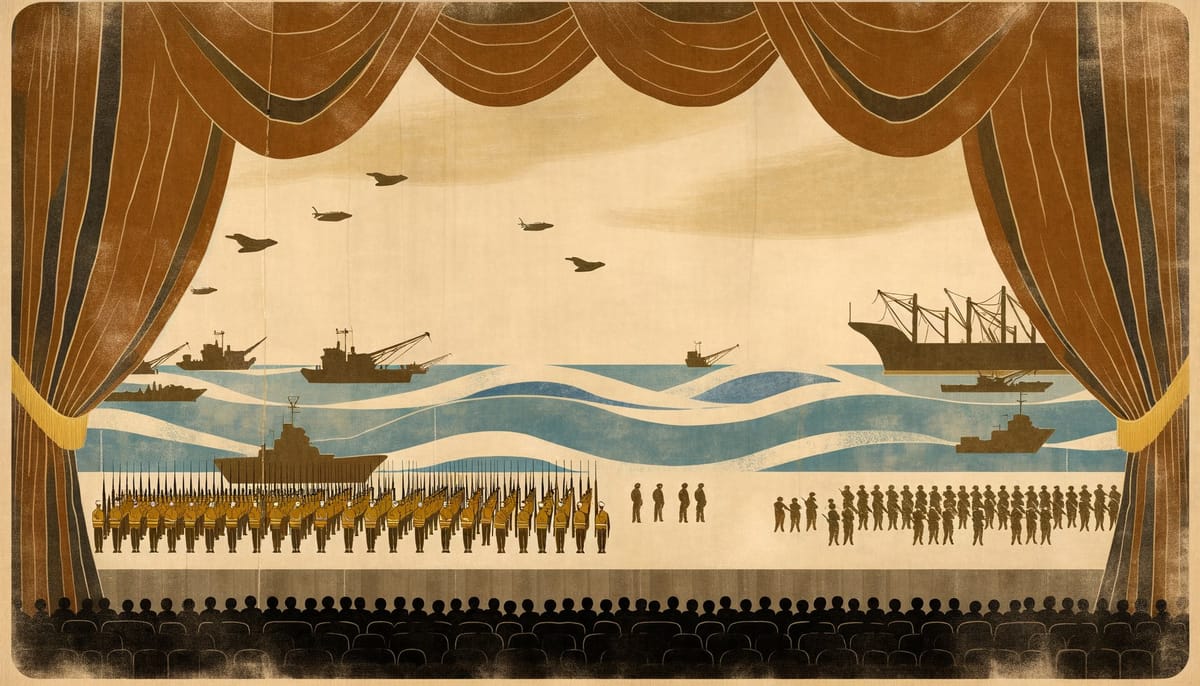
The most dangerous scenario combines both: exercises that normalize blockade tactics until the moment they become an actual blockade, with no clear transition point. The rehearsal continues until the curtain rises and the audience realizes the play has already begun.
The Intervention Points
Three leverage points exist, each with significant costs.
First, allied forces could conduct freedom of navigation operations during PLA exercises, physically demonstrating that announced live-fire zones do not constitute legal exclusion areas. This challenges the normalization narrative but risks escalation. A collision or miscalculation during overlapping operations could trigger the very conflict the strategy aims to prevent. Japan’s recent shift toward explicit Taiwan contingency planning suggests appetite for this approach, but implementation remains tentative.
Second, insurance and shipping industries could develop protocols that distinguish exercise-induced disruption from genuine blockade conditions. This would require coordination among competitors and potentially government involvement in what are currently private risk assessments. The Joint War Committee’s Listed Areas designation could be modified to account for exercise patterns rather than treating all military activity as equivalent risk. The cost: reduced insurance industry autonomy and potential Chinese retaliation against participating firms.
Third, Taiwan could adopt asymmetric resilience strategies that reduce the effectiveness of blockade tactics regardless of whether they’re exercises or operations. Stockpiling critical supplies, developing distributed infrastructure, and hardening civilian systems against disruption would raise the threshold for coercion success. Taiwan’s 2025 National Defense Report moves in this direction, but implementation lags rhetoric. The cost: significant public expenditure during peacetime for scenarios that may never materialize.
None of these options eliminates the fundamental problem: China has discovered that the boundary between exercise and operation is more permeable than international law assumes. Exploiting that permeability may be the strategy itself.
Questions Worth Asking
Q: Could China actually blockade Taiwan without the US intervening? The 2024 CSIS wargaming analysis suggests a Chinese blockade would likely trigger US military response, but the threshold remains ambiguous. A “quarantine” framed as law enforcement rather than military blockade might not meet the legal definition requiring intervention. The exercise-based approach specifically probes this ambiguity.
Q: How would Taiwan’s semiconductor industry survive a blockade? It probably wouldn’t, at least not at current production levels. TSMC facilities require continuous power, chemical supplies, and specialized equipment maintenance. Even a partial blockade disrupting supply chains would degrade output within weeks. This vulnerability is precisely why the silicon shield works as deterrence—and why China might prefer strangulation to invasion.
Q: What would indicate that exercises have become an actual blockade? Traditional indicators—formal declaration, sustained interdiction, impartial enforcement—may never appear. More useful signals: duration extending beyond announced windows, interdiction of vessels rather than mere rerouting, and Chinese statements reframing “exercises” as “countermeasures.” The transition may be gradual rather than binary.
Q: Is China’s 2027 timeline real? The Pentagon treats it as a planning assumption rather than confirmed intelligence. What’s clear is that PLA modernization programs target capabilities consistent with Taiwan operations by that date. Whether political leadership has committed to action by 2027 remains unknown—possibly even to Chinese decision-makers themselves.
The Performance Continues
The distinction between rehearsal and performance assumes a clear opening night. China’s Taiwan strategy dissolves that assumption. The exercises are the operation. The simulation achieves strategic effects. The blockade exists in the aggregate even as each individual drill remains legally ambiguous.
This is not preparation for war in the traditional sense. It is war conducted at a tempo too slow for democratic attention spans, too ambiguous for legal frameworks, and too normalized for warning systems calibrated to crisis. The invasion, if it comes, will not begin. It will simply accelerate.
Taiwan’s defenders understand this. Their 2025 National Defense Report speaks of “resisting cognitive coercion”—the battle for perception that precedes any battle for territory. The question is whether that resistance can outlast a strategy designed specifically to exhaust it.
The ships will return tomorrow. And the day after. And the day after that. The rehearsal has no scheduled end. Perhaps because it was never a rehearsal at all.
Sources & Further Reading
The analysis in this article draws on research and reporting from:
- CSIS: How China Could Blockade Taiwan - Comprehensive analysis of Chinese blockade doctrine and scenarios
- Pentagon 2025 China Military Power Report - Official US assessment of PLA capabilities and intentions
- Global Taiwan Institute: Justice Mission 2025 Analysis - Detailed breakdown of December 2025 exercises
- Lloyd’s List: China Drills Force Vessel Rerouting - Shipping industry impact documentation
- Reuters: China’s Sand Dredger Weapon - Investigation of gray-zone maritime tactics
- Air University: China Coast Guard Law Translation - Primary source on legal framework
- Irregular Warfare Center: Taiwan’s 2025 National Defense Report - Analysis of Taiwan’s strategic response
- Asia Times: Japan’s Taiwan Stance - Allied response evolution