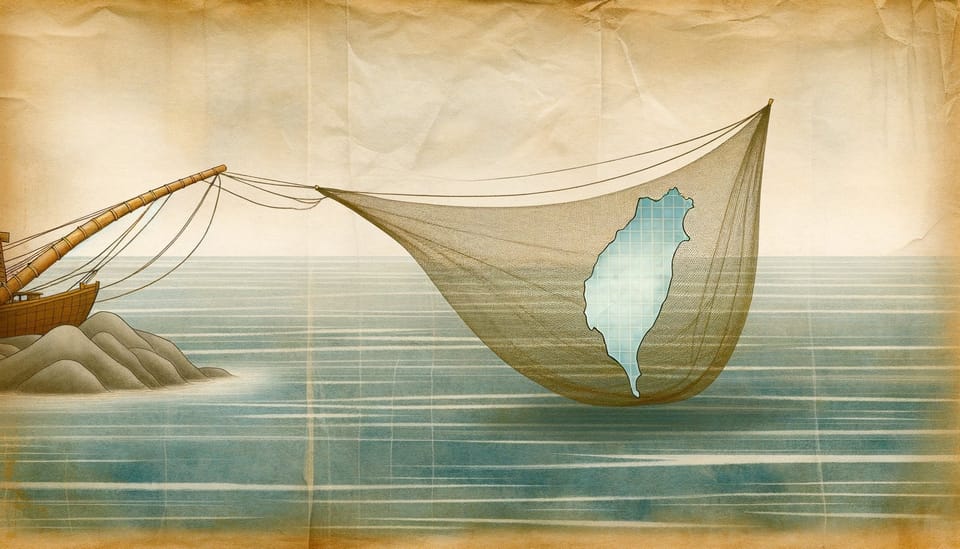
The Reef That Decides Everything
The rusting hull of the Sierra Madre sits on Second Thomas Shoal, a Philippine Navy vessel deliberately grounded in 1999 to stake a territorial claim. A handful of marines live aboard, resupplied by small boats that must run a gauntlet of Chinese Coast Guard water cannons.
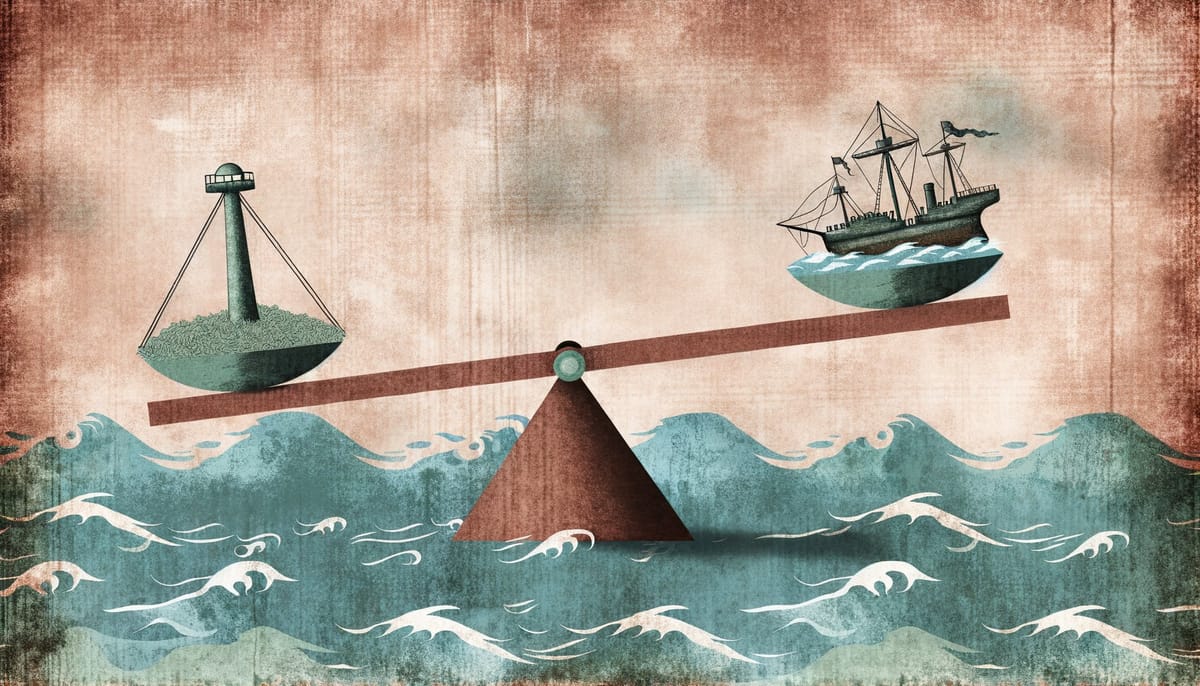
The South China Sea disputes are not about fish, oil, or shipping lanes. They are about whether China can establish regional hegemony through incremental coercion without triggering the war that would destroy it. Every water cannon blast, every blocked resupply mission, every artificial island bristling with radar arrays is a calibrated test of that proposition. The geopolitical factors that will decide these disputes are not the ones most analysts discuss. They are stranger, more structural, and far more dangerous than conventional wisdom suggests.
The Trap Nobody Sees
The standard narrative runs like this: China wants the South China Sea, America wants to stop it, and the outcome depends on military balance and alliance cohesion. This framing is not wrong. It is incomplete in ways that guarantee strategic failure.
Start with what China has actually built. Between 2013 and 2016, it constructed seven artificial islands in the Spratly archipelago, dredging 3,200 acres of reef into military installations. These host airstrips capable of handling fighter jets, surface-to-air missile batteries, and—crucially—the most sophisticated electronic warfare infrastructure in Asia. The South China Sea has become what one Pentagon assessment calls an “electromagnetic kill zone”: any vessel or aircraft operating within range faces GPS denial, communications jamming, and radar spoofing that can make ships disappear from screens or appear where they are not.
This is not primarily about denying access to the US Navy. It is about creating an epistemic crisis. Modern military operations depend on sensors talking to other sensors, on commanders trusting that what they see is real. China’s electronic warfare architecture attacks that trust at its foundation. A carrier strike group entering the South China Sea does not merely face missiles. It faces the possibility that its own instruments are lying to it.
The conventional response—more ships, more exercises, more reassurance to allies—misunderstands the problem. The United States cannot out-build an adversary operating in its own backyard with interior lines of communication and a command economy capable of 200-300% production surges. Between 2012 and 2020, China’s Coast Guard expanded from 156 vessels to 524. The US Coast Guard has 11 major cutters for the entire Pacific. Mathematics is not on Washington’s side.
But China faces its own structural trap, one less visible but equally binding. The Belt and Road Initiative has sunk hundreds of billions of dollars into infrastructure across Central Asia—ports, railways, pipelines threading through Kazakhstan, Pakistan, Myanmar. These investments create dependencies that flow both ways. A serious military conflict in the South China Sea would sever the maritime routes that carry 80% of China’s oil imports. The overland alternatives through Central Asia become essential. But those alternatives depend on stable relationships with countries that explicitly seek to reduce their own dependence on Beijing. China’s grand strategy requires both maritime dominance and continental connectivity. War destroys the latter to achieve the former.
This creates a peculiar equilibrium. China cannot afford the war that would consolidate its claims. America cannot afford the permanent military presence that would deny them. Both sides are locked into a competition neither can win and neither can exit.
The Performance That Became Reality
The nine-dash line—that swooping cartographic claim encompassing nearly the entire South China Sea—began as a bureaucratic afterthought. A mid-level official drew it in 1947 for a Nationalist Chinese government that would soon flee to Taiwan. It appeared on maps, then in textbooks, then in weather forecasts. By the time anyone asked what legal basis it had, the question was almost irrelevant. Repetition had done the work of legitimacy.
This is the insight that unlocks the entire dispute: territorial claims in the South China Sea are not descriptions of legal rights. They are performances that create the reality they describe. China does not assert the nine-dash line because it believes in historical precedent. It asserts the nine-dash line because assertion, repeated often enough through enough channels, manufactures the precedent it claims to inherit.
The 2016 arbitration ruling should have ended this. An international tribunal constituted under the UN Convention on the Law of the Sea ruled that China’s claims had no legal basis, that its artificial islands generated no maritime entitlements, that its actions had violated Philippine sovereign rights. China’s response was to ignore the ruling entirely—and to accelerate construction. This was not defiance for its own sake. It was a demonstration that legal frameworks operate only where power permits them to operate.
The tribunal’s ruling did accomplish one thing: it clarified that the dispute cannot be resolved through law. UNCLOS provides mechanisms for delimiting maritime boundaries. It provides no mechanism for enforcing those delimitations against a permanent member of the UN Security Council that has decided to reject them. The Philippines won a legal victory and lost the reef.
ASEAN’s attempts to negotiate a binding Code of Conduct have foundered on the same rock. Twenty years of talks have produced nothing enforceable. China prefers it this way. A vague, non-binding declaration allows maximum flexibility. Each bilateral negotiation can be tailored to the specific vulnerabilities of the counterparty. Vietnam gets different treatment than the Philippines, which gets different treatment than Malaysia. Divide and accommodate.
The structural logic is relentless. ASEAN operates by consensus. China needs only one member—Cambodia, Laos, perhaps Myanmar—to block any statement it dislikes. The organization designed to give small states collective voice against great powers has become the mechanism through which a great power prevents collective action.
The Militia That Isn’t
In the gray space between peace and war, China has deployed an instrument perfectly calibrated to exploit legal ambiguity: the maritime militia. These are fishing vessels, nominally civilian, crewed by fishermen who receive military training, government fuel subsidies, and communications equipment linking them to naval command structures. They swarm disputed features, block foreign vessels, and create facts on the water—all while maintaining the fiction of spontaneous civilian activity.
The genius of this system lies in its deniability. When Philippine boats are rammed or water-cannoned, China can claim these are disputes between fishermen. When militia vessels occupy a contested shoal, Beijing can insist it has no control over where civilians choose to fish. The legal frameworks governing military confrontation do not apply to fishing boats. The frameworks governing fishing boats do not account for fishing boats that report to the People’s Liberation Army.
But the militia system contains its own pathologies. Fuel subsidies have created a perverse economy in which fishing itself is no longer viable without state support. Depleted fish stocks—devastated by decades of overfishing and reef destruction—mean that legitimate fishing cannot sustain the fleet. The subsidies that enable militia operations have destroyed the economic base that once made fishing communities independent. Fishermen have become state-dependent operatives not through coercion but through the elimination of alternatives.
This creates a feedback loop with no obvious exit. The more the fisheries collapse, the more fishermen depend on militia work. The more militia activity occurs, the more reefs are damaged. The more reefs are damaged, the faster fisheries collapse. Environmental destruction and strategic competition have merged into a single self-reinforcing system.
The scale of ecological violence is staggering. Giant clam harvesting—militia vessels using propellers to dig mollusks from reef structures—has destroyed over 40 square miles of coral. This exceeds the damage from artificial island construction itself. The harvesting occurs below the visibility threshold of satellite monitoring, distributed across hundreds of vessels rather than concentrated at construction sites. It is geological violence operating at timescales that make political reversal meaningless. Coral reefs form over millennia. They can be destroyed in months.
The Alliance That Reassures No One
Every few months, a US carrier strike group transits the South China Sea. Destroyers conduct freedom-of-navigation operations within 12 nautical miles of Chinese-occupied features. Statements are issued. Allies are reassured. Nothing changes.
The carrier has become a ritual object. Its presence performs American commitment without demonstrating American capability to alter outcomes. Philippine officials track carrier locations obsessively—not because the carrier provides security, but because its absence would confirm abandonment. The therapeutic function has displaced the strategic one.
This creates a peculiar dynamic. The carrier deployment reassures allies by its presence while simultaneously intensifying the anxiety it is meant to cure. If American commitment were truly reliable, allies would not need constant reassurance. The very frequency of reassurance signals the doubt it is meant to dispel. Each transit that fails to change Chinese behavior confirms that transits do not change Chinese behavior. The ritual continues because stopping it would be worse than continuing it, not because it works.
Japan and Australia face their own versions of this trap. Both have invested heavily in the alliance architecture. Both recognize that American staying power is uncertain—hostage to electoral cycles, domestic polarization, and the attention span of a superpower with global commitments. Neither has the independent capability to balance China alone. The alliance is indispensable and insufficient. It cannot be abandoned and cannot be relied upon.
The Philippines occupies the sharpest edge of this dilemma. Under Rodrigo Duterte, Manila tilted toward Beijing, accepting infrastructure investment and soft-pedaling maritime disputes. Under Ferdinand Marcos Jr., it has swung back toward Washington, allowing expanded US military access and publicizing Chinese harassment. Neither approach has altered the fundamental dynamic. China continues to occupy contested features. The United States continues to issue statements. The Sierra Madre continues to rust.
The Escalation Nobody Wants
The most dangerous feature of the South China Sea competition is not that someone might start a war. It is that a war might start itself.
The system contains multiple actors with divergent incentives operating under conditions of radical uncertainty. The People’s Liberation Army Navy seeks to demonstrate combat readiness. The Coast Guard seeks to demonstrate law enforcement effectiveness. Provincial governments seek economic development. Fishing companies seek profits. Maritime militia seek subsidies. Each optimizes for its own objectives. None has complete visibility into what the others are doing.
Xi Jinping’s centralization of power has, paradoxically, increased the risk of uncontrolled escalation. By removing civilian officials from military command chains, the reforms eliminated the bureaucratic friction that once slowed operational decisions. The same flattening that improves wartime responsiveness removes the intermediate review layers that might catch a tactical commander’s misjudgment before it becomes a strategic crisis.
On the American side, the problem is different but equally dangerous. Carrier strike groups operate under rules of engagement designed for great-power war, not gray-zone harassment. A Chinese coast guard vessel that water-cannons a Philippine boat is an annoyance. The same vessel approaching a US destroyer at high speed triggers threat-assessment protocols calibrated for missile attack. The gap between Chinese gray-zone tactics and American kinetic responses creates space for catastrophic miscalculation.
The scenario that keeps strategists awake is not a deliberate Chinese assault on Taiwan or a premeditated American strike on the artificial islands. It is a collision at sea, a dead sailor, a commander who must decide in seconds whether the approaching vessel is hostile, a response that cannot be recalled. The system is optimized for incidents. Eventually, an incident will exceed the system’s capacity to absorb it.
What Decides This
The geopolitical factors that will determine outcomes in the South China Sea are not primarily military. They are temporal, economic, and psychological.
The temporal factor is the most underappreciated. China operates on generational timescales. The Communist Party’s legitimacy narrative spans centuries—the Century of Humiliation, the rejuvenation of the Chinese nation, the recovery of lost territories. American strategy resets every four years, sometimes every two. Philippine administrations oscillate between accommodation and resistance. This temporal asymmetry advantages the patient actor. China does not need to win quickly. It needs to not lose while its competitors exhaust themselves.
The economic factor cuts both ways. China’s dependence on South China Sea shipping lanes creates vulnerability to blockade—but blockade would devastate the global economy, including America’s allies. The interdependence that was supposed to make war unthinkable has instead made coercion below the threshold of war devastatingly effective. China can squeeze the Philippines economically without firing a shot. The Philippines cannot reciprocate.
The psychological factor may be decisive. Nationalism in China has become a constraint on leadership flexibility. Having told its population for decades that the South China Sea is sacred national territory, Beijing cannot easily compromise without facing domestic backlash. The same dynamic operates in Vietnam, the Philippines, and to a lesser extent Malaysia. Leaders who concede territorial claims face punishment from their own publics. The disputes have become identity conflicts, and identity conflicts do not resolve through negotiation.
Three intervention points could alter the trajectory. None is easy. All involve trade-offs.
First, the United States and its allies could invest seriously in the Coast Guard and maritime law enforcement capabilities that match the gray-zone competition. This means fewer carriers and more cutters, fewer fighter jets and more patrol aircraft. It means accepting that the relevant metric is not tonnage but presence—being there, every day, at every contested feature. The trade-off: this requires sustained funding for unglamorous assets that do not excite defense contractors or congressional appropriators.
Second, ASEAN states could pursue minilateral arrangements that bypass the consensus requirement. The Philippines, Vietnam, and Indonesia share interests that Cambodia does not. A trilateral maritime coordination mechanism—short of a formal alliance—could create facts that ASEAN’s paralysis cannot. The trade-off: this risks fragmenting the organization and inviting Chinese retaliation against the participants.
Third, the United States could clarify its commitment to Philippine territorial defense in terms that remove ambiguity. The Mutual Defense Treaty’s application to South China Sea disputes remains deliberately vague. Precision would deter Chinese adventurism—and obligate American intervention in scenarios Washington might prefer to avoid. The trade-off: clarity forecloses options. It also requires American policymakers to decide whether they are willing to fight for Second Thomas Shoal. That question has no comfortable answer.
The Reef Abides
The most likely outcome is none of the above. The competition will continue in its current form: China incrementally expanding control, the United States periodically demonstrating presence, smaller claimants maneuvering between the giants, and the legal frameworks that were supposed to govern maritime disputes slowly becoming irrelevant.
This is not stability. It is managed instability, a system that functions precisely because it never resolves. The Sierra Madre will eventually collapse—rust and typhoons will accomplish what Chinese pressure has not. When it does, the Philippines will face a choice: attempt to replace it and risk confrontation, or accept the loss and watch China occupy yet another feature. That moment will clarify what years of diplomatic language have obscured.
The South China Sea disputes are a laboratory for 21st-century great-power competition. They demonstrate that legal frameworks matter only when backed by power, that economic interdependence constrains but does not prevent coercion, that democracies struggle with competitions measured in decades, and that the space between peace and war has become the decisive terrain. Whoever masters that terrain will shape the century.
On a rusting ship, on a submerged reef, in a sea that belongs to everyone and no one, the future is being decided. The water cannons will fire again tomorrow.