The Pipeline and the Sword
Russia's weaponisation of energy exports has transformed NATO's strategic calculus more profoundly than any military build-up since 1991. The alliance now faces a contest where molecules matter as much as missiles—and where Europe's thirty-year bet on interdependence has become its most...
The Invisible Front
The explosion that severed Nord Stream’s twin pipelines in September 2022 registered on seismographs across Scandinavia. The signal was complex—lasting longer than expected, containing multiple components including escaping gas. Forensic reconstruction remains impossible. Each additional data point generates new interpretive possibilities rather than convergence on a single explanation.
This is not a failure of investigation. It is a feature of the new confrontation.
Russia’s energy relationship with Europe has passed through three distinct phases: Cold War isolation, post-Soviet integration, and now something without precedent—weaponised interdependence where the infrastructure of cooperation becomes the vector of coercion. The mathematics are brutal. Europe imported 155 billion cubic metres of Russian gas in 2021, roughly 45% of total consumption. By 2023, that figure had collapsed to under 15%. The continent did not merely adjust. It underwent emergency surgery without anaesthesia.
What makes energy central to NATO-Russia tensions is not simply that gas and oil flow across borders. It is that energy infrastructure inscribes geopolitical relationships into physical geography. Pipelines cannot be rerouted with a policy memo. LNG terminals require five years to build. Dependency, once established, persists for decades after the political conditions that created it have vanished.
Nord Stream’s routing—bypassing Ukraine to connect Russia directly to Germany—was not merely an engineering choice. It materially inscribed Ukraine’s strategic irrelevance into European energy geography. Like redirecting a river permanently alters downstream ecosystems, rerouting gas flows created facts on the ground that outlasted the diplomatic assumptions behind them.
The Coercion Calculus
Gazprom’s behaviour in the years preceding the 2022 invasion followed a pattern legible only in retrospect. Storage facilities in Europe under Russian control were systematically depleted. Spot market sales declined even as prices rose. When Germany halted certification of Nord Stream 2 following Russia’s recognition of the Donbas republics, the Kremlin possessed leverage it had spent two decades constructing.
The effectiveness of energy coercion operates non-linearly. Below certain dependency thresholds, targets can absorb supply disruptions through diversification, storage drawdowns, and demand destruction. Above those thresholds, compliance becomes catastrophic. Poland, which had reduced Russian gas dependency to 40% by 2022, weathered the cutoff. Germany, at 55%, faced industrial crisis. The dose determines the poison.
This creates a strategic paradox. Russia’s coercive leverage was greatest precisely when it remained latent. The moment Moscow weaponised supply—cutting flows through Nord Stream 1 to 20% capacity, then zero—it triggered the response that would ultimately diminish its power. Europe’s frantic diversification destroyed the dependency that made coercion possible. Russia won the battle of 2022 and may have lost the war of the 2020s.
But the timeline matters enormously. Europe’s shift from imported fossil fuels to domestic renewables creates a temporal asymmetry. The continent needs five to fifteen years to build capital infrastructure. Russia faces immediate revenue collapse. This mismatch explains Moscow’s strategic logic: coerce now, while leverage exists, before the window closes permanently.
The Alliance Under Strain
NATO’s 2022 Strategic Concept marked a doctrinal revolution, naming Russia as “the most significant and direct threat” and explicitly integrating energy security into alliance posture. But doctrine is not capability. The alliance confronts a structural problem: energy attacks occupy an ambiguous zone where Article 5’s collective defence guarantee becomes uncertain.
What constitutes an “armed attack” when pipelines explode with no claimed perpetrator? When cyber operations degrade power grids without visible damage? When supply cuts inflict economic harm without kinetic violence? NATO’s attempts to clarify these thresholds paradoxically increase the strategic value of ambiguous attacks. The more precisely the alliance defines what triggers collective response, the more precisely adversaries can calibrate operations to stay beneath that line.
This is not a failure of alliance management. It is a structural feature of hybrid warfare against treaty organisations designed for conventional conflict.
The variation among NATO members compounds the problem. Turkey maintains energy ties to Russia through TurkStream, gaining leverage over both Moscow and Brussels. Hungary blocks EU sanctions and extracts exemptions for its Paks nuclear project. These are not betrayals of alliance solidarity. They are rational responses to different energy geographies, different threat perceptions, different domestic political constraints.
Poland, which completed the Baltic Pipe connecting Norwegian gas fields to Central Europe in 2022, experiences Russian energy policy as existential threat. Germany, which built its industrial model on cheap Russian gas, experiences it as economic disruption. France, with 70% nuclear generation, experiences it as someone else’s problem. The “same” crisis produces incommensurable national experiences.
Survey data reveals the depth of this divergence. Even after controlling for objective indicators—import dependency, storage levels, price exposure—10-16% of variance in energy security concern exists at the country level. The same questions about reliability, affordability, and supply produce structurally different responses across translation. Alliance cohesion rests on a fiction: that members share a common understanding of the threat they face.
The Infrastructure Vulnerability
The Nord Stream explosions revealed what security planners had long understood but publics had ignored: Europe’s energy infrastructure is catastrophically vulnerable to sabotage. Pipelines cross thousands of kilometres of seabed. Compressor stations sit in remote locations. LNG terminals concentrate import capacity in a handful of coastal sites. The attack surface is vast, the attribution problem severe.
Baltic Sentry, NATO’s enhanced maritime presence in the Baltic Sea, represents the alliance’s response. Frigates patrol. Surveillance aircraft orbit. Underwater sensors monitor. But the architecture optimises for visibility over prevention—mirroring how historical surgical theatres prioritised audience sightlines over sterile environments. The patrol demonstrates concern. It does not guarantee protection.
Cyber vulnerabilities compound physical ones. Power grids, pipeline control systems, and terminal operations depend on digital infrastructure that hostile actors can penetrate without physical presence. The attacks that remain unobservable are precisely those that create correlation patterns appearing thermodynamically natural—exploiting the principle where induced correlations can locally decrease entropy while appearing as normal system behaviour.
Natural sensor degradation creates additional complexity. Gas flow sensors drift due to wear, temperature, and pressure fluctuations. This natural process provides perfect cover for adversarial manipulation. An attack that degrades calibration would be forensically indistinguishable from equipment aging. Attribution becomes impossible not because evidence is hidden but because it is structurally ambiguous.
The insurance industry, not governments, is creating the functional taxonomy of these risks. Lloyd’s “impact state” concept—excluding losses only within designated war zones—and requirements for “state-backed” cyber attribution before triggering exclusions establish operational definitions of warfare that international law has failed to provide. When insurers refuse coverage for Baltic infrastructure, they render strategic judgments that shape what projects get built and where.
The Market Transformation
Europe’s emergency response to Russian supply cuts has redrawn the global energy map. The continent added 40 billion cubic metres of LNG import capacity in 2022-2023, more than the previous decade combined. New pipelines from Norway, Azerbaijan, and North Africa partially replaced Russian volumes. Demand destruction—industrial closures, household conservation, mild winters—did the rest.
The price was staggering. European gas prices reached €340 per megawatt-hour in August 2022, roughly fifteen times the historical average. Industrial energy costs in Germany tripled. Chemical companies announced production halts. The business model of energy-intensive manufacturing—the foundation of German prosperity—faced existential challenge.
This was not temporary disruption. It was phase transition. Just as coral reefs experiencing bleaching events with insufficient recovery time undergo regime shifts to different community compositions, industrial clusters experiencing repeated energy shocks may permanently alter their composition. BASF’s announcement of “permanent” downsizing at Ludwigshafen, its German headquarters, signals that some production will never return.
Russia redirected exports eastward. Pipeline flows to China increased. Seaborne crude found buyers in India at discounted prices. The G7 price cap—$60 per barrel for Russian oil transported on Western-insured vessels—created a shadow fleet of aging tankers operating outside the regulated system. The cap’s dual nature, simultaneously prohibiting and permitting Russian oil based on price, generated permanent arbitrage infrastructure rather than eliminating Russian revenues.
The 124% volatility in oil markets during Q1 2022 was not merely measuring uncertainty. It was a performative instrument creating trading mandates. When volatility crosses institutional risk thresholds, algorithmic systems and compliance frameworks force position adjustments regardless of fundamental views. The market becomes a mechanism for transmitting political shocks into economic outcomes at speeds no policy can match.
The Domestic Battleground
Energy prices shape elections. This is not a hypothesis. It is observable fact.
The correlation between utility costs and incumbent party performance operates with mechanical regularity across democracies. Governments that preside over price spikes lose votes. Those that subsidise consumption win them. The policy implications are perverse: the politically rational response to energy crisis is to shield consumers from price signals, precisely the mechanism that would reduce demand and accelerate transition.
Germany’s €200 billion energy support package, announced in September 2022, represented the largest fiscal intervention in the Federal Republic’s history. France capped electricity prices at 4% increases when market rates rose 300%. Italy, Spain, and others followed with varying schemes. The subsidies worked politically. They also delayed the adjustment that would reduce vulnerability to future coercion.
Grandmothers who lost life savings in the 1991 Soviet collapse encode “catastrophic loss from system change” into household decision-making. This creates structural resistance to policy narratives framing energy transitions as “disruption” or “transformation”—words that trigger intergenerational trauma responses in populations with living memory of previous system failures. The political economy of energy transition runs through family kitchens, not just cabinet rooms.
The 120-day threshold for “severely delinquent” utility debt creates a temporal lag ensuring energy costs never appear as isolated stressors. By the time utility debt reaches measurable severity, it has already layered over mortgage payments, medical bills, and credit card balances. Policymakers see aggregate delinquency statistics. Households experience undifferentiated financial drowning. The political salience of energy prices understates their actual impact on lived experience.
Cold exposure impairs executive function at 10°C. Food insecurity reduces electoral participation by 7%. Energy poverty creates sustained cold exposure in homes, producing cognitive impairment that compounds into reduced civic engagement. The populations most affected by energy crisis become least able to politically articulate their interests. This is not conspiracy. It is mechanism.
The Transition Trap
Europe’s response to Russian energy coercion has accelerated the renewable transition. REPowerEU targets 45% renewable electricity by 2030, up from 22% in 2021. Solar and wind installations have surged. Heat pump sales have doubled. The crisis accomplished what climate policy alone could not: it made decarbonisation a security imperative rather than merely an environmental preference.
But the transition creates new vulnerabilities even as it resolves old ones. Critical minerals for batteries and solar panels concentrate in China. Rare earth processing remains a near-monopoly. The supply chains enabling energy independence from Russia create energy dependence on Beijing. Europe may be trading one coercive relationship for another.
The temporal mismatch is severe. LNG terminals built as emergency response have 25-year operational lifespans. This is precisely one-seventh of the Haudenosaunee responsibility horizon—the indigenous principle of considering impacts seven generations hence. Infrastructure decisions made in crisis create path dependencies lasting decades beyond the conditions that prompted them. Europe is locking in gas import capacity that may become stranded assets, or may prove essential insurance, depending on how the transition unfolds.
Russia’s budget dependency on hydrocarbon revenues—39-50% of federal income—creates its own trap. The relationship resembles codependency: the state derives identity from being needed as Europe’s energy supplier, even as that role diminishes. The compulsive need for European gas purchases mirrors the codependent’s need to be needed. Losing the customer threatens not just revenue but regime legitimacy.
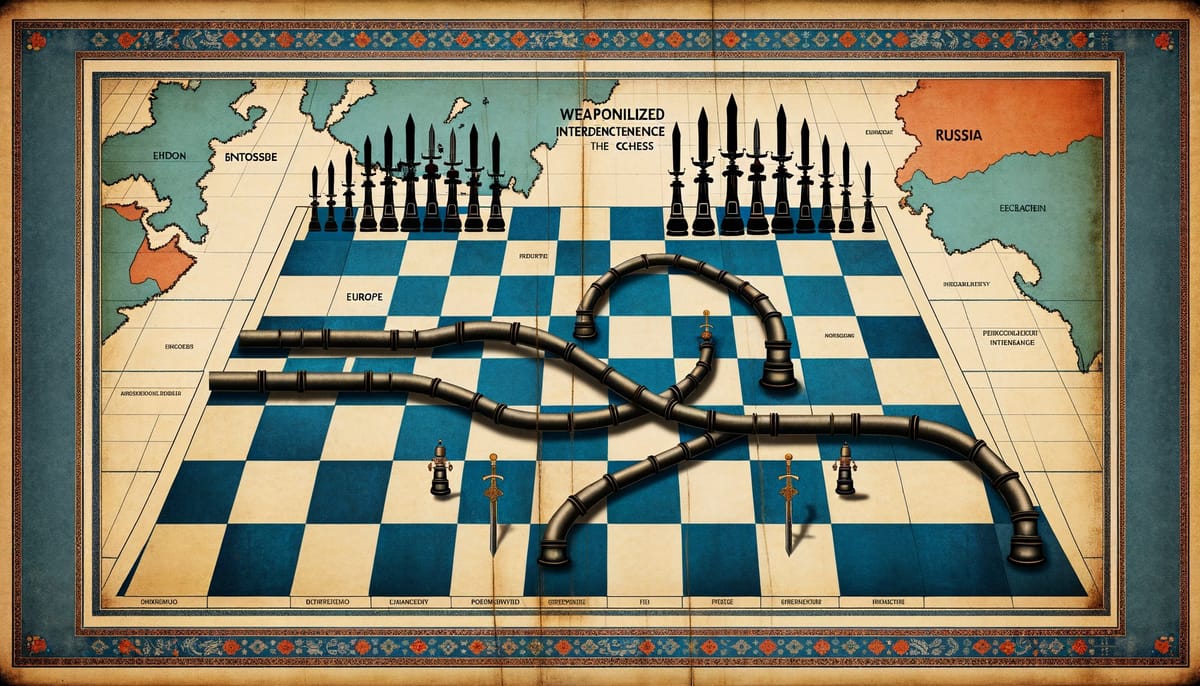
This mutual entrapment explains the peculiar intensity of the confrontation. Neither side can easily exit. Russia cannot quickly find alternative markets absorbing 155 billion cubic metres annually. Europe cannot quickly build infrastructure replacing Russian supply. The interdependence that was supposed to constrain conflict instead fuels it, as each side attempts to escape a relationship neither can leave cleanly.
The Path Not Taken
Three intervention points could alter the trajectory. None is easy. All involve trade-offs.
First, NATO could establish explicit energy infrastructure protection as a core alliance mission, with dedicated assets and clear Article 5 thresholds. This would require member states to fund capabilities currently absent—underwater surveillance, rapid response forces, hardened redundancy in critical systems. The cost would run to tens of billions annually. The benefit would be deterrence through demonstrated capability rather than ambiguous declaration. The trade-off: resources diverted from conventional military modernisation, and potential escalation if protection forces encounter Russian assets.
Second, the EU could accelerate common energy purchasing and strategic reserves, reducing the fragmentation that Russian coercion exploits. A genuine energy union would require Germany to subsidise Polish storage, France to share nuclear capacity, and all members to accept Brussels authority over national energy policy. The sovereignty costs are real. Hungary would need to be overruled or expelled. The trade-off: deeper integration that many electorates oppose, or continued vulnerability to divide-and-conquer tactics.
Third, Western capitals could explicitly link energy transition financing to security alignment, offering accelerated decarbonisation support to countries that reduce Russian dependency and withholding it from those that don’t. This would weaponise climate finance, converting environmental policy into geopolitical instrument. The trade-off: undermining the universal framing of climate action that has enabled broad coalitions, and potentially driving fence-sitters toward Moscow rather than away.
The most likely scenario involves none of these. Muddling through—continued diversification without strategic coordination, continued vulnerability without systematic protection, continued transition without explicit security linkage—remains the path of least resistance. It is also the path that maximises optionality for adversaries and minimises coherence for the alliance.
The Long Game
Russia operates on generational timescales. NATO democracies reset strategy every four years when governments change. Ukraine exists in perpetual present where survival depends on ammunition deliveries measured in days. These temporal frameworks are incommensurable. They produce not disagreement but mutual incomprehension.
The energy dimension of NATO-Russia tensions will persist regardless of how the Ukraine war concludes. The infrastructure exists. The dependencies, though diminished, remain. The coercive toolkit has been demonstrated and will be refined. Future Russian leaders will inherit the strategic option that current ones have exercised.
Europe’s task is not to eliminate vulnerability—an impossibility for any economy integrated into global markets—but to reduce it below the threshold where coercion becomes effective. This requires sustained investment in alternatives, strategic reserves sufficient to weather supply disruptions, and alliance solidarity that denies adversaries the ability to divide targets.
The pipeline and the sword have merged into a single instrument. Energy is no longer merely an economic input or environmental concern. It is a domain of strategic competition as consequential as the maritime, cyber, or space domains that military planners obsess over. The alliance that grasps this transformation will shape the coming decades. The one that doesn’t will be shaped by them.
The seismographs that recorded Nord Stream’s destruction captured something more than an explosion. They registered the sound of an era ending—the era when interdependence meant peace, when trade constrained conflict, when pipelines were infrastructure rather than weapons. What comes next remains unwritten. But the authors will be those who understand that in the contest between Russia and NATO, energy is not a sideshow. It is the main event.