
The Lights in the Sky Are Not What You Think
For seventy-seven years, governments have investigated unidentified aerial phenomena with billions of dollars and thousands of personnel. The findings point not toward alien visitors but toward something more unsettling: the systematic limits of human perception, institutional knowledge, and our...
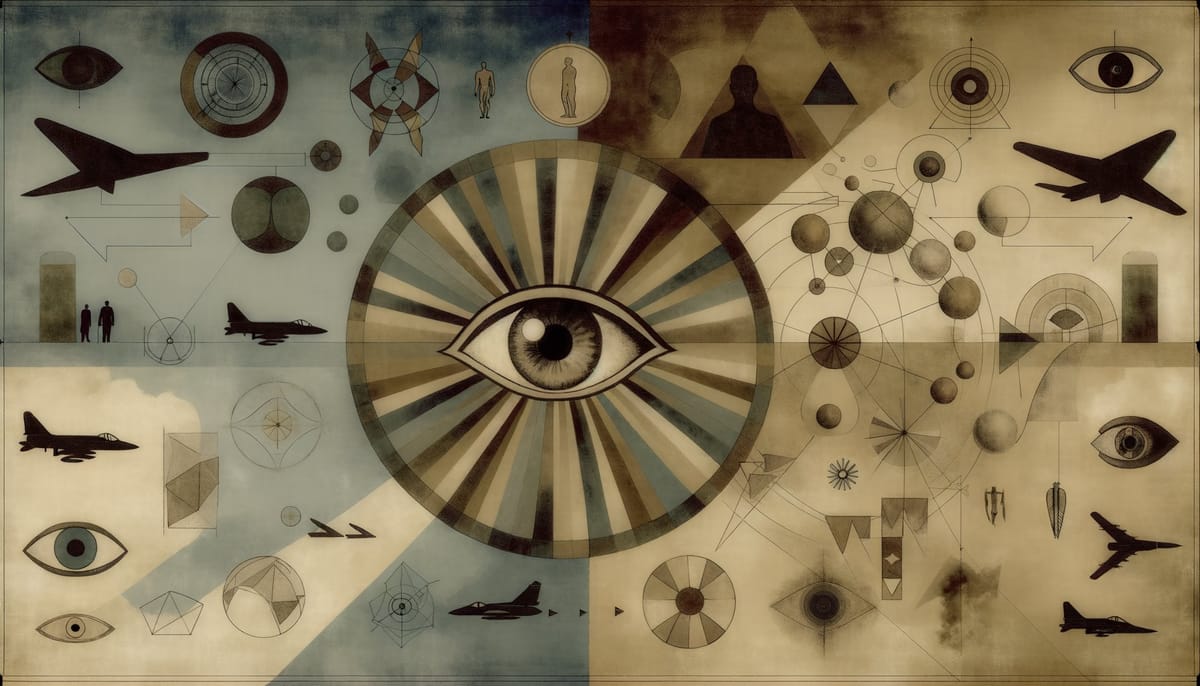
The Persistence of Mystery
The Pentagon’s All-domain Anomaly Resolution Office has examined over 1,600 reports since 2023. It has resolved most of them. Weather balloons. Commercial drones. Starlink satellites catching the sun. The residue—perhaps three percent—remains unexplained. This number has held remarkably stable across seven decades of investigation, from Project Blue Book through France’s GEIPAN to today’s Congressional hearings. The consistency is itself the clue.
Three percent unexplained is not evidence of extraterrestrial visitation. It is the signature of measurement systems operating at their design limits. Every detection apparatus, from Mark I eyeballs to infrared sensors on F/A-18s, has a false-positive rate. Every classification system has edge cases. Every human observer has perceptual blind spots. The question is not why some sightings remain unexplained, but why we expect otherwise.
The most likely explanation for the UAP phenomenon is neither aliens nor mass delusion. It is something more mundane and more profound: the collision between human cognitive architecture, institutional incentive structures, and the irreducible uncertainty of operating at the boundaries of detection capability. We are not witnessing evidence of non-human intelligence. We are witnessing the limits of human intelligence—and our systematic inability to accept those limits.
The Sensor Problem
Begin with physics. Modern military sensors are engineering marvels optimized for specific tasks: tracking aircraft, identifying missiles, guiding weapons. They are not optimized for cataloguing atmospheric anomalies. The Patriot missile system during the Gulf War generated a 4,000-to-1 ratio of false classifications to actual threats. This was not a bug. It was the inevitable consequence of sensitivity settings calibrated for the unforgiving mathematics of air defense: miss one incoming missile and people die.
Fighter pilots operate in an environment of extreme physiological stress. At 6-8G without full loss of consciousness, the brain enters transient altered states. Blood pools away from the visual cortex. Peripheral vision narrows. The vestibular system—evolved for walking on African savannas—sends signals that contradict what the eyes report. Standard training doctrine instructs pilots to trust their instruments over their senses. But this creates a cognitive trap. The brain, forbidden from trusting proprioception and unable to reconcile conflicting inputs, may project the conflict outward. The impossible maneuver becomes an object rather than an error.
Infrared sensors designed to track jet exhaust will register temperature inversions as solid objects. Radar systems calibrated against satellite ephemeris data—the orbital mechanics of known objects—will flag anything that violates those assumptions. Event-based cameras with independent pixel operation detect edge cases that traditional sensors miss, not by revealing new phenomena but by eliminating the exposure effects that previously masked them. Each technological advance resolves old mysteries while generating new ones at the detection threshold.
The 2004 USS Nimitz encounter illustrates the pattern. Pilots reported objects descending from 80,000 feet to sea level in seconds, then hovering, then accelerating beyond any known aircraft capability. The footage shows an indistinct blob. The radar returns were ambiguous. The eyewitness accounts were vivid. Which evidence should we weight most heavily?
The answer depends on understanding what each source actually measures. Radar cross-sections vary with aspect angle; a tumbling object can appear to accelerate impossibly. Infrared signatures depend on temperature differentials that atmospheric conditions can distort. Human visual memory reconstructs rather than records, filling gaps with expectations. The Nimitz incident is not proof of exotic technology. It is a case study in the epistemology of sensor fusion—and the difficulty of knowing what we know.
The Perception Problem
Human cognition is not a passive recording device. It is a prediction engine that constructs reality from incomplete data, filling gaps with priors drawn from experience and expectation. This works brilliantly for navigating the ancestral environment. It works poorly for assessing phenomena that violate those priors.
The Kantian sublime—the experience of perceptual inadequacy when confronting the vast or infinite—produces a specific failure mode in memory formation. Observers report “impossible” characteristics with high confidence precisely because the experience overwhelmed normal processing. The dissociation between confidence and accuracy in eyewitness testimony is well-documented in courtrooms. It applies equally to skies.
Consider the phenomenology of UAP encounters. Witnesses consistently report geometric shapes—spheres, discs, triangles, cubes—without visible propulsion mechanisms. This taxonomy reveals more about Western epistemological frameworks than about the objects themselves. We privilege visual-spatial categorization over relational or contextual features. We assume that “what it looks like” is the fundamental question. A Navajo observer might ask different questions entirely. The shape-based classification system is not neutral; it encodes assumptions about what counts as knowledge.
The psychological literature on causal illusions explains much of what remains. Humans are pattern-completion machines. We see faces in clouds, agency in random events, intention in noise. When something unusual appears in the sky, the brain reaches for the nearest available explanation. For a medieval peasant, that was angels or demons. For a Cold War citizen, Soviet aircraft. For a contemporary viewer saturated in science fiction, extraterrestrial spacecraft. The phenomenon adapts to the cultural moment because the phenomenon is partly constructed by that moment.
This does not mean witnesses are lying or stupid. It means they are human. The experience is real. The interpretation is culturally contingent. And the gap between experience and interpretation is where the mystery lives.
The Institutional Problem
Governments have investigated UAP for decades. The investigations have produced remarkably consistent findings: most sightings are explainable, a small percentage are not, and no evidence demonstrates non-human technology. Why does this conclusion fail to satisfy?
Because the institutions investigating are structurally incapable of producing satisfying answers. Consider the incentive architecture. A military officer who reports seeing something anomalous risks career damage from stigma. A military officer who confirms something anomalous risks being wrong in a domain where being wrong gets people killed. The rational strategy is to file the report and move on. The system generates data but not resolution.
Classification compounds the problem. Information about sensor capabilities, detection thresholds, and operational contexts is legitimately sensitive. Revealing that a particular radar system has a specific false-positive rate under certain atmospheric conditions tells adversaries something useful. So the context that would allow civilian analysts to evaluate UAP reports remains hidden. The public sees the anomaly without the baseline. Mystery is the inevitable product.
The Glomar doctrine—“we can neither confirm nor deny”—creates a pre-evidentiary gate that prevents records from entering any pool where standards of proof would apply. Statements like “no evidence exists” can be simultaneously true (nothing in discoverable records) and meaningless (discoverable records may be empty by design). The epistemological status of government denials is inherently ambiguous. This is not conspiracy. It is bureaucracy operating as designed.
Congressional oversight faces its own structural limits. The UAP Disclosure Act’s vague language is not accidental. Legislative drafters maintain ambiguity when large coalitions are involved, enabling all parties to claim success while ensuring no action requires specific commitments. Hearings generate attention. Attention generates more hearings. The cycle sustains itself without producing resolution because resolution would end the cycle.
The French model offers an instructive contrast. GEIPAN has operated transparently for 45 years, publishing its investigations and methodology. It produces approximately three percent unexplained cases—the same rate as secretive American programs. Transparency does not reduce mystery. It transforms mystery into a stable, manageable category rather than an expanding void of speculation. The American approach, by contrast, converts institutional opacity into evidence of concealment, feeding the very narratives it seeks to suppress.
The Economic Problem
Follow the money. The Pentagon allocated $22 million to the Advanced Aerospace Threat Identification Program between 2007 and 2012. AARO’s current budget runs to tens of millions annually. These are rounding errors in defense appropriations. But the broader ecosystem—contractors, consultants, media platforms, publishing ventures—generates far more.
The streaming industry’s shift from subscriber counts to attention-duration metrics offers a template. Congressional hearings on UAP generate engagement. Engagement generates advertising revenue for platforms covering hearings. Platforms covering hearings demand more hearings. The commercial incentive structure rewards maintaining “unexplained” categories rather than resolving them. A solved mystery is a dead story.
Venture capital applies similar pressures. Standard due diligence protocols emphasize market opportunity, management team capabilities, and product uniqueness—criteria satisfied by charismatic founders making exotic physics claims. The evaluation frameworks designed for software startups cannot assess hardware validation requirements for breakthrough physics. Money flows toward compelling narratives, not toward experimental verification.
Defense contractors face a subtler incentive. Acknowledging that a particular sensor system has high false-positive rates under specific conditions would be commercially damaging. Maintaining ambiguity about what sensors can and cannot detect preserves both capability mystique and upgrade budgets. The institutional myth of potential breakthrough technology provides legitimacy and resources without requiring demonstration of technical efficacy.
This is not a conspiracy of silence. It is an alignment of interests that produces silence as an emergent property. No one needs to coordinate. Everyone benefits from the status quo. Resolution would require someone to sacrifice their position for collective clarity. That someone does not exist.
The Historical Problem
The UAP phenomenon has a history, and the history is revealing. Major waves occurred in 1947, 1952, the 1960s, 2004, and post-2017. Each wave correlates with changes in detection technology, media infrastructure, and geopolitical anxiety. The 1947 wave followed the atomic bomb and coincided with early radar deployment. The 1952 wave accompanied Cold War tensions and improved aviation. The post-2017 wave followed smartphone ubiquity and social media virality.
The phenomena reported in each wave match the technological imagination of the era. 1950s saucers looked like 1950s aerospace concepts. Contemporary UAP exhibit characteristics—hypersonic acceleration, transmedium travel—that match contemporary physics speculation. The objects evolve with the observers. This is precisely what we would expect if the phenomenon is substantially constructed by perception and culture rather than representing stable external entities.
Sprites offer an instructive parallel. These upper-atmospheric electrical discharges were reported for centuries, dismissed as folklore, and only confirmed in 1989 when Space Shuttle video infrastructure captured them. The phenomena existed. The detection capability did not. Once the capability existed, sprites transitioned from impossible to mundane within a decade.
The UAP phenomenon has not made this transition despite far more intensive investigation. This suggests either that the phenomena are genuinely more elusive than sprites—possible but requiring explanation—or that the phenomena are substantially different in kind: not stable external objects awaiting better sensors, but emergent products of the observation process itself.
The Geopolitical Problem
Some UAP are almost certainly foreign surveillance platforms. China’s explicit strategy to achieve “radical innovation” that cuts ahead of Western development paths includes investments in unconventional aerospace concepts. Russia maintains research programs in domains Western science considers marginal. The absence of sensor systems capable of tracking hypersonic weapons creates a permanent category of “conventional but unattributable” phenomena.
This reality complicates the disclosure question. Acknowledging that certain UAP represent adversary technology reveals detection gaps. Denying that any UAP represent adversary technology requires certainty that intelligence agencies cannot possess. The safest bureaucratic position is ambiguity—which feeds public speculation about more exotic explanations.
Allied coordination faces similar constraints. Five Eyes intelligence sharing operates on assumptions of mutual capability assessment that UAP investigations could compromise. NATO’s consensus requirement means that any member’s disclosure decision affects all members. The structural incentives favor collective silence even when individual members might prefer transparency.
The international dimension also explains why different countries report different phenomena. Detection infrastructure varies. Classification practices vary. Cultural interpretation frameworks vary. The “global” UAP phenomenon is actually dozens of national phenomena, each shaped by local conditions, aggregated into apparent consistency by selection bias in English-language media.
The Path Not Taken
What would genuine resolution require? Not more hearings. Not more funding for investigation offices. Not disclosure of classified programs that may or may not exist.
It would require something harder: epistemic humility at institutional scale.
First, systematic publication of sensor performance characteristics—false-positive rates, detection thresholds, known failure modes—for systems involved in UAP detection. This would sacrifice some operational security for analytical clarity. The trade-off is real. But without baseline data, no UAP report can be properly evaluated. We are asking whether signals exceed noise without knowing the noise floor.
Second, longitudinal studies of human perception under conditions that generate UAP reports: high-G flight, extended vigilance, unusual atmospheric optics. The phenomenology of these experiences is poorly documented. Military aviation medicine focuses on preventing accidents, not cataloguing the perceptual anomalies that precede them. A systematic database of what pilots see when their brains are stressed would provide the comparison class that UAP analysis lacks.
Third, international standardization of reporting and investigation protocols. France’s GEIPAN model demonstrates that transparency produces stable mystery rates without feeding speculation spirals. Extending this approach multilaterally would require diplomatic effort but would transform UAP from a national security problem into a scientific one. The former is structurally unresolvable. The latter is merely difficult.
Fourth, honest acknowledgment that some percentage of observations will never be explained—not because they represent exotic phenomena, but because measurement systems have inherent limits. Three percent unexplained is not failure. It is the signature of systems operating correctly at their boundaries. The demand for total explanation is the demand for omniscience. We are not omniscient. We should stop pretending otherwise.
The Uncomfortable Truth
The most likely explanation for the UAP phenomenon is not extraterrestrial visitation. The distances are too vast, the evidence too thin, the alternative explanations too robust. Nor is it mass delusion or government conspiracy. The witnesses are sincere. The government is genuinely uncertain.
The most likely explanation is that we are witnessing the interaction between human cognitive limits, institutional dysfunction, and the irreducible uncertainty of operating at detection boundaries—all amplified by media ecosystems that profit from mystery and political systems that cannot admit ignorance.
This explanation satisfies no one. Believers want confirmation. Skeptics want dismissal. Both want certainty. The phenomenon persists precisely because certainty is unavailable and uncertainty is intolerable.
The lights in the sky are real. What they represent is a mirror. We see in them our pattern-seeking minds, our institutional failures, our cultural anxieties, our technological hubris. We see the limits of human knowledge—and our endless creativity in avoiding that recognition.
The universe may contain other intelligences. The evidence from UAP investigations does not demonstrate this. What it demonstrates is something we should have known all along: that seeing is not believing, that institutions serve their own purposes, and that the hardest thing for a species to accept is the boundary of its own understanding.
The mystery is not out there. The mystery is us.