The Geometry of Hedging: What India and Pakistan Reveal About International Order
India and Pakistan maintain simultaneous relationships with the United States, China, and Russia without facing meaningful consequences. Their success reveals not diplomatic cleverness but a structural transformation in how international order actually works—one where commitment is costly and...
The Geometry of Hedging
When India announced it would host the 2024 BRICS summit in Kazan while simultaneously participating in Malabar naval exercises with the United States, Japan, and Australia, no one in Delhi considered this contradictory. The same week, Pakistan’s foreign ministry dispatched delegations to Beijing for CPEC negotiations, to Washington for IMF consultations, and to Moscow for preliminary talks on a gas pipeline. Neither capital perceived these parallel engagements as strategic incoherence. They understood something that Western analysts often miss: the international order no longer demands exclusive loyalty.
The conventional framing treats India and Pakistan as middle powers “balancing” between great powers—as if they were performing a careful act of diplomatic tightrope-walking, anxiously maintaining equilibrium between competing gravitational pulls. This metaphor flatters Western assumptions about a unipolar order in graceful decline. The reality is more interesting and more consequential. Both nations are not balancing at all. They are accumulating—stacking relationships like financial instruments in a diversified portfolio, extracting value from each without surrendering autonomy to any.
What their behavior reveals is not the twilight of American hegemony or the dawn of Chinese dominance. It reveals something more fundamental: the international order has become structurally permissive in ways that reward hedging over commitment. The rules still exist. They simply no longer bind.
The Architecture of Simultaneity
India’s “multi-alignment” and Pakistan’s “hedging” are often treated as clever diplomatic strategies—the tactical maneuvering of shrewd foreign ministries. This misses the structural conditions that make such strategies viable. Both nations maintain simultaneous relationships with powers that are themselves in escalating competition. India purchases S-400 missile systems from Russia while deepening defense technology partnerships with the United States. Pakistan receives Chinese infrastructure investment through CPEC while negotiating IMF programs that require American blessing. Neither faces meaningful punishment for these apparent contradictions.
The S-400 case is instructive. When India finalized its $5.4 billion purchase from Russia in 2018, American law was clear: CAATSA (Countering America’s Adversaries Through Sanctions Act) mandated sanctions against any nation acquiring significant Russian defense equipment. The law contained no ambiguity. Yet India received a waiver. The waiver mechanism—designed as an exception—has become the rule. It institutionalizes strategic ambiguity as a structural feature of American policy itself. By making waivers available but not guaranteed, CAATSA creates a system where rules exist in deliberate superposition: simultaneously binding and negotiable, depending on who is asking.
This is not American weakness. It is American adaptation to a world where enforcement costs exceed compliance benefits. Washington could sanction India. The cost would be losing a critical partner in Indo-Pacific competition with China. The mathematics are straightforward. So the exception becomes permanent, and the rule becomes advisory.
Pakistan’s version operates through different mechanisms but achieves similar results. Islamabad’s economic dependence on China through CPEC ($62 billion in committed infrastructure) coexists with dependence on American-influenced institutions for macroeconomic survival. The IMF’s 23rd bailout package in 2023 came with conditions that theoretically constrain Pakistani fiscal policy. In practice, China’s willingness to provide bridge financing during IMF negotiations gives Pakistan leverage to soften conditionality. Neither patron can afford to let Pakistan collapse. Both know the other will prevent it. Pakistan has transformed its fragility into an asset.
The structural insight is this: when great powers compete for the same partners, the partners gain leverage they did not earn through their own capabilities. India and Pakistan are not powerful states. They are well-positioned states. The distinction matters.
Why Commitment Became Costly
The Cold War’s alliance architecture rested on a simple premise: exclusive commitment purchased security guarantees. NATO members accepted American military leadership in exchange for Article 5 protection. Warsaw Pact states accepted Soviet dominance in exchange for regime survival. Defection carried existential risk. The system demanded loyalty because it could enforce consequences.
Contemporary great power competition lacks this enforcement capacity. The United States cannot credibly threaten to abandon India if India maintains Russian defense ties—because abandoning India means ceding the Indo-Pacific to Chinese influence. China cannot credibly threaten to withdraw from CPEC if Pakistan maintains American financial relationships—because withdrawal means surrendering strategic access to the Arabian Sea and the Strait of Hormuz. The competitors have trapped themselves.
This trap has a name in game theory: the commitment problem in reverse. Traditionally, states struggle to make credible commitments to allies. Now great powers struggle to make credible threats to defectors. The result is a permissive environment where middle powers can accumulate relationships without facing the costs of disloyalty.
India has exploited this environment with particular sophistication. Delhi participates in the Quad—a security dialogue explicitly designed to counter Chinese maritime expansion—while simultaneously chairing BRICS summits that position China as a partner in reshaping global governance. It imports Russian oil at discounted prices under Western sanctions while expanding technology partnerships with American firms seeking alternatives to Chinese supply chains. It maintains nuclear cooperation agreements with both Washington and Moscow. None of these relationships are exclusive. All of them are productive.
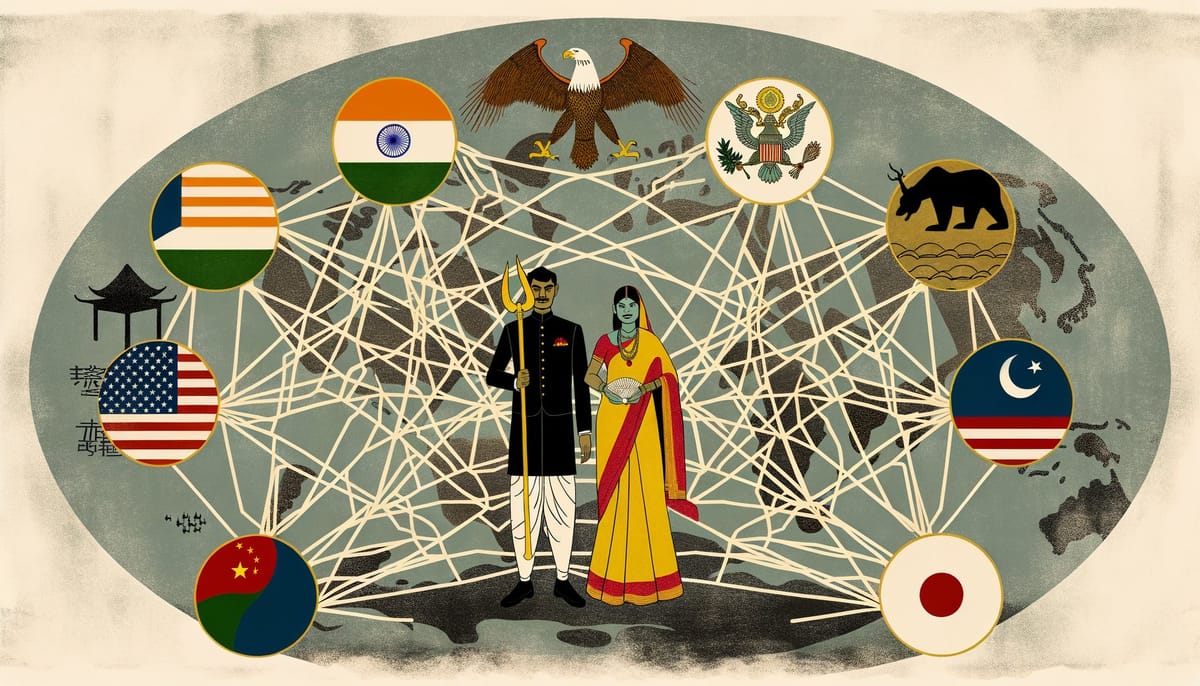
The conventional criticism—that India is “sitting on the fence”—misunderstands the geometry. India is not on a fence. It is at the center of a web, with threads extending to every major power. The web’s strength comes precisely from its multiplicity. Cut one thread, and the others hold.
The Institutional Void
What makes this accumulation strategy sustainable is not just great power competition but the erosion of institutional enforcement mechanisms. The post-1945 order created institutions designed to constrain state behavior: the UN Security Council for collective security, the IMF and World Bank for economic governance, the WTO for trade disputes. These institutions assumed a hierarchy of legitimacy that no longer commands universal assent.
India and Pakistan’s forum-shopping behavior illustrates the decay. When India faces criticism in UN human rights bodies over Kashmir, it mobilizes BRICS solidarity to deflect pressure. When Pakistan faces pressure in FATF (Financial Action Task Force) over terrorism financing, it leverages Chinese diplomatic support to avoid blacklisting. Both states participate in the Shanghai Cooperation Organization, which provides an alternative legitimacy framework outside Western-dominated institutions. The institutional landscape has become a marketplace where states select venues that favor their interests.
This is not institutional collapse. It is institutional fragmentation. The rules still exist in each forum. But the forums compete, and states can choose which rules to follow by choosing which forums to privilege. The result is a kind of regulatory arbitrage applied to sovereignty itself.
The BRICS expansion in 2024 crystallized this dynamic. The bloc’s membership criteria explicitly require that candidates impose no non-UNSC sanctions on existing members—a direct rejection of Western authority to designate states as “sanctionable” outside UN frameworks. This is not merely an alternative institution. It is an anti-classificatory mechanism that challenges the taxonomic power of Western-led order. India and Pakistan both operate within this framework while simultaneously participating in Western institutions. They have learned to speak multiple institutional languages without committing to any single grammar.
Domestic Politics as International Constraint
The sustainability of multi-alignment depends on domestic political conditions that differ sharply between India and Pakistan—and these differences explain why India’s strategy appears more successful.
India’s domestic political economy supports diversification. Its trade relationships span American technology imports, Russian energy and defense, and Chinese manufacturing inputs. No single external relationship dominates the economy sufficiently to create structural dependency. Indian nationalism, particularly under BJP governance, frames multi-alignment as civilizational assertion—a return to historical patterns of great power status rather than subordination to any external patron. The domestic narrative supports the international strategy.
Pakistan’s domestic constraints are more severe. The military’s institutional interests require perpetual threat justification from India, which locks foreign policy into security frameworks that limit economic diversification. Military welfare foundations that draw from the defense budget create a metabolic requirement for sustained Indo-Pakistani tension—the more “self-sufficient” these commercial enterprises become, the more they require threat narratives to justify continued military budgetary dominance. This structural dependency on conflict limits Pakistan’s ability to normalize relations with India, which in turn constrains its options for reducing dependence on China.
The civil-military imbalance compounds the problem. Pakistani foreign policy operates through dual channels: a civilian government managing economic relationships with the IMF and Western partners, and a military establishment managing security relationships with China and, increasingly, Russia. These channels do not always coordinate. The result is strategic incoherence that differs qualitatively from India’s strategic flexibility. India chooses to engage multiple partners. Pakistan is often forced to by institutional fragmentation.
Digital nationalism has further constrained both states’ maneuverability, though in different ways. Social media has democratized foreign policy commentary, creating mass audiences that demand emotional satisfaction rather than strategic subtlety. Indian Twitter erupts when any government appears to “capitulate” to Pakistan; Pakistani social media explodes when any gesture toward India suggests “betrayal.” These outrage cycles operate faster than diplomatic processes, creating ratchet mechanisms that constrain elite flexibility. The epistemic simplification of digital nationalism—requiring only outrage rather than policy knowledge—means that leaders must pre-emptively avoid any action that could be framed as weakness, regardless of strategic merit.
The Information Battlespace
Great power competition over India and Pakistan extends beyond material relationships into narrative warfare. Each major power maintains sophisticated information operations designed to shape perceptions of alignment and legitimacy.
Chinese state media (CGTN, Global Times) promotes narratives of inevitable Chinese rise and American decline, targeting Pakistani audiences with messaging that frames CPEC as civilizational partnership rather than debt dependency. Russian information operations emphasize multipolarity and Western hypocrisy, finding receptive audiences in both Indian and Pakistani publics skeptical of American intentions. American public diplomacy emphasizes democratic values and economic opportunity, though with decreasing effectiveness as its own democratic institutions face credibility challenges.
The structural insight is that these competing narratives do not cancel each other out. They create a saturated information environment where all external claims are treated with suspicion—which paradoxically reinforces domestic nationalism as the only trusted frame. Indian and Pakistani publics increasingly interpret great power messaging through nationalist lenses that filter out inconvenient content. The information warfare may be intense, but its net effect is to strengthen domestic resistance to external influence rather than to shift alignment preferences.
This has implications for great power strategy. Neither Washington nor Beijing nor Moscow can reliably shape Indian or Pakistani public opinion through information operations. The domestic filters are too strong. What they can do is provide material benefits that domestic elites can claim credit for—which returns the competition to tangible deliverables rather than narrative dominance.
What Breaks First
The current equilibrium is stable but not permanent. Several dynamics could disrupt it.
First, a genuine India-China military conflict would force choices that multi-alignment currently avoids. The 2020 Galwan Valley clash killed soldiers on both sides but did not escalate to war. Both governments managed the crisis through ritualized de-escalation—a pattern that anthropological research identifies as universal in conflict mediation. But the LAC (Line of Actual Control) remains contested, and each skirmish creates domestic political pressure for harder responses. A larger clash could force India to choose between Russian defense partnerships (which require Chinese acquiescence) and American security cooperation (which requires distancing from Russia). The web of relationships would face stress it has not yet experienced.
Second, Pakistan’s debt sustainability is genuinely precarious. Chinese lending through CPEC has created structural dependencies that limit Islamabad’s economic flexibility. The “debt trap” narrative is overstated—China has shown willingness to restructure rather than seize assets—but the debt service burden constrains fiscal space for development. If Pakistan’s economy deteriorates sufficiently, it may face choices between Chinese and IMF-backed restructuring paths that are genuinely incompatible. The hedging strategy works only when multiple patrons remain willing to provide support. Economic crisis could force a reckoning.
Third, American domestic politics could eliminate the waiver mechanisms that make Indian multi-alignment viable. A future administration less invested in Indo-Pacific competition might enforce CAATSA strictly, forcing India to choose between Russian defense systems and American technology partnerships. This is not the current trajectory—both American parties support India engagement—but political volatility makes it possible. India’s strategy depends on American strategic patience that cannot be guaranteed indefinitely.
Fourth, climate and energy transitions could restructure the material basis of these relationships. India’s massive imports of discounted Russian oil depend on continued Western sanctions that create price differentials. If sanctions ease or if India’s energy transition accelerates, the economic logic of the Russia relationship weakens. Pakistan’s strategic value to China depends partly on energy transit routes that may become less critical as renewable deployment accelerates. The material foundations of current alignments are not fixed.
The Order Revealed
What does India and Pakistan’s behavior reveal about the actual structure of international order? Three conclusions emerge.
First, the order is neither unipolar nor multipolar but something more complex: it is hierarchical in some domains and anarchic in others. American military dominance remains real; no other power can project force globally as the United States can. But military dominance does not translate into political compliance. States can defy American preferences in domains where enforcement costs exceed benefits—and those domains are expanding. The order is layered, with different rules applying at different levels.
Second, institutions matter less than relationships. The formal architecture of international governance—UN, IMF, WTO—provides frameworks that states can invoke or ignore depending on circumstance. What actually constrains behavior is the network of bilateral and minilateral relationships that create mutual dependencies. India’s relationship with the United States is not mediated primarily through institutions but through defense contracts, technology transfers, diaspora connections, and elite educational networks. These relationship infrastructures are thicker than institutional memberships and more consequential for behavior.
Third, the order rewards ambiguity over clarity. States that commit clearly to one patron sacrifice leverage with others. States that maintain strategic ambiguity preserve optionality. The lesson India and Pakistan have learned—and that other middle powers are learning—is that clarity is costly and ambiguity is cheap. This creates an international environment where signals are deliberately noisy, commitments are deliberately conditional, and alignment is deliberately provisional.
This is not the liberal international order that American strategists designed. Nor is it the multipolar concert that Chinese strategists prefer. It is something messier: an order where rules exist but enforcement is selective, where institutions persist but authority fragments, where great powers compete but cannot compel. India and Pakistan have not created this order. They have simply learned to navigate it with unusual skill.
The Path Not Taken
Could things be otherwise? In principle, great powers could coordinate to eliminate the arbitrage opportunities that middle powers exploit. A US-China agreement on spheres of influence would remove the competitive dynamic that gives India and Pakistan leverage. A restoration of institutional hierarchy—perhaps through UN Security Council reform that creates genuine enforcement capacity—could reduce forum-shopping. A return to Cold War-style alliance blocs would force choices that multi-alignment avoids.
None of these alternatives is likely. US-China competition shows no signs of abating; if anything, it is intensifying across technological, economic, and military domains. Institutional reform requires consensus among states that benefit from fragmentation. Alliance consolidation would require middle powers to accept subordination they have learned to resist.
The more probable trajectory is continuation and expansion of the current pattern. Other states are learning from India and Pakistan’s example. Saudi Arabia maintains relationships with both Washington and Beijing. Turkey participates in NATO while purchasing Russian air defense systems. Indonesia and Vietnam hedge between American security partnerships and Chinese economic integration. The middle-power playbook is spreading.
This is not a crisis for international order. It is a transformation. The order that emerges will be less coherent, less predictable, and less amenable to great power management than the one it replaces. It will also be more resilient to hegemonic collapse, because no single power’s decline will unravel the entire structure. The web has no center. That is its weakness and its strength.
India and Pakistan did not design this world. But they understood it earlier than most. Their simultaneous relationships with Washington, Beijing, and Moscow are not diplomatic contortions. They are rational responses to structural conditions that reward flexibility over commitment. The international order has become a space where loyalty is optional and hedging is rational. That is the revelation their behavior provides—not about their own cleverness, but about the world the great powers have made.