The Fire Next Time: Iran's 2026 Uprising and the Limits of Repression
The protests that erupted in December 2025 have spread to all 31 Iranian provinces, transforming from economic grievance into existential challenge. The Islamic Republic's response reveals a system that has exhausted its capacity for adaptation—and a population that has stopped believing in reform.
The Fire Next Time
On December 28, 2025, the Grand Bazaar of Tehran—a labyrinth of commerce that has survived Mongol invasions, Qajar intrigue, and revolutionary upheaval—fell silent. Shopkeepers pulled down their shutters not in observance of any holiday, but in protest against a budget that offered nothing. Within 72 hours, the silence had spread to all 31 provinces.
The protests that erupted represent something the Islamic Republic has not faced since its founding: a revolt that began with economics but refused to stay there. Previous uprisings—2009’s Green Movement over election fraud, 2019’s fuel price protests, 2022’s Woman, Life, Freedom movement—could be contained because each had a defined grievance. This one has no such limit. The chants that began as complaints about inflation have become calls for the Supreme Leader’s death.
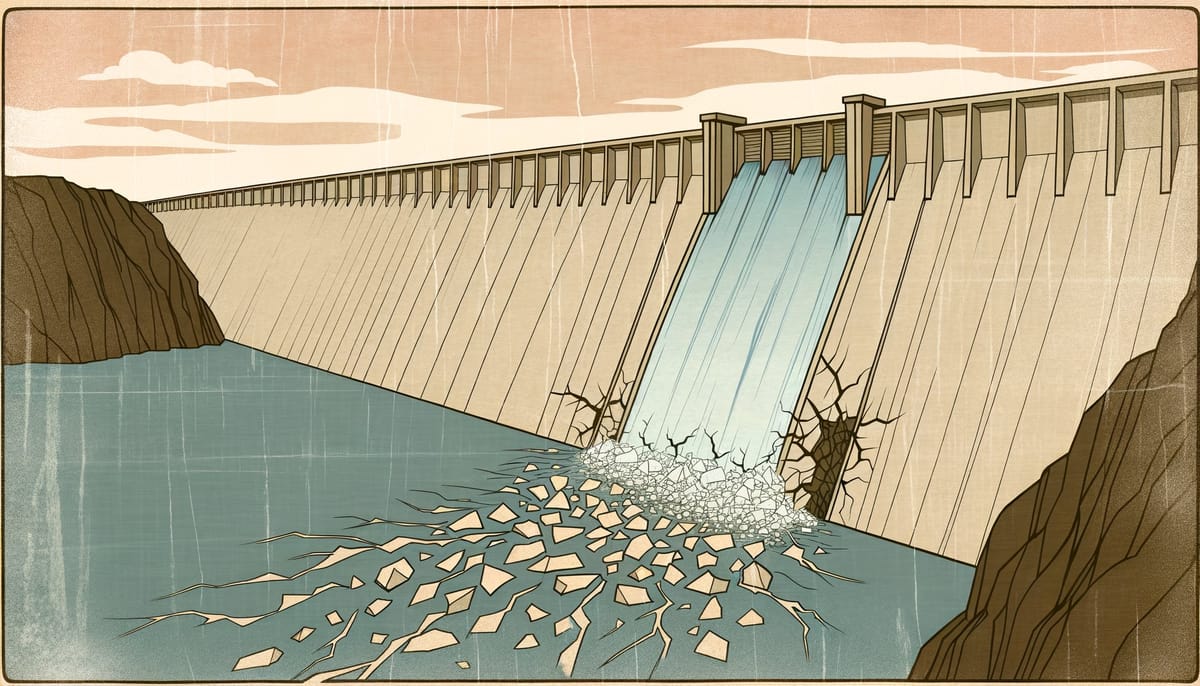
What makes the 2025-2026 protests structurally different is not their size, though they are massive. It is their simultaneity. When protests erupt everywhere at once, the security apparatus cannot concentrate force. When demands escalate from bread to freedom in days rather than months, the regime cannot calibrate repression. The Islamic Republic faces a thermodynamic problem: the system has absorbed so much pressure that small perturbations now trigger cascading failures.
A Budget That Broke the Spell
President Masoud Pezeshkian stood before parliament in late December defending an indefensible document. The annual state budget, he argued, represented the best possible outcome given circumstances. The circumstances were these: inflation at 52.6%, the rial in freefall, youth unemployment above 22%, and an economy hollowed by sanctions, mismanagement, and the regime’s extraction apparatus.
The bazaaris heard something else. They heard a reformist president—elected on promises of change—admitting he could change nothing. The budget shortfall functioned, as one analyst noted, like a Zen koan: an unsolvable problem that forced consciousness through a breakthrough. The technocrats had no answer. The reformists had no leverage. The only remaining response was the street.
What happened next defied the regime’s playbook. Previous protests had epicenters—Tehran in 2009, provincial cities in 2019, universities in 2022. This one had none. The Grand Bazaar’s closure triggered sympathy strikes in Tabriz, Isfahan, Shiraz, and Mashhad within 48 hours. By January 5, according to the BBC, protests had reached over 100 cities. The speed was not organizational but informational: smartphone footage circulated faster than security forces could redeploy.
The regime’s response revealed its understanding of the threat. Supreme Leader Ali Khamenei signaled a harsher crackdown within days. The Islamic Revolutionary Guard Corps deployed not just Basij militia but ground forces—a military response to a civilian uprising. By mid-January, Human Rights Watch documented that security forces had unleashed “a deadly crackdown marked by unlawful use of force and firearms and mass arbitrary arrests.”
The numbers tell a grim story. Over 400 killed. More than 15,000 detained. At least 60 facing death sentences under charges of moharebeh—“enmity against God”—a crime whose definition expands to fit whatever the judiciary requires.
Why This Time Is Different
Every authoritarian system rests on a bargain: obedience in exchange for something. The Soviet Union offered security and ideological purpose. The Chinese Communist Party offers prosperity and national restoration. The Islamic Republic’s bargain was always more complex: revolutionary legitimacy, Islamic governance, and—crucially—economic protection through subsidies that insulated ordinary Iranians from global prices.
That bargain has collapsed. Not gradually, but comprehensively. The subsidy system that once distributed cheap fuel, food, and medicine has been gutted by sanctions and corruption. The revolutionary generation that remembers the Shah’s brutality is dying. Their grandchildren know only the Islamic Republic’s brutality. And the ideological legitimacy that once commanded genuine belief has curdled into ketman—the Shia practice of outward conformity masking inward dissent.
The protests reveal what ketman conceals: a population that has mentally defected while physically remaining. When the costs of outward conformity suddenly exceed the costs of resistance, the transition happens everywhere at once. This is not coordination. It is phase transition—the sudden shift from one state to another when a critical threshold is crossed.
Consider the chants. In 2009, protesters shouted “Where is my vote?”—a demand for reform within the system. In 2022, “Woman, Life, Freedom” challenged the system’s social control but stopped short of demanding its end. In 2025-2026, the chants are “Death to Khamenei” and “Death to the dictator.” The demand is not reform but removal.
The regime understands the difference. Its response has been not to address grievances but to eliminate the capacity for grievance. Internet shutdowns now last days rather than hours. Hospitals have been ordered to report wounded protesters, transforming medical facilities into surveillance nodes. Defense attorneys who take protest cases face arrest themselves—44 lawyers detained since 2022, forcing families into informal patronage networks to negotiate with the state.
This is not a crackdown designed to restore order. It is a crackdown designed to make resistance impossible.
The Machinery of Repression
The Islamic Republic’s security architecture was built for exactly this moment. The IRGC, the Basij, the Intelligence Ministry, the Revolutionary Courts—each institution exists to convert political dissent into criminal conspiracy, and criminal conspiracy into capital punishment.
The legal mechanism is elegant in its brutality. Article 286 of the Islamic Penal Code criminalizes “spreading corruption on earth”—a charge whose definition includes “disrupting order” through undefined means. Moharebeh charges transform protest into treason. The evidentiary requirements are minimal: the National Information Network’s domestic routing architecture converts metadata—traffic patterns, geolocation, contact graphs—into legally admissible “digital traces” that satisfy evidentiary thresholds without traditional witnesses.
The speed of prosecution serves a tactical purpose. When the judiciary issues 1,000 indictments in days, it creates a processing bottleneck that becomes a weapon. The courts cannot execute all defendants. Rapid charging functions as a sorting mechanism: identify leaders for death sentences, offer plea bargains to followers, and create uncertainty that paralyzes everyone else.
But the machinery has limits. The IRGC can deploy forces to any single city. It cannot deploy forces to 100 cities simultaneously. The Basij can infiltrate any single neighborhood. It cannot infiltrate every neighborhood when every neighborhood is protesting. The intelligence services can monitor any single network. They cannot monitor all networks when the population has learned to communicate through couriers, coded messages, and the physical presence of bodies in streets.
The regime’s solution has been to escalate indiscriminately. Live ammunition against unarmed crowds. Mass arrests without charges. Torture documented by UN investigators. The strategy assumes that sufficient violence will restore fear. But violence has a paradox: each killing creates martyrs, and the Islamic Republic’s own ideology sanctifies martyrdom.
The Economic Spiral
The protests began with economics and economics will shape their trajectory. Iran’s economy operates in a doom loop: sanctions restrict foreign exchange, the rial collapses, inflation destroys purchasing power, the informal economy absorbs shocks until it cannot, and then the streets fill.
The numbers are stark. Inflation exceeds 50%. Youth unemployment exceeds 22%. The informal economy—perhaps 30-40% of GDP—has functioned as a shock absorber for years, redistributing resources through networks invisible to the formal banking system. But years of compound crises have pushed these networks to exhaustion. The bazaaris who launched the protests are not radicals. They are merchants who can no longer make the numbers work.
The regime’s economic tools are limited. Subsidies require foreign exchange the state does not have. Price controls create shortages that fuel black markets. Crackdowns on the informal economy destroy the only mechanism keeping millions fed. The budget that triggered the protests was not a choice but an admission: the state cannot meet its obligations.
International dynamics compound the crisis. The World Bank’s Commodity Markets Outlook documents how sanctions have isolated Iran from global commodity markets, forcing reliance on discounted sales to China and Russia. These partners extract maximum concessions from Iranian weakness. Russia’s 20-year partnership treaty, signed in January 2025, locks Iran into dependency while Russia positions to abandon the relationship if a Ukraine ceasefire materializes.
The economic spiral cannot be reversed without political change. But political change requires either regime reform or regime collapse. The reformists have proven impotent—President Pezeshkian lacks control over security forces and cannot deliver economic relief. The hardliners have proven unwilling—Supreme Leader Khamenei interprets any concession as weakness that invites destruction.
The Succession Shadow
Behind the immediate crisis looms a larger one: Khamenei is 86 years old. The Assembly of Experts has reportedly chosen a successor but refuses to disclose the identity “for their safety”—creating an information asymmetry that paralyzes elite position-taking. Factions cannot align with the future because they do not know what the future holds.
This uncertainty transforms the protests into a succession struggle by other means. Hardliners who crush the uprising position themselves as defenders of the revolution. Reformists who fail to deliver change are discredited. The IRGC, which controls both security and vast economic enterprises, calculates that its institutional interests require regime survival regardless of who leads it.
The succession question explains the regime’s all-or-nothing response. A leadership transition during active protests would invite factional conflict. Concessions that appear weak could embolden rivals. The safest path for any potential successor is to demonstrate ruthlessness now—to prove that they can hold the system together when it matters most.
But ruthlessness has costs. Each death documented by international observers, each torture victim who survives to testify, each family radicalized by loss—these accumulate into a legitimacy deficit that no succession can repair. The Islamic Republic may survive this crisis. It cannot survive it unchanged.
International Paralysis
The world watches Iran burn and does remarkably little. The pattern is familiar: condemnations without consequences, sanctions that are already maximal, and diplomatic isolation that the regime has learned to endure.
The United States, European Union, and United Kingdom have issued statements invoking Iran’s “responsibility to protect” its own population—R2P language carefully calibrated to establish what intervention would not occur. By stating the internal standard without invoking the international one, Western powers create a measurable boundary that the regime can use to calibrate repression. The message is clear: kill protesters, face condemnation; do not threaten regional stability, face nothing more.
Russia and China maintain studied silence. The BRICS bloc’s lack of unified response reveals rhizomatic strength through non-coordination—each state abstains independently without coordinating a counter-narrative, making the pattern impossible for Western diplomacy to address. China needs Iranian oil. Russia needs Iranian drones. Neither will sacrifice material interests for Iranian protesters.
The UN Human Rights Office has called for accountability “in line with international human rights standards.” The Fact-Finding Mission established after 2022 issued its “latest and final report” in March 2025—documenting patterns that are now repeating without the Mission present to document them. The international human rights architecture observes, records, and exits precisely as the performance repeats.
Three Futures
The trajectory of the 2025-2026 protests depends on variables that cannot be predicted but can be understood.
Scenario One: Successful Repression. The regime kills enough people, arrests enough organizers, and maintains enough economic function to exhaust the protests. This is the 2019 model—brutal crackdowns followed by sullen quiescence. The cost is a population that hates the regime more than before, a security apparatus that has consumed resources needed elsewhere, and a succession crisis that remains unresolved. The regime survives but is weaker.
Scenario Two: Negotiated Transition. Reformist elements within the system, backed by pragmatic IRGC factions, force concessions that defuse immediate tensions without threatening core regime interests. This would require Khamenei to accept limits on his authority—something his entire psychological formation rejects. It would require the IRGC to accept civilian oversight—something its institutional interests forbid. The scenario is theoretically possible and practically unlikely.
Scenario Three: Cascading Collapse. The protests continue, the economy deteriorates, security forces fragment, and the regime loses the capacity to maintain control. This is the 1979 model in reverse—the system that emerged from revolution consumed by one. The probability is low but non-zero. Phase transitions happen suddenly. The system that appears stable on Monday can be gone by Friday.
The most likely outcome lies between the first and third scenarios: a protracted conflict in which neither side achieves decisive victory. The regime retains enough force to prevent collapse. The population retains enough grievance to prevent stability. Iran enters a period of chronic crisis—not revolution, not restoration, but grinding deterioration punctuated by periodic violence.
FAQ: Key Questions Answered
Q: How do the 2025-2026 protests compare to previous Iranian uprisings? A: These protests are distinguished by their simultaneity (all 31 provinces within days), their escalation speed (from economic grievances to regime-change demands in under a week), and their lack of a single epicenter that security forces can target. Previous protests had geographic or thematic focal points; this one does not.
Q: What triggered the protests? A: The immediate trigger was President Pezeshkian’s defense of a state budget that failed to address economic crisis. The underlying causes are structural: 52.6% inflation, youth unemployment above 22%, currency collapse, and the exhaustion of informal economic networks that previously absorbed shocks.
Q: Could the protests lead to regime change? A: Regime collapse remains unlikely but possible. The Islamic Republic retains significant coercive capacity, and no organized opposition exists to replace it. However, the protests reveal a population that has mentally defected from the regime’s legitimacy claims—a condition that makes long-term stability difficult regardless of short-term repression success.
Q: What is the international community doing? A: Western powers have issued condemnations and invoked Iran’s responsibility to protect its population, while carefully avoiding language that would commit them to intervention. Russia and China remain silent, prioritizing economic and military relationships with Tehran over human rights concerns.
The Reckoning Deferred
The Islamic Republic has survived crises before. It may survive this one. But survival is not the same as stability, and stability is not the same as legitimacy.
What the 2025-2026 protests reveal is a system that has exhausted its capacity for adaptation. The reformists cannot reform. The hardliners cannot satisfy. The economy cannot recover without political change, and political change cannot occur without economic recovery. The regime is trapped in a contradiction it created and cannot escape.
The protesters in the streets of Tehran, Isfahan, and a hundred other cities know this. They chant for the Supreme Leader’s death not because they expect to achieve it, but because they have stopped believing in any alternative. When a population loses faith in reform, it gains faith in rupture.
The fire next time may not come this month or this year. But the fuel has been laid. The matches are struck. And the regime that once claimed to embody divine justice now embodies only the fear of its own people.
Sources & Further Reading
The analysis in this article draws on research and reporting from:
- 2025–2026 Iranian protests - Wikipedia - Comprehensive timeline and documentation of protest spread across all 31 provinces
- Human Rights Watch: Iran Authorities’ Renewed Cycle of Protest Bloodshed - Documentation of security force violations and mass arrests
- The Guardian: New protests erupt in Iran as supreme leader signals crackdown - Reporting on Khamenei’s response and escalation
- UN News: Human Rights Chief disturbed by Iran protest violence - UN High Commissioner’s statements on accountability
- Stimson Center: In Iran Protests, Information Spreads Faster than Organization - Analysis of protest coordination dynamics
- House of Commons Library: Iran - What challenges face the country in 2026? - Policy briefing on structural challenges
- World Bank Commodity Markets Outlook - April 2025 - Economic context and sanctions impact analysis
- Amnesty International: Iran deaths and injuries as authorities unleash protest bloodshed - Casualty documentation and legal persecution of attorneys