The Exemplary Destruction: What Jimmy Lai's Conviction Reveals About Beijing's Control of Hong Kong's Business Elite
Jimmy Lai's life sentence is not punishment but potlatch—the ritual destruction of the most valuable to demonstrate absolute sovereignty. For Hong Kong's surviving tycoons, the message is unmistakable: everything they possess exists at Beijing's pleasure.
The Exemplary Destruction
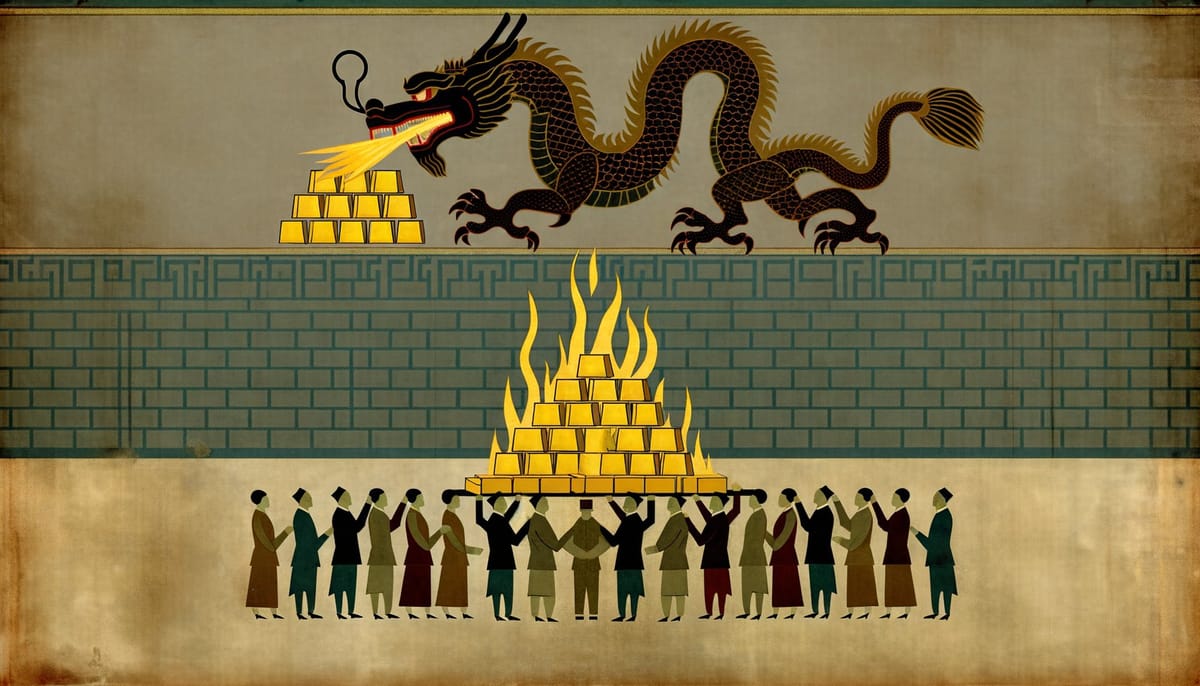
Jimmy Lai’s life sentence represents something rarer than punishment. It is a potlatch—the ritual destruction of the most valuable thing to demonstrate that the destroyer stands outside the economy of value itself.
In Pacific Northwest indigenous societies, chiefs established dominance not by accumulating wealth but by publicly destroying it. They burned preserved coppers and Hudson Bay blankets, the highest-value goods first, to prove they needed neither conservation nor accumulation. The act was governance itself. Beijing’s treatment of Lai follows identical logic. By annihilating the wealthiest, most internationally connected, most symbolically prominent member of Hong Kong’s business elite, the Chinese Communist Party demonstrates that it operates outside the transactional framework that governs lesser powers. The message to surviving tycoons is not “comply or face consequences.” It is “we can destroy anything, therefore everything you possess exists at our pleasure.”
This distinction matters. A transactional regime punishes deviation. A sovereign regime demonstrates that the very concept of deviation is a category error—there are no rules to break because there is only will to obey.
The Theological Architecture
Understanding Beijing’s strategy requires abandoning the vocabulary of law enforcement. The National Security Law functions less as legislation than as liturgy. Its Article 29 prohibition against “collusion with foreign forces” contains deliberate vagueness—not a drafting defect but a structural optimization. Ambiguity increases what epidemiologists would call the “host range” of the legal virus. When crimes lack precise definition, business elites must apply maximally cautious interpretations, effectively deputizing themselves as their own prosecutors.
The 855-page verdict against Lai catalogues 161 publications in exhaustive detail. The length performs a function beyond legal justification. Like Byzantine iconoclast councils meticulously documenting images slated for destruction, the verdict establishes a theological taxonomy of forbidden mediation. By treating journalism as heresy rather than crime, Beijing transforms the trial from adjudication into excommunication.
This explains why international legal arguments gain no traction. Western observers invoke due process, evidentiary standards, proportionality. They might as well critique the Council of Nicaea for insufficient peer review. The categories do not translate. Beijing is not making legal claims subject to legal refutation. It is performing sovereignty through the ritual destruction of a heretic.
The Confucian concept of zhengming—the rectification of names—illuminates the mechanism. Zhengming operates not through definition but through forced behavioral alignment. Punishment does not declare what a “businessman” is; it demonstrates what a businessman must do. The criminal conviction collapses the gap between the word and the required conduct. After Lai, no Hong Kong tycoon can claim ignorance about what “patriotic businessman” means in practice.
The Sankin-Kōtai of Capital
Japan’s Tokugawa shoguns controlled their feudal lords not primarily through violence but through financial exhaustion. The sankin-kōtai system required daimyo to maintain dual residences and undertake costly annual journeys to Edo. The expense made rebellion economically impossible. Hostages in the capital provided insurance, but the real control mechanism was the systematic drain on resources.
Hong Kong’s property tycoons face an analogous architecture. Their business models require continuous engagement with mainland regulatory approval—land auctions, development permits, infrastructure contracts. Each approval cycle functions as a journey to the capital, each project as a residence that must be maintained. The cumulative effect is not fear of punishment but structural dependency that makes defection financially suicidal.
The mathematics are brutal. Henderson Land, New World Development, Sun Hung Kai—these empires cannot relocate. Their assets are literally embedded in Hong Kong soil. Their mainland exposure has grown precisely as political pressure has intensified. They are not choosing compliance; they are discovering that compliance was always the only option their business models permitted.
Finance operates differently. HSBC and Standard Chartered publicly endorsed the National Security Law in 2020, but their endorsement resembles what Gnostic theology called choosing which archon to obey—a forced declaration of cosmic allegiance rather than a policy preference. The banks face dual sovereignty: American sanctions law and Chinese political requirements. Their statements acknowledge this impossible position by refusing to resolve it. They comply visibly with Beijing while maintaining compliance infrastructure for Washington. The superposition cannot hold indefinitely, but neither power has yet forced collapse.
The 24% growth in Hong Kong’s hedge fund sector during peak US-China sanctions (2021-2024) reveals something counterintuitive. Wave-swept shores enable observation of ecological succession “over years rather than decades”—the very disturbance that should destroy communities actually accelerates their evolutionary adaptation. Capital that thrives in Hong Kong now is capital that has already incorporated political risk into its operating model. The exodus of risk-averse capital creates ecological release, allowing risk-tolerant entrants to occupy vacated niches rapidly.
The Quantum Property Problem
When authorities froze Lai’s publicly listed shares in Next Digital, they revealed that property rights in authoritarian contexts exist in quantum-like superposition. The shares were simultaneously owned (legally registered, traded on exchange) and not owned (subject to state seizure without compensation). The act of political observation collapsed the wavefunction.
This matters beyond Lai. Every asset in Hong Kong now exists in similar superposition. The freezing was not confiscation through legal process—it was demonstration that legal process is itself contingent on political favor. The Copenhagen interpretation of quantum mechanics treats the measuring apparatus as exempt from quantum effects, possessing unexplained properties that effect collapse. Beijing’s surveillance apparatus occupies identical ontological status. It cannot be analyzed using the framework it applies to others.
The transubstantiation parallel is precise. Catholic theology holds that bread and wine undergo total substance transformation while their accidents—appearances—remain unchanged. Corporate assets in Hong Kong can undergo complete ontological transformation from private property to state property while balance sheets, trading prices, and legal registrations remain superficially identical. The substance changes; the species persists. Only political observation reveals which state obtains.
For business elites, this creates a distinctive form of anxiety. They cannot know whether their assets are “really” theirs until a political event forces measurement. Rational response to this uncertainty is maximum compliance—not because compliance guarantees safety, but because it reduces the probability of observation.
The Double Bind as Therapy
Gregory Bateson identified the double bind as a pathology generator: contradictory messages requiring impossible compliance create psychological distress. But CCP thought reform inverts this structure into a therapeutic framework. The Party positions itself as therapist, dissolving contradictions through submission to its interpretive authority.
Hong Kong’s business elite now inhabits this inverted double bind. They must simultaneously maintain international credibility (for capital access) and demonstrate patriotic loyalty (for political survival). These requirements contradict. But the contradiction is not a bug—it is the mechanism of control. By making the requirements impossible to satisfy independently, Beijing ensures that elites must continuously seek Party guidance on how to navigate the impossibility. Dependency masquerades as assistance.
The “patriots governing Hong Kong” framework formalizes this dynamic. Patriotism lacks objective criteria; it exists only in Party recognition. Business elites cannot self-certify as patriots. They can only perform patriotism and await validation. This transforms every commercial decision into a political audition, every public statement into a loyalty test.
Mirror neuron research suggests the mechanism operates below conscious choice. Watching Lai’s trial, business elites do not merely receive information—their motor systems involuntarily rehearse the physical postures of submission. The body learns compliance before the mind decides. By the time conscious calculation occurs, the neural pathways have already been laid.
The Temporal Trap
Beijing’s strategy exploits what might be called temporal incommensurability. The Party operates on generational timescales—the 2047 endpoint of One Country, Two Systems provides a fixed horizon that disciplines all intermediate decisions. Hong Kong’s business elite operates on quarterly cycles—earnings reports, dividend announcements, refinancing deadlines. The mismatch is not accidental.
Mahāyāna Buddhism offers an unexpected parallel. Bodhisattvas deliberately delay nirvana to accumulate merit through continued existence. The staged process itself generates authority that instant achievement cannot provide. Beijing’s gradualism follows identical logic. The phased integration of Hong Kong—NSL in 2020, Article 23 in 2024, electoral reform throughout—derives legitimacy from the staging itself. Each phase demonstrates patience, and patience demonstrates confidence, and confidence demonstrates inevitability.
For business elites facing quarterly pressures, this creates asymmetric time horizons. They must respond to immediate political signals while Beijing plans across decades. The result is continuous tactical capitulation without strategic alternatives. Each quarter’s compliance narrows the following quarter’s options. The trap closes slowly enough that no single moment feels like surrender.
The false recapitulation in sonata form provides the musical analogy. False recapitulations occur in the “wrong” key during development—they sound like resolution but harmonically deny it, creating exhaustion before the true tonic return. Lai’s conviction arrives at the “wrong” structural moment, after electoral reform had already eliminated meaningful opposition. It resolves nothing because nothing required resolution. The exhaustion is the point.
The Ecological Transformation
Population genetics offers a disturbing framework for understanding elite transformation. Bottleneck events reduce genetic diversity not by selecting superior genes but through random elimination. The genes that survive “aren’t necessarily any better than the ones that got eliminated—they were just favored by chance.”
The exodus of Hong Kong’s professional class—462% spike in net migration in 2023-2024—functions as precisely such a bottleneck. The business elites who remain are not necessarily more capable or more loyal than those who left. They are simply the ones whose circumstances permitted staying. But because they remain, their characteristics will define the successor population. Compliance traits become fixed not through selection for compliance but through elimination of alternatives.
The BN(O) visa pathway accelerates this dynamic. By providing exit options specifically to those with British connections—often the most internationally oriented professionals—the policy selects for departure precisely the population segment most likely to resist political integration. What remains is not a representative sample but a residual population pre-adapted to the new environment.
Mainland enterprises surpassing foreign entities for the first time in 2024, with 35% of new retail entrants being mainland Chinese, confirms the ecological succession. This is not correlation—it is niche occupation following vacancy. The ecosystem is not dying; it is transforming into something that will bear Hong Kong’s name while operating on mainland logic.
The Attack Surface
Cybersecurity analysis recommends minimizing attack surface by “turning off features and interfaces that aren’t being used” and “simplifying the model.” Sectors with irreducible operational complexity cannot follow this advice. Property development requires government permits, community engagement, environmental review, infrastructure coordination—each interface a potential vulnerability. Finance requires regulatory approval, correspondent banking relationships, compliance certifications. Media required sources, advertisers, distribution networks.
Lai’s Apple Daily exemplified maximum attack surface. Its business model required interfaces with readers, advertisers, sources, international partners, and regulators—each connection a point of potential pressure. When authorities moved, the network collapsed not gradually but catastrophically, because the system had no redundancy against coordinated attack on multiple nodes simultaneously.
Property tycoons learned the lesson. Their response has been attack surface minimization—reducing public statements, avoiding political visibility, consolidating interfaces with government into predictable channels. The quieter they become, the smaller their vulnerability. Silence is security.
But attack surface reduction has costs. The interfaces that create vulnerability also create value. A media company without sources produces nothing worth reading. A property developer without community engagement faces perpetual opposition. The business elite’s strategic withdrawal from public life preserves their assets while hollowing their function.
What Breaks First
The default trajectory is clear. Hong Kong transforms from a jurisdiction where rule of law attracts capital into a jurisdiction where political alignment attracts capital. This is not collapse—it is metamorphosis. The caterpillar does not die; it becomes something unrecognizable.
International financial institutions face the sharpest choice. SWIFT compliance, sanctions exposure, and correspondent banking relationships create dependencies on Western regulatory approval that cannot be severed without exiting global finance entirely. But mainland market access creates dependencies that cannot be maintained without political accommodation. The superposition holds until a crisis forces measurement.
The trigger could be Taiwan. American secondary sanctions following a cross-strait conflict would force immediate choice between Chinese and Western financial systems. Hong Kong’s utility as a bridge depends on the bridge remaining passable from both directions. A Taiwan crisis collapses that utility overnight.
Alternatively, the trigger could be internal. A sufficiently prominent business figure attempting exit with assets could provoke capital controls that reveal the true constraints on property rights. The quantum superposition of ownership collapses when someone tests whether their assets are actually theirs.
The most likely scenario is neither dramatic crisis nor stable equilibrium but gradual degradation punctuated by periodic demonstrations. Each demonstration—each Lai—recalibrates elite behavior without requiring continuous enforcement. The system is efficient precisely because it requires only occasional exemplary destruction to maintain compliance.
The Narrow Path
Three intervention points exist, each with severe trade-offs.
First, Western governments could offer expedited immigration pathways specifically for Hong Kong business elites willing to relocate assets. This would accelerate capital flight, potentially destabilizing Hong Kong’s property market and financial system. The cost: proving Beijing’s narrative about foreign interference, while creating refugee populations with uncertain integration prospects. The benefit: preserving human capital and providing exit options that reduce leverage over remaining elites.
Second, international financial regulators could require enhanced disclosure of political risk in Hong Kong-linked investments. This would price political uncertainty into capital allocation decisions, potentially redirecting investment to Singapore or other alternatives. The cost: accelerating Hong Kong’s marginalization while providing limited benefit to those already trapped. The benefit: protecting future investors while creating market signals that might constrain Beijing’s most aggressive moves.
Third, multinational corporations could coordinate on minimum standards for political speech requirements, refusing to endorse political positions as a condition of market access. This would require unprecedented corporate coordination and willingness to sacrifice China market access. The cost: almost certainly triggering retaliation that damages participating companies. The benefit: establishing precedent that political coercion carries commercial consequences.
None of these interventions reverses the trajectory. They merely alter its speed and distribute its costs differently. Beijing holds the structural advantage of patience, geographic control, and willingness to accept economic damage for political objectives. Western responses operate within frameworks that prioritize economic efficiency over political resistance.
FAQ: Key Questions Answered
Q: Can Hong Kong business elites still operate independently under the National Security Law? A: Operational independence exists within political boundaries that remain deliberately undefined. Elites can pursue commercial objectives freely provided those objectives never intersect with political sensitivity—but sensitivity is determined retroactively by authorities, creating permanent uncertainty that encourages preemptive self-censorship.
Q: What happens to foreign companies operating in Hong Kong? A: Foreign companies face a narrowing corridor. They can maintain operations by avoiding political visibility and accepting that their assets exist in quantum superposition—legally protected until political observation determines otherwise. The 24% growth in hedge funds suggests risk-tolerant capital continues finding opportunity, but the population of suitable investors is self-selecting for those comfortable with political contingency.
Q: Is Singapore replacing Hong Kong as Asia’s financial hub? A: Singapore is absorbing specific functions—family offices, regional headquarters, talent—but cannot replicate Hong Kong’s China access. The relationship is less replacement than specialization: Singapore for activities requiring Western regulatory alignment, Hong Kong for activities requiring mainland integration. The question is whether any jurisdiction can bridge both.
Q: Will Jimmy Lai’s conviction deter foreign investment in Hong Kong? A: Investment requiring political neutrality has already departed or adjusted expectations. Remaining and incoming investment has priced political risk into its models. The conviction confirms rather than creates the risk environment. Capital that stayed through 2020-2024 will not exit over a verdict that surprises no one.
The Residual
Lai will likely die in prison. He is 77. His sentence effectively guarantees it. This too is part of the message—not merely punishment but erasure, the demonstration that resistance leads not to martyrdom but to disappearance.
The business elite who watched his trial understand. They saw a man who built a billion-dollar enterprise, who dined with prime ministers and testified before Congress, who commanded a media empire that shaped Hong Kong’s political consciousness for decades, reduced to a defendant in a courtroom where the verdict was never in doubt. They understood that his wealth, his connections, his international profile provided no protection. They understood that if Beijing could destroy him, it could destroy anyone.
The potlatch is complete. The most valuable thing has been burned. The surviving chiefs know what they must do.