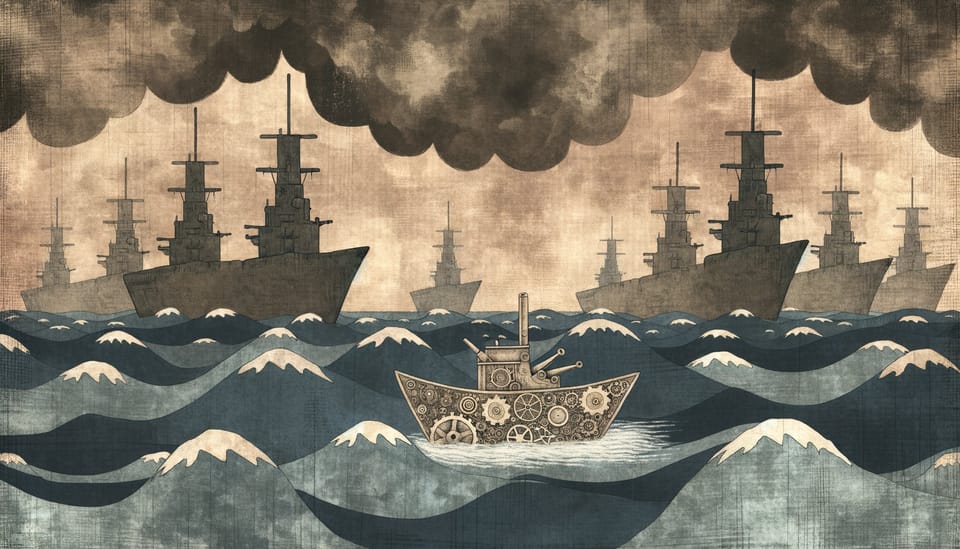
The Decibel Countdown: China's Submarine Weakness and the Taiwan Window
Chinese submarines remain dangerously loud—detectable by sensors designed to exploit their acoustic signatures. As allied underwater surveillance networks mature faster than Chinese quieting technology improves, Beijing faces a narrowing window where undersea weakness constrains Taiwan options....

The Decibel Countdown
China’s submarine fleet carries a secret it cannot hide: noise. The Type 093 nuclear attack submarines remain louder than Soviet Victor III-class boats from the 1970s. The Jin-class ballistic missile submarines—meant to provide a credible second-strike nuclear deterrent—produce acoustic signatures noisier than Russian submarines built nearly half a century ago. In the silent world of undersea warfare, where detection means death, China’s submarines announce themselves like drums in a library.
This acoustic vulnerability matters because submarines are not optional equipment for any serious attempt to coerce or invade Taiwan. They must sanitize sea lanes before an amphibious fleet can sail. They must hunt American carrier groups. They must threaten intervention forces with enough credibility to make Washington hesitate. And right now, they cannot do these things without being tracked, targeted, and killed.
The question haunting Beijing is whether this weakness can be fixed before adversaries make it permanent—and whether waiting to fix it surrenders a window that will never reopen.
What the Noise Reveals
The conventional story of Chinese military modernization emphasizes relentless progress. New destroyers slide down shipways. Hypersonic missiles enter service. The People’s Liberation Army Navy has grown into the world’s largest fleet by hull count. But beneath the waterline, the narrative fractures.
According to U.S. Naval War College assessments, Chinese submarines exhibit “surprising weaknesses in propulsion (from marine diesels to fuel cells) and submarine quieting.” The problem is not effort—China has invested enormously in its undersea fleet. The problem is physics and metallurgy, disciplines where money alone cannot buy competence.
Submarine quieting requires mastery of vibration isolation, precision manufacturing of propulsion components, and advanced metallurgical capabilities for reactor systems. Naval reactor compartments demand shielded containment barriers and collision protection using the most advanced materials in any energy system. China’s civilian nuclear infrastructure has not yet demonstrated the metallurgical sophistication that submarine propulsion requires. The gap between building a nuclear power plant and building a submarine reactor that won’t betray its boat is measured in decades of accumulated tacit knowledge.
The Americans and their allies know this. More importantly, they are building systems designed to exploit it.
The “Fish Hook” undersea surveillance architecture—a network of fixed sensors, autonomous vehicles, and AI-enabled acoustic processing stretching from Japan through the Philippines—functions as what one analyst called an “invasive predator” in the undersea ecosystem. Its purpose is not merely detection but persistent tracking: knowing where Chinese submarines are at all times, denying them the concealment that makes submarines lethal.
AI-enabled acoustic pattern recognition has transformed anti-submarine warfare. Machine learning systems trained on decades of acoustic signatures now achieve better-than-human detection rates. The “golden ears” of veteran sonar operators—that intuitive feel for a contact developed over years of listening—is being externalized into algorithms that never tire and never forget. Every Chinese submarine patrol becomes training data for systems designed to hunt its successors.
The Closing Window
Xi Jinping announced in 2017 that the PLA must achieve “full modernization and intelligentisation” by 2035, accelerating the original 2049 timeline by nearly fifteen years. The Pentagon’s 2024 China Military Power Report confirms this remains the target: complete military modernization by 2035.
The submarine modernization schedule tells a specific story. The Type 095 nuclear attack submarine and Type 096 ballistic missile submarine represent China’s attempt to close the acoustic gap. Naval War College analysts assess that the Type 095 “could approach Russia’s Improved Akula I class”—a submarine from the late 1980s. Progress, certainly. Parity with current American Virginia-class boats, no.
More critically, these submarines are not yet operational in significant numbers. The construction timeline suggests meaningful deployment in the early 2030s at earliest. Meanwhile, allied capabilities are not standing still.
The AUKUS agreement will deliver nuclear-powered submarines to Australia. Japan continues upgrading its already-formidable submarine force. South Korea is pursuing its own nuclear submarine program, with AUKUS-style frameworks under discussion. The sensor networks grow denser. The AI systems grow smarter. The acoustic environment grows more hostile to noisy boats.
This creates what strategists call a “temporal incommensurability”—a mismatch between the timelines of different actors that produces windows of vulnerability and opportunity. China’s window of maximum submarine weakness coincides with a period when allied ASW capabilities are improving faster than Chinese quieting technology.
By 2035, one of two things will be true: either China will have fielded enough quiet submarines to contest the undersea domain, or the allied sensor-shooter network will have matured to the point where even improved Chinese submarines cannot operate effectively. The current trajectory favors the latter.
The Taiwan Strait’s Acoustic Trap
Geography compounds the problem. The Taiwan Strait averages only 60 meters deep—a shallow, noisy environment where acoustic detection becomes both easier and harder in counterintuitive ways.
Shallow water creates multiple surface and bottom reflections that degrade sonar performance. This might seem advantageous for submarines. But the acoustic characteristics of shallow water favor smaller, quieter diesel-electric submarines over nuclear boats. Nuclear submarines must run reactor cooling pumps continuously; they cannot go completely silent. In the confined waters of the Taiwan Strait, this matters.
Taiwan operates a fleet of diesel-electric submarines. So do Japan and South Korea. These boats can sit on the bottom, running on batteries, producing almost no acoustic signature while waiting for targets. Chinese nuclear submarines entering the Strait to support an invasion would face a gauntlet of quiet adversaries in an environment that amplifies their own noise.
The operational requirements for a Taiwan campaign make this worse. Chinese military doctrine emphasizes “joint blockade and joint support operations.” Submarines must establish sea control before amphibious forces can transit. They must threaten American carrier groups sufficiently to create hesitation. They must protect the invasion fleet from submarine attack.
Each mission requires submarines to move, and movement means noise. A submarine sitting quietly at the bottom is not hunting carriers. A submarine hunting carriers is advertising its position. The operational tempo of a Taiwan campaign would force Chinese submarines into exactly the behaviors that make them vulnerable.
The Demographic Shadow
Submarines are not the only clock running against Beijing. China’s demographic trajectory creates its own temporal pressure.
By 2035, approximately 450 million Chinese citizens will be over 60—roughly 32.7% of the population. The economic burden of supporting this elderly cohort will constrain military spending precisely when modernization costs peak. More subtly, the generation that remembers the civil war split with Taiwan will be gone. The revolutionary legitimacy that ties Taiwan to CCP founding mythology will become historical abstraction rather than living memory.
This creates a double pressure. The economic window for military action narrows as demographic costs rise. The ideological urgency intensifies as the generation for whom Taiwan represents unfinished civil war business passes from the scene.
The CCP has invested enormous political capital in the narrative of reunification. Taiwan’s continued separation functions as what trauma researchers call “ongoing institutional betrayal”—not a past wound but a present failure that delegitimizes the regime’s foundational claims. Each year that passes without resolution erodes the revolutionary mandate.
Some Chinese strategists may calculate that action becomes harder with each passing year, not because capabilities decline but because the political will to accept costs diminishes. A 2027 or 2030 attempt would be led by officials who grew up with reunification as a defining mission. A 2040 attempt would be led by officials for whom Taiwan is a policy problem rather than an existential cause.
The Porcupine’s Teeth
Taiwan is not passive in this calculation. The “porcupine strategy”—making the island too costly to swallow—has acquired teeth that interact with submarine weakness in unexpected ways.
Mine warfare represents Taiwan’s most asymmetric advantage. Mines are cheap. Mine clearance is expensive and slow—weeks to months per harbor. Taiwan can mine its own ports, forcing China to choose between destroying the infrastructure it needs for successful invasion logistics or accepting massive delays while clearing mines under fire.
This creates what one analyst termed “event horizon generation”: each defensive layer produces a commitment threshold that China must cross. Mining the ports doesn’t just slow invasion; it forces a decision about whether to proceed knowing the ports will be damaged. Mining the strait approaches forces a decision about acceptable submarine losses. Mining the beaches forces a decision about amphibious casualty rates.
The submarine weakness amplifies each threshold. If Chinese submarines cannot sanitize the approaches, mine clearance vessels operate under constant threat. If Chinese submarines cannot establish sea control, the invasion fleet sails into contested waters. If Chinese submarines cannot threaten American intervention forces, the calculus of American involvement shifts.
The porcupine’s quills are not meant to defeat an invasion. They are meant to make the invasion’s costs visible before the first shot is fired—and to ensure those costs compound as submarine weakness persists.
The Sensor Network as Enclosure
The allied undersea surveillance architecture represents something historically unprecedented: the functional enclosure of international waters without formal sovereignty claims.
UNCLOS Article 113 requires flag states, not coastal states, to prosecute damage to submarine cables beyond territorial waters. This creates a jurisdictional gap that fixed sensor networks exploit. The Fish Hook architecture achieves property-like exclusion—Chinese submarines cannot operate freely in these waters—without triggering the legal frameworks designed to prevent maritime territorial expansion.
Historical enclosure required Parliamentary Acts to convert common rights into exclusive property. Modern sensor networks achieve the same functional result through technological fait accompli. The commons of the deep ocean is being enclosed not by law but by capability.
This matters for the “now or never” calculation because sensor networks, once established, are extraordinarily difficult to displace. Each year of operation generates more training data for AI systems. Each year of maintenance reveals more about adversary tactics. Each year of expansion fills more gaps in coverage.
China faces a choice: act while the network remains incomplete, or accept that the undersea domain will be permanently contested on terms set by adversaries.
The American Maintenance Mirror
One signal from the topology deserves attention: the U.S. submarine fleet’s own operational availability crisis. American submarines achieve only 60-66% availability rates, with maintenance backlogs stretching years.
This reveals a universal truth that Chinese planners cannot escape. Submarine operations impose maintenance burdens that no industrial base can easily absorb. The skills required—specialized welding, nuclear system maintenance, precision machining—take decades to develop. The parts supply chains are notoriously difficult to sustain.
China’s newer submarines will face the same maintenance trap. High operational tempo during a Taiwan campaign would accelerate wear. Wartime losses would be difficult to replace. The industrial base that builds submarines is not the same as the industrial base that maintains them under combat conditions.
The American maintenance crisis is public knowledge. China’s is not—but the physics are identical. If the United States struggles to keep 60% of its submarines operational, China’s newer fleet will face similar or worse constraints as it matures.
What Happens If Beijing Waits
The default trajectory is unfavorable to Chinese ambitions. Each year brings:
- Denser allied sensor networks with better AI processing
- More allied submarines (Australian, Japanese, South Korean) operating in the Western Pacific
- Incremental improvements in Chinese submarine quieting that do not match the pace of detection capability growth
- Demographic and economic constraints that reduce fiscal flexibility
- Erosion of the political coalition for whom Taiwan represents existential priority
By 2035, the undersea domain will likely be functionally denied to Chinese submarines in any Taiwan contingency. Not because Chinese boats cannot sail—they can—but because they cannot sail without being tracked, and tracked submarines are dead submarines.
The window does not close suddenly. It narrows gradually, like a door being pushed shut by an unseen hand. The question is whether Beijing recognizes the narrowing in time to act, and whether acting produces outcomes better than waiting.
The Limits of “Now or Never”
The “now or never” framing contains its own trap. It assumes that action within the window produces success, and inaction produces permanent failure. Neither assumption survives scrutiny.
Action within the window—say, 2027—would exploit submarine weakness but confront other vulnerabilities. Amphibious lift remains insufficient for a full-scale invasion. The PLA has never conducted a contested amphibious operation. American intervention, while uncertain, becomes more likely the more obvious the aggression.
The CSIS wargaming studies consistently show that Chinese blockade and invasion scenarios succeed only under assumptions of American hesitation or allied fragmentation. Submarine weakness is one variable among many.
Inaction does not produce permanent failure—it produces a different strategic environment. A China that cannot militarily coerce Taiwan in 2035 may pursue economic integration, political subversion, or demographic patience. The CCP has demonstrated capacity for long-term strategic adjustment before.
The “now or never” frame may be more useful as a description of how Chinese planners perceive their situation than as an objective assessment of strategic reality. Perception, however, drives decisions.
The Acoustic Signature of History
The submarine gap will close. Chinese engineering is not permanently inferior; it is temporarily behind. The Type 095 and 096 will eventually enter service. They will be quieter than their predecessors. They may approach Western capabilities of the 2020s by the 2030s.
But the allied response is not static. Quantum gravimeters—sensors that detect mass displacement directly rather than acoustic signatures—are under development. If they mature, the entire paradigm of submarine quieting becomes irrelevant. Detection would bypass acoustics entirely.
The race is not between Chinese submarines and American submarines. It is between Chinese submarine capability and the evolution of detection technology. That race has no finish line.
What remains is a window—perhaps a decade, perhaps less—where Chinese submarine weakness creates operational constraints that affect Taiwan contingency planning. Whether Beijing interprets this as pressure to act or incentive to wait depends on factors beyond acoustic signatures: leadership risk tolerance, economic conditions, American political unity, Taiwanese resilience.
The submarines cannot hide their noise. What they reveal about Chinese strategic calculations may be equally audible to those who listen carefully.
FAQ: Key Questions Answered
Q: How loud are Chinese submarines compared to American and Russian boats? A: Chinese Type 093 nuclear attack submarines remain louder than Soviet Victor III-class submarines from the 1970s. The Jin-class ballistic missile submarines are noisier than Russian SSBNs from the late 1970s. American Virginia-class submarines are significantly quieter than any current Chinese platform.
Q: What is the Fish Hook undersea surveillance network? A: Fish Hook refers to the allied network of fixed sensors, autonomous underwater vehicles, and AI-enabled acoustic processing systems stretching from Japan through the Philippines. Its purpose is persistent tracking of submarine movements in the Western Pacific, particularly Chinese boats.
Q: Could China successfully blockade Taiwan with its current submarine force? A: Current assessments suggest significant difficulty. Chinese submarines would face detection by allied sensor networks, opposition from Taiwanese, Japanese, and potentially American submarines, and the operational challenges of shallow-water warfare in the Taiwan Strait where their acoustic disadvantages are amplified.
Q: When will China’s new Type 095 and 096 submarines enter service? A: Construction timelines suggest meaningful deployment in the early 2030s. These submarines are expected to be significantly quieter than current platforms, potentially approaching Russian submarine capabilities from the late 1980s, but they will not match current American Virginia-class performance.
Sources & Further Reading
The analysis in this article draws on research and reporting from:
- U.S. Naval War College China Maritime Studies Institute - Technical assessment of PLAN submarine capabilities and modernization trajectory
- Pentagon China Military Power Report 2024 - Official U.S. assessment of Chinese military modernization timelines
- Mind Foundry AI-enabled Acoustic Intelligence - Analysis of machine learning applications in anti-submarine warfare
- War on the Rocks Mine Warfare Analysis - Assessment of Taiwan’s asymmetric defense options
- DTIC Environmental Data for Naval Warfare - Technical analysis of acoustic propagation in shallow water environments
- Economist Intelligence Unit China Demographics - Demographic projections and economic implications for 2035
- U.S. Naval Institute Proceedings - Analysis of submarine maintenance challenges affecting operational availability
- BE Horizon Japan-South Korea Nuclear Submarine Framework - Regional nuclear submarine proliferation dynamics