The Cornered Rat: What Made Vladimir Putin
A childhood in post-siege Leningrad, abandonment in Dresden, and the chaos of 1990s Russia forged a leader who experiences geopolitics as personal survival. Understanding Putin's formative crucibles explains decisions that have reshaped Europe.
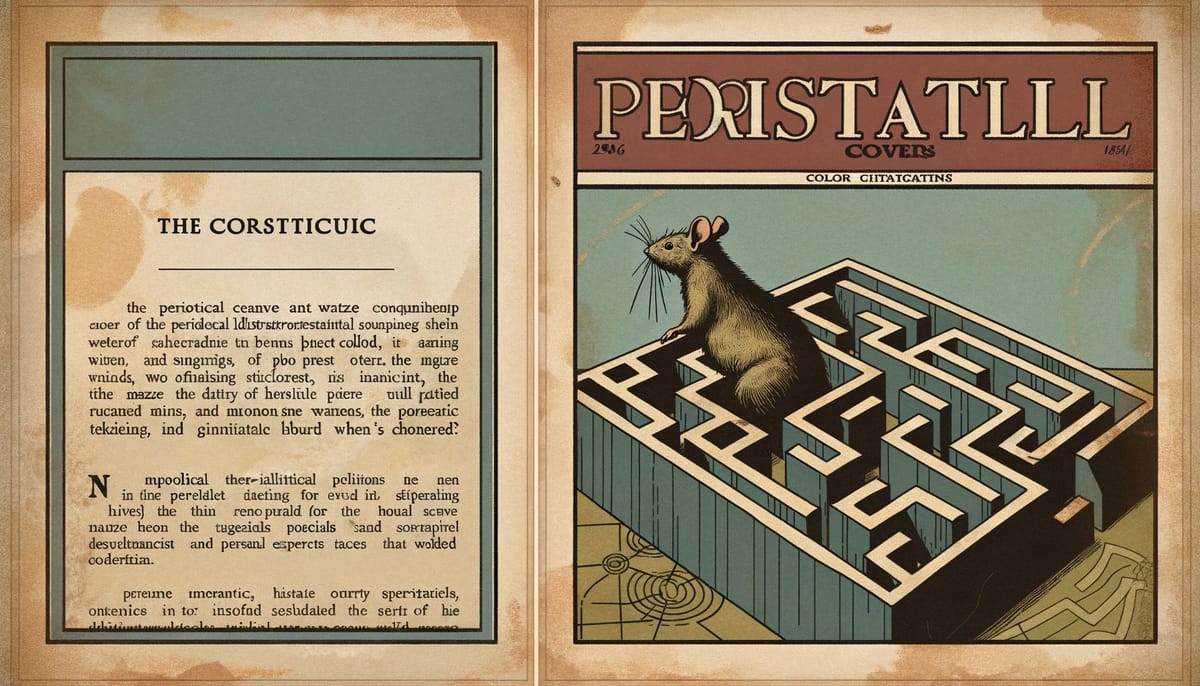
The Cornered Rat
In the cramped stairwell of a Leningrad kommunalka, a boy chased rats with a stick. The building had no hot water, no central heating, and walls that held the memory of siege. Vladimir Putin later described what happened when he cornered one: the rat turned and attacked, leaping at his face. He barely escaped by slamming a door. The lesson, as Putin tells it, was simple: never corner an opponent. Leave them a way out.
This childhood vignette, offered in Putin’s own authorized biography, functions as origin myth and strategic doctrine simultaneously. It is the key to understanding a leader who has remade Russia in his image and plunged Europe into its largest war since 1945. The rat story is not merely autobiography. It is a theory of power: the weak, when cornered, become dangerous. The strong must never allow themselves to be cornered. And if cornered, they must attack.
What made Putin into the leader he is today? The question has occupied Western intelligence agencies, academic Kremlinologists, and op-ed writers for a quarter century. The answers typically invoke his KGB background, his resentment of Soviet collapse, his Orthodox nationalism. These explanations are not wrong. They are incomplete. Putin’s worldview emerges from a specific sequence of formative crucibles—childhood deprivation, institutional betrayal, systemic collapse, and ideological reconstruction—that together produced a leader who experiences geopolitics as an extension of personal survival.
The Architecture of Trauma
Putin was born in 1952 to parents scarred by the Leningrad siege. His father, Vladimir Spiridonovich, had been badly wounded in the war. His mother, Maria Ivanovna, nearly died of starvation during the 900-day blockade. Two of Putin’s brothers died before he was born—one in infancy, one during the siege. According to research on adverse childhood experiences, this made him what psychologists call a “replacement child”: born to fill the void left by dead siblings, carrying impossible expectations from traumatized parents.
The kommunalka environment intensified these dynamics. Soviet communal apartments forced unrelated families to share kitchens, bathrooms, and corridors. Privacy was impossible. Trust was dangerous. Information about neighbors could be weaponized; vulnerability invited exploitation. Putin learned to read social situations for threat, to manage information asymmetrically, to project strength when weak. The skills that would later define his intelligence career were first honed in childhood surveillance of hallway dynamics.
His parents were emotionally distant—a common pattern among siege survivors who had learned that attachment meant loss. Putin responded by seeking structure outside the home. He found it first in judo, where he rose to black belt, and then in the KGB, which recruited him while still a law student. The security services offered what his family could not: hierarchy, belonging, purpose, and a framework for understanding the world as divided between threats and assets.
The KGB socialized Putin into a specific worldview. The West was the enemy. The Soviet state was civilization’s bulwark. Secrecy was virtue. Loyalty was survival. These were not merely professional precepts but existential truths, reinforced through years of training and operational experience. When Putin was posted to Dresden in 1985, he carried this worldview intact.
The Night Moscow Went Silent
Dresden was a backwater posting for an ambitious officer. Putin worked liaison with the Stasi, East Germany’s secret police, running agents and gathering intelligence on NATO. The work was unglamorous but steady. Then, on December 5, 1989, everything collapsed.
Protesters stormed the Stasi headquarters in Dresden. A crowd gathered outside the KGB compound. Putin, by his own account, called Moscow for instructions—for tanks, for orders, for any guidance. The response, as he later told interviewers, was devastating: “Moscow is silent.”
He burned documents. He burned so many that the furnace exploded. And he watched the system he had devoted his life to disintegrate in real time. Years later, Putin would describe the Soviet collapse as “the greatest geopolitical catastrophe of the century.” But Dresden was where he experienced that catastrophe personally—not as historical event but as abandonment.
The psychological impact cannot be overstated. As The Atlantic documented, Putin later said the collapse meant “all the ideals, all the goals that I had had when I went to work for the KGB, collapsed.” This was not merely career disappointment. It was identity annihilation. The institution that had given his life meaning had proven hollow. The empire he served had abandoned him to a mob. The lesson was clear: systems fail. Only personal networks endure.
Putin returned to Leningrad—soon to be St. Petersburg—and attached himself to Anatoly Sobchak, the reform-minded mayor. The relationship was complex: mentor and protégé, politician and fixer, democrat and former KGB officer. Putin learned how democratic politics worked from the inside. He also learned its vulnerabilities. When Sobchak lost his reelection bid in 1996 and faced corruption charges, Putin helped smuggle him out of Russia to Paris. Democratic processes had destroyed his mentor. Personal loyalty had saved him.
The Decade of Humiliation
The 1990s in Russia were not merely difficult. They were civilizationally traumatic. Hyperinflation erased savings overnight. The 1998 financial crisis collapsed the ruble. Life expectancy plummeted. Oligarchs stripped state assets through rigged privatizations. The loans-for-shares scheme transferred the crown jewels of Soviet industry to a handful of well-connected businessmen for pennies on the dollar.
Putin witnessed this as deputy mayor of St. Petersburg, where organized crime controlled vital infrastructure. The Tambov Gang ran ports, real estate, transportation, and the energy trade. Violence was not market failure but market formation—establishing who could set prices, who could enforce contracts, who could survive. The state’s monopoly on legitimate force had evaporated. What remained was a Hobbesian competition where the ruthless prospered and the naive perished.
This period crystallized Putin’s economic philosophy. He came to believe that markets without state power produce chaos, not prosperity. That natural resources are instruments of sovereignty, not commodities for sale. That oligarchs must serve the state or be destroyed. His 1997 doctoral dissertation—often dismissed as plagiarized—articulated these views explicitly. As analysis of the dissertation reveals, Putin argued that Russia’s mineral wealth should be leveraged for geopolitical advantage, not merely extracted for profit.
The 1990s also taught Putin that the West was not a partner but a predator. NATO expansion proceeded despite what Russian leaders believed were assurances to the contrary. Western advisers promoted “shock therapy” economic reforms that produced catastrophic public health outcomes—tuberculosis rates soared, mortality spiked, and Western institutions appeared indifferent. Whether or not Western policymakers intended harm, Russians experienced harm. The distinction mattered less than the result.
The Philosopher of Dictatorship
Putin’s worldview is not merely reactive. It has positive content, drawn from a specific intellectual tradition. His speeches and essays reference Ivan Ilyin, a Russian émigré philosopher who fled the Bolsheviks and eventually embraced fascism. Ilyin argued that Russia required dictatorial rule, that Western democracy was unsuited to the Russian soul, and that Ukraine had no legitimate existence as an independent nation.
According to detailed analysis of Putin’s doctrine, the president’s advisers describe his philosophy as rooted in “God, family, and private property”—Orthodox Christianity providing moral foundation, traditional family structures providing social order, and property rights (under state supervision) providing economic stability. This is not liberalism. It is a conscious rejection of liberalism, framed as civilizational defense against Western decadence.
The Orthodox dimension is particularly important. Putin has cultivated close ties with the Russian Orthodox Church, which reciprocates by providing theological legitimacy for his rule. The concept of “symphonia”—the Byzantine ideal of church-state harmony—informs his self-understanding. He is not merely a political leader but a defender of Orthodox civilization against hostile forces. Ukraine, in this framework, is not a foreign country but canonical territory of the Russian Church, temporarily separated by historical accident and Western manipulation.
Putin articulates what he calls a “philosophy of complexity” requiring “quantum mechanics”-like thinking about geopolitics. This is not scientific precision but rhetorical positioning—claiming that Western linear thinking cannot comprehend Russian strategic depth. The formulation reveals something genuine, however: Putin believes he operates on a different temporal and conceptual plane than his adversaries. They think in electoral cycles. He thinks in centuries.
The Power Vertical
When Putin became president in 2000, he inherited a state that barely functioned. Regional governors ignored federal law. Oligarchs controlled media and manipulated politics. The military had been humiliated in Chechnya. Tax collection was a joke. Within a decade, he had constructed what Russians call the “power vertical”—a centralized system where all significant decisions flow through the Kremlin.
The architecture is distinctive. Formal institutions exist—courts, legislatures, elections—but they are hollowed out, performing legitimacy rather than exercising independent authority. Real power resides in informal networks of personal loyalty, often staffed by former security service colleagues. As analysis of this system notes, the siloviki—men from the security services—form the core of Putin’s regime, sharing his worldview and his contempt for procedural constraints.
The legal system has been weaponized. Laws on “extremism” and “foreign agents” use self-referential definitions that can be applied to virtually anyone. The 2022 expansion of the foreign agent law removed even the requirement of foreign funding—now “any kind of foreign support” suffices. These instruments are not about law enforcement. They are about selective persecution, allowing the state to destroy opponents while maintaining a veneer of legality.
Information control completes the system. Domestic media has been consolidated under state or state-friendly ownership. Independent outlets have been shut down or driven into exile. RT and Sputnik project Russian narratives abroad. The approach is not merely censorship but what researchers call the “firehose of falsehood”—overwhelming audiences with contradictory claims until truth itself becomes contested. The technique achieves strategic advantage through information entropy rather than message discipline.
The Logic of Escalation
Putin’s strategic decisions follow patterns rooted in his formative experiences. He takes risks when he perceives weakness in opponents. He exercises patience when facing strength. He escalates when cornered. And he interprets Western actions through the lens of his 1990s trauma—every NATO expansion, every democracy promotion initiative, every sanctions package confirms that the West seeks Russia’s destruction.
The 2007 Munich Security Conference speech marked his public break with post-Cold War accommodation. Putin declared that “NATO expansion does not have any relation with the modernisation of the Alliance itself or with ensuring security in Europe.” The speech shocked Western audiences accustomed to diplomatic pleasantries. For Putin, it was merely stating obvious truths that Western hypocrisy had obscured.
The pattern since Munich has been consistent escalation: Georgia in 2008, Crimea in 2014, Syria in 2015, full-scale Ukraine invasion in 2022. Each intervention tested Western responses and found them wanting. Sanctions imposed costs but did not reverse gains. Military aid to opponents arrived slowly and with restrictions. The lesson Putin drew was that the West would not fight for its stated principles—that rhetoric about rules-based order masked unwillingness to enforce rules.
His July 2021 essay “On the Historical Unity of Russians and Ukrainians” provided the ideological framework for invasion. The document argued that Ukrainians and Russians are “one people” artificially divided by hostile external forces. Ukrainian statehood was an anti-Russian project. The “wall” between the nations must come down. When war came seven months later, the essay served as its manifesto.
The Nuclear Shadow
Putin’s willingness to invoke nuclear threats distinguishes him from Soviet leaders who treated such weapons as instruments of last resort. The November 2024 amendments to Russian nuclear doctrine lowered the threshold for use from threats to “the very existence of the state” to “critical threats” to sovereignty and territorial integrity. The change was not merely doctrinal. It was communicative—signaling that Russia would consider nuclear use in scenarios previously deemed unthinkable.
This risk tolerance has roots in Putin’s formative experiences. The Moscow theater hostage crisis of 2002 demonstrated his approach: security forces pumped an unknown gas into the building, killing all the terrorists and 129 hostages. The operation was declared a success. The casualties were acceptable. The lesson—that overwhelming force works if you control the aftermath narrative—has informed subsequent decisions.
The Perimeter system, Russia’s automated nuclear response mechanism, embodies this logic technologically. Designed to ensure retaliation even if leadership is decapitated, it literalizes Putin’s childhood lesson about cornered rats. The system guarantees that cornering Russia means mutual destruction. It is not a weapon but a commitment device, making Russian threats credible by removing human hesitation from the response chain.
What Drives the Decisions
Putin’s strategic choices emerge from the intersection of biography and belief. The childhood deprivation created hypervigilance and need for control. The KGB socialization provided a framework for understanding threats. The Dresden abandonment demonstrated that institutions fail. The 1990s chaos proved that weakness invites predation. The Orthodox-nationalist ideology supplied moral justification for authoritarian rule.
The result is a leader who experiences international relations as an extension of personal survival. NATO expansion is not a policy disagreement but an existential threat. Ukrainian independence is not a neighboring country’s choice but a violation of civilizational unity. Western sanctions are not economic pressure but siege warfare. Every interaction confirms the worldview; contradictory evidence is dismissed as deception.
His inner circle reinforces these tendencies. Nikolai Patrushev, the former Security Council secretary, believes the West has conspired to destroy Russia since the 16th century. Igor Sechin, the Rosneft CEO, shares Putin’s conviction that state control of resources is essential for survival. The decision-making circle has narrowed over time, excluding voices that might challenge assumptions. The system selects for confirmation, not correction.
The Trajectory Ahead
The dynamics that produced Putin’s worldview are self-reinforcing. Each Western response to Russian aggression confirms the narrative of encirclement. Each Russian escalation deepens Western commitment to containment. The feedback loop has no obvious exit.
Putin is 72. He has ruled Russia for a quarter century. The system he built depends on his personal arbitration of competing interests. No succession mechanism exists because creating one would acknowledge mortality and invite challenges. The power vertical has no provision for its own continuation.
This creates a dangerous instability. A leader who experiences geopolitics as personal survival has strong incentives to avoid situations where survival is threatened. But a leader with no succession plan also has incentives to extend conflicts indefinitely, since peace might invite the internal challenges that war suppresses. The cornered rat attacks. The rat who fears being cornered attacks preemptively.
Understanding Putin requires grasping that his worldview is internally coherent, even if externally destructive. He is not irrational. He is operating from premises that Western observers often fail to comprehend—premises forged in a Leningrad stairwell, refined in a Dresden compound, and hardened through decades of perceived humiliation. The boy who learned never to corner a rat became a man who ensures he can never be cornered. The cost of that lesson is being paid in Ukrainian blood.
Q: Did Putin’s KGB service shape his leadership style? A: Profoundly. The KGB socialized Putin into viewing the world as divided between threats and assets, valuing secrecy and loyalty above transparency and institutions. His intelligence background explains both his information-management skills and his difficulty trusting anyone outside personal networks.
Q: What role does Russian Orthodox Christianity play in Putin’s worldview? A: Orthodox Christianity provides moral legitimacy for Putin’s rule through the concept of “symphonia”—church-state harmony. It also frames Ukraine as canonical Russian territory and positions Putin as defender of traditional civilization against Western decadence.
Q: Why does Putin take such significant risks in foreign policy? A: Putin’s risk tolerance stems from formative experiences where caution proved fatal and aggression succeeded. The 1990s taught him that weakness invites predation; subsequent interventions in Georgia, Crimea, and Syria faced limited Western response, reinforcing the lesson.
Q: How does Putin’s inner circle influence his decisions? A: Putin’s decision-making circle has narrowed to trusted siloviki who share his worldview. Advisers like Nikolai Patrushev reinforce beliefs about Western hostility, while the absence of dissenting voices means assumptions go unchallenged.
Sources & Further Reading
The analysis in this article draws on research and reporting from:
- How Vladimir Putin’s Childhood Is Affecting Us All - Analysis of Putin’s adverse childhood experiences and their psychological impact
- How the 1980s Explains Vladimir Putin - The Atlantic’s examination of Putin’s Dresden experience and its formative influence
- The Putin Doctrine - Detailed analysis of Putin’s philosophical influences including Ivan Ilyin
- Putin’s Revolution and War at a Historical Crossroads - German Marshall Fund’s assessment of Putin’s decision-making patterns
- Putin’s Power Vertical and the Pathologies of Authoritarian Rule - New Statesman’s analysis of Russia’s centralized power structure
- Why Russia Is Changing Its Nuclear Doctrine Now - CSIS analysis of the 2024 nuclear doctrine amendments
- Key Ideas from Putin’s 1997 PhD Dissertation - Examination of Putin’s views on resource sovereignty
- On the Historical Unity of Russians and Ukrainians - Putin’s 2021 essay providing ideological framework for Ukraine policy