
The Commitment Trap
Australia's $368 billion submarine program locks it into US alliance dependency while China remains its largest trading partner. Trump 2.0's economic loyalty tests are eliminating the space for strategic hedging.
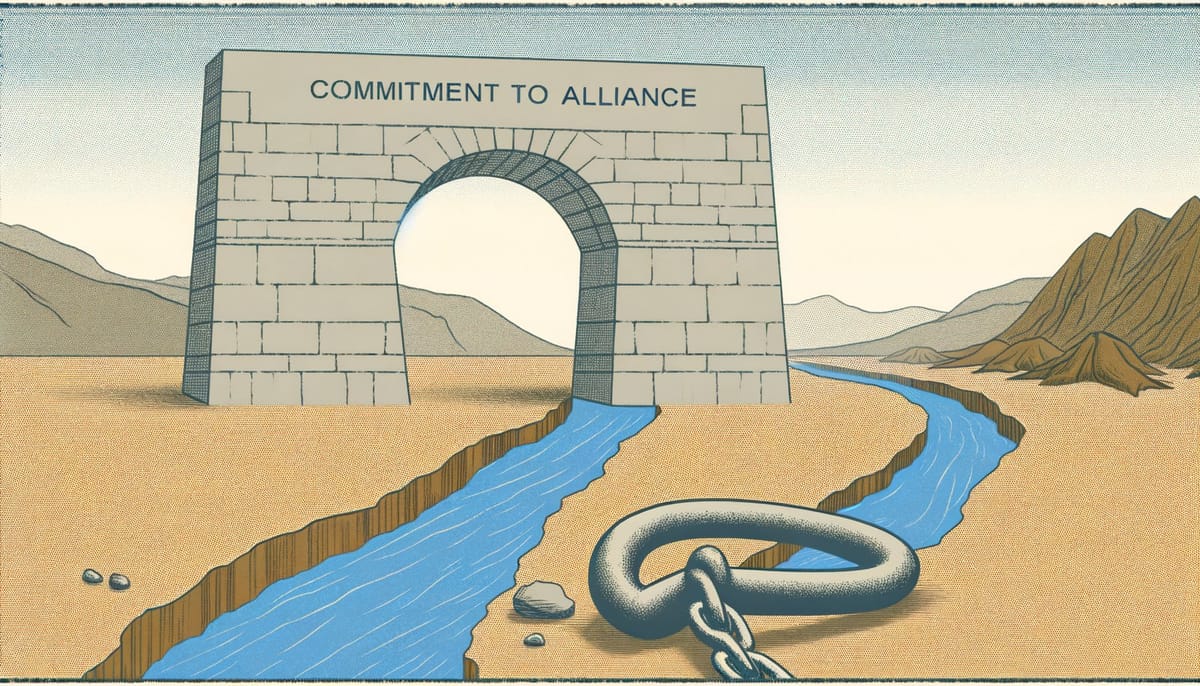
The Commitment Trap
Australia’s nuclear submarine program has a problem that $368 billion cannot solve. The AUKUS agreement locks Canberra into operational integration with US Pacific strategy decades before the first submarine arrives. Meanwhile, China remains Australia’s largest trading partner, accounting for 30% of exports worth $196 billion annually. This creates a temporal mismatch: alliance obligations that demand immediate compliance with trade relationships requiring long-term stability.
The conventional wisdom treats this as a balancing act—Australia walking a diplomatic tightrope between Washington and Beijing. But the physics have changed. Trump 2.0’s National Security Strategy explicitly demands “economic alignment as a critical component of the ANZUS alliance.” This transforms the relationship from mutual defense into comprehensive dependency. Australia no longer chooses between security and prosperity. It must choose which master to serve.
The Mathematics of Irreversibility
AUKUS operates through what defense analysts call “capability lock-in.” The Virginia-class submarines arriving in the early 2030s require US-manufactured reactor cores, weapons systems, and maintenance protocols. Australia cannot operate these vessels without American permission. More critically, the $6.7 billion in Northern Territory defense infrastructure creates domestic constituencies—construction firms, logistics companies, local governments—whose economic survival depends on alliance continuity.
This constituency capture preceded strategic value. Master Builders NT and KPMG-validated economic impact studies now lobby for AUKUS expansion before the program proves its deterrent effect. The infrastructure spending functions as a political prophylactic, making alliance termination economically devastating for key swing states.
China understands this dynamic. Beijing’s 2020-2022 trade coercion campaign deliberately exempted iron ore and LNG—82.9% of Australian exports to China—while punishing wine, barley, and education services. The selective punishment revealed that China values economic leverage over immediate compliance. Australian coal exports resumed in 2023 not because diplomatic relations improved, but because China’s energy security required it.
The asymmetry is structural. Australia’s defense commitments are irreversible; its trade relationships remain contingent. AUKUS submarine technology cannot be returned or repurposed. Chinese market access can disappear overnight.
The Trump Variable
Trump’s second presidency introduces a new forcing function: economic loyalty tests. The 2025 National Security Strategy frames trade policy as national security policy. Universal tariffs and secondary sanctions become tools for alliance discipline. Australia faces a choice between Chinese market access and American technology transfer.
This represents a qualitative shift from Trump’s first term. Then, Australia could maintain strategic ambiguity through careful diplomatic choreography—supporting US positions in principle while preserving Chinese economic ties. Trump 2.0 demands operational alignment. The administration views Australia’s continued China trade as subsidizing American competitors.
Consider the timeline pressures. Trump’s tariff threats operate on quarterly business cycles. Australian exporters need immediate market certainty. AUKUS capabilities arrive in the 2030s. Chinese retaliation would be immediate; American protection is theoretical. This temporal gap creates acute vulnerability.
The Lowy Institute’s 2025 polling reveals the domestic contradiction. 71% of Australians view Chinese military threats as likely. 80% consider the US alliance important. Yet 63% believe America would defend Australia in a crisis. This cognitive compartmentalization—high threat perception with stable alliance confidence—suggests Australians have not internalized the trade-offs their leaders face.
The Beijing Calculation
China’s strategy exploits Australia’s federal structure and resource dependence. Iron ore exports generate $100 billion annually, concentrated in Western Australia. LNG exports worth $50 billion flow primarily from Queensland and Western Australia. These states possess constitutional authority over resource extraction and strong incentives to resist federal foreign policy that threatens their economic base.
Beijing learned from its 2020-2022 coercion campaign. Broad economic punishment generated Australian resilience and successful market diversification. Targeted pressure on specific industries and states proved more effective. The threat of iron ore sanctions—China’s nuclear option—remains undeployed precisely because its credibility depends on restraint.
China’s rare earth processing monopoly provides additional leverage. Australia mines 12% of global rare earths but processes virtually none domestically. Chinese export restrictions on processing technology—not raw materials—could cripple Australia’s defense industrial ambitions without triggering traditional sanctions responses.
This creates a sophisticated pressure matrix. China can escalate economic coercion gradually: education visa restrictions, agricultural quarantine delays, rare earth processing limitations, and finally iron ore sanctions. Each step increases costs while maintaining plausible deniability.
The Alliance Trap
ANZUS Article IV requires Australia to “act to meet the common danger in accordance with its constitutional processes.” This deliberately vague language preserved Australian sovereignty during the Cold War. Trump 2.0 interprets constitutional processes as including economic policy. Trade relationships become alliance obligations.
The operational integration proceeds regardless of political preferences. Australian defense personnel train on US systems. Intelligence sharing protocols assume compatible threat assessments. Military exercises rehearse combined operations. These activities create institutional muscle memory that makes independent action increasingly difficult.
The submarine program exemplifies this dynamic. Australian naval officers will spend years training in US facilities. The boats themselves require American maintenance and weapons. Command and control systems integrate with US Pacific Fleet operations. By the mid-2030s, Australia will possess a navy it cannot operate independently.
This represents a return to pre-Westphalian sovereignty patterns. Medieval kingdoms owed military service to overlords in exchange for protection. The modern alliance system recreates this dependency through technological complexity rather than feudal obligation.
The Economic Reckoning
Australia’s defense spending trajectory reveals the fiscal squeeze. Defense expenditure will reach 2.3% of GDP by 2033-34, representing an 89% increase over the decade. AUKUS alone consumes $368 billion over thirty years. These commitments occur as China trade generates $312 billion annually in two-way trade.
The fiscal mathematics are unforgiving. Defense spending increases require either higher taxation, reduced social spending, or economic growth. Chinese trade restrictions would eliminate the growth option while alliance demands prevent the taxation option—American investors require competitive tax rates. Social spending becomes the residual variable.
Medical research funding illustrates the trade-off. Grant success rates hover at 9-13% while defense research receives guaranteed funding increases. The immune system analogy is precise: external threat perception triggers resource allocation toward immediate defense while starving long-term resilience infrastructure.
The Temporal Trap
Strategic hedging requires temporal flexibility. Middle powers preserve options by avoiding permanent commitments. AUKUS eliminates this flexibility through irreversible capability investments. The submarine program cannot be canceled without forfeiting sunk costs and alliance credibility.
China operates on generational planning cycles. The Belt and Road Initiative spans decades. Military modernization follows thirty-year timelines. American politics operates on electoral cycles. Trump 2.0 demands immediate results. Australia must reconcile these incompatible temporal frameworks.
The hedging literature reveals why this matters. Successful hedging requires maintaining relationships with competing powers throughout their rivalry. Early alignment forecloses future options. Australia’s AUKUS commitment occurred before the US-China rivalry reached its current intensity. The decision appears prescient if America wins, catastrophic if China does.
Crisis Scenarios
Taiwan represents the ultimate stress test. Chinese invasion would trigger ANZUS obligations while devastating Australian trade. The economic costs would be immediate: $196 billion in Chinese exports, supply chain disruption across manufacturing and agriculture, energy security threats through LNG market closure.
Military engagement would require capabilities Australia lacks. The submarine program provides long-term deterrence, not crisis response. Australian surface vessels would face Chinese missile saturation attacks. The geography favors defense: Australia could contribute intelligence and logistics without direct combat exposure.
But alliance expectations have evolved. Trump’s burden-sharing demands assume allied combat participation, not logistical support. The administration would interpret Australian restraint as alliance abandonment. Economic sanctions would follow military disengagement.
Alternative scenarios stress the relationship differently. Renewed Chinese trade coercion would test American support. Graduated economic pressure—education restrictions, agricultural barriers, rare earth processing limits—might not trigger alliance responses. Australia would face economic damage without security compensation.
The Path Forward
Three scenarios emerge from current trajectories. Full alignment with US demands would sacrifice Chinese trade for alliance integration. Australia would become a Pacific Britain: prosperous through American partnership but economically dependent on alliance continuity.
Continued hedging attempts face structural obstacles. Trump 2.0’s economic loyalty tests make strategic ambiguity impossible. Binary choices replace diplomatic nuance. Australia must choose economic alignment or face secondary sanctions.
The third path—managed decline of both relationships—appears most likely. Australia would maintain formal alliance commitments while accepting reduced Chinese market access. Neither Washington nor Beijing would receive full compliance. Both would apply graduated pressure.
This scenario minimizes short-term disruption while maximizing long-term vulnerability. Australia would preserve sovereignty at the cost of strategic influence. Regional middle power status would erode as larger neighbors choose sides.
The Deeper Pattern
Australia’s dilemma reflects broader middle power constraints in bipolar competition. The tributary system allowed multiple relationships through hierarchical acknowledgment. Westphalian sovereignty promised legal equality regardless of power differentials. Neither framework accommodates technological dependence combined with economic integration.
The AUKUS commitment represents a return to alliance dependency disguised as capability enhancement. Australia gains military technology while surrendering strategic autonomy. The submarines provide deterrent capability but require American permission to operate.
China’s economic leverage operates through similar mechanisms. Market access creates dependency relationships that transcend formal sovereignty. Australian exporters modify behavior to maintain Chinese approval. Economic integration becomes political subordination.
The Reckoning
Australia’s tightrope walk faces a fundamental constraint: the rope is disappearing. Trump 2.0’s economic alignment demands eliminate the space between alliance and trade relationships. AUKUS technological dependence reduces strategic flexibility. Chinese economic leverage grows as American protection remains theoretical.
The question is not how long Australia can maintain its balancing act, but what replaces it. Full alliance integration offers security at the cost of sovereignty. Chinese accommodation provides prosperity through subordination. Independent middle power status requires capabilities Australia lacks and costs it cannot afford.
The mathematics are stark. Australia must choose between economic sovereignty and military security. The tightrope metaphor assumes both are possible simultaneously. The physics of great power competition suggest otherwise.
Sources & Further Reading
The analysis in this article draws on research and reporting from:
- The opportunity cost of AUKUS | The Strategist - Analysis of AUKUS fiscal and strategic trade-offs
- East Asia’s Alliance Dilemma: Public Perceptions of the Competing Risks - Academic research on alliance burden-sharing and public opinion
- US alliance: effect - Lowy Institute Poll - Australian public opinion data on US alliance and China threat perception
- Australia’s response to Chinese economic coercion - Detailed analysis of China’s 2020-2022 trade restrictions and Australian responses
- Four Costly Signaling Mechanisms | American Political Science Review - Academic framework for understanding alliance commitment mechanisms
- Stabilizing China Trade and Seeking Indo-Pacific Balance - Strategic analysis of economic hedging options
- China’s Rare Earth Processing Monopoly Crisis 2025 - Critical minerals dependence and supply chain vulnerabilities