The Carrier Question: China's Missiles and the Future of Taiwan Defense
China's long-range anti-ship missiles can now theoretically reach American carriers thousands of miles from its coast. But whether this capability translates into strategic advantage depends on kill chains, countermeasures, and political will—variables that neither side has tested in combat.

The Geometry of Vulnerability
A carrier strike group costs $7 million per day to operate. A DF-26 missile costs perhaps $30 million to build. The exchange ratio favors the missile by orders of magnitude—but exchange ratios do not win wars. What matters is whether the missile can find, track, and hit a moving target across 4,000 kilometers of open ocean, through layers of electronic warfare, decoys, and interceptors, while its targeting chain survives counterattack. China claims it can. The Pentagon is not certain China cannot. That uncertainty is reshaping American strategy in the Pacific.
The question of whether China’s long-range strike capability negates American carrier power in a Taiwan contingency appears simple. It is not. It conflates capability with employment, range with accuracy, and platforms with systems. The carrier is not a weapon; it is a logistics node for projecting airpower. Whether that node can operate close enough to Taiwan to matter depends on variables that neither side has tested in combat: the kill chain’s resilience, the defender’s countermeasures, and the political will to absorb losses.
What China Has Built
China now operates five types of anti-ship ballistic missiles, each designed to hold American carriers at risk. The DF-21D, operational since 2010, reaches 1,450 to 2,150 kilometers. The DF-26, dubbed the “Guam Killer,” extends to approximately 4,000 kilometers. The DF-17 carries a hypersonic glide vehicle. The YJ-21 launches from ships and aircraft. Most consequentially, the DF-27 reportedly achieves intercontinental range—5,000 to 8,000 kilometers—potentially threatening carriers operating west of Hawaii.
Range alone means little. Hitting a carrier requires a kill chain: sensors to detect, systems to track, networks to process, and weapons to strike—all functioning faster than the target can move. The Taiwan Strait spans 180 kilometers at its narrowest. A carrier operating 1,000 kilometers east of Taiwan places its F-35Cs roughly 600 nautical miles from combat—the edge of their unrefueled range. Push the carrier back to 2,000 kilometers and the math breaks. The air wing cannot reach the fight.
China’s 2020 live-fire test of a DF-26 against a moving maritime target in the South China Sea created what strategists call an irreversible information asymmetry. Beijing now knows its actual hit probability. Washington must estimate. That gap shapes every deployment decision.
The targeting problem, however, remains unsolved in operational conditions. China’s over-the-horizon radars can detect carrier-sized objects at vast distances, but detection is not targeting. The ocean is large. Carriers move. Electronic warfare degrades sensors. The kill chain must hand off targeting data through multiple nodes—satellites, aircraft, command centers—each vulnerable to disruption. American doctrine increasingly focuses on breaking that chain rather than intercepting its output.
The Carrier’s Evolving Role
The U.S. Navy has not stood still. Distributed Maritime Operations, the doctrine adopted in response to Chinese anti-access capabilities, disperses the fleet while concentrating effects. Rather than massing carrier groups within range of massed missiles, the concept spreads platforms across vast areas, networking their sensors and shooters to create kill webs rather than kill chains.
This sounds elegant in PowerPoint. Implementation creates paradoxes. Carriers must disperse for survivability but concentrate for sortie generation. An F-35C’s combat radius demands the carrier operate within overlapping coverage zones to sustain air operations. Disperse too widely and the air wing cannot mass fires. Concentrate too tightly and the missiles find you.
The Navy’s response has been layered. SM-6 missiles provide terminal defense against ballistic threats. Electronic warfare suites aim to blind incoming seekers. Decoys attempt to seduce them. But the arithmetic is unforgiving: a carrier group might carry 300 interceptors across its escorts. China might launch 500 missiles in a saturation attack. Each interception depletes non-replenishable capacity. There is no reloading at sea.
War games consistently produce carrier losses in Taiwan scenarios. A leaked Pentagon assessment reportedly showed China sinking the USS Gerald R. Ford in simulated conflict. Such exercises test worst-case assumptions, but their conclusions shape force structure debates. The carrier industrial base—distributed across congressional districts precisely to ensure political survival—faces questions about whether $13 billion platforms remain viable against $30 million missiles.
Beyond the Carrier Question
Framing Taiwan’s defense around carrier vulnerability misses the operational picture. Carriers are one element of a system that includes submarines, bombers, land-based missiles, allied forces, and Taiwan’s own defenses. The question is not whether carriers survive but whether the combined force can impose costs sufficient to deter or defeat Chinese aggression.
American attack submarines operate with near-impunity in the Western Pacific. China’s anti-submarine warfare remains its most significant capability gap. A dozen Virginia-class boats carrying Tomahawk missiles can strike Chinese invasion fleets, logistics nodes, and command centers without exposing themselves to the missile threats that endanger surface ships. Their limitation is magazine depth: each submarine carries roughly 40 weapons. Reload requires returning to port.
B-21 Raider bombers, entering service, can launch standoff weapons from beyond Chinese air defense range. B-52s carrying hypersonic missiles extend that reach further. The Air Force’s bomber fleet provides strike capacity independent of carrier survivability—but depends on basing access that itself faces Chinese missile threats.
Guam, the linchpin of American power projection in the Pacific, lies within DF-26 range. Its aging power grid has been compromised by Chinese cyber operations, with Volt Typhoon malware pre-positioned in critical infrastructure. An attack on Taiwan might begin with Guam’s lights going dark.
Taiwan’s Own Choices
Taiwan’s defense posture has shifted toward what analysts call asymmetric denial. Rather than matching China platform-for-platform, Taipei increasingly invests in mobile anti-ship missiles, sea mines, drones, and dispersed ground forces designed to make invasion prohibitively costly. The logic mirrors Ukraine’s defense against Russia: make the attacker bleed for every kilometer.
The transition remains incomplete. Taiwan’s four-month conscription period provides insufficient training for the complex asymmetric tactics required. Political resistance to extended service persists. The island retains expensive legacy platforms—tanks, fighter jets—that critics argue would be destroyed in the opening hours of conflict.
Geography favors the defender. The Taiwan Strait’s shallow waters, complex acoustics, and strong currents complicate amphibious operations. China would need to cross 180 kilometers of contested water, establish beachheads against prepared defenses, and sustain logistics under constant attack. No military has attempted an opposed amphibious assault of this scale since 1945. The Normandy landings succeeded against a Germany already losing on two fronts. China would face a defender backed by American and allied power.
The Taiwan Relations Act commits the United States to provide Taiwan with defensive articles and services but imposes no legal obligation for direct military intervention. Strategic ambiguity—the deliberate uncertainty about American response—has served as deterrent for decades. Whether that ambiguity enhances or undermines deterrence as Chinese capabilities grow remains fiercely debated.
The Alliance Dimension
Japan’s role has transformed. Once constrained to self-defense, Tokyo now acknowledges that a Taiwan contingency constitutes a threat to Japan’s survival, potentially triggering collective self-defense provisions. American bases in Japan—Kadena, Yokosuka, Sasebo—would be essential to any Taiwan defense. They would also be targets.
Australia’s AUKUS commitment places nuclear-powered submarines in the equation by the 2030s. The Philippines has reopened bases to American forces. South Korea’s role remains ambiguous, constrained by its own China relationship and North Korean threat.
Allied contributions matter less for their military weight than for their political signal. China must calculate not against American power alone but against a coalition whose collective response remains uncertain. That uncertainty—the inverse of American strategic ambiguity toward Taiwan—complicates Chinese planning.
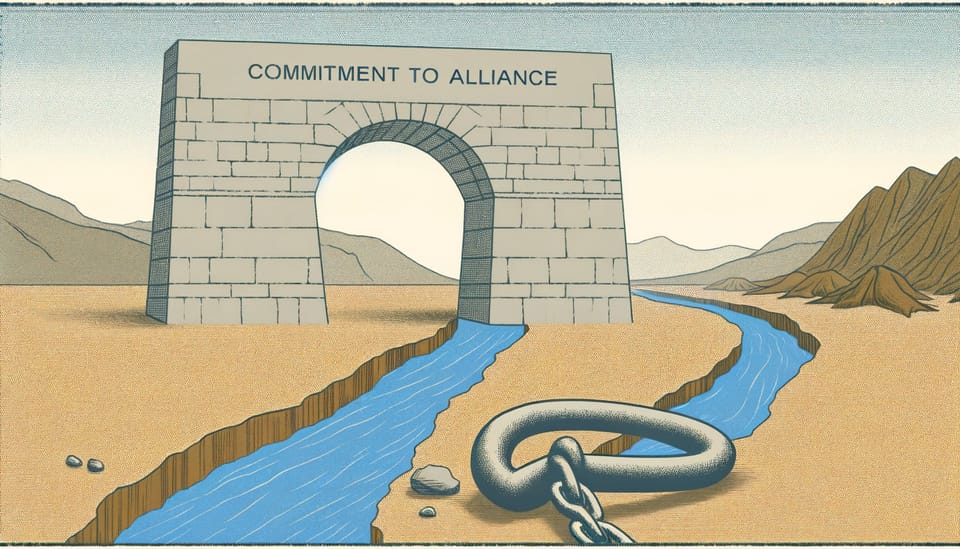
The burden-sharing dynamic creates its own tensions. American pressure for allies to spend more, host more, risk more can undermine the alliance cohesion it seeks to strengthen. The potlatch logic of alliance politics—where each demonstration of commitment creates obligations for reciprocation—means American carrier deployments near Taiwan bind Washington as much as they reassure Taipei.
What Actually Breaks
If current trajectories continue, the most likely failure mode is not carrier sinking but political paralysis. The Pentagon’s classified assessments projecting heavy American losses in a Taiwan scenario create a strategic paradox: accurate military analysis may itself constrain deterrence by revealing to domestic audiences—and to Beijing—the costs Washington might be unwilling to bear.
American casualty sensitivity has historically tolerated roughly 5,000 deaths before public support collapses. A single carrier loss could approach that threshold. The political question—whether an administration would risk a carrier to defend Taiwan—may matter more than the military question of whether the carrier would survive.
China faces its own constraints. Economic interdependence with the United States and allies imposes costs that military capability cannot offset. Taiwan produces over 90% of the world’s most advanced semiconductors. A war that destroys TSMC’s fabs would devastate China’s own technology sector. The Malacca Strait, through which 80% of China’s oil imports transit, remains vulnerable to distant blockade.
Xi Jinping has set 2027—the centenary of the People’s Liberation Army—as a readiness deadline. Whether this represents an invasion timeline or a modernization benchmark remains unclear. The ambiguity itself shapes American planning, forcing investments and deployments that might otherwise be delayed.
Intervention Points
Three leverage points could shift the trajectory.
First, accelerating Taiwan’s asymmetric transition. This requires American pressure on Taipei to abandon prestige platforms in favor of mines, missiles, and drones—and American willingness to prioritize these systems in arms transfers over the fighter jets Taiwan’s air force prefers. The political feasibility is medium: Taiwan’s military culture resists the shift, but the logic is increasingly undeniable.
Second, hardening the Western Pacific basing network. Guam’s vulnerability is a choice, not a fate. Dispersing fuel and munitions, hardening command facilities, and establishing expeditionary airfields across the Pacific would complicate Chinese targeting. The cost runs to tens of billions. The alternative is watching the first island chain become untenable in the opening hours of conflict.
Third, developing counter-kill-chain capabilities. Breaking China’s targeting network—through cyber operations against its satellites, electronic warfare against its radars, and kinetic strikes against its command nodes—may prove more effective than intercepting missiles already in flight. This requires capabilities the United States has been reluctant to demonstrate, for fear of revealing them.
Each intervention carries costs. Pressuring Taiwan risks alienating the partner being defended. Hardening Guam diverts resources from other priorities. Demonstrating counter-ISR capabilities surrenders surprise. There are no free options.
The Most Likely Outcome
Carriers will not disappear from the Pacific. They will operate differently—further from Chinese shores, in distributed formations, with expanded defensive screens. Their role will shift from strike platform to command node, coordinating fires from submarines, bombers, and allied forces while staying outside the densest missile threat rings.
This represents adaptation, not defeat. The carrier remains the most flexible instrument of American power projection, capable of responding to crises from the Taiwan Strait to the Persian Gulf within days. No alternative provides equivalent capability. The question is whether flexibility justifies vulnerability in the specific scenario of Taiwan defense.
The honest answer is that no one knows. China has never fired an anti-ship ballistic missile at a maneuvering carrier defended by electronic warfare, decoys, and interceptors. The United States has never operated a carrier strike group under sustained missile attack. Both sides plan based on models, simulations, and assumptions that combat would rapidly invalidate.
What can be said with confidence: the era of carrier invulnerability is over. American strategy in the Pacific now rests on a distributed architecture where carriers are one node among many, valuable but not essential. Whether that architecture can defend Taiwan depends less on any single platform than on the system’s collective resilience—and on political will that no weapon can manufacture.
FAQ: Key Questions Answered
Q: Can China actually hit a moving aircraft carrier from 5,000 miles away? A: China has tested anti-ship ballistic missiles against moving maritime targets, but never against a defended carrier employing electronic warfare, decoys, and interceptors. The theoretical capability exists; operational reliability under combat conditions remains unproven.
Q: Would the US legally have to defend Taiwan if China attacks? A: No. The Taiwan Relations Act requires the US to provide defensive articles and services but creates no binding commitment to military intervention. Any decision to use force would require presidential judgment and, beyond 60 days, congressional authorization.
Q: What happens to the global economy if Taiwan is invaded? A: Taiwan produces over 90% of the world’s most advanced semiconductors. A conflict that damages TSMC’s fabrication facilities would cause a global technology crisis affecting everything from smartphones to automobiles to military systems—including China’s own.
Q: Are aircraft carriers becoming obsolete? A: Carriers face new vulnerabilities but retain unique capabilities for power projection and crisis response. Their role is evolving from frontline strike platform to distributed command node operating further from contested areas while coordinating fires from submarines, bombers, and missiles.
The Ritual of Readiness
Every few months, a carrier strike group transits the Taiwan Strait. The choreography is familiar: Beijing protests, Washington affirms freedom of navigation, analysts parse the timing. The ritual continues because both sides find it useful—China to demonstrate resolve, America to demonstrate presence.
But rituals can outlive their meaning. The carrier transit that once signaled uncontested dominance now signals something more ambiguous: a willingness to accept risk, a commitment that may or may not survive contact with actual missiles. The signal works only if the recipient believes the sender would follow through.
China is watching. So is Taiwan. So is every ally calculating whether American protection remains credible in an age when American platforms face genuine threat. The answer will not come from weapons specifications or war game outcomes. It will come from a decision, made in crisis, about what America is willing to lose.
That decision has not yet been made. It may never need to be. Deterrence succeeds by making the test unnecessary. But the test is now imaginable in ways it was not a decade ago. That imagination—shared in Beijing, Taipei, Tokyo, and Washington—is itself reshaping the strategic landscape.
The carrier remains. Its meaning has changed.
Sources & Further Reading
The analysis in this article draws on research and reporting from:
- Pentagon China Military Power Report 2024 - Comprehensive assessment of PLA capabilities including anti-ship ballistic missile development
- USNI News on DF-27 Capabilities - Reporting on China’s intercontinental anti-ship missile development
- Congressional Research Service: Distributed Maritime Operations - Analysis of US Navy’s evolving operational concepts
- Taiwan Relations Act - Primary legal document governing US-Taiwan relations
- Congressional Research Service: Taiwan Defense Issues - Assessment of Taiwan defense challenges and US policy options
- CATO Institute: Taiwan’s Asymmetric Defense - Analysis of Taiwan’s defense transition requirements
- CSIS Missile Threat: DF-26 - Technical specifications of China’s intermediate-range ballistic missiles