
The Art of Not Choosing: How Asia Navigates Great Power Conflict
From ASEAN's calculated silence to Taiwan's shadow over every calculation, Asian states have built a sophisticated grammar of non-commitment. But the ambiguity space that enabled decades of stability is shrinking fast.
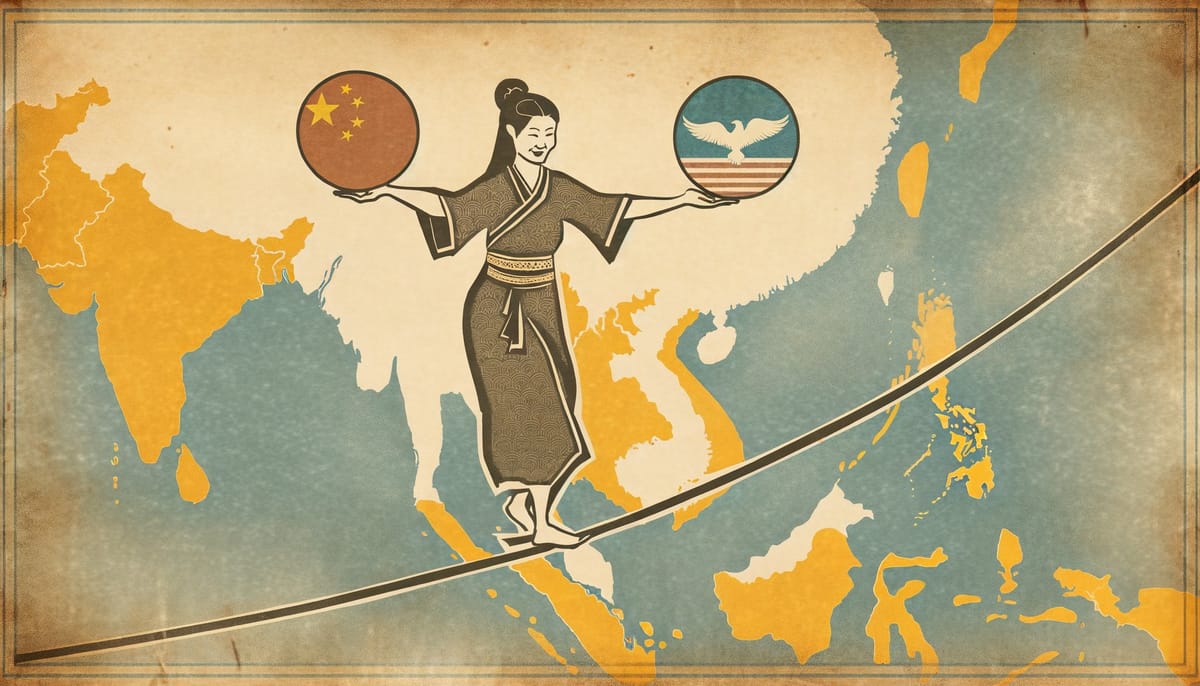
The Art of Not Choosing
When China’s coast guard vessels surrounded Scarborough Shoal in 2012, the Philippines expected ASEAN to respond. It waited. When Vietnam’s fishing boats faced ramming in disputed waters, Hanoi looked to its neighbors. They demurred. When Cambodia blocked joint statements on the South China Sea year after year, the pattern became doctrine. ASEAN’s consensus requirement—unanimity among ten members—had transformed from diplomatic courtesy into strategic architecture. The silence was the strategy.
This is how Asia manages great power conflict: not through decisive alignment but through the cultivation of ambiguity as a survival mechanism. The region’s states have developed what might be called a grammar of non-commitment, a sophisticated vocabulary of hedging that allows them to extract benefits from both Washington and Beijing while binding themselves permanently to neither. It works until it doesn’t. And the conditions under which it stops working are now visibly approaching.
The Superposition States
The physics metaphor is precise. Quantum systems exist in superposition—simultaneously occupying multiple states—until observation forces collapse into a single outcome. Southeast Asian foreign policy operates identically. Vietnam maintains a “four nos” defense policy (no military alliances, no foreign bases, no alignment against third countries, no force in international relations) while quietly expanding defense cooperation with the United States, India, and Japan. The policy’s value lies entirely in its ambiguity.
Singapore hosts American naval logistics and rotational forces while maintaining robust economic ties with China and refusing to be drawn into explicit alliance frameworks. Indonesia proclaims “free and active” non-alignment as constitutional principle while accepting both Chinese infrastructure investment and American security cooperation. Thailand, a formal US treaty ally, conducts joint military exercises with China and purchases Chinese submarines. The Philippines, under different presidents, has oscillated between confrontation and accommodation with Beijing, sometimes within the same administration.
This is not incoherence. It is system design.
The mathematics are brutal. ASEAN’s consensus mechanism creates what computer scientists would recognize as a Byzantine fault tolerance problem—except inverted. Byzantine systems tolerate up to one-third malicious nodes by design. ASEAN requires 100% agreement, meaning any single compromised member exercises effective veto power. Cambodia’s consistent blocking of South China Sea language in joint statements demonstrates the vulnerability: a 1/n failure threshold in a ten-member organization.
Yet the vulnerability is also the feature. Consensus requirements allow every member to credibly claim they cannot act without regional agreement, deflecting pressure from both great powers while preserving individual maneuver space. The inability to act collectively becomes the excuse for acting independently.
The Hedging Architecture
Three structural forces shape how Asian states navigate great power competition: economic gravity, security anxiety, and institutional inadequacy. Each pulls in different directions. The result is not paralysis but a distinctive pattern of managed contradiction.
Economic gravity pulls toward China. The numbers admit no argument. China is the largest trading partner for virtually every Asian economy. RCEP, the Regional Comprehensive Economic Partnership, institutionalizes supply chain integration across fifteen countries representing 30% of global GDP. Chinese components flow into Vietnamese factories for assembly into goods exported to American consumers. Decoupling is not a policy option; it is an economic fantasy.
The dependency runs deeper than trade statistics suggest. Chinese rare earth processing controls 90% of global refining capacity—the alchemical separation stage where raw ore becomes usable material. Mining can be relocated; refining cannot, at least not within any politically relevant timeframe. Australia discovered this when Chinese trade restrictions following its call for a COVID-19 inquiry revealed the limits of commodity leverage. Ore means nothing without processing. The bottleneck is the power.
Security anxiety pulls toward America. China’s military modernization, its assertiveness in the South China Sea, its gray-zone coercion through coast guard vessels and maritime militia—these generate hedging demand that only US security guarantees can partially satisfy. Japan’s dramatic defense budget increases, Australia’s AUKUS nuclear submarine commitment, the Philippines’ renewed embrace of American basing access: all reflect calculations that economic interdependence with China does not preclude security competition.
The Quad’s revival illustrates the dynamic. After forming briefly in 2007 and lying dormant for a decade—a period of institutional stasis that resembles paleontological patterns more than policy failure—it reconstituted rapidly when threat perceptions aligned. Successful minilaterals emerge not from comprehensive institutional design but from pre-existing bilateral relationships that lower coordination costs. Australia-Japan, US-India, Japan-India: the dyads existed before the quadrilateral crystallized around them.
Institutional inadequacy shapes what hedging can achieve. ASEAN centrality—the norm that regional security discussions should flow through ASEAN-led mechanisms—provides process without power. The ASEAN Regional Forum convenes. The East Asia Summit meets. The Declaration on the Conduct of Parties in the South China Sea remains, after two decades, a declaration rather than a code. Negotiations continue. Brackets multiply in draft texts, preserving disagreement in diplomatic amber.
The Gray Zone Gambit
China has developed a coercion grammar specifically calibrated to exploit hedging systems. The maritime militia—fishing vessels that coordinate with coast guard and naval forces while maintaining civilian cover—operates in what analysts call the gray zone: below the threshold of armed conflict but above normal peacetime activity.
The organizational structure is the strategy. Decentralized command creates attribution problems. No umbrella ownership means no clear chain of responsibility. Individual vessels can be disavowed; patterns cannot be prosecuted. The lack of coordination becomes the coordination mechanism—actors synchronize around structural punctuation points rather than explicit orders, like gamelan musicians orienting to colotomic gong markers rather than a conductor’s baton.
Salami-slicing—incremental territorial assertion through accumulated micro-aggressions—requires continuous calibration. Each provocation must remain below response thresholds while cumulatively shifting baselines. The 2012 Scarborough Shoal standoff established the template: presence, persistence, patience. The Philippines withdrew its vessels to de-escalate. China’s remained. Possession followed.
Gray-zone effectiveness depends on the target’s hedging posture. States committed to clear alignment can respond symmetrically; ambiguous states cannot without collapsing their superposition. Vietnam’s response to the 2014 oil rig crisis—accepting the incident while avoiding escalation—preserved hedging space at the cost of territorial position. The Philippines’ 2016 arbitration victory at The Hague produced a legal ruling China ignores and a precedent other claimants hesitate to invoke.
International law functions here as negative space. The Treaty of Amity and Cooperation’s non-interference obligations achieve definition only through surrounding positive commitments—the void exists because the structure exists. Legal frameworks constrain not through enforcement but through the costs of explicit violation. China’s rejection of the arbitral tribunal’s jurisdiction was expensive in legitimacy terms, which is why it bothered to reject rather than simply ignore.
The Alliance Asymmetry
American alliances in Asia exhibit a fundamental asymmetry that shapes how partners manage great power conflict. NATO operates through integrated command structures, standardized equipment, and collective defense obligations tested across seven decades. Asian alliances are bilateral spokes radiating from a Washington hub, with minimal lateral connections and no collective mechanism.
This architecture has advantages. Bilateral arrangements can be tailored to specific partners. Japan’s alliance differs from South Korea’s differs from the Philippines’ differs from Thailand’s. No consensus requirement paralyzes response. But the hub-and-spoke model also means that alliance coordination depends on American initiative and American presence.
The US-Japan-South Korea trilateral represents an attempt to build lateral connections. Historical animosities between Tokyo and Seoul—rooted in colonial memory and unresolved grievances—have repeatedly obstructed cooperation. The Camp David summit of 2023 marked a breakthrough, but sustainability depends on political continuity in all three capitals. South Korean presidents serve single five-year terms. Japanese prime ministers rise and fall with factional politics. American administrations reverse predecessors’ commitments.
AUKUS operates on different logic entirely. Nuclear submarine technology transfer to Australia represents a thirty-year commitment that transcends electoral cycles—or attempts to. The industrial base requirements are staggering: Australia must build advanced manufacturing capacity it currently lacks to sustain vessels it has never operated. The timeline extends beyond any plausible planning horizon for democratic governments.
This is the alliance paradox. Credible commitments require duration that democracies struggle to provide. China’s strategic culture operates on generational timescales; NATO democracies reset every four years. The temporal mismatch is structural, not incidental.
The Economic Weapon
Economic interdependence was supposed to constrain conflict. The theory held that trade creates mutual vulnerability, raising the costs of confrontation beyond any rational benefit. China’s rise was welcomed partly on this logic: integrate Beijing into the global economy and its behavior would moderate.
The theory failed to anticipate weaponization. Economic interdependence creates leverage that can be exploited rather than constraints that bind symmetrically. China’s trade restrictions on Australia, its rare earth export controls during disputes with Japan, its economic pressure on South Korea over THAAD deployment: all demonstrated that interdependence empowers the less vulnerable party.
Asymmetric dependency is the key variable. Australia’s trade restrictions cost China little; China’s restrictions devastated Australian wine, barley, and coal exports. The relationship was not mutual vulnerability but unilateral exposure. Diversification efforts followed, but structural dependencies—particularly in critical minerals processing—proved resistant to rapid adjustment.
“Friend-shoring” and supply chain resilience have become policy priorities across the region. The logic is defensive: reduce exposure to coercion by relocating dependencies to aligned partners. The costs are substantial. Economic modeling suggests GDP losses of 2-4% for aggressive decoupling scenarios. Efficiency gains from decades of optimization would reverse.
The transition creates its own vulnerabilities. Vietnam’s emergence as a manufacturing alternative to China depends on Chinese components. Semiconductor supply chains run through Taiwan—the most dangerous chokepoint in the global economy. TSMC’s geographic dispersal to Arizona and Japan doesn’t eliminate Taiwan’s leverage; it extends the dependency network while concentrating the most advanced production on an island China claims.
The Taiwan Variable
Every Asian hedging calculation incorporates Taiwan scenarios, usually implicitly. A Chinese attempt to seize Taiwan would force choices that current ambiguity strategies are designed to defer. Japan’s proximity makes neutrality physically impossible. South Korea’s alliance obligations would activate. Southeast Asian sea lanes would become conflict zones.
The scenarios vary in intensity. Blockade differs from invasion differs from gray-zone strangulation. Each generates different response pressures. But all share a common feature: they collapse superposition. States currently maintaining productive ambiguity would face binary alignment demands.
This is why Taiwan functions as the region’s strategic unconscious—present in every calculation, explicitly discussed in few. The 2022 Pelosi visit demonstrated the dynamic: a congressional trip generated military exercises that previewed blockade capabilities, which accelerated defense investments across the region, which reinforced the security dilemma the exercises were meant to resolve.
Deterrence stability depends on credibility assessments that cannot be verified until tested. Does the United States have the will to intervene? Would Japan permit base access for combat operations? Can Taiwan’s reserves mobilize effectively? Would China’s amphibious capabilities survive attrition? The answers are unknowable in advance, which is precisely what makes deterrence function—and what makes miscalculation possible.
The Information Terrain
Great power competition increasingly operates through information and influence rather than military force alone. Chinese diaspora media networks, social media manipulation, elite capture through business relationships: these constitute a parallel competition that existing alliance structures poorly address.
The challenge is asymmetric. Democracies cannot replicate authoritarian information control without ceasing to be democracies. Transparency requirements, press freedom, and open political competition create attack surfaces that closed systems lack. The vulnerability is structural.
Counter-influence efforts face a detection problem. Distinguishing foreign manipulation from domestic political speech requires capabilities that threaten civil liberties. Content moderation at platform scale introduces new gatekeeping powers. The cure risks resembling the disease.
Regional responses vary. Singapore’s POFMA legislation grants government authority to label falsehoods—effective against crude disinformation but dependent on state credibility. Taiwan’s distributed fact-checking networks leverage civil society rather than state capacity. Neither model transfers easily across different political systems.
The deeper issue is narrative competition. China offers a story about civilizational resurgence, historical grievance, and alternative modernity. The American counter-narrative—democracy, rules-based order, individual rights—resonates unevenly across societies with different political traditions. Southeast Asian states are not choosing between systems; they are navigating between stories about what development means and who gets to define success.
The Trajectory
Current dynamics point toward intensified competition with diminishing hedging space. Several forces drive this trajectory.
American policy increasingly frames competition in ideological terms. Democracy-versus-autocracy framing forces hybrid regimes—states with formal democratic institutions and authoritarian practices—into uncomfortable positions. Values-based alliance demands destroy the ambiguity that allows Vietnam or Singapore to maintain productive relationships with both powers.
Chinese assertiveness continues to generate security demand that economic ties cannot satisfy. Each South China Sea incident, each Taiwan Strait transit, each gray-zone provocation shifts regional threat perceptions incrementally. The cumulative effect resembles hormetic adaptation: medium-intensity pressure triggers maximum adaptive response rather than accommodation.
Climate change introduces new variables. Sea level rise threatens low-lying states. Extreme weather disrupts agriculture and infrastructure. Resource competition intensifies. These pressures interact with great power competition in unpredictable ways—sometimes creating cooperation opportunities, more often adding stress to already strained relationships.
The default trajectory is not war but progressive erosion of the ambiguity space that has enabled regional stability. States will face more frequent demands to demonstrate alignment. Hedging will become more costly and less effective. The superposition will collapse not through dramatic crisis but through accumulated pressure.
The Choices
Asian states face genuine choices, not merely reactions to great power pressure. Three broad strategies are available, each with distinct trade-offs.
Alignment offers security guarantees at the cost of autonomy and economic flexibility. The Philippines’ renewed embrace of American basing access reflects this calculation: proximity to Taiwan and exposure to Chinese coercion make the security premium worth the diplomatic constraints. Japan’s defense transformation follows similar logic. The risk is entrapment—being drawn into conflicts that serve alliance leader interests more than local ones.
Accommodation prioritizes economic relationships and conflict avoidance at the cost of territorial claims and regional influence. This is essentially the Cambodian position, though few states would frame it so bluntly. The risk is that accommodation invites further pressure; concessions establish baselines for subsequent demands.
Institutionalization attempts to bind both great powers through regional mechanisms and international law. ASEAN’s persistent efforts to negotiate a South China Sea code of conduct reflect this approach. The risk is that institutions without enforcement capacity merely provide diplomatic cover for unchanged behavior.
Most states will continue mixing elements of all three, adjusting the blend as circumstances change. The skill lies in calibration—knowing when to lean toward alignment, when to accommodate, when to invoke institutional process. This is statecraft, not strategy: the art of managing contradiction rather than resolving it.
Frequently Asked Questions
Q: Will ASEAN ever take a unified position on the South China Sea? The consensus requirement makes unified positions on contested issues structurally unlikely. Individual members will continue pursuing bilateral arrangements while maintaining the fiction of regional coordination. The value of ASEAN lies precisely in its inability to bind members to positions they wish to avoid.
Q: Could a Taiwan conflict draw Southeast Asian states into war? Direct military involvement is unlikely for most Southeast Asian states, but neutrality would be difficult to maintain. Sea lane disruptions, refugee flows, and economic shockwaves would affect the entire region regardless of formal positions. The pressure to choose sides would intensify dramatically.
Q: Is economic decoupling from China realistic for Asian economies? Complete decoupling is neither realistic nor desirable for most regional economies. Selective de-risking—reducing exposure in critical sectors while maintaining broader trade relationships—represents the feasible middle path. The costs of aggressive decoupling exceed the benefits for all but the most security-focused states.
Q: How effective are US alliances in Asia compared to NATO? Asian alliances lack NATO’s integrated command structures and collective defense mechanisms, but they offer flexibility that European arrangements do not. The hub-and-spoke model allows tailored relationships with diverse partners. Effectiveness depends on specific contingencies rather than abstract comparison.
The Grammar of Survival
Asia’s management of great power conflict is neither elegant nor stable. It is a continuous improvisation, a daily negotiation between incompatible pressures. The hedging strategies that have preserved autonomy for decades face mounting strain. The ambiguity space is shrinking.
Yet the alternatives—decisive alignment with either power—carry risks that most regional states judge unacceptable. China is too close, too economically central, too permanently present to confront directly. America is too distant, too politically volatile, too intermittently engaged to rely upon exclusively.
The result is a region that will continue speaking the grammar of non-commitment even as the vocabulary becomes harder to sustain. States will hedge until hedging fails, then adapt to new constraints while preserving whatever autonomy remains. This is not a strategy for triumph. It is a strategy for survival. In a region where great powers compete and small states endure, survival is achievement enough.
