The Arctic is breaking in three places at once—and no one can stop it
NATO allies clash over Greenland's future while Russian pipelines sink into thawing permafrost and Chinese shipping routes prove more fragile than promised. The Arctic's transformation is outpacing every institution meant to govern it.
🎧 Listen to this article
The Ice Breaks Everywhere
Three fractures are racing toward the same cliff edge. NATO allies cannot agree on whether Greenland’s future lies with Copenhagen or Washington. Russian pipelines are buckling as the ground beneath them turns to mud. Chinese container ships are discovering that ice-free does not mean risk-free. The question is not which system fails first. The question is whether any of them can adapt before the Arctic’s accelerating transformation renders their current strategies obsolete.
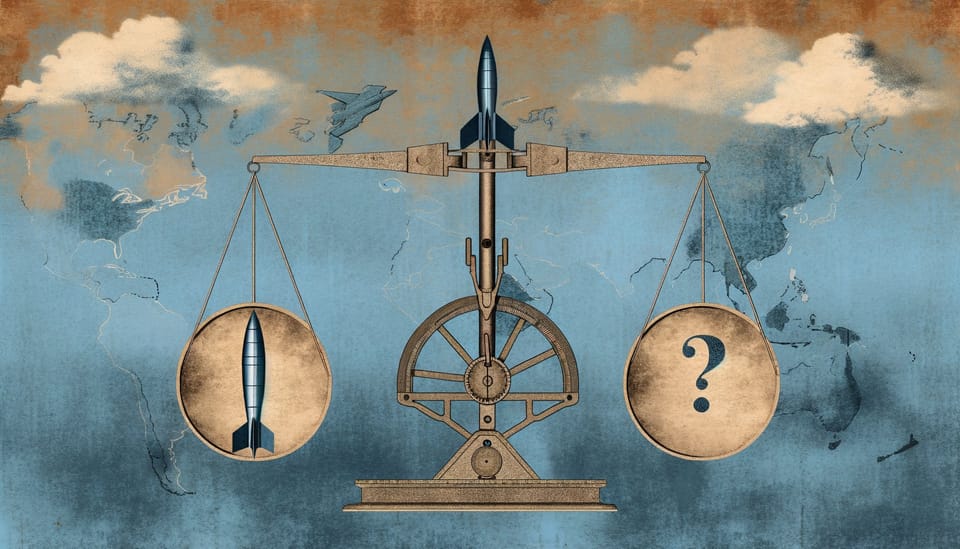
The conventional framing—NATO cohesion versus Russian extraction versus Chinese shipping—assumes these are parallel tracks. They are not. Each failure mode feeds the others. A fractured NATO emboldens Russian resource nationalism. Russian infrastructure collapse raises Chinese shipping costs. Chinese Arctic ambitions intensify American pressure on Greenland. The Arctic is not a chessboard with discrete pieces. It is a pressure vessel where every crack weakens the whole.
Denmark’s Red Line, America’s Ambition
The Kingdom of Denmark has drawn a line it cannot defend. Greenland’s sovereignty, Danish officials insist, is non-negotiable. Yet the American president has announced “the framework of a future deal” with NATO’s secretary-general regarding Greenland’s security arrangements. The gap between Copenhagen’s rhetoric and Washington’s actions is widening by the month.
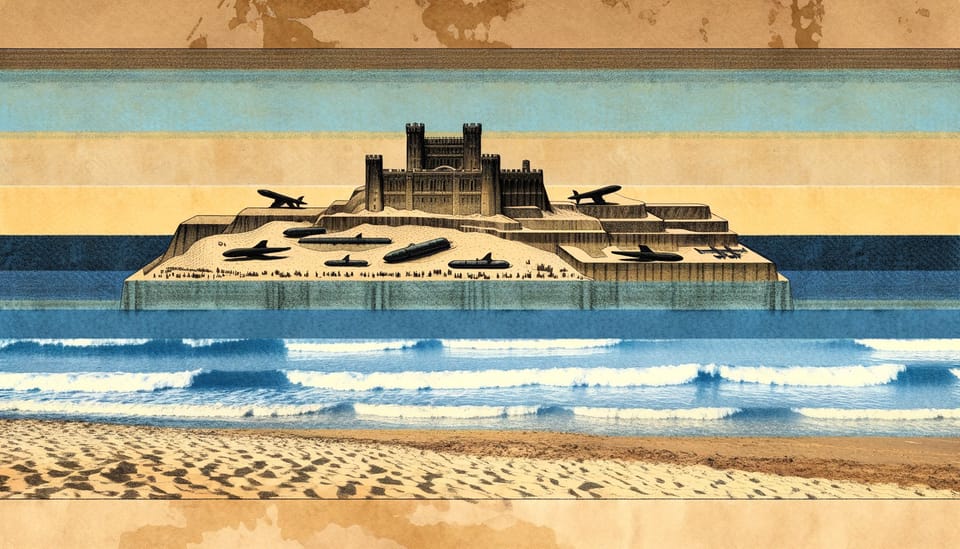
This is not a new tension. The United States has coveted Greenland since 1867, when Secretary of State William Seward first proposed purchase. What has changed is the Arctic itself. Ice-free summers—now projected with 60% probability in the 2030s—transform Greenland from a frozen afterthought into the strategic pivot of the northern hemisphere. The GIUK gap, that Cold War chokepoint between Greenland, Iceland, and the United Kingdom, has regained its relevance. But now it guards not just submarine transit routes but emerging shipping lanes and undersea cable corridors.
Greenland’s own government has articulated its position with unusual clarity. Its 2024 foreign policy strategy, titled “Nothing about us without us,” demands that Nuuk participate in any decisions affecting its territory. The document reflects a population of 57,000 people who have watched great powers negotiate their future for centuries. They are tired of being the object rather than the subject of Arctic diplomacy.
The structural problem is this: Greenland’s strategic value makes independence economically viable, but that same value ensures neither Denmark nor the United States will permit true autonomy. The Kvanefjeld rare earth deposit could fund Greenlandic self-governance for generations. It also contains uranium. Any serious extraction would trigger security overrides from Washington that would hollow out the sovereignty being sought. Greenland exists in a kind of quantum superposition—simultaneously Danish territory, autonomous nation, and potential independent state—until external action forces collapse into a single condition.
NATO’s consensus requirement, normally its strength, becomes an exploitable weakness here. Article 5 guarantees collective defense, but collective defense of what, exactly? If Greenland’s legal status shifts—through independence, through some novel arrangement with Washington, through a referendum that Copenhagen refuses to recognize—the alliance’s foundational assumptions crack. The United States has already implied that NATO cannot adequately secure the Arctic. If permanent territorial control is necessary and allies cannot provide it, alliances become obstacles rather than assets.
The fracture is accelerating because climate change is accelerating. Every year of warming adds urgency to American calculations and anxiety to Danish ones. Greenland’s position along both the Northwest Passage and the Transpolar Sea Route means its strategic value compounds as ice retreats. The same geographic necessity that makes Thule Air Base irreplaceable for American early warning systems gives Greenland leverage it has never possessed. Nuuk can convert geographic necessity into political demands—economic investment, educational funding, infrastructure development—that neither Copenhagen nor Washington can easily refuse.
Permafrost Turns to Quicksand
Twelve thousand kilometers east, Russia’s Arctic ambitions are sinking into the ground. The Yamal Peninsula, home to the world’s largest natural gas reserves, is built on permafrost that is no longer permanent. Ground temperatures have risen faster than air temperatures. The frozen substrate that supports pipelines, processing facilities, and entire cities is becoming unstable.
The numbers tell one story. Yamal LNG achieved record exports in 2024—287 cargo loadings generating $9.5 billion for Russia’s federal budget over three years. This is the revenue stream funding Moscow’s war in Ukraine, the hard currency that sanctions were designed to choke. By this measure, Russian Arctic extraction is succeeding.
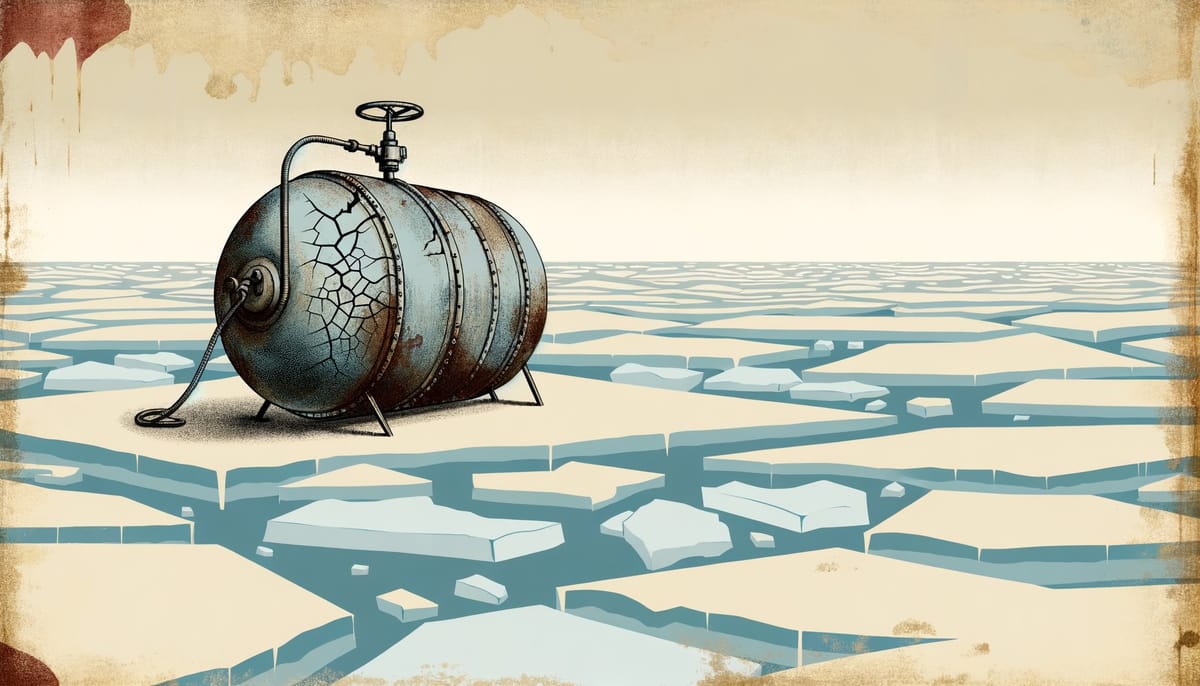
The physics tell another. Permafrost thaw rates have accelerated beyond engineering specifications. The 2020 Norilsk diesel spill—21,000 tons of fuel released when a storage tank’s foundation failed—was not an accident in the conventional sense. It was a preview. Infrastructure designed for frozen ground cannot survive ground that flows.
Arctic LNG 2, Russia’s flagship expansion project, illustrates the compound failure. Western sanctions have blocked access to specialized LNG tankers. Without ice-class vessels, the project cannot ship its product. Production has been suspended. But even if sanctions lifted tomorrow, the underlying infrastructure faces the same permafrost instability that threatens every Russian Arctic installation.
The Russian response has been characteristically defiant. State media celebrates Arctic development as proof of technological sovereignty. The Northern Fleet’s modernization continues. New military bases dot the coastline. Yet the material foundation of this Arctic empire is liquefying. Each summer’s thaw penetrates deeper. Each winter’s freeze is shorter and less complete. The ground that seemed eternal is revealing itself as temporary.
Moscow’s strategic culture operates on generational timescales. Putin has described the Soviet collapse as the greatest geopolitical catastrophe of the twentieth century. His Arctic policy reflects a determination to prevent any similar loss of territory or resources. But generational planning collides with geological acceleration. The permafrost does not negotiate. It does not respond to state directives. It simply melts.
Chinese investment offers a partial escape. The Silk Road Fund has financed Russian LNG projects, providing capital that Western sanctions have blocked. This creates a different dependency—not on Western technology and markets, but on Chinese capital and shipping capacity. Russia trades one vulnerability for another. The Arctic resources remain, but the infrastructure to extract them requires partners whose interests may not align with Moscow’s.
The Route That Isn’t Ready
China completed fourteen container ship voyages via the Northern Sea Route in 2025. Up from eleven the previous year. Up from seven the year before that. The trend line points toward a future where Chinese goods flow across the Arctic rather than through the Suez Canal, saving weeks of transit time and avoiding chokepoints that American naval power could close.
The reality is more complicated. Fourteen voyages across an entire shipping season is a rounding error in global trade. The Suez Canal handles fifty ships per day. The Northern Sea Route handles fifty ships per year. The gap between aspiration and capacity is measured in orders of magnitude.
China’s 2018 Arctic policy white paper declared the country a “near-Arctic state” and introduced the Polar Silk Road concept. The language was characteristically ambitious. China would “jointly understand, protect, develop and participate in the governance of the Arctic.” What this means in practice remains unclear. China has no Arctic coastline. Its claims to Arctic participation rest on the same logic that would give landlocked Mongolia maritime rights.
The physical barriers are substantial. Ice-free does not mean ice-absent. Even in peak summer, the Northern Sea Route requires ice-class vessels and icebreaker escort for most of its length. Russia controls that escort capacity. Russian regulations require permission for transit through waters Moscow claims as internal. The route that promises independence from American-dominated chokepoints creates dependence on Russian-controlled infrastructure.
Insurance markets have noticed. Premiums for Arctic transit reflect not just ice risk but geopolitical uncertainty. Underwriters must price the possibility that sanctions could strand a vessel, that Russian authorities could deny passage, that climate volatility could close a route that physical conditions had opened. The insurance industry’s eschatology—its embedded assumptions about catastrophic futures—shapes which routes are financially viable regardless of their physical accessibility.
Just-in-time logistics, the backbone of modern manufacturing, cannot tolerate the variance that Arctic shipping introduces. A container delayed by sea fog in the Kara Sea disrupts production schedules in Stuttgart. The efficiency gains from shorter distances evaporate when reliability disappears. Chinese manufacturers have built supply chains around predictable transit times. The Arctic offers shorter distances but unpredictable arrivals.
The deeper problem is that China’s Arctic ambitions depend on Russian cooperation, and Russian cooperation depends on Chinese investment, and Chinese investment depends on Russian stability, and Russian stability depends on infrastructure that is sinking into thawing permafrost. The circular dependency has no external anchor. Each link in the chain weakens the others.
Where the Cracks Converge
The Arctic Council, the primary forum for circumpolar governance, has been functionally paralyzed since March 2022. Seven of its eight member states suspended cooperation with Russia following the invasion of Ukraine. The institution designed to manage Arctic challenges cannot convene its full membership. Climate adaptation, search and rescue coordination, environmental monitoring—all the practical work of Arctic governance—proceeds in fragments or not at all.
This institutional vacuum matters because the Arctic’s transformation does not wait for diplomatic resolution. Coastal erosion rates have reached forty meters per year in some locations. The physical markers that define international boundaries under UNCLOS are disappearing. Baselines established decades ago no longer correspond to actual coastlines. The legal architecture of Arctic governance rests on geographic features that climate change is erasing.
UNCLOS itself contains a structural flaw. Continental shelf claims require geological surveys to establish where sovereign rights extend. But geological surveys are conducted by national teams with national interests. The theory-ladenness of observation—the way presuppositions shape what scientists find—means that overlapping claims from Russia, Denmark, Canada, and Norway cannot be resolved by appeal to objective fact. Each nation’s geologists discover evidence supporting their nation’s claims.
The Svalbard Treaty creates additional complexity. Norway exercises sovereignty over the archipelago, but signatory states retain equal access rights for economic activity. This 1920 arrangement, designed to prevent conflict over coal mining, now governs access to oil, gas, and strategic positioning. Whether NATO’s Article 5 applies to Svalbard—whether an attack on Norwegian facilities there would trigger collective defense—remains deliberately ambiguous.
Russia’s military buildup in the Arctic continues despite economic pressure. The Northern Fleet has been elevated to military district status. New bases have been constructed along the Northern Sea Route. Dual-use infrastructure—ports that serve both commercial shipping and naval operations—blurs the line between economic development and military positioning. The same facilities that load LNG tankers can resupply warships.
The United States has responded with the ICE Pact, a trilateral agreement with Canada and Finland to enhance icebreaker production capacity. The initiative acknowledges a stark capability gap: Russia operates over forty icebreakers, including nuclear-powered vessels capable of year-round Arctic operations. The United States operates two, both aging. The pact aims to address this imbalance, but shipbuilding takes years. The capability gap will persist through the decade’s most critical period.
The Default Trajectory
Without intervention, the most likely sequence unfolds as follows. NATO cohesion fractures first, not through dramatic rupture but through accumulated ambiguity. The United States establishes security arrangements with Greenland that bypass Danish authority. Copenhagen protests but cannot prevent what it cannot enforce. Other allies watch and draw conclusions about American commitment to alliance norms.
Russian extraction continues but at diminishing returns. Infrastructure failures multiply as permafrost degradation accelerates. Revenue still flows, but an increasing share goes to maintenance and repair rather than expansion. The Arctic remains a source of Russian wealth, but a source that requires ever more investment to sustain.
Chinese shipping expands incrementally without achieving transformative scale. The Northern Sea Route becomes a supplementary option for specific cargoes—bulk commodities that tolerate delay, strategic shipments that justify premium costs—rather than a primary trade artery. China gains Arctic presence without Arctic dominance.
This trajectory serves no one’s stated interests. NATO wants alliance cohesion. Russia wants reliable extraction. China wants efficient shipping. All three want stable governance frameworks that protect their investments. Yet each actor’s pursuit of unilateral advantage undermines the cooperative structures that would benefit all.
The alternative requires something none of the major powers have demonstrated: willingness to accept constraints on their own behavior in exchange for constraints on others. The Arctic Council’s paralysis reflects not just the Ukraine war but a deeper unwillingness to subordinate national interests to collective governance. Until that changes, the Arctic’s transformation will outpace the institutions meant to manage it.
FAQ: Key Questions Answered
Q: When will the Arctic actually be ice-free in summer? A: Statistical models suggest a 60% probability of ice-free summers in the 2030s, with some projections indicating possible ice-free conditions as early as 2028-2034. “Ice-free” in scientific usage means less than one million square kilometers of sea ice, not the complete absence of ice.
Q: Can Russia’s Arctic LNG projects survive Western sanctions? A: Yamal LNG has proven resilient, achieving record exports in 2024. Arctic LNG 2 has not—production was suspended in 2024 due to tanker shortages caused by sanctions. The difference lies in timing: Yamal was operational before sanctions tightened, while Arctic LNG 2 required components and vessels that sanctions blocked.
Q: Why doesn’t China just build its own icebreakers? A: China is building icebreakers, but the capability gap with Russia is measured in decades of experience and dozens of vessels. More fundamentally, icebreakers alone do not create Arctic shipping capacity. The Northern Sea Route requires Russian permission, Russian navigation services, and Russian rescue infrastructure. China can build ships; it cannot build geography.
Q: What would Greenland independence mean for NATO? A: An independent Greenland could choose its own alliance relationships. If it remained aligned with NATO, little changes operationally. If it sought neutrality or alternative partnerships, NATO loses its northern anchor and the United States loses Thule Air Base’s early warning capabilities. The strategic stakes explain why neither Copenhagen nor Washington will permit uncontrolled independence.
The Geometry of Delay
Every year of deferred action narrows future options. The infrastructure Russia builds on unstable permafrost will require replacement regardless of who pays for it. The shipping routes China develops will face the same insurance and reliability constraints regardless of geopolitical alignment. The governance frameworks NATO cannot agree upon will be needed regardless of Greenland’s ultimate status.
The Arctic’s transformation is not a future event to be planned for. It is a present reality to be managed. The ice is already retreating. The permafrost is already thawing. The institutions are already failing. The question posed at the outset—what breaks first—may already have an answer. Everything is breaking simultaneously, at different rates, in ways that compound rather than offset each other.
What remains is the choice between managed adaptation and chaotic collapse. Managed adaptation requires the major powers to accept that their Arctic ambitions are mutually constraining—that American security, Russian resources, and Chinese shipping all depend on governance structures that none can dominate. Chaotic collapse requires only that each actor continue pursuing unilateral advantage while the physical and institutional foundations of Arctic order erode beneath them.
The ice does not care which path they choose. It melts regardless.
Sources & Further Reading
The analysis in this article draws on research and reporting from:
- 2024 Department of Defense Arctic Strategy - Primary U.S. policy document on Arctic security posture
- Greenland’s Foreign, Security and Defense Policy 2024-2033 - Greenland’s autonomous government strategy statement
- Nature Climate Change on Arctic ice projections - Scientific analysis of ice-free summer timelines
- High North News on Yamal LNG exports - Data on Russian Arctic energy production
- Reuters on Arctic LNG 2 suspension - Reporting on sanctions impact
- gCaptain on Chinese Arctic shipping - Container voyage statistics
- The Barents Observer on Chinese LNG investment - China-Russia Arctic financing
- Natural Resources Canada on coastal erosion - Physical infrastructure vulnerability data