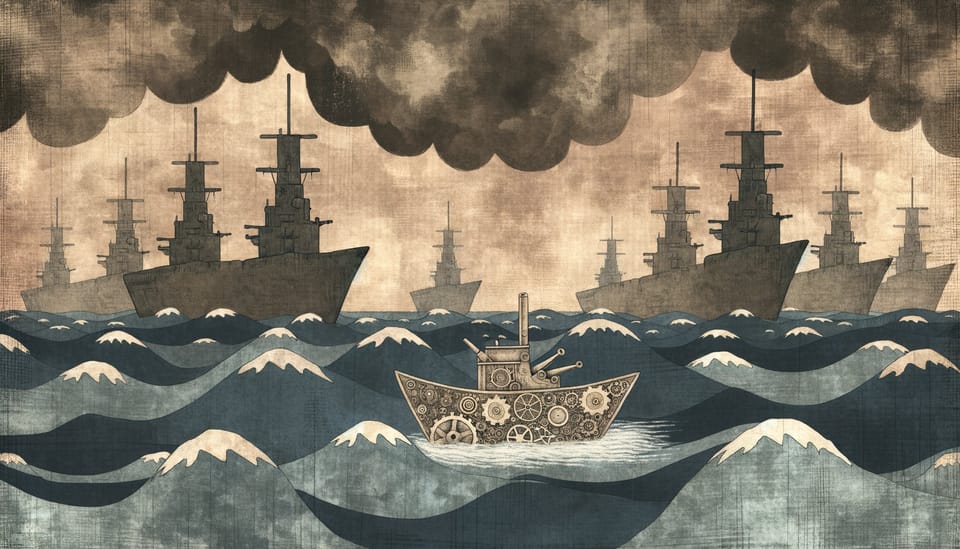
The Architecture of Impunity: Why the World Cannot Stop Sudan's Genocide
The United States has formally declared genocide in Darfur. The RSF continues killing. Sudan reveals that the humanitarian intervention system was never designed to work against adversaries with great-power protection and independent revenue streams.
The Architecture of Impunity
In January 2025, the United States formally declared that the Rapid Support Forces had committed genocide in Sudan’s Darfur region. The determination was precise, documented, and—in practical terms—meaningless. Within weeks, RSF fighters continued their systematic campaign of ethnic cleansing against the Masalit people, disposing of bodies in mass graves that Yale’s Humanitarian Research Lab documented through satellite imagery. The word “genocide” had been uttered. Nothing changed.
This gap between naming and stopping reveals something more troubling than mere bureaucratic failure. Sudan exposes the complete inversion of the humanitarian intervention architecture built after Rwanda. That system was designed to prevent mass atrocities through escalating international pressure—diplomatic isolation, economic sanctions, and ultimately military force. Each mechanism assumed the next would deter. None did. The RSF operates today with near-total impunity, its gold revenues flowing through Dubai, its weapons arriving via Libyan corridors, its commanders untouched by the International Criminal Court warrants that nominally pursue them.
The question is not why the international community has failed to stop the RSF. The question is whether the system was ever designed to succeed.
The Doctrine That Devoured Itself
The Responsibility to Protect emerged from Rwanda’s ashes with a simple premise: sovereignty is conditional. When a state fails to protect its population from mass atrocities, that responsibility transfers to the international community. The 2005 World Summit endorsed R2P unanimously. For a brief moment, it appeared that international law had evolved to close the gap between conscience and action.
Libya killed it.
In 2011, the UN Security Council authorized a no-fly zone to protect Libyan civilians from Muammar Gaddafi’s forces. NATO interpreted this mandate expansively, providing air support that enabled rebel forces to overthrow and kill Gaddafi. The intervention was hailed as a model by Western officials. Russia and China saw something different: humanitarian language weaponized for regime change.
The consequences were immediate and permanent. Russia’s UN Ambassador declared that Moscow had been “deceived” and would never again permit such a resolution. China, already skeptical of Western intervention, hardened its position. When Syria’s civil war produced atrocities dwarfing Libya’s, the Security Council remained paralyzed. R2P had been invoked precisely once for its intended purpose—and the invocation destroyed the consensus required for future use.
This is not policy failure. It is institutional trauma encoded into decision-making architecture. The Libya intervention created what might be called a doctrinal autoimmune response: the mechanism designed to protect civilians now triggers reflexive blocking by the very powers whose cooperation it requires. Russia and China do not oppose humanitarian intervention because they support atrocities. They oppose it because the precedent demonstrated that humanitarian language provides cover for strategic objectives they cannot control.
The pattern repeats in Sudan with mechanical precision. The Security Council extended sanctions in 2024, including asset freezes and travel bans. It did not introduce RSF-specific measures despite documented genocide. The resolution passed because it threatened no one with meaningful consequences. Any stronger action would have met vetoes from permanent members whose interests—in gold, in migration control, in regional influence—depend on maintaining leverage over Sudan’s warring parties.
The Political Economy of Atrocity
Understanding why sanctions fail requires understanding what the RSF actually is. It is not merely a militia. It is a vertically integrated extraction enterprise.
The RSF evolved from the Janjaweed militias that Omar al-Bashir mobilized to suppress rebellion in Darfur. Under Mohamed Hamdan Dagalo—known as Hemedti—it transformed into something unprecedented: a paramilitary organization with independent revenue streams sufficient to sustain prolonged warfare against a national army. The foundation is gold.
Sudan’s artisanal gold mines produce an estimated $2-3 billion annually. Unlike oil extraction, which requires technical expertise and fixed infrastructure vulnerable to sanctions, artisanal mining needs only labor—and coercion to organize that labor. The RSF controls the mines. It controls the routes to export points. It controls the violence necessary to maintain both. The extraction method generates the coercive apparatus. The coercive apparatus enables the extraction. Each reinforces the other.
The gold flows through Dubai. The UAE has emerged as the world’s largest gold refining center, processing an estimated 40% of global supply. Once Sudanese gold enters Dubai’s refineries, it becomes legally indistinguishable from legitimate supply. The certification process does not collapse uncertainty about origins—it multiplies documentation that obscures them. Each assay, each refining step, each re-documentation creates another layer of plausible deniability.
This architecture explains why targeted sanctions fail. The US Treasury has designated RSF-linked entities. European banks have restricted transactions. But the gold does not move through sanctioned channels. It moves through networks designed precisely to circumvent them—informal hawala systems, cash transactions, shell companies in jurisdictions that do not recognize US sanctions authority. The RSF operates outside the financial system that sanctions target.
More troubling still: the gold serves purposes beyond RSF financing. It feeds directly into the BRICS de-dollarization strategy. Central banks seeking alternatives to dollar reserves have increased gold purchases dramatically. The same physical commodity flows that constitute documented war crimes simultaneously function as inputs for sanctions-resistant reserve assets. Russia, under comprehensive Western sanctions, has particular interest in maintaining gold channels that bypass Western financial infrastructure.
The RSF’s atrocity economy is not a bug in the international system. It is a feature that multiple powerful actors have reasons to preserve.
The Attention Deficit
Even if the political will existed, the humanitarian system lacks capacity to respond. This is not primarily a funding problem, though funding is catastrophic. Sudan’s 2024 humanitarian response plan received 24.5% of requested resources—a 75.5% gap that represents not passive neglect but active non-participation by major donors.
The deeper problem is structural. The international humanitarian architecture was designed for discrete emergencies: earthquakes, famines, refugee flows with identifiable beginnings and ends. It was not designed for simultaneous, protracted conflicts competing for finite attention.
Research on cognitive load under stress reveals that pressure does not accelerate processing—it narrows focus. The humanitarian sector under resource constraints does not process more crises faster. It processes fewer crises more intensely, creating systematic blind spots. Ukraine absorbs attention and resources. Gaza absorbs attention and resources. Sudan competes with both while offering less strategic relevance to major donors and less compelling media narratives.
This is not compassion fatigue in the psychological sense. It is compassion fatigue as a production constraint. Media coverage ends not when audiences stop caring but when narrative templates are exhausted. The range of possible stories about Sudan—ethnic cleansing, famine, displacement—has been told. Editors move on. Without sustained coverage, political pressure dissipates. Without political pressure, governments face no domestic cost for inaction.
The UN Integrated Transition Assistance Mission in Sudan (UNITAMS) illustrates the dynamic. Established in 2020 to support Sudan’s democratic transition, it was terminated in December 2023—eight months after civil war erupted—with a three-month liquidation window. The Security Council created an abrupt scaffolding removal precisely when support was most needed. The decision reflected not strategic calculation but institutional exhaustion: the mission’s mandate had been overtaken by events, and no member state was willing to invest political capital in redesigning it.
The Military Impossibility
Assume, counterfactually, that the Security Council authorized intervention. Assume the political will materialized. What would it require?
The RSF controls territory roughly the size of France across Darfur and parts of Kordofan. Its forces are dispersed, mobile, and embedded within civilian populations they simultaneously victimize and depend upon for logistics. There is no front line to defend, no command structure to decapitate, no infrastructure to disable that would not produce humanitarian catastrophe.
The precedent is instructive. UNAMID—the African Union-United Nations Hybrid Operation in Darfur—deployed 20,000 troops at its peak, making it one of the largest peacekeeping operations in UN history. It was not large enough to protect a region of that size. The mission operated for thirteen years without achieving its core mandate of civilian protection. It withdrew in 2020, having demonstrated that peacekeeping forces cannot impose peace on parties that do not want it.
Any intervention force would face the same constraints at larger scale. The RSF’s supply lines run through Chad, Libya, and the Central African Republic—porous borders that no feasible deployment could seal. Its weapons arrive via networks that have survived decades of arms embargoes. The ecological research on wildlife corridor permeability applies: successful interdiction requires blocking not single pathways but the “permeability” of multiple low-resistance routes that collectively enable movement even when individual paths are blocked. No intervention force has ever achieved this against a determined, well-resourced adversary in terrain this vast.
The military option is not politically blocked. It is operationally impossible without commitment levels no state is willing to provide.
What the Silence Reveals
Sudan’s abandonment is not exceptional. It is the new normal.
The R2P framework assumed a hierarchy of response: diplomatic pressure, then economic sanctions, then military intervention as last resort. Each tier was supposed to create incentives for the next to succeed. Diplomatic isolation would make sanctions more painful. Sanctions would make military threats credible. The architecture depended on escalation being both possible and believable.
Neither condition holds. Escalation is blocked at the Security Council by permanent members with interests in maintaining the status quo. Escalation is blocked operationally by the absence of any state willing to bear the costs of enforcement. The RSF has calculated—correctly—that it can commit genocide without meaningful consequence.
This calculation is now available to every armed group worldwide. The lesson of Sudan is not that humanitarian intervention is difficult. It is that humanitarian intervention is deprecated functionality—technically possible but generating warnings that discourage use. The protocol remains on the books. No one executes it.
The implications extend beyond Sudan. Myanmar’s military junta has observed. Ethiopia’s government has observed. Any regime or armed group contemplating mass violence against its population now has empirical evidence that the international community will document atrocities, issue statements, impose limited sanctions, and ultimately do nothing that alters the perpetrators’ calculus.
This is not the collapse of humanitarian intervention. It is its completion. The system has reached its logical endpoint: a permanent gap between the language of protection and the reality of abandonment.
The Paths Not Taken
What could change? The honest answer is: probably nothing sufficient to alter outcomes in Sudan. But understanding the intervention points clarifies what the international community has chosen not to do.
Financial interdiction at source. The UAE is vulnerable to pressure in ways the RSF is not. Dubai’s gold refineries depend on access to Western financial systems, Western luxury goods markets, Western legitimacy. Threatening secondary sanctions on UAE financial institutions that process conflict gold would impose costs on an actor with something to lose. The trade-off: the UAE is a critical partner for Western interests in the Gulf, a major arms customer, and a counterweight to Iranian influence. No Western government has been willing to sacrifice that relationship for Sudan.
Regional diplomatic investment. Egypt and Saudi Arabia have competing interests in Sudan’s outcome—Egypt fears Ethiopian influence and Nile water control; Saudi Arabia seeks to limit UAE regional expansion. A sustained diplomatic effort to align these interests around conflict termination could create pressure on both warring parties. The trade-off: such diplomacy requires years of patient engagement with no guarantee of success, no domestic political payoff, and continuous high-level attention that no government has been willing to provide.
Humanitarian access as leverage. Both the RSF and the Sudanese Armed Forces depend on international legitimacy to varying degrees. Making humanitarian access a condition for any diplomatic engagement—refusing to negotiate with parties that block aid—could create incentives for compliance. The trade-off: this risks further reducing access in the short term and assumes that warring parties value international legitimacy more than military advantage. Current evidence suggests they do not.
Each option has been considered. Each has been rejected. The rejections are not irrational. They reflect accurate assessments that the costs of meaningful intervention exceed the benefits as calculated by the states that would bear them.
The Honest Accounting
Sudan reveals the humanitarian intervention architecture for what it always was: a system designed by powerful states to address atrocities that did not threaten their interests, in locations where intervention was militarily feasible, against adversaries without great-power protection.
Rwanda met those criteria. Kosovo met those criteria. Libya appeared to meet them until the intervention’s consequences demonstrated otherwise. Sudan meets none of them. The RSF has great-power protection through Russia’s Security Council veto and China’s abstention. The territory is militarily infeasible for any realistic intervention. The atrocities do not threaten any powerful state’s core interests.
The system works exactly as designed. It was never designed to work here.
This is not cynicism. It is clarity. The gap between humanitarian rhetoric and humanitarian action is not a failure to be corrected. It is a feature that allows powerful states to maintain moral standing without incurring costs. The statements condemning atrocities, the sanctions that do not bite, the resolutions that do not authorize force—these are not failed attempts at protection. They are successful performances of concern that substitute for protection.
The Masalit people of Darfur are being systematically murdered. The international community has documented this with precision. The documentation changes nothing. That is the system working as intended.
Frequently Asked Questions
Q: Why hasn’t the UN authorized military intervention in Sudan? A: The UN Security Council requires agreement among its five permanent members (US, UK, France, Russia, China) for any military authorization. Russia has signaled it would veto such action, viewing humanitarian intervention as a pretext for Western regime change after the 2011 Libya experience. Without Security Council authorization, no legal basis exists for intervention under international law.
Q: What is the Responsibility to Protect (R2P) and why hasn’t it worked in Sudan? A: R2P is a 2005 UN framework establishing that when states fail to protect their populations from mass atrocities, the international community has an obligation to act. It has not worked in Sudan because its implementation requires Security Council consensus that no longer exists. The Libya intervention in 2011 destroyed that consensus by exceeding its mandate, and no subsequent case has rebuilt it.
Q: How is the RSF funded and why don’t sanctions stop them? A: The RSF generates independent revenue primarily through control of artisanal gold mines in Darfur, producing an estimated $2-3 billion annually. This gold is exported through informal networks to Dubai, where refining processes obscure its origins. Sanctions target formal financial channels, but the RSF operates largely outside those systems through cash transactions and hawala networks.
Q: What would it take to actually stop the atrocities in Sudan? A: Stopping RSF atrocities would require either military intervention at a scale no state is willing to provide (larger than the 20,000-troop UNAMID mission that failed over 13 years), or financial pressure on UAE gold refineries severe enough to disrupt RSF revenue—which would require Western states to sacrifice their strategic partnership with the UAE. Neither option is currently on the table.
The Quiet Withdrawal
In March 2024, the last UN personnel departed Khartoum, completing UNITAMS liquidation. The mission that was supposed to shepherd Sudan’s democratic transition instead witnessed its collapse and left. No replacement was authorized. No alternative mechanism was proposed.
The withdrawal was administrative, procedural, unremarkable. It received minimal coverage. It changed nothing on the ground—the mission had been ineffective for months before its termination. But it marked something: the formal acknowledgment that the international community had no plan, no presence, no intention of meaningful engagement.
Somewhere in Darfur, RSF fighters continued their work. The satellite imagery continued to accumulate. The reports continued to document. The words continued to be spoken—genocide, crimes against humanity, ethnic cleansing—each one precise, each one true, each one weightless.
The system that was supposed to prevent this was never broken. It was always this. Sudan simply made it visible.
Sources & Further Reading
The analysis in this article draws on research and reporting from:
- UN Fact-Finding Mission Report - Primary documentation of RSF and SAF violations constituting war crimes and crimes against humanity
- Human Rights Watch: US Genocide Determination - Analysis of the January 2025 genocide finding and its implications
- Security Council Report on Sudan - Comprehensive tracking of UN Security Council actions and resolutions
- The Responsibility to Protect Debate: An Enduring Black Hole - Academic analysis of R2P’s structural failures and the Libya precedent
- Clark University: Why Has the World Retreated from Humanitarian Intervention? - Expert assessment of the post-Libya intervention landscape
- The Global Observatory: Lessons from Darfur - Retrospective analysis of UNAMID’s limitations and failures
- Refugees International: Sudan Humanitarian Fund Roadmap - Assessment of humanitarian response gaps and funding failures
- OCHA Sudan - Current humanitarian situation and response tracking