
The Architecture of Exclusion: How Travel Bans Are Reshaping Global Mobility
The United States has imposed its most expansive travel restrictions since 1952, affecting 19 countries with potential expansion to 32. The diplomatic and economic consequences extend far beyond counterterrorism—they are reordering who moves, where, and under what conditions.
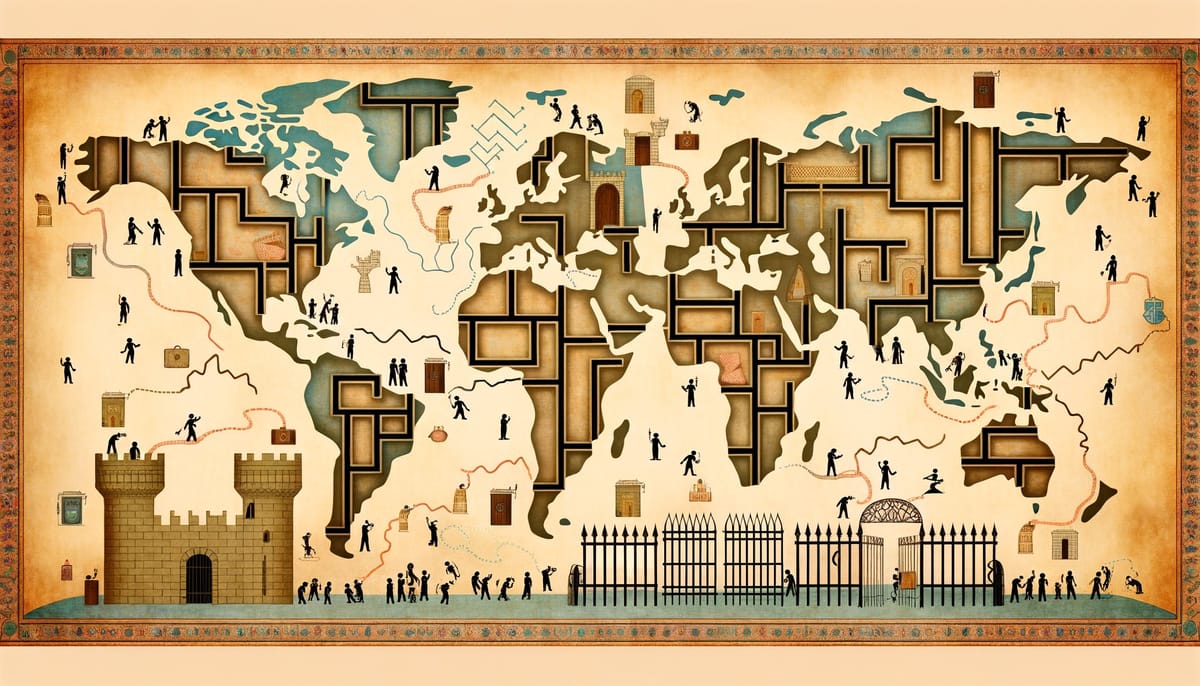
The Architecture of Exclusion
Chad’s response took exactly one day. On June 5, 2025, President Idriss Deby announced the suspension of U.S. visa issuance, invoking “principles of reciprocity.” The diplomatic language was measured. The message was not. A landlocked African nation of 18 million people had just demonstrated that travel bans are not one-way instruments.
The June 4 presidential proclamation restricting entry from 19 countries—full bans on 12, partial restrictions on 7—marked the most expansive use of Section 212(f) authority since the Immigration and Nationality Act’s passage in 1952. By December 2025, the Department of Homeland Security recommended expanding restrictions to 32 countries. The stated justifications—inadequate vetting information, high overstay rates, refusal to accept deportees—follow familiar security scripts. But the effects extend far beyond counterterrorism. They are reshaping the topology of global movement itself.
International tourism recovered to 1.4 billion arrivals in 2024, reaching 99% of pre-pandemic levels. Yet this aggregate masks violent regional disparities. Europe, the Middle East, and Africa surpassed 2019 numbers. Asia-Pacific remained 13% below. The recovery is real but uneven—and the new restrictions threaten to calcify that unevenness into permanent structure.
What emerges is not simply a policy debate about security versus openness. It is a fundamental reordering of who moves, where, and under what conditions. The architecture of global mobility is being rebuilt in real time.
The Legal Machinery
Section 212(f) of the Immigration and Nationality Act grants presidents sweeping authority to suspend entry of any class of aliens whose presence would be “detrimental to the interests of the United States.” The Supreme Court’s 2018 ruling in Trump v. Hawaii affirmed this power’s breadth, requiring only a “facially legitimate and bona fide reason.” The standard is deferential to the point of near-automaticity.
The June 2025 proclamation exploits this latitude fully. Afghanistan, Iran, Libya, Somalia, Sudan, Syria, Yemen—these were expected. The additions of Haiti, Burma, the Republic of Congo, Equatorial Guinea, and Eritrea expanded the geographic footprint dramatically. The partial restrictions on Cuba, Venezuela, Laos, Turkmenistan, and others created a second tier of limited access. The logic varies: some countries lack adequate identity documentation systems; others refuse to accept deportees; still others present elevated terrorism concerns. The effect is uniform exclusion with differentiated justifications.
The proclamation functions as what legal theorists might recognize as Schmittian sovereignty in action—the sovereign decides on the exception without normative content. The requirement to cite “national security” or “foreign affairs” creates performative ritual rather than substantive constraint. Presidents must invoke the magic words. They need not demonstrate their truth.
This matters because it reveals the structural impossibility of legal challenge. Courts defer. Congress lacks appetite for confrontation. The executive acts unilaterally, and the ban takes effect. Preliminary injunctions occasionally pause implementation, but they create their own pathology: legal liminality produces stronger deterrence than clear prohibition. Potential travelers face not just denial but uncertainty about whether denial will persist. The temporariness of injunctions generates permanent anxiety.
The European Union has moved in parallel directions, though through different mechanisms. In November 2025, the EU adopted new rules enabling visa-free travel suspension for third countries, adding grounds including deterioration of relations “in cases of human rights concerns.” The framing differs—Brussels speaks of values where Washington speaks of security—but the functional effect converges. Visa liberalization dialogues, once pathways to openness, now function as permanent compliance-demonstration infrastructure. Partner countries must maintain continuous monitoring systems, migration data sharing protocols, and readmission agreements. The “dialogue” framing masks that these are not negotiations between equals but conditions imposed by gatekeepers.
The Rerouting of Movement
Travel bans do not stop movement. They redirect it.
When direct routes close, indirect ones open. The 14-day prior-visit restriction in U.S. transit bans creates precise temporal arbitrage windows. A traveler from a banned country who transits through a third nation and remains 15 days can claim cleaner mobility history. This is not evasion in the criminal sense. It is rational adaptation to irrational geography. Transit hubs in Istanbul, Dubai, and Doha have built business models on this logic. They offer not just connections but what might be called mobility laundering—the aging of travel history until it becomes acceptable.
Saudi Arabia’s aviation expansion targets—250 destinations, 330 million passengers—represent the minimum network density required to make such laundering frictionless. Like correspondent banking networks that enable financial flows to bypass sanctioned jurisdictions, aviation networks require sufficient node density to offer alternative pathways. The infrastructure is being built not despite travel bans but because of them.
The same geographic nodes that served medieval trans-Saharan trade—Aït-Ben-Haddou, the caravan routes through Mali and Mauritania—now function as migration corridor waypoints. Modern “migration routes” are not spontaneous responses to border enforcement but reactivations of centuries-old pathways. The routes persist; only the cargo changes.
Business travel tells a different story. Video conferencing grew from an $11.5 billion market in 2020 to $19.1 billion in 2025. Business travel spending recovered to $1.48 trillion in 2024, surpassing the 2019 peak. Both sectors experienced simultaneous explosive growth. Video conferencing did not replace business travel; it created a new category of international interaction that previously did not exist at scale. The executive who would never have flown to Jakarta for a preliminary meeting now conducts it virtually—then flies for the deal closure. Total interaction volume increased. The nature of what requires physical presence narrowed.
This bifurcation accelerates under travel bans. Routine interactions migrate online. High-stakes encounters—those requiring trust-building, negotiation, or relationship maintenance—demand presence more intensely. The result is not less business travel but more concentrated business travel among those who can still move freely. Mobility becomes a marker of status, a form of capital accessible only to those holding the right passports.
Student mobility reveals the pattern most starkly. Canada’s two-step immigration pathway—where 35-40% of international students achieve permanent residency—creates what physicists might call designed superposition maintenance. Students exist in quantum uncertainty between temporary and permanent status for extended periods. The pathway explicitly preserves ambiguity as a feature, not a bug. The United States, by contrast, offers no comparable pathway. H-1B fee escalation to $100,000 does not reduce demand for skilled labor; it relocates the geographic accounting. Companies shift operations to Canada, Ireland, or Singapore. The talent follows the visa regime, not the other way around.
The Diplomatic Feedback Loop
Chad’s reciprocal visa suspension was not an isolated tantrum. It was a signal—and signals require receivers.
The African Union has not issued a unified condemnation of the expanded travel bans. Individual member states have responded through bilateral channels. But a pattern is emerging that resembles stigmergic coordination: states react to environmental traces left by other states’ actions without needing to communicate or plan collectively. Each protest, each counter-ban, modifies the diplomatic medium. Subsequent actors respond to the modified environment rather than to each other directly. The result looks like coordinated strategy but requires no coordination.
The African Continental Free Trade Area, ratified by 54 of 55 African Union members, stands in sharp contrast to the stalled Free Movement Protocol. The same nations that rapidly liberalized trade flows deliberately block mobility commons. Trade agreement ratification proceeded at historic speed. Mobility protocol ratification stalled at the starting gate. The divergence reveals that “free movement” threatens state sovereignty in ways capital flow liberalization does not. Goods can cross borders without voting, demanding services, or claiming rights. People cannot.
Schengen visa rejection rates for African applicants have accelerated to 3.6 times the global average—double the ratio from just two years earlier. This acceleration functions as intensifying selective pressure, triggering what may become phase-transition behavior in regional integration. Not gradual adaptation but rapid institutional morphogenesis. The ASEAN common visa framework, the GCC’s Schengen-style unified visa proposal, the East African Community’s mobility protocols—all gained momentum as external restrictions tightened. The architecture of regional mobility is being constructed in response to the architecture of global exclusion.
Diplomatic reciprocity creates its own paradoxes. Travel bans on UN delegates—documented in multiple instances—function as autoimmune failures where the host country’s sovereignty-protecting mechanisms attack the very organs of the multilateral body the country claims to support. The United States restricts entry of diplomats accredited to institutions headquartered in New York. The contradiction is not accidental. It is structural.
Embassy architecture tells the story in concrete and steel. Post-1999 security requirements transformed diplomatic compounds from symbolic presences into fortified bunkers. The shift from open architecture to defensive design creates performative contradiction: security requirements that physically distance the embassy from local populations simultaneously undermine the theatrical legitimation capacity that embassies exist to project. The building announces: we do not trust you. The visa window confirms it.
The Human Calculus
Kinship networks operate on different temporal logic than policy cycles.
Diaspora families separated by travel bans face what might be called kinship obligation maintenance costs that rise exponentially with duration. Social network models treat activity intensity as “temperature”—but in diaspora kinship networks under travel restrictions, maintaining bonds requires high activity (frequent communication, travel to third countries for reunions) precisely when the system imposes friction that should reduce activity. The result is thermal runaway: families either invest unsustainably in connection maintenance or watch relationships cool to ambient temperature.
Ancestor veneration practices reveal the stakes most starkly. Travel bans designed as temporary health measures during COVID-19 inadvertently enforced permanent ritual abandonment. Ancestor veneration operates under strict rules with compulsory participation requirements. The temporariness of pandemic restrictions became permanent rupture when practitioners could not return for required ceremonies within prescribed windows. The ritual was not postponed. It was lost.
Remittance flows continued through mobile money infrastructure even when physical travel stopped. But digital remittance platforms during travel bans create dissociation between financial flow and embodied presence. The money arrives. The body does not. Receiving households experience what researchers have documented as intensified phantom symptoms—the presence of absence made material through financial transfers that remind recipients of who is not there.
The mathematics of family separation compound monthly. Each quarter of enforced distance requires additional effort to overcome. Children grow. Parents age. The relationship that existed before the ban is not the relationship that will exist when it lifts. Time is not neutral.
The Security Paradox
The stated purpose of expanded travel bans is security. The evidence for their effectiveness is thin.
Fusion centers—the post-9/11 information-sharing nodes meant to connect federal, state, and local intelligence—exhibit what official assessments call “widespread deficiencies in basic counterterrorism information-sharing capabilities.” The deficiencies are not technical failures awaiting better software. They are structural impossibilities. The system demands predictive certainty about future terrorist intent while operating in a domain where intention remains fundamentally unknowable until expressed through action.
Travel bans address this uncertainty through exclusion rather than prediction. If you cannot identify which individuals from a population pose threats, exclude the population. The logic is coherent but the implementation is not. The 12 countries under full ban produced zero fatal terrorist attacks on U.S. soil in the decade preceding the proclamation. The correlation between country of origin and terrorist threat is weaker than the policy implies.
What travel bans do accomplish is visible action. They demonstrate that government is doing something. The ritual performance of security—the announcement, the implementation, the enforcement imagery—generates political returns independent of security returns. Quantitative repeal mandates (“repeal 10 regulations for each new one”) transform policy into pure ritual where the act of deletion becomes divorced from security rationale. The numerical mandate creates its own justification.
Fee-based vetting programs reveal the self-sustaining nature of security theater. TSA PreCheck generated $558 million in fees in 2025, funding 420 full-time positions that process more applicants, generating more fees. The program does not measure threat reduction. It measures its own perpetuation. The obligatory passage point metabolizes its own justification.
The Emerging Order
Two trajectories are now visible. They are not compatible.
The first trajectory extends current dynamics. Travel bans expand to 32 countries, then 40. Regional blocs respond with their own restrictions. Mobility bifurcates between those holding privileged passports and those holding suspect ones. Business travel concentrates among elites while mass tourism fragments into regional circuits. Diaspora communities attenuate. Educational exchange narrows. The world does not stop moving, but movement becomes a luxury good.
The second trajectory requires active construction. Regional mobility frameworks—ASEAN, African Union, GCC—mature into genuine alternatives to Western-centric hub systems. Transit states capture value from routing around restrictions. Technology enables remote work at scale, reducing the premium on physical presence. The architecture of exclusion generates the architecture of alternatives.
Neither trajectory is inevitable. Both are underway.
The intervention points are few but real. Visa liberalization dialogues could become genuine negotiations rather than compliance monitoring. Humanitarian waiver systems—1,607 granted under the current proclamation—could scale into meaningful exception pathways rather than performative gestures. Regional aviation infrastructure could be financed to reduce dependence on Gulf and European hubs. None of these changes is easy. All require political will that does not currently exist.
The most likely scenario is neither full restriction nor full liberalization but permanent uncertainty. Legal challenges will produce temporary injunctions. Policy will oscillate with administrations. Travelers will adapt to ambiguity as a permanent condition. The system will function poorly for everyone while functioning adequately for those who matter to those who decide.
Australia risks becoming what it has always been: a quarry with better marketing. The same could be said of any nation that mistakes restriction for strategy. Travel bans are tools. They are not architecture. The architecture requires knowing what you are building toward, not merely what you are keeping out.
What Comes Next
The question is not whether travel bans reshape global mobility. They do. The question is whether the reshaping serves any purpose beyond the political convenience of those who impose it.
Chad’s visa suspension lasted weeks, not months. The gesture was made; the point was proven. But the infrastructure of reciprocity now exists. The next ban will generate faster, more coordinated responses. The next response will generate further restrictions. The spiral has its own momentum.
International tourist arrivals will reach 1.5 billion in 2025. The number means less than its distribution. Who moves, and who does not, will define the century’s political economy more than aggregate flows ever could. The architecture of exclusion is being built. The question is whether anyone is building anything else.
Frequently Asked Questions
Q: Which countries are currently affected by U.S. travel bans? A: The June 2025 proclamation imposes full entry suspensions on 12 countries (Afghanistan, Burma, Republic of Congo, Equatorial Guinea, Eritrea, Haiti, Iran, Libya, Somalia, Sudan, Syria, Yemen) and partial restrictions on 7 others (Burundi, Cuba, Laos, Sierra Leone, Togo, Turkmenistan, Venezuela). DHS has recommended expansion to 30-32 countries.
Q: Can people from banned countries still get visas to the United States? A: Limited exceptions exist through humanitarian waivers, with 1,607 granted under the current proclamation. Applicants must demonstrate that denial would cause undue hardship and that their entry poses no security threat. The process is discretionary and approval rates remain low.
Q: How do travel bans affect international students? A: Students from affected countries face visa denials or prolonged processing delays. Many redirect applications to Canada, the UK, or Australia. U.S. universities report declining enrollment from banned regions, with some programs losing critical mass in specialized fields.
Q: Have other countries retaliated against U.S. travel restrictions? A: Chad suspended U.S. visa issuance within 24 hours of being added to the ban list, citing reciprocity principles. Other affected nations have lodged formal diplomatic protests. The pattern suggests future bans will generate faster coordinated responses from regional blocs.