Taiwan's 72-hour gamble: Can asymmetric defence hold until America arrives?
Taiwan has staked its survival on buying three days for US intervention. The strategy is sound. The assumptions behind it may not be. What happens when the porcupine meets a patient predator?
🎧 Listen to this article
The Hundred-Hour Gamble
Taiwan’s defence planners have settled on a number: 72 hours. That is how long they believe the island must hold against a Chinese assault before American forces can arrive in strength. The figure has become an article of faith in Taipei’s security establishment, shaping everything from weapons procurement to reserve training schedules. It is also, almost certainly, wrong.
The problem is not that Taiwan cannot delay a Chinese invasion for three days. Under the right conditions, with the right weapons and tactics, it probably can. The problem is that 72 hours assumes a conflict that begins and ends on Taiwan’s terms—a clean amphibious assault met by a prepared defence, with American aircraft carriers steaming westward at flank speed. Reality will be messier. China’s People’s Liberation Army has spent two decades developing capabilities designed to ensure American forces never arrive at all, or arrive too late to matter. Taiwan’s asymmetric warfare pivot, however impressive on paper, must contend with an adversary who has read the same playbooks and drawn different conclusions.
The question is not whether Taiwan can buy time. The question is whether the time it buys will be worth anything.
The Porcupine’s Predicament
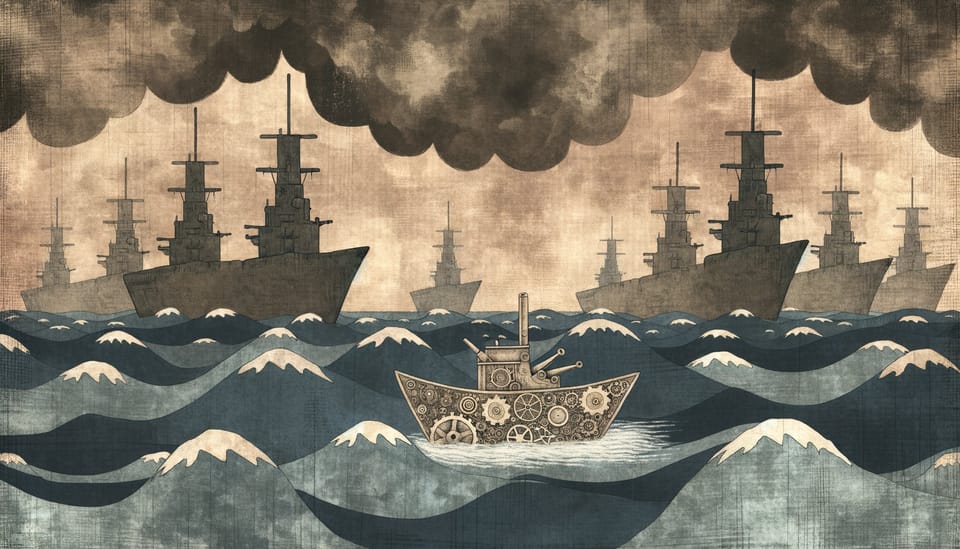
Taiwan’s Overall Defence Concept, introduced in 2017 by Admiral Lee Hsi-min, represents the most significant shift in the island’s military thinking since the end of martial law. The strategy abandons the fantasy of matching China’s military might and embraces “deterrence by denial”—making conquest so costly that Beijing calculates it is not worth attempting. In practice, this means small, mobile, lethal platforms: anti-ship missiles hidden in fishing villages, drones launched from highway overpasses, sea mines scattered across the Taiwan Strait. The goal is not to defeat the PLA but to impose unacceptable losses.
The logic is sound. Taiwan cannot outspend China; the mainland’s defence budget exceeds the island’s by a factor of 25. It cannot outproduce China; the PLA Navy launched more tonnage in 2022 than the entire Royal Navy displaces. What Taiwan can do is exploit geography. The Taiwan Strait is 130 kilometres at its narrowest point, and any amphibious force must cross it under fire. Beach landing sites are limited. Weather windows are brief—invasion conditions exist only in April-May and September-October. An invasion would be, as multiple analysts have noted, “the most complex military amphibious assault in military history.”
Taiwan’s asymmetric arsenal is designed to exploit these constraints. Hsiung Feng III anti-ship missiles can threaten landing craft at ranges exceeding 150 kilometres. Mobile coastal defence batteries can relocate before Chinese satellites complete their next pass. The newly established Information, Communications, and Electronic Force (ICEF) can inject noise into PLA command networks. Underground tunnel complexes shelter critical assets from precision strikes. The island has studied Ukraine’s distributed manufacturing model and begun dispersing production of drones and munitions.
Yet implementation has lagged. Taiwan’s defence spending, while increasing, remains below 3% of GDP. The officer corps, trained in centralised command doctrine, has been slow to embrace distributed operations. Conscription terms, recently extended from four months to one year, still produce reservists with limited combat readiness. A Stimson Center analysis concluded that Taiwan has “squandered” much of its defensive potential through incomplete transformation. The porcupine has quills, but many remain sheathed.
More fundamentally, the asymmetric strategy optimises for a specific scenario: a conventional amphibious invasion met by prepared defences. China may not oblige.
Beijing’s Calculus
CIA Director William Burns confirmed what analysts had long suspected: Xi Jinping has instructed the PLA to be ready to invade Taiwan by 2027. The deadline is not arbitrary. It coincides with the centenary of the PLA’s founding, a symbolically potent date in Chinese political culture. It also reflects Xi’s assessment of the strategic window—a period before American industrial mobilisation can close the military gap, and before Taiwan’s asymmetric capabilities mature fully.
But readiness is not intention. The PLA’s 2027 deadline establishes capability, not a decision to act. And the calculus facing Xi is considerably more complex than Western commentary often suggests.
China’s strategic culture, shaped by Confucian, Daoist, and Legalist traditions, emphasises patience and the avoidance of premature action. As scholars of Chinese strategic thought note, the Daoist concept of wu-wei—action through non-action—counsels waiting for circumstances to ripen rather than forcing outcomes. This sits in tension with Xi’s apparent urgency, creating what some analysts describe as “temporal incommensurability” at the heart of Chinese decision-making.
The one-child policy casts a long shadow. China’s military-age population consists disproportionately of only sons, each representing a family’s sole hope for continuity. The policy has transformed social expectations around casualty tolerance, creating what demographers call “little emperor syndrome”—a generation raised with intense parental investment and correspondingly high expectations of survival. An invasion producing tens of thousands of casualties could trigger social instability that threatens the regime’s legitimacy more than failure to reunify.
Xi’s risk calculus must also account for economic consequences. Taiwan Semiconductor Manufacturing Company produces over 90% of the world’s most advanced chips. An invasion would almost certainly destroy this capacity—whether through combat damage, deliberate sabotage, or the flight of irreplaceable engineers. The global economic disruption would be measured in trillions of dollars, and China, despite efforts at semiconductor self-sufficiency, remains critically dependent on TSMC’s output for its own technology sector.
None of this means invasion is impossible. It means the decision tree is more branching than a simple “invade or don’t” suggests. China’s options include:
Full amphibious invasion: The maximalist scenario, requiring 1-2 million troops and producing the highest casualties. Success would resolve the Taiwan question permanently but risk catastrophic failure.
Limited blockade: Naval and air quarantine choking Taiwan’s economy without requiring beach landings. Lower casualties, but time favours the defender as international pressure mounts.
Decapitation strike: Precision attacks on leadership and command nodes, followed by demands for surrender. Quick if successful, but failure leaves China committed to escalation.
Grey-zone coercion: Continued salami-slicing through airspace incursions, cyber attacks, and economic pressure. Lower risk, but slower returns and vulnerability to Taiwanese adaptation.
Each scenario imposes different delay requirements on Taiwan’s defence. A decapitation strike must be defeated in hours, not days. A blockade might persist for weeks before American intervention becomes decisive. Taiwan’s 72-hour benchmark assumes the most favourable case—a conventional invasion with adequate warning.
The Intervention Gap
The United States has maintained “strategic ambiguity” regarding Taiwan’s defence since 1979. The Taiwan Relations Act commits America to provide defensive weapons and “maintain the capacity to resist any resort to force”—but does not explicitly commit US forces to Taiwan’s defence. President Biden has stated four times that America would defend Taiwan, only to have his administration walk back each statement. The ambiguity is deliberate, designed to deter both Chinese aggression and Taiwanese provocation.
In practice, ambiguity creates uncertainty about intervention timelines. According to Heritage Foundation analysis, forward-based forces in Japan, Guam, and deployed vessels could be combat-ready within days 0-5 of a crisis. Surge forces from Hawaii and the US West Coast would arrive between days 6-15. Full mobilisation of continental US assets would require weeks to months.
These timelines assume Chinese acquiescence. They should not.
The PLA has spent two decades building what strategists call an anti-access/area denial (A2/AD) network specifically designed to prevent American intervention. The DF-21D “carrier killer” missile can theoretically strike moving ships at ranges exceeding 1,500 kilometres. The DF-26 extends that range to Guam. Submarine forces have expanded dramatically. Space and cyber capabilities can blind American intelligence and communications. The 2024 Pentagon assessment notes that China continues to refine options for “an amphibious invasion, firepower strike, and possibly a maritime blockade.”
The A2/AD network does not need to destroy American forces to succeed. It needs to delay them. If Chinese missiles can keep carrier strike groups beyond effective range for the first two weeks of a conflict, Taiwan’s 72-hour window becomes irrelevant. The island would be fighting alone, its asymmetric defences ground down by sustained bombardment, its ammunition stocks depleted, its population demoralised.
Japan’s role introduces additional complexity. American bases in Okinawa and elsewhere would be essential for any intervention, but Japan’s pacifist constitution and collective self-defence laws create legal ambiguity about participation. The Japanese government’s true intentions—what the Japanese call honne—may diverge from its publicly stated policies, or tatemae. A crisis would force Tokyo to choose between its security alliance with Washington and its economic relationship with Beijing. That choice cannot be predicted in advance.
The intervention gap, then, is not merely logistical. It is political, legal, and psychological. Taiwan’s asymmetric capabilities must buy time not just for ships to sail but for decisions to be made, coalitions to form, and domestic politics to align. Seventy-two hours is optimistic for the first. It may be wildly insufficient for the rest.
The Munitions Wall
Asymmetric warfare consumes ammunition at extraordinary rates. Ukraine’s experience offers a sobering preview: Ukrainian forces fire approximately 6,000 artillery rounds daily, while Russia sustains 20,000. The United States produced 240,000 artillery shells annually before the conflict—barely 40 days of Ukrainian consumption. Production has since increased, but the gap between wartime demand and peacetime supply remains vast.
Taiwan faces similar constraints. Anti-ship missiles are expensive and complex to manufacture. Drone production, while accelerating, cannot match Chinese industrial capacity. Sea mines must be laid before hostilities begin, limiting tactical flexibility. The island’s ammunition stockpiles are classified, but analysts estimate they would support high-intensity combat for weeks, not months.
The production differential compounds over time. Each week of conflict depletes Taiwan’s stocks while China’s industrial base—the world’s largest—churns out replacements. Distributed manufacturing offers some resilience, but Taiwan’s economy cannot match the mainland’s throughput. The asymmetric defender eventually runs out of asymmetric weapons.
American resupply faces its own bottlenecks. Precision-guided munitions require specialised components, many of which originate in—ironically—Taiwan and China. The US defence industrial base, optimised for peacetime efficiency rather than wartime surge, cannot rapidly scale production. Stockpiles drawn down for Ukraine have not been fully replenished. A Taiwan contingency would compete for the same limited production capacity.
This creates a grim arithmetic. Taiwan’s asymmetric strategy can impose devastating losses on an invading force, but only while supplies last. If the conflict extends beyond the initial assault—through blockade, siege, or prolonged resistance—the defender’s advantages erode. Time, conventionally the defender’s ally, becomes the attacker’s weapon.
The Cyber Shadow
Before the first missile flies, the war will begin in cyberspace. The PLA’s cyber capabilities can target Taiwan’s power grid, financial systems, and communications infrastructure. GPS spoofing can degrade precision weapons. Electronic warfare can jam radars and blind air defences. The opening hours of any conflict would see Taiwan’s networks under sustained assault.
Taiwan’s ICEF represents a nascent response, but cyber defence is inherently reactive. The attacker chooses the time, place, and method; the defender must protect everything simultaneously. Taiwan’s critical infrastructure, like that of most advanced economies, was designed for efficiency rather than resilience. Redundancy is expensive. Hardening is incomplete.
The cyber dimension also affects intervention timelines. American forces rely on satellite communications, GPS navigation, and networked command systems. Chinese attacks on space-based assets—whether through kinetic kill vehicles, directed energy weapons, or cyber intrusion—could degrade these capabilities precisely when they are most needed. The Kessler syndrome, in which cascading collisions create debris fields that render orbits unusable, represents an extreme but not impossible outcome.
Taiwan’s asymmetric strategy assumes its distributed forces can operate independently when central command is disrupted. This requires training, doctrine, and culture that the island’s military has been slow to develop. Officers accustomed to hierarchical control must learn to exercise initiative. Reservists with minimal training must execute complex operations under fire. The transformation is underway, but incomplete.
What Must Change
Taiwan’s asymmetric pivot is necessary but not sufficient. Three shifts could improve the odds:
Accelerated implementation over new concepts. Taiwan has the right strategy on paper. Execution lags. Defence spending should rise to 4% of GDP, with procurement focused on proven asymmetric systems rather than prestige platforms. Reserve training must become realistic and sustained. The officer corps requires cultural transformation toward mission command. These changes face political resistance—they are expensive, disruptive, and require admitting past mistakes. They are also essential.
Regional integration over bilateral dependence. Taiwan’s survival cannot rest on American intervention alone. Japan, the Philippines, and Australia all have stakes in preventing Chinese dominance of the Western Pacific. The emerging US-Philippines-Japan triad offers a framework for distributed deterrence, with multiple nations contributing to a layered defence. Taiwan’s role should be as one node in a regional network, not as an isolated outpost dependent on a single protector. This requires diplomatic finesse that Taipei has sometimes lacked.
Resilience over resistance. The current strategy optimises for defeating an invasion. It should also prepare for surviving one. Underground infrastructure, distributed governance, and plans for prolonged resistance can impose costs even after conventional defeat. The goal is not merely to win the battle for the beaches but to make occupation untenable. Ukraine’s example suggests that determined resistance can persist far longer than invaders anticipate.
Each shift involves trade-offs. Higher defence spending means lower investment in social programs that maintain domestic cohesion. Regional integration requires compromises on sovereignty that Taiwan’s fractious politics may reject. Preparing for occupation acknowledges the possibility of defeat, which undermines the deterrent message.
The alternative is worse. Taiwan’s current trajectory relies on assumptions—about Chinese intentions, American resolve, and its own readiness—that may not hold. The 72-hour benchmark offers false precision in an inherently uncertain domain.
FAQ: Key Questions Answered
Q: Can Taiwan actually stop a Chinese amphibious invasion? A: Taiwan cannot defeat the PLA in a prolonged conventional war, but its asymmetric capabilities can make the initial assault extremely costly. Anti-ship missiles, sea mines, and coastal defences could destroy a significant portion of any invasion fleet. The goal is not victory but deterrence through the credible threat of unacceptable losses.
Q: How long would it take US forces to reach Taiwan in a crisis? A: Forward-deployed forces in Japan and Guam could engage within days. Surge forces from Hawaii and the US West Coast would arrive in one to two weeks. Full mobilisation would require months. Chinese A2/AD capabilities are designed to delay or prevent American intervention during the critical early phase.
Q: Why doesn’t the US simply commit to defending Taiwan? A: Strategic ambiguity serves multiple purposes: it deters Chinese aggression without encouraging Taiwanese provocation, preserves flexibility for American policymakers, and avoids forcing Beijing into a corner. Abandoning ambiguity would clarify commitments but might also accelerate the crisis it seeks to prevent.
Q: What role would Japan play in a Taiwan conflict? A: Japan hosts critical American bases and would likely be drawn into any conflict, whether by choice or Chinese attack. However, Japan’s constitutional constraints and domestic politics create uncertainty about the speed and scope of its participation. Tokyo’s decision would depend on circumstances that cannot be predicted in advance.
The Waiting Game
Taiwan’s defence planners have done the calculations, war-gamed the scenarios, and settled on their number. Seventy-two hours. Three days to hold the line while American cavalry rides to the rescue. It is a comforting figure, precise enough to guide procurement decisions and training schedules, round enough to fit on a PowerPoint slide.
The number is almost certainly wrong, but its wrongness matters less than what it reveals. Taiwan has accepted that it cannot win alone. Its strategy is explicitly designed to buy time for external intervention that may or may not come. The island’s fate rests on assumptions about American political will, Japanese legal interpretation, and Chinese risk tolerance that no one can verify in advance.
This is not a criticism. Small powers facing large adversaries have limited options. Taiwan’s asymmetric pivot is the best of a bad lot. But clarity about its limitations is essential. The porcupine’s quills can wound, perhaps grievously. They cannot guarantee survival.
What they can do is raise the stakes high enough that all parties—Beijing, Washington, Taipei, Tokyo—prefer continued ambiguity to the clarity of war. That is the real function of Taiwan’s defence: not to win a conflict but to prevent one from starting. The 72-hour benchmark is less a military requirement than a political signal, a message to allies and adversaries alike that Taiwan will fight, that the cost will be high, and that the outcome will depend on choices made far from the Taiwan Strait.
Whether the message is received, and how it is interpreted, will determine whether the gamble pays off.
Sources & Further Reading
The analysis in this article draws on research and reporting from:
- Taiwan Relations Act (1979) - The foundational US law governing relations with Taiwan
- US Department of Defense China Military Power Report 2024 - Annual Pentagon assessment of PLA capabilities
- Heritage Foundation Deployment Analysis - Timeline estimates for US force deployment
- War on the Rocks Taiwan Analysis - Assessment of invasion constraints and weather windows
- Stimson Center Taiwan Defence Report - Critical analysis of ODC implementation gaps
- Wilson Center Taiwan Relations Act Brief - Legal analysis of US commitments
- The Daoist Tradition in China’s Strategic Culture - Academic analysis of Chinese strategic thought