Runway Roulette: America's Pacific Dispersal Gamble
The United States is spending $40 billion to rebuild World War II-era Pacific airfields as a hedge against Chinese missiles. The strategy assumes dispersal complicates targeting. But satellites see everything, logistics constrain everything, and coral crumbles unpredictably. Is Washington...
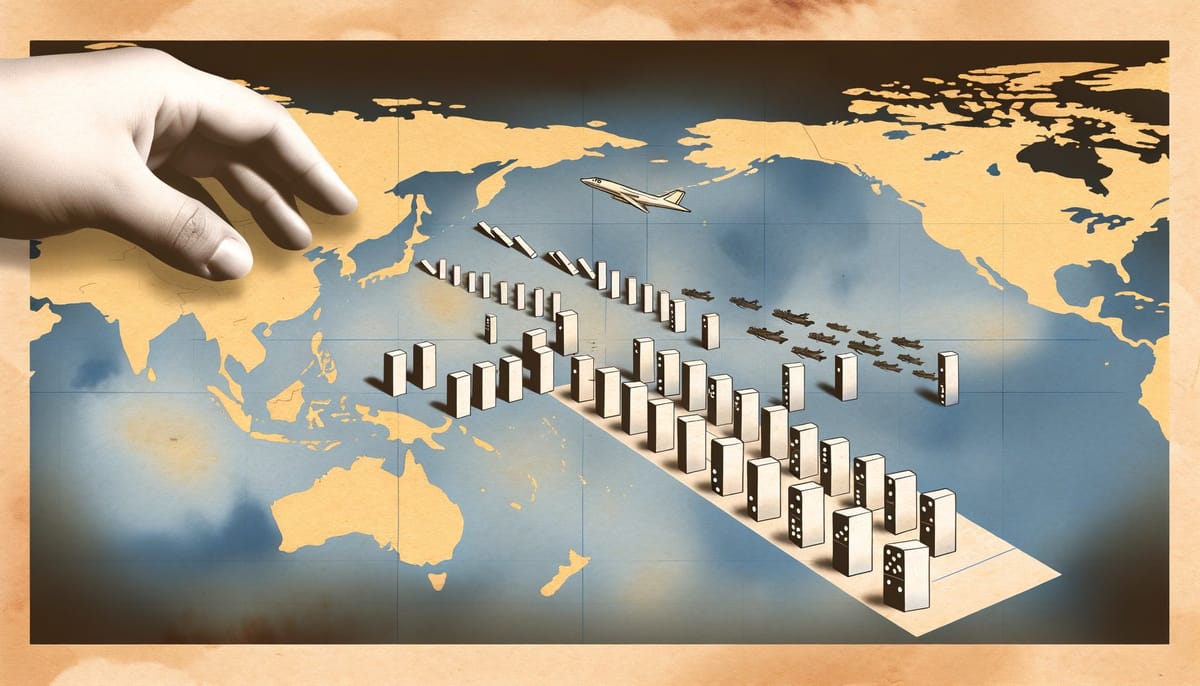
The Runway Paradox
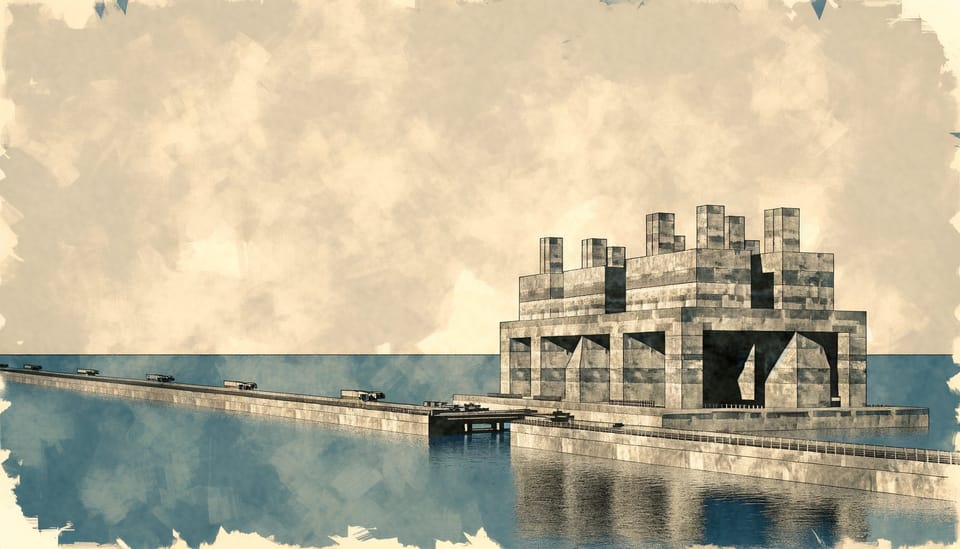
Tinian’s North Field last saw combat operations in August 1945, when B-29s carrying atomic weapons lifted off its coral runways toward Japan. Eighty years later, the United States Air Force is restoring those same runways to 1945-era specifications—while simultaneously modernizing them for stealth fighters. The $409 million contract awarded to Fluor in April 2024 represents the most visible edge of a larger gamble: that dispersing American airpower across dozens of Pacific islands will complicate Chinese targeting enough to restore deterrence.
The logic sounds elegant. Instead of concentrating aircraft at a handful of large bases that China’s missile force can saturate, spread them across so many locations that the adversary cannot hit them all. This is the essence of Agile Combat Employment, the Air Force’s doctrinal response to what it calls “pervasive intelligence, surveillance, and reconnaissance and all-domain long-range fires.”
But elegance and effectiveness are not synonyms. The question Beijing is asking—and Washington should be asking—is whether dispersal creates genuine operational problems for Chinese planners, or merely multiplies the number of craters American engineers must fill.
From Ninety-Three to Thirty-Three
The arithmetic of American basing tells its own story. At the end of World War II, the United States operated 93 air bases across the Pacific. Today, that number has shrunk to 33 permanent overseas installations—a 65% reduction that reflects decades of peacetime consolidation, host-nation politics, and budget constraints. The bases that remain are exquisitely capable but dangerously concentrated. Kadena Air Base in Okinawa, Andersen Air Force Base in Guam, and a handful of installations in Japan and South Korea host the bulk of American tactical airpower in the Western Pacific.
China has noticed. The People’s Liberation Army Rocket Force operates more than 1,200 ground-launched ballistic and cruise missiles capable of reaching these bases, according to the Pentagon’s 2024 China Military Power Report. The DF-17 hypersonic glide vehicle, with a range of 1,800-2,500 kilometers and terminal speeds exceeding Mach 5, was designed specifically to defeat missile defenses and strike “stationary ship-sized targets”—Pentagon jargon for airfields, ports, and command facilities. China’s satellite constellation now exceeds 510 platforms capable of intelligence, surveillance, and reconnaissance, including the Yaogan-41 geostationary satellite that can track car-sized objects anywhere in the Indo-Pacific.
The math is brutal in its simplicity. A single Chinese missile brigade can deliver enough precision munitions to crater every runway at Kadena in a single salvo. Repair crews, no matter how skilled, cannot work faster than missiles fly.
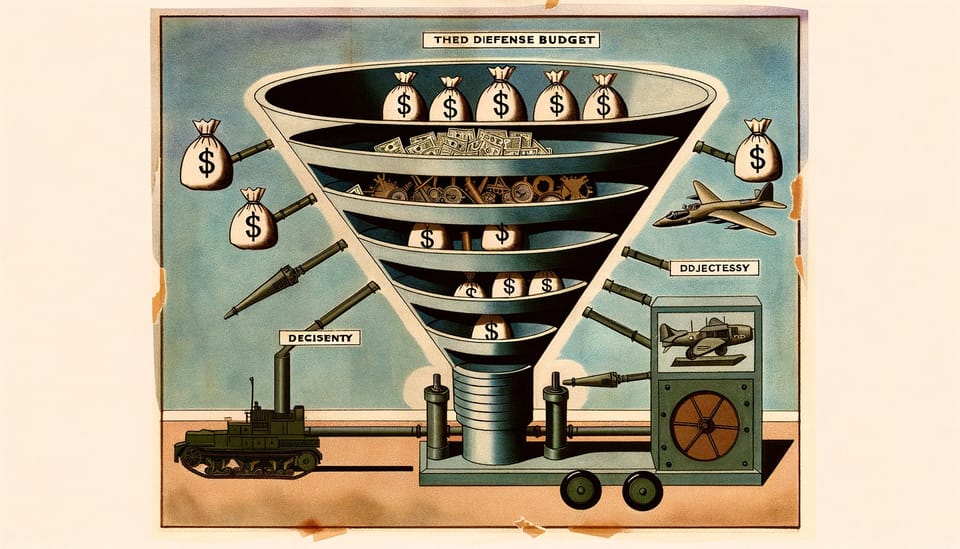
Hence the turn to dispersion. The Pacific Deterrence Initiative, established by Congress in 2021, has authorized over $40 billion through fiscal year 2024—the largest regional deterrence investment since the Cold War. Of the $9.1 billion allocated in FY2024, $2.38 billion funds “Infrastructure Improvements to Enhance Responsiveness and Resiliency.” This bureaucratic phrase conceals a radical operational shift: rebuilding World War II-era airstrips, pre-positioning fuel and munitions, and training personnel to operate from austere locations with minimal support.
The Geometry of Survival
Agile Combat Employment rests on a simple geometric insight: the more locations from which aircraft can operate, the more missiles an adversary must expend to suppress American airpower. If China must allocate ten missiles per airfield to ensure destruction, dispersing to thirty locations forces expenditure of 300 missiles. Dispersing to a hundred locations—the theoretical aspiration—would require a thousand.
This is the theory. Reality intrudes at multiple points.
First, satellites see everything. China’s ISR constellation provides persistent coverage of the Pacific, with revisit times measured in hours rather than days. The Yaogan-41 satellite can monitor an entire theater from geostationary orbit, detecting aircraft movements, fuel deliveries, and construction activity. Moving aircraft between locations to complicate targeting works only if the adversary cannot track the movement. Against an opponent with 510 surveillance satellites, the shell game becomes transparent.
Second, logistics constrain everything. An F-35 requires 25 maintenance personnel per aircraft for sustained operations, plus fuel, munitions, spare parts, and secure communications. Dispersing to austere locations does not eliminate these requirements—it multiplies them. Each additional operating location needs its own fuel cache, its own munitions stockpile, its own maintenance capability. The Air Force is training “Multi-Capable Airmen” who can perform multiple functions, but a crew chief cannot become a weapons loader and a fuel specialist simultaneously. The constraint is not training. It is physics.
Third, coral is not concrete. Many Pacific airfields sit on coral atolls whose limestone foundations vary wildly in structural properties—compressive strength ranges from 7 to 56 megapascals within the same formation, according to geological surveys. This eight-fold variation makes it impossible to engineer predictable blast protection using standard military hardening calculations. A bunker that survives one strike may collapse under an identical weapon fifty meters away.
The Air Force’s Rapid Runway Repair doctrine calls for repairing 120 craters in 6.5 hours—a capability demonstrated in exercises but never tested under fire. Each crater requires a precision-guided munition costing $1-3 million to create, but can be filled with commodity materials and manual labor. This asymmetry sounds favorable until one considers that China can manufacture missiles faster than the United States can train runway repair crews. The PLARF has expanded its missile production facilities by 60% since 2020, with the rate doubling after observing Western difficulties supplying Ukraine.
The Targeting Paradox
Here is where the logic of dispersal encounters its deepest contradiction. The very process of rebuilding airfields creates the intelligence that enables their destruction.
Environmental Impact Statements required under the National Environmental Policy Act must detail facility locations, construction specifications, and operational parameters. These documents are public. The Guam Military Buildup EIS, for example, specifies runway dimensions, fuel storage capacities, and ammunition handling facilities in sufficient detail to generate targeting packages. Chinese analysts need not penetrate classified networks. They need only read Federal Register notices.
The Enhanced Defense Cooperation Agreement with the Philippines, which grants American forces access to nine bases including sites in northern Luzon, illustrates the problem. Philippine officials justify northern EDCA sites as evacuation infrastructure for Filipinos in Taiwan—a dual-use narrative that provides political cover for deterrence infrastructure. But the same concrete that shelters evacuees can arm aircraft. China’s targeting doctrine makes no distinction. The moment munitions arrive at an EDCA site, the entire facility becomes a legitimate military objective under laws of armed conflict.
Pre-positioning weapons inverts the traditional dual-use problem. Instead of civilian infrastructure becoming militarized (bridges, power plants), purely civilian territory becomes targetable through stored offensive capability. A Philippine school hosting American munitions is no longer a protected site. The host nation bears the consequences.
What China Sees
Chinese military planners do not view Pacific dispersal as the Americans intend it. From Beijing’s perspective, the United States is not complicating targeting—it is expanding the target set.
System Destruction Warfare, the PLA’s operational doctrine, emphasizes attacking the “coherence” and “functionality” of adversary systems rather than pursuing material attrition. The goal is not to destroy every American aircraft but to sever the connections that allow aircraft to generate combat power: fuel, munitions, maintenance, communications, command. A dispersed force is more vulnerable to systemic disruption precisely because it depends on more nodes.
Consider a hub-and-spoke network with Andersen Air Force Base as the hub and twenty austere locations as spokes. Destroying Andersen does not eliminate the spokes, but it eliminates their ability to receive fuel, munitions, and replacement parts. The spokes become stranded aircraft awaiting capture or destruction. Dispersal without redundant logistics is not resilience. It is distribution of targets.
The CSIS Taiwan wargames, which have run dozens of iterations modeling Chinese invasion scenarios, consistently find catastrophic American losses—around 500 aircraft and 20 surface ships per game, including two aircraft carriers. These losses occur despite dispersal because logistics vessels transiting contested waters cannot survive. The submarines and aircraft that protect American supply lines are themselves consuming the supplies they protect, creating a thermodynamic trap where defensive operations consume the resources needed for offensive action.
The Sunk-Cost Vulnerability
American strategic culture contains a psychological vulnerability that Chinese planners have identified and may exploit. Western, Educated, Industrialized, Rich, Democratic (WEIRD) societies exhibit pronounced susceptibility to sunk-cost fallacy—the tendency to continue investing in failing projects because of prior investment rather than future returns.
China can weaponize this tendency not by falling for sunk-cost reasoning itself, but by encouraging American investment in infrastructure that becomes strategically obsolete. Every billion dollars poured into Tinian’s runways is a billion dollars not invested in long-range missiles, autonomous systems, or undersea capabilities that China cannot as easily target. The more America invests in fixed infrastructure, the more committed it becomes to defending that infrastructure—and the more predictable its force posture becomes.
This is not speculation. Chinese military literature explicitly discusses exploiting adversary attachment to legacy systems and sunk investments. The strategy is elegant: let America build expensive targets, then threaten those targets to constrain American options. The infrastructure becomes a hostage.
The Alliance Geometry
Dispersal requires host-nation consent. Host-nation consent requires political sustainability. Political sustainability requires that populations believe basing enhances rather than endangers their security.
This calculation varies dramatically across the Pacific. Japan’s constitutional reinterpretation permitting collective self-defense applies only when “Japan’s survival is threatened”—a determination that must be made in real-time during a crisis, not negotiated in advance. The Compact of Free Association grants the United States exclusive military access to Micronesian lands, waterways, and airspace, but Chuukese customary law establishes that lineage land is owned by matrilineal descendants who cannot alienate it. The state government can grant access that traditional owners reject, creating legal conflicts that may paralyze operations at critical moments.
The Philippines presents the starkest case. EDCA’s nine-year gap between signing (2014) and full implementation (2023) reflected genuine domestic opposition to American military presence. The agreement now functions, but public opinion remains volatile. A single incident—an accident, a crime, a mishandled protest—could trigger the political cascade that ejected American forces in 1991. Dispersal that depends on Philippine consent is dispersal that depends on Philippine politics.
Australia offers the most permissive environment, with Reciprocal Access Agreements and force posture initiatives that face minimal domestic opposition. But Australia is also the most distant from Taiwan, reducing its utility for the rapid-response scenarios that drive ACE doctrine. The bases most politically sustainable are operationally marginal. The bases most operationally critical are politically fragile.
Climate and the Double Obsolescence
A timeline convergence is approaching that planners have not adequately addressed. Climate-driven environmental changes and adversary capability improvements are maturing in the same 15-year window, creating what might be called double obsolescence.
Atoll freshwater aquifers face contamination from sea-level rise by mid-century. The same islands hosting dispersed airfields will become increasingly difficult to sustain as drinking water becomes scarce and storm surge damages infrastructure. Meanwhile, Chinese precision-strike capabilities continue improving, with hypersonic missiles, autonomous targeting, and satellite-guided terminal guidance reducing the survivability of any fixed installation.
By 2040, many Pacific airfields may be simultaneously uninhabitable due to environmental degradation and indefensible due to adversary capabilities. Infrastructure investments made today lock in facilities that may serve neither purpose within their design lifespan. The Pentagon is building for a threat environment that will not exist by the time construction completes.
The Sisyphean Signal
There is one argument for dispersal that its critics underestimate: the signal it sends.
Deterrence operates through adversary perception. If China believes the United States will fight—and can fight effectively—from dispersed Pacific locations, that belief may prevent the conflict that would test the capability. The demonstrated willingness to eternally reconstruct becomes the deterrent signal itself, not the airfields’ tactical utility. The adversary must calculate not just whether it can destroy American infrastructure, but whether destruction will matter.
This is the Sisyphean logic: the act of rebuilding, repeated indefinitely, communicates resolve that capability alone cannot. The runways are not the point. The commitment to runways is the point.
But Sisyphean deterrence has limits. If China concludes that American dispersal is theater—visible activity without operational substance—the signal inverts. Instead of communicating resolve, it communicates desperation. Instead of complicating Chinese planning, it reveals American vulnerability. The same infrastructure that signals commitment can signal weakness, depending on whether the adversary believes it works.
What Would Actually Work
Genuine resilience in the Pacific requires capabilities China cannot easily target, not infrastructure China can destroy and America can rebuild.
Long-range strike from outside Chinese missile range offers one path. Aircraft and missiles operating from Guam, Hawaii, or continental bases can reach Taiwan Strait without exposing themselves to PLARF salvos. The trade-off is response time: weapons launched from 4,000 kilometers require hours to arrive, during which a fait accompli may become irreversible.
Undersea capabilities offer another. Submarines operating in the Western Pacific face detection challenges that aircraft at fixed bases do not. The trade-off is capacity: submarines cannot deliver the sortie rates that airpower provides, and their weapons magazines are finite.
Autonomous systems offer a third. Drones that do not require runways, fuel trucks, or maintenance crews eliminate the logistics tail that dispersal multiplies. The trade-off is capability: current autonomous systems cannot match crewed aircraft in complex missions, and the command-and-control architecture for large-scale autonomous operations does not exist.
Each alternative sacrifices something the current approach provides. There is no costless path to Pacific deterrence. The question is which costs America is willing to bear—and which costs it is currently ignoring.
FAQ: Key Questions Answered
Q: How many missiles would China need to neutralize American Pacific airbases? A: Estimates vary, but CSIS wargames suggest China could crater major runways at Kadena and Andersen with 100-200 missiles—a fraction of PLARF’s inventory. Dispersal increases the required number but does not change the fundamental asymmetry between missile production and runway repair capacity.
Q: Can rapid runway repair keep pace with Chinese missile strikes? A: In exercises, yes. Under fire, unknown. The 6.5-hour repair doctrine assumes uncontested work conditions and pre-positioned materials. Sustained bombardment would prevent both. The real constraint is not repair speed but the exhaustion of repair crews and materials over multi-day campaigns.
Q: Do Pacific allies support American base expansion? A: Support varies dramatically. Australia and Japan have expanded access agreements with minimal opposition. The Philippines remains politically volatile, with EDCA implementation delayed nine years by domestic resistance. Micronesian compact states face conflicts between federal agreements and customary land ownership that may surface during crises.
Q: What alternatives to dispersal exist for Pacific deterrence? A: Long-range strike from outside Chinese missile range, undersea capabilities, and autonomous systems each offer partial solutions. None matches the sortie generation of forward-deployed tactical airpower. The Pentagon is investing in all three while continuing dispersal—a hedge that may prove wise or may dilute resources across incompatible approaches.
The Coral and the Missile
Tinian’s runways will be rebuilt. The contracts are signed, the money appropriated, the construction underway. Whether those runways will matter in a conflict with China depends on questions the construction cannot answer: Will logistics function under fire? Will allies permit operations from their territory? Will China’s targeting outpace America’s dispersal?
The honest answer is that no one knows. The Pacific Deterrence Initiative represents the largest regional defense investment since the Cold War, but investment is not strategy. Money spent on infrastructure that China can destroy more cheaply than America can rebuild is money that buys activity rather than capability.
What dispersal does buy is time—time for long-range strike to mature, for autonomous systems to prove themselves, for alliances to deepen or fracture. The runways are not the deterrent. They are the placeholder for a deterrent that does not yet exist.
Whether that placeholder holds until the real thing arrives is the $40 billion question. The coral is patient. The missiles are not.
Sources & Further Reading
The analysis in this article draws on research and reporting from:
- Air Force Doctrine Note 1-21: Agile Combat Employment - foundational doctrine establishing ACE principles and operational concepts
- DoD Pacific Deterrence Initiative FY2024 Budget - detailed breakdown of infrastructure investments and capability priorities
- Pentagon Report on China Military Power 2024 - assessment of PLARF capabilities and satellite constellation
- CSIS Missile Threat: DF-17 Analysis - technical specifications of China’s hypersonic glide vehicle
- RAND Corporation: Building Multi-Capable Airmen - analysis of personnel requirements for distributed operations
- FPRI: US-Philippines Enhanced Defense Cooperation Agreement - examination of EDCA’s political and operational dimensions
- ICAAD: Compact of Free Association Strategic Assessment - analysis of legal and sovereignty issues in Micronesian basing
- South China Morning Post: China Space Military Technology - reporting on Yaogan-41 and ISR constellation expansion