The Six-Minute Warning: What China's Taiwan Exercises Reveal About the Vanishing Window for Defense
China's Joint Sword exercises compressed attack timelines to hours, not days. Taiwan's radars can detect missiles six minutes out—but detection is not decision. The real question is whether anyone can act on what they see before the window closes entirely.
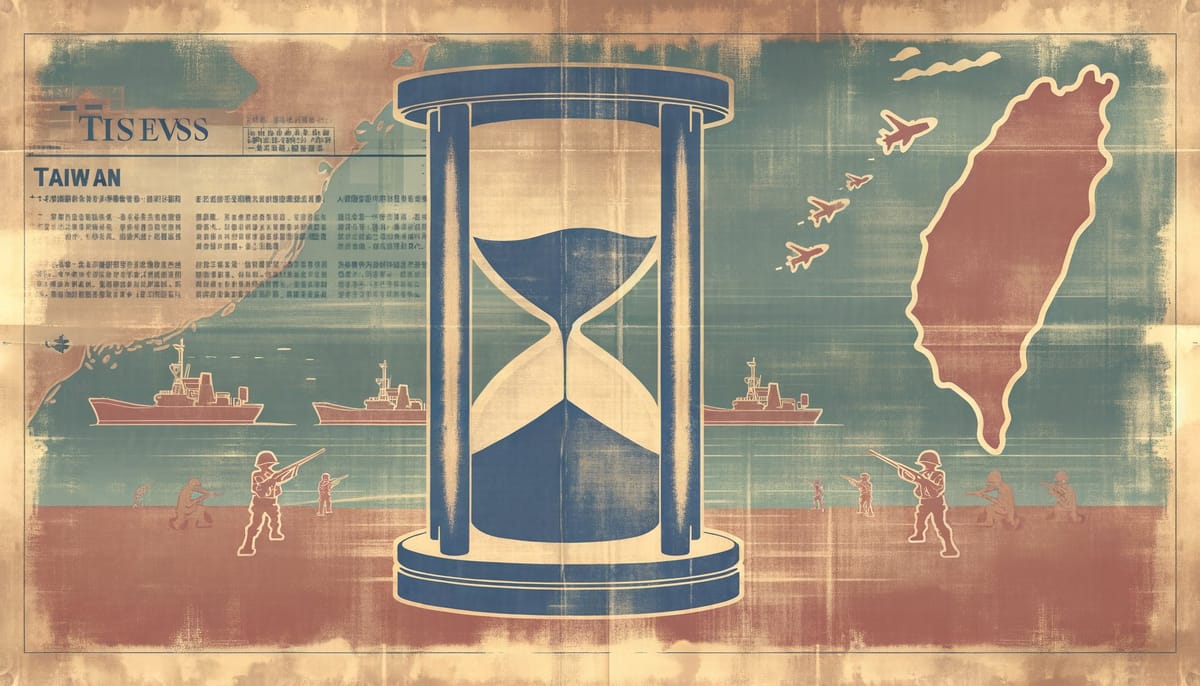
The Six-Minute Warning
Taiwan’s PAVE PAWS radar system can detect an incoming ballistic missile and provide six minutes of warning. Six minutes: enough time to wake a president, not enough to brief one. Enough to sound an alarm, not enough to evacuate a city. The gap between detection and decision has become the central strategic fact of the Taiwan Strait.
China’s Joint Sword-2024B exercise exposed this gap with clinical precision. On October 14, 2024, Beijing’s first communiqué went out at 5:01 AM. By nightfall, the exercise had concluded. The PLA Eastern Theater Command had encircled Taiwan, practiced strikes on sea and land targets, and rehearsed blocking access to key ports—all within a single news cycle. Taiwanese officials later estimated the planning took seventy days. The execution took one.
This compression matters. Traditional military doctrine assumes warning time scales with threat magnitude: small probes offer little notice, but major operations require visible mobilization. The PLA has spent a decade inverting this logic. What the CSIS “Cold Start” analysis calls a “cold start military posture with Chinese characteristics” means the ability to shift from peacetime routines to combat readiness without obvious prior indications. The question is no longer whether Taiwan would see an attack coming. It is whether anyone could act on what they saw.
The Readiness Paradox
The 2024 Pentagon China Military Power Report states that “the PLA continues to make steady progress toward its 2027 goals, whereby the PLA must be able to achieve ‘strategic decisive victory’ over Taiwan.” Progress toward what, exactly? The phrase “strategic decisive victory” does heavy lifting. It implies not merely military capability but the confidence to use it—and the institutional machinery to execute rapidly.
Here the evidence fractures. On one hand, the PLA’s joint integration has deepened dramatically. The dissolution of the Strategic Support Force in 2024 and creation of the Information Support Force suggests Beijing learned from watching Russia’s Ukraine failures. Centralized integration of cyber, electronic warfare, and psychological operations creates detectable organizational signatures. The restructuring disperses these functions, making the force harder to read.
On the other hand, Xi Jinping has purged his own military leadership with an intensity that undermines the very readiness he demands. He Weidong, former Commander of the Eastern Theater Command—the man who would have led any Taiwan operation—was removed in October 2025. The sweeping purge of PLA generals suggests, as Asia Times reported, “far more than routine anti-corruption.” Factional loyalty has displaced operational competence as the primary selection criterion.
This creates a paradox. The PLA’s exercises demonstrate increasing sophistication. Joint Sword-2024A and 2024B tested “essential components” of invasion options, including strikes on sea and land targets. The sequential naming—A, then B—signals a deliberate campaign of capability demonstration. Yet the officers conducting these exercises serve at Xi’s pleasure, and Xi’s pleasure is capricious. Complex systems research shows that tighter coupling between network components paradoxically lowers the failure threshold. As PLA joint integration deepens, the point at which cascading collapse begins may be lower than anyone assumes.
The readiness question cannot be answered by counting ships or measuring missile ranges. It requires understanding a system where the supreme leader has made himself the single point of failure.
What Warning Actually Means
Warning time is not a number. It is a series of nested decisions, each with its own clock.
Taiwan’s PAVE PAWS radar provides over six minutes of warning for incoming ballistic missiles. The Chang Bai radar system extends coverage further. Satellites track ship movements. Signals intelligence monitors communications. In theory, Taiwan possesses comprehensive awareness of PLA activities.
In practice, awareness is not understanding. The PLA has systematically contaminated the baseline against which anomalies are measured. Each Joint Sword exercise that does not escalate trains analysts to classify encirclement as routine. The Taiwan Strait median line—never a legal boundary but a mutually recognized threshold for forty years—has been erased through systematic crossing. When the tripwire dissolves, what remains is continuous pressure with no clear transition point.
Consider the detection problem from the defender’s perspective. The PLA conducts exercises constantly. Ships move. Aircraft fly. The question is never “is something happening?” but “is this the one that matters?” False alarm conditioning through ambiguous warning creates what one NSA analysis called “ontological paralysis”—defenders cannot trust their own epistemological framework during actual attack.
The problem compounds with sleep. Sleep inertia—the cognitive impairment immediately upon waking—is most severe in the first three minutes. A six-minute missile warning for a decision-maker awakened from deep sleep is effectively a three-minute warning. The body’s neurobiology does not care about national security.
Then there is the legal clock. Taiwan’s constitution requires emergency decrees to be “directly authorized” by the President and issued to deal with “imminent dangers.” The procedural bottleneck assumes detectability and response time. The PLA’s exercise doctrine—where “exercise” and “operation” become indistinguishable—renders this assumption obsolete. By the time legal processes complete, the operational window may have closed.
The most insidious form of warning compression is not technical but bureaucratic. Repeated PLA drills create classification thresholds: formal warning systems must distinguish “routine” from “real.” Each drill that doesn’t escalate trains the bureaucracy to raise its classification bar. The system learns to discount signals. When the genuine threat arrives, it must clear a threshold designed to filter out all the false alarms that preceded it.
The Shadow Fleet
China’s amphibious lift capacity presents a puzzle. The PLA Navy possesses approximately 670 ZTD-05 amphibious assault vehicles—enough for perhaps one brigade. A full-scale invasion would require six brigades or more. The gap between capability and requirement seems to offer comfort.
This comfort is misplaced. The PLA has solved its lift problem not through military procurement but through civilian infrastructure. RO-RO ferries operating profitable domestic routes—the Bohai Strait, Xiamen-Kinmen—function as pre-blessed assault transports requiring no visible reconfiguration. Port throughput data shows 6.9% container growth and 4% cargo growth annually. Each percentage point expands the civilian fleet pool available for military requisition.
The “shadow navy” of civilian ferries creates a detection nightmare. Commercial vessels oscillate between economic and military identities. A ferry carrying passengers to Kinmen today could carry marines tomorrow. The PLA’s deliberate outsourcing of logistics to civilian firms—JD, SF Express, and Deppon now handle over 60% of military procurement—means mobilization signals leak through commercial infrastructure that operates in both formal and informal economies.
This has an unexpected consequence. When a logistics company receives an unusual order—extra fuel, pre-positioned supplies, vehicle reservations—the information doesn’t stay contained. Truck drivers talk. Warehouse workers notice. The informal economy becomes an inadvertent early warning network, distributed and uncontrolled. Whether this warning reaches anyone who can act on it is another matter.
Biological metabolic scaling offers an uncomfortable analogy. Larger organisms have lower mass-specific metabolic rates at rest but require disproportionately more energy during activity bursts. Military logistics assumes linear scaling: double the force, double the supply. Reality follows a three-quarter power law. A Taiwan invasion force would exhibit metabolic signatures that scale nonlinearly with force size. Detection thresholds exist where resource consumption becomes thermodynamically incompressible—the invasion simply cannot hide its appetite.
The question is whether anyone is watching the right indicators.
The Democratic Dilemma
The United States faces a structural impossibility. The War Powers Resolution requires the President to report to Congress within 48 hours of introducing forces into hostilities. The requirement assumes military action can be initiated before congressional ritual completion, treating legitimacy as retrospective documentation rather than prospective authorization.
For Taiwan, this creates a temporal gap. A PLA operation launched at dawn Taiwan time arrives in Washington at dinner. Congressional leadership must be notified. Intelligence must be briefed. Options must be presented. Each step consumes hours that missiles traverse in minutes.
Japan’s constraints are more severe. The US military strategically linked the Senkaku and Taiwan disputes, creating a structural dependency where Japanese response speed is constrained by constitutional interpretation ambiguity. Article 9’s prohibition on collective self-defense has been reinterpreted but not resolved. When the crisis arrives, lawyers will argue while ships burn.
Domestic opposition compounds the problem. Okinawa’s 2019 referendum showed 72% opposition to the Henoko base construction. The very populations most threatened by adversary aggression become the primary constraint on defensive pre-positioning. Visible US military infrastructure creates domestic political costs that erode the alliance’s foundation during peacetime—precisely when pre-positioning would be most valuable.
The PLA understands this. Gray-zone operations exploit the gap between military necessity and democratic legitimacy. Coast Guard vessels instead of PLA Navy ships create a category problem: responding with military force makes Taiwan the aggressor under international law. The Coast Guard’s “law enforcement inspections” during PLA drills establish precedent for administrative port access control that blurs into blockade without ever crossing the legal threshold.
Insurance markets have already priced in the ambiguity. Carriers have quadrupled premiums on Taiwan-China risk and reduced exposure. The “silicon shield”—the assumption that Taiwan’s semiconductor dominance provides deterrence—erodes as markets signal conflict probability. Economic interdependence that supposedly prevents war is being unwound by the markets’ own risk calculations.
Taiwan’s Asymmetric Answer
Taiwan’s defense establishment has not been idle. The 2025 National Defense Report emphasizes “resolute defense and multi-domain deterrence,” with defense spending rising toward 3% of GDP by 2026. The shift toward asymmetric capabilities reflects hard-won realism about what warning time actually permits.
The Presbyterian Church’s 1,200 congregations across Taiwan function as pre-existing distributed command nodes mapping onto indigenous territorial knowledge in the central mountains. The “Noah’s Ark Plan”—civil defense preparation using church networks—reveals that resilience doesn’t require building new infrastructure. It requires activating what already exists.
TSMC’s classification as “military sector” creates a legal paradox. The designation allows employee deferral from reservist duty, protecting strategic industrial capacity. But the same designation signals that the company itself is a military target. Taiwan News reported that employees can request call-up deferral, but the very existence of the mechanism advertises the company’s strategic value.
Taiwan’s cultural identity functions as an immune system against memetic invasion. Surveys show 62% of Taiwanese perceive themselves as distinct from China. This “evolutionary resistance” to memetic colonization mirrors how established ecosystems resist invasive species through niche saturation. China’s influence operations encounter a population whose identity has evolved to recognize and reject the pathogen.
The Amis maritime communities offer an unexpected asset. Indigenous oral traditions encode multi-century observational data about “normal” maritime patterns—ancestral sea paths, tidal rhythms, ritual fishing territories. These baselines make anomalies visible to people who have watched the same waters for generations. Gray-zone incursions that confuse satellite analysts may be obvious to fishermen whose grandfathers fished the same grounds.
Taiwan’s path to energy resilience remains the critical vulnerability. Virtual Power Plants demonstrate mastery of aggregating distributed assets into strategic reserve capacity for electricity. The same logic has not been applied to liquid fuels. Taiwan lacks a strategic petroleum reserve adequate to sustained conflict. The distributed coordination technology exists. The political will to apply it does not.
The Cascade
What happens when warning compresses to zero?
The default trajectory is not invasion but something worse: a crisis that nobody chooses but nobody can stop. Margin calls in financial markets require immediate liquidity across all positions simultaneously. Military warnings similarly demand immediate payment of all accumulated readiness debts at once—maintenance backlogs, training deficiencies, equipment shortfalls, personnel gaps. The moment of crisis reveals every deferred decision.
The PLA’s exercise naming conventions—Joint Sword, Strait Thunder, Justice Mission—create a narrative escalation track independent of actual military capability. By progressing from technical/operational names to moral/political ones, Beijing constructs a rhetorical ladder that constrains its own options. Having invoked “justice,” retreat becomes harder.
Xi Jinping’s 2049 deadline for national rejuvenation transforms from aspirational goal into legitimacy constraint. By publicly linking Taiwan reunification to the centennial timeline, Xi has created a political trap where failure to achieve reunification before 2049 would represent personal and party failure. The deadline accelerates military readiness development regardless of whether the capability matches the ambition.
The monsoon-driven current reversals in the Taiwan Strait create natural operational windows. Winter northeast monsoons maximize southward China Coastal Water penetration. Summer southwest monsoons enable northward South China Sea Water flow. The PLA’s new amphibious barges are designed to overcome these biospheric constraints by enabling operations from non-traditional beaches. Nature’s calendar is being overwritten by engineering.
AI-generated military propaganda enables same-day production and dissemination of escalatory narratives. Memetic tempo now outpaces logistics preparation cycles by orders of magnitude. A video of drone swarms over Taipei can circulate globally before the actual drones have left their hangars. The information environment escalates faster than the physical one.
What Would Change the Trajectory
Three intervention points offer leverage. Each carries costs.
First, Taiwan could harden its energy infrastructure against blockade. This requires building strategic petroleum reserves, distributing fuel storage, and extending the Virtual Power Plant logic from electricity to liquid fuels. The cost: billions of dollars and admission that the silicon shield is insufficient. The benefit: extending the timeline from days to weeks, which may be the difference between allied intervention and fait accompli.
Second, the United States could pre-position forces in ways that compress its own response timeline. This means more assets in Guam, more frequent rotations through Japan, more visible commitment. The cost: domestic political opposition in host nations, increased tension with Beijing, and the risk of entrapment in a conflict Washington might otherwise avoid. The benefit: credible deterrence requires credible presence.
Third, Taiwan and its partners could invest in distributed early warning networks that complement technical systems. Indigenous maritime communities, commercial shipping networks, informal economy observers—these human sensors are resistant to the adversarial machine learning attacks that threaten satellite and radar systems. The cost: coordination complexity and security risks from broader information sharing. The benefit: warning systems that cannot be spoofed by pixel manipulation.
The most likely scenario involves none of these. Taiwan will continue incremental improvements. The United States will maintain strategic ambiguity. China will continue compressing timelines and contaminating baselines. The warning window will shrink until it vanishes.
Frequently Asked Questions
Q: How much warning would Taiwan actually have before a Chinese attack? A: It depends on the attack type. For ballistic missiles, Taiwan’s PAVE PAWS radar provides roughly six minutes of warning—enough to alert leadership but not enough for meaningful response. For a full-scale invasion requiring amphibious lift, traditional indicators might provide days or weeks of warning, but China’s “cold start” posture and civilian shipping integration are designed to compress this window toward zero.
Q: Could China invade Taiwan without the US knowing in advance? A: The US would almost certainly detect preparations for a full-scale invasion through satellite imagery, signals intelligence, and allied reporting. The question is whether decision-makers would correctly interpret the signals amid the noise of routine exercises. China’s strategy of conducting frequent drills that resemble invasion preparations creates a “cry wolf” effect that degrades analytical confidence.
Q: What is China’s 2027 timeline and is it real? A: The 2027 date refers to the PLA’s internal goal of achieving capability for “strategic decisive victory” over Taiwan, as documented in Pentagon assessments. It represents a capability milestone, not a predetermined invasion date. However, Xi Jinping’s public linkage of Taiwan reunification to his legacy creates political pressure that may accelerate timelines regardless of military readiness.
Q: Why doesn’t Taiwan just declare independence and force a crisis? A: Formal independence declaration would trigger China’s Anti-Secession Law, which mandates “non-peaceful means” in response. Taiwan’s current ambiguous status preserves deterrence by avoiding a legal tripwire while maintaining de facto autonomy. The strategic value of ambiguity exceeds the symbolic value of declaration.
The Compression
The PLA’s cold start capability represents a fundamental shift in how military power translates into political outcomes. Traditional deterrence assumed that major operations required visible preparation, giving defenders time to respond and allies time to intervene. China has invested heavily in eliminating that assumption.
What remains is a competition over time itself. Taiwan seeks to extend its warning window through distributed detection and hardened infrastructure. China seeks to compress it through exercise normalization and civilian-military fusion. The United States seeks to pre-position response capability while managing alliance politics.
The outcome will not be determined by ships or missiles alone. It will be determined by which side better understands that warning time is not measured in minutes on a radar screen. It is measured in the accumulated decisions—made or deferred—that determine whether those minutes can be used.
Six minutes is a long time if you know what to do with it. It is no time at all if you don’t.
Sources & Further Reading
The analysis in this article draws on research and reporting from:
- CSIS “Cold Start” Analysis - Detailed assessment of PLA rapid mobilization capabilities and Joint Sword exercise timelines
- 2024 Pentagon China Military Power Report - Official US assessment of PLA progress toward 2027 capability goals
- Breaking Defense coverage of Pentagon report - Analysis of US vulnerability assessments
- Taiwan’s 2025 National Defense Report - Taiwan’s official defense posture and spending plans
- The Diplomat on Taiwan energy resilience - Analysis of Taiwan’s infrastructure vulnerabilities
- Institute for the Study of War on China-Taiwan updates - Tracking of PLA exercise patterns and planning timelines
- Taiwan Strait shipping patterns research - Maritime traffic analysis relevant to logistics assessment
- Taiwan News on TSMC military sector designation - Reporting on reservist deferral mechanisms for strategic industries