The 2027 Question: What Breaks First Over Taiwan
China's military readiness deadline approaches as American deterrence, semiconductor supply chains, and allied resolve in Tokyo and Seoul each show stress fractures. The question is not whether the system holds—but which component fails first, and whether the failure propagates before anyone...
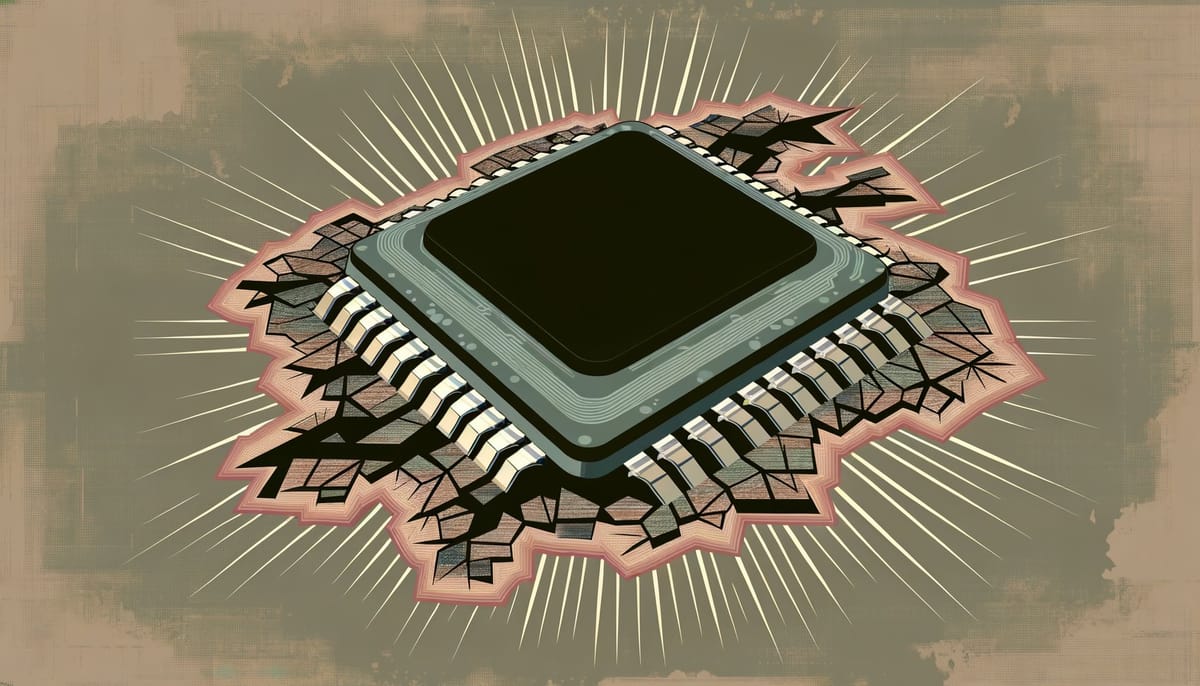
The Clock and the Cracking
Taiwan’s silicon shield is not a metaphor. It is a physical fact: 64% of the world’s foundry capacity, over 90% of advanced nodes below 7 nanometers, concentrated on an island 180 kilometers from a nuclear-armed rival that has ordered its military to be ready to seize it by 2027. The question is not whether something breaks under this pressure. The question is what fractures first—and whether the fracture is visible before it becomes catastrophic.
Three candidates present themselves. American deterrence credibility, already strained by strategic ambiguity’s internal contradictions. Semiconductor supply chains, whose concentration makes them simultaneously indispensable and indefensible. Allied resolve in Tokyo and Seoul, where constitutional constraints and economic dependencies create paralysis dressed as deliberation. Each shows stress fractures. None has collapsed. But the physics of pressure suggest the weakest point will fail suddenly, not gradually—and identifying that point before failure may be the most consequential analytical task of the decade.
The conventional wisdom holds that Beijing watches Washington. This is true but incomplete. Beijing watches Washington watching Tokyo watching Seoul watching Washington. The system is reflexive. A wobble anywhere propagates everywhere.
Strategic Ambiguity’s Structural Flaw
American deterrence toward Taiwan rests on a deliberate contradiction. The Taiwan Relations Act requires providing defensive arms and maintaining “the capacity of the United States to resist any resort to force or other forms of coercion.” It does not commit to military intervention. President Biden has stated four times that America would defend Taiwan militarily; four times, officials have clarified that policy remains unchanged. This is not confusion. It is strategy.
The logic runs as follows: ambiguity deters both Chinese aggression and Taiwanese provocation. Beijing cannot be certain America will stay out; Taipei cannot be certain America will come in. Both behave cautiously. The equilibrium holds.
Except it doesn’t. The War Powers Resolution imposes a 60-day clock on unauthorized military action. Any president who commits forces to Taiwan’s defense must either secure congressional authorization or withdraw. Strategic ambiguity thus serves a domestic constitutional function: it preserves presidential flexibility by avoiding pre-commitment that would create impeachment exposure if the president later declined to act. The ambiguity is not primarily about deterring China. It is about preserving executive maneuver room.
This creates a credibility problem that compounds over time. Beijing’s analysts understand American constitutional constraints. They observe that public presidential statements generate “audience costs”—domestic political penalties for backing down. But they also observe that these costs emerge from what the sociologist Erving Goffman called “expression games”: performances whose credibility depends not on the constraint itself but on the quality of the performance. A president who commits publicly but whose party controls neither chamber faces different constraints than one with unified government. The signal degrades with context.
The U.S. Navy’s maintenance crisis illustrates the gap between declaratory policy and operational capacity. In 2022, maintenance completion rates fell to 36%. By 2024, they had recovered to 67%—still a third of scheduled work unfinished. This improvement occurred precisely during the period when Chinese cyber operations embedded deepest into American infrastructure through the Volt Typhoon campaign. The Navy celebrates progress while the foundations remain compromised. Beijing notices.
Deterrence credibility thus faces a temporal squeeze. The 2027 deadline—confirmed by CIA Director William Burns as Xi Jinping’s order for military readiness—creates a closing window. American force posture improvements cannot outpace Chinese capability development before that date. The Pentagon’s 2025 report states that China expects to achieve “strategic decisive victory” over Taiwan by the end of 2027. The question is whether American credibility can survive the gap between commitment and capacity.
The Silicon Shield’s Paradox
Taiwan’s semiconductor dominance was never designed as a defense strategy. It emerged from industrial policy, geography, and TSMC founder Morris Chang’s insight that separating chip design from fabrication would create economies of scale impossible for integrated manufacturers to match. The result: Taiwan produces chips that power everything from iPhones to F-35 targeting systems. Destroying or capturing this capacity would crater the global economy.
The theory holds that this interdependence deters invasion. China needs Taiwanese chips for its own AI development. The United States needs them for weapons systems. Neither can afford to see the fabs destroyed. Taiwan becomes too valuable to attack.
The paradox is that the shield degrades through its own success. Every TSMC fab built in Arizona—over $65 billion committed—demonstrates that advanced manufacturing can relocate. Every Chinese investment in domestic capacity, however inferior, reduces Beijing’s dependence on Taiwanese production. The shield works only if Taiwan remains indispensable. American and Chinese policies both work to make it dispensable.
The CHIPS Act accelerates this dynamic. Its $280 billion commitment to domestic production explicitly prepares for a world where Taiwan’s fabs are inaccessible. This is prudent risk management. It is also a signal to Beijing that Washington considers Taiwan’s capture survivable. The very act of hedging undermines the deterrent value of the asset being hedged.
Supply chain vulnerability extends beyond Taiwan itself. Samsung’s Xi’an fab represents $18.87 billion in investment—capital that cannot be extracted, upgraded, or redeployed under current export controls. This is not a negotiable asset but a hostage. South Korean semiconductor exports to China fell 13.7% after October 2022 export controls, creating direct financial incentives for chaebol lobbying against alliance coherence. The supply chain is not merely fragile; it is internally contradictory, with different nodes pulling in different directions.
The temporal dimension matters most. Taiwan’s semiconductor dominance represents 30 years of accumulated tacit knowledge—the kind that cannot be transferred through blueprints or training programs. CHIPS Act fabs attempt to compress this inheritance into 3-5 year buildouts. The gap between physical infrastructure and operational capability creates what might be called a reincarnation lag: the buildings exist before the expertise to run them does. By 2027, American fabs will produce chips. They will not produce enough chips, at sufficient yields, to replace Taiwan.
This creates a window of maximum vulnerability: Taiwan’s shield weakening, alternatives not yet viable, China’s capability peaking. The supply chain does not break cleanly. It frays at multiple points simultaneously.
Tokyo’s Constitutional Cage
Japan’s defense transformation appears dramatic. The 2025 budget exceeds ¥9 trillion—$58 billion allocated to standoff missile capabilities that could strike Chinese targets 1,000 kilometers away. The 2015 reinterpretation of collective self-defense permits military action to protect allies under certain conditions. Public concern about regional security runs at 82%, far exceeding South Korea’s 52%.
The transformation is real. It is also insufficient.
Japan’s “survival-threatening situation” threshold creates a legal tripwire that may prove impossible to cross. The doctrine permits force only when an armed attack on a foreign country “threatens Japan’s survival” and poses a “clear danger to fundamentally overturn people’s right to life, liberty and pursuit of happiness.” This is not a low bar. A Chinese blockade of Taiwan that cuts Japan’s energy imports might qualify. A limited amphibious assault might not. The legal architecture creates ambiguity about precisely the scenarios most likely to occur.
The ringi-sho consensus system compounds the problem. Japanese bureaucratic decision-making requires proposals to circulate through multiple levels, gathering approval at each stage. Decisions “get stuck at certain levels” by design—the system prevents precipitous action. In peacetime, this produces stability. In crisis, it creates exploitable temporal windows. Gray zone operations that stay below the threshold triggering consensus machinery can proceed faster than the response.
Demographic collapse accelerates the constraint. Japan’s 18-26 cohort has shrunk 40% over recent decades. Willingness to fight stands at 11%—the lowest among surveyed nations. The Self-Defense Forces face a recruitment crisis that no budget increase can solve. Suppliers are pulling out of the defense industry despite new procurement initiatives, citing profit margins capped at 7% actual versus 15% theoretical. The industrial base cannot surge.
Japan’s nuclear latency presents a final complication. The Three Non-Nuclear Principles—no possession, production, or introduction of nuclear weapons—function as a moral legitimacy framework. Yet Japan operates the Rokkasho reprocessing plant, maintains substantial plutonium stockpiles, and possesses the technical capability to weaponize within months. The victim identity does not constrain nuclear hedging; it enables it by providing political cover. The question is whether this latent capability strengthens deterrence or creates instability by tempting preemption.
Tokyo’s resolve is genuine. Its capacity to act on that resolve within relevant timescales is questionable.
Seoul’s Triangular Trap
South Korea faces a geometric impossibility: alliance with Washington, economic dependence on Beijing, existential threat from Pyongyang. Any two can be managed. All three create paralysis.
The numbers tell the story. China remains South Korea’s largest export market at 19.7% of total exports. Samsung’s revenue surge—54% from Americas in 2024—reflects partial decoupling, but the production base remains vulnerable. A Taiwan crisis that triggers Chinese retaliation against South Korean firms would devastate an economy still recovering from the 1997 financial crisis’s structural reforms.
Public opinion shows the strain. Support for Taiwan intervention stands at 64.5%—surprisingly high given the economic stakes. But this figure exists alongside deep distrust of the military among mothers of conscript sons, and a population carrying unprocessed historical trauma from Japanese occupation, Korean War division, and authoritarian rule. The candlelight protest movement that toppled President Park Geun-hye demonstrated a structural veto mechanism: coalition consensus requirements mean government commitments can be blocked by the most restrictive faction, not the median voter.
North Korea’s nuclear arsenal adds a dimension absent from Japan’s calculations. Any South Korean military commitment to a Taiwan contingency opens vulnerability on the peninsula. Pyongyang need not act; the threat alone constrains Seoul’s options. The U.S. extended deterrent that protects South Korea from the North creates dependency that limits autonomy regarding China.
The chaebol structure creates additional friction. Samsung represents 23% of South Korea’s GDP. Its interests do not align neatly with alliance priorities. The debt-to-equity improvements since 1997 that made chaebols more resilient to financial shocks paradoxically make blockade-induced price signals less actionable for Western policymakers—lower leverage means chaebols can absorb initial stress without triggering the market panic that would force government response.
Seoul’s position resembles the Korean shamanic concept of han—unresolved grief that cannot be released until properly witnessed. The 64.5% support for Taiwan intervention exists in a population whose historical wounds remain unacknowledged. Choosing alliance utility over unresolved trauma mirrors the psychological conditions for collective moral injury. The support is real but brittle.
The Sequencing Problem
Which breaks first? The question assumes sequential failure, but the system is coupled. A crack in one component propagates stress to others.
Consider the scenario: Beijing initiates a “quarantine” of Taiwan—not a blockade (an act of war) but an inspection regime for contraband. Lloyd’s Joint War Committee designates the Taiwan Strait high-risk. Insurance clauses activate, premiums spike, commercial shipping diverts. TSMC’s EUV lithography machines, requiring exquisite environmental calibration, cannot operate under the stress of military posturing nearby. Chip production falls before any shot is fired.
Washington faces a choice: treat the quarantine as the blockade it functionally is, or accept the legal fiction. The War Powers clock starts only with hostilities. Strategic ambiguity becomes strategic paralysis.
Tokyo’s survival-threatening situation threshold may or may not be met. The ringi system grinds. Meanwhile, Japanese energy imports transit the same waters. The constitutional machinery was not designed for this tempo.
Seoul calculates: if Washington wavers, the extended deterrent protecting the peninsula wavers too. If Tokyo hesitates, the trilateral architecture fractures. The 64.5% support for intervention meets the reality that intervention means choosing between alliance and economy, with Pyongyang watching.
The most likely first failure is not dramatic. It is the slow erosion of insurance markets, shipping routes, and commercial confidence that makes Taiwan’s fabs economically inaccessible before they become militarily contested. The silicon shield does not shatter. It becomes too expensive to use.
This is the scenario Beijing has studied. The PLA’s lesson-learning apparatus has absorbed Ukraine’s demonstration that Western sanctions are survivable with preparation. China’s Cross-Border Interbank Payment System exists because SWIFT exclusion proved non-fatal to Russia. Stockpiling, de-dollarization, and alternative payment rails are not aggressive moves but defensive preparations that happen to enable aggression.
What Holds and What Doesn’t
The system is more resilient than pessimists assume and more fragile than optimists hope.
American deterrence credibility survives because China cannot be certain it will fail. The 60-day War Powers clock, the maintenance backlogs, the cyber vulnerabilities—these are known unknowns. Beijing’s risk tolerance is not infinite. The PLA’s anti-corruption purges have created institutional caution; officers fear accusations of failure more than they seek glory. The invasion timeline is a readiness goal, not a deadline.
Semiconductor supply chains bend without breaking because alternatives, however inadequate, exist. Samsung’s non-China capacity, Intel’s domestic fabs, European specialty production—none can replace Taiwan, but all can sustain essential functions at reduced capability. The global economy would suffer a severe recession, not collapse.
Allied resolve in Tokyo and Seoul proves more durable than their constraints suggest because the alternative—abandonment by Washington—is worse than the costs of commitment. Japan’s constitutional cage has doors; the survival-threatening situation doctrine can be interpreted broadly under sufficient pressure. South Korea’s triangular trap has no good exits, but some exits are less bad than others.
The question is whether “holding” is enough. A system that survives a Taiwan crisis in degraded form is not the same as one that deters the crisis from occurring. The distinction matters.
The Intervention Points
Three leverage points exist, each with costs.
First, accelerate semiconductor diversification while explicitly maintaining Taiwan’s centrality. The CHIPS Act’s current trajectory signals that Taiwan is replaceable. A revised approach would build redundancy while publicly committing to Taiwan’s role as the primary node. This requires accepting continued vulnerability in exchange for preserved deterrence. The cost: billions in investment that may prove unnecessary if deterrence holds, catastrophic if it doesn’t.
Second, clarify—not abandon—strategic ambiguity through private diplomatic channels. Public commitment creates audience costs that constrain flexibility. Private assurances to Beijing about American red lines, combined with private warnings about consequences, preserve maneuver room while reducing miscalculation risk. Research suggests private signals carry more credibility than public ones. The cost: domestic political exposure if the private position leaks, and the risk that Beijing interprets private assurance as public weakness.
Third, build allied capacity for autonomous action within alliance frameworks. Japan’s constitutional constraints and South Korea’s triangular pressures cannot be resolved by Washington. But they can be accommodated through pre-positioned logistics, joint planning that respects national decision-making timelines, and explicit burden-sharing arrangements that reduce the perception of American abandonment. The cost: reduced American control over escalation dynamics, and the risk that autonomous allied action triggers responses Washington would prefer to avoid.
None of these interventions eliminates the underlying fragility. They buy time. Time for Chinese demographics to constrain PLA manpower. Time for domestic semiconductor capacity to mature. Time for the 2027 deadline to pass without action, allowing the next deadline to become the focus.
This is not a solution. It is managed instability. The honest assessment is that the current trajectory leads to a crisis whose outcome depends on decisions not yet made by leaders not yet in office under circumstances not yet known. What breaks first may matter less than whether anything holds at all.
Frequently Asked Questions
Q: Is China actually planning to invade Taiwan in 2027? A: The 2027 date represents a military readiness goal, not a fixed invasion timeline. CIA Director William Burns confirmed that Xi Jinping ordered the PLA to be capable of seizing Taiwan by 2027—capability does not equal intent. Beijing retains flexibility on timing based on circumstances.
Q: How dependent is the global economy on Taiwanese semiconductors? A: Taiwan produces over 60% of global semiconductors and more than 90% of the most advanced chips below 7 nanometers. TSMC alone holds 64-67% of the foundry market. A disruption would affect everything from consumer electronics to military systems, though the impact would vary by sector and chip type.
Q: Would Japan actually fight to defend Taiwan? A: Japan’s 2015 collective self-defense reinterpretation permits military action when an ally faces attack that threatens Japan’s survival. Whether a Taiwan scenario meets this threshold depends on the specific nature of Chinese action—a full invasion likely qualifies, while a limited blockade creates legal ambiguity. Japan’s capability to act is constrained by demographic decline and defense industrial limitations.
Q: What would happen to chip supplies if China blockaded Taiwan? A: Even a partial blockade or “quarantine” would trigger insurance market disruptions, shipping diversions, and production interruptions before any military action. TSMC’s advanced fabs require stable operating conditions; nearby military activity alone could degrade output. Global chip prices would spike immediately, with cascading effects across industries within weeks.
The Weight of Uncertainty
The most dangerous assumption is certainty—that Beijing will act, that Washington will respond, that Tokyo and Seoul will follow. The system’s stability depends on uncertainty being distributed across all parties. When any actor becomes certain of another’s behavior, the equilibrium shifts.
What breaks first may be the uncertainty itself. A Chinese leader convinced that American credibility has collapsed. An American president certain that allies will not follow. A Japanese prime minister who concludes that constitutional constraints cannot be overcome in time. A South Korean president who decides that economic survival requires accommodation.
The fracture, when it comes, will not announce itself. It will appear as a reasonable response to unreasonable circumstances, a pragmatic adjustment to changed conditions, a necessary recalibration of priorities. The language will be diplomatic. The consequences will not be.
Taiwan’s silicon shield, American deterrence credibility, allied resolve in Tokyo and Seoul—all three are load-bearing walls in the same structure. The question of which breaks first assumes they can fail independently. They cannot. The structure holds together or it does not hold at all.
Sources & Further Reading
The analysis in this article draws on research and reporting from:
- Pentagon Annual Report on Chinese Military and Security Developments 2025 - Primary source for PLA capability assessments and 2027 readiness timeline
- CSIS Analysis on Semiconductors and National Defense - Comprehensive assessment of semiconductor supply chain vulnerabilities
- Taiwan Embassy Economic Report 2025 - TSMC market share and Taiwan semiconductor production data
- AP News on Japan Defense Spending - Details on Japan’s ¥9 trillion defense budget and missile capabilities
- The Diplomatic Pouch Analysis on Japan’s Survival-Threatening Situation Doctrine - Legal analysis of Japan’s collective self-defense framework
- Asahi Shimbun on Defense Industry Supplier Exodus - Reporting on Japan’s defense industrial base constraints
- Habtoor Research on Global Economic Ramifications of Taiwan Conflict - Economic modeling of conflict scenarios
- Journal of Politics on Coercion and Credibility of Assurances - Academic research on deterrence signaling dynamics