The Philippines Cannot Defend Its Undersea Cables—and Neither Can Anyone Else
Ninety-five percent of Philippine internet traffic travels through fiber-optic threads that no navy can protect. China's gray zone operations exploit legal voids and attribution impossibilities, leaving Southeast Asia's digital infrastructure structurally vulnerable to interference that cannot...
The Nervous System You Cannot See
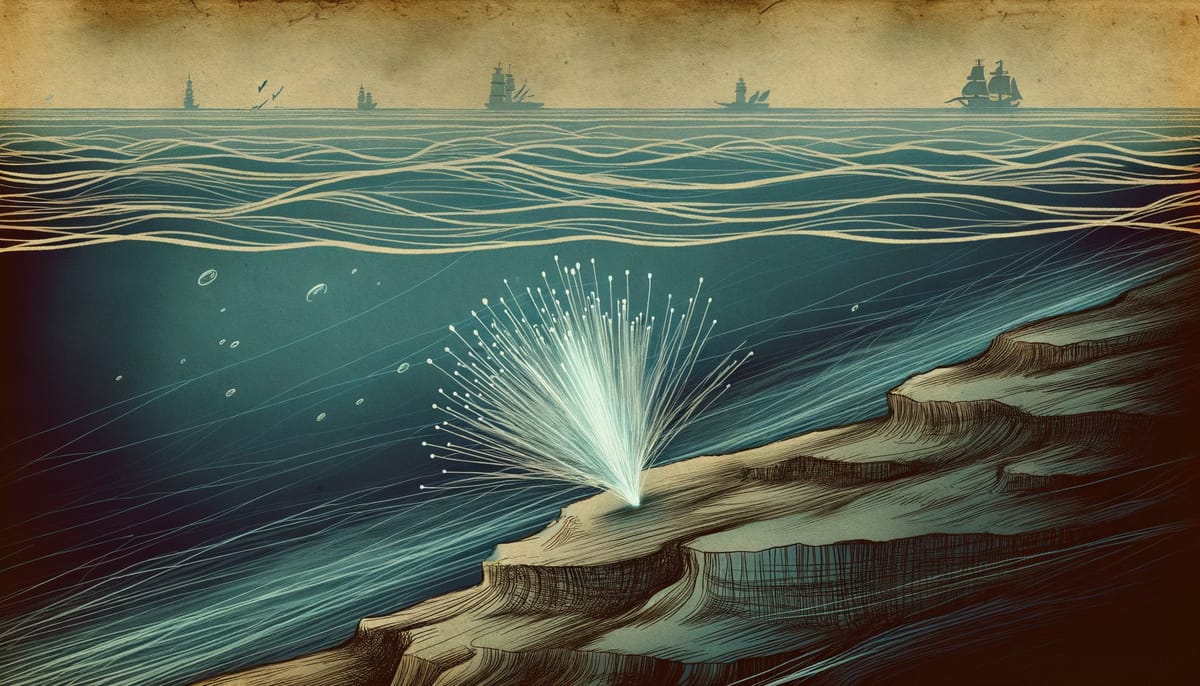
Ninety-five percent of the world’s internet traffic travels through cables thinner than a garden hose, buried in ocean sediment. The Philippines hosts roughly 16,000 kilometers of this fiber-optic nervous system—1.1% of the global total, threading through waters that China increasingly treats as its own. When a cable breaks, the consequences arrive not as dramatic blackouts but as stuttering video calls, failed bank transfers, and business process outsourcing centers falling silent. The question is not whether Manila can defend these threads. It is whether anyone can.
The conventional framing pits Chinese sabotage against Philippine defense. This misses the structural reality. Undersea cables exist in a legal and operational limbo where the tools of conventional defense—patrol boats, surveillance aircraft, rapid response forces—accomplish almost nothing. A fishing trawler dragging an anchor across a cable bed looks identical to a fishing trawler actually fishing. A research vessel mapping the seabed could be conducting legitimate oceanographic surveys or cataloging cable routes for future interference. Attribution is not difficult. It is often impossible.
The Architecture of Vulnerability
The Philippines operates as an externalized cognitive organ for Western corporations. Its business process outsourcing sector—call centers, back-office operations, customer support—depends entirely on submarine cable connectivity. When cables fail, the sector does not slow down. It stops. This is not mere economic inconvenience. It is structural dependency encoded in fiber optic glass.
The topology of this dependency reveals itself in the numbers. The Philippine Domestic Submarine Cable Network connects 22 landing stations across the archipelago, creating internal redundancy. International connectivity is another matter. A handful of cables—Apricot, Bifrost, Candle—link the Philippines to global internet infrastructure. PLDT controls dual landing stations for Apricot at Digos and Baler. Converge holds exclusive partnership for Bifrost at Davao. This concentration creates chokepoints that no amount of patrol boats can protect.
The legal framework compounds the vulnerability. UNCLOS Article 79 grants freedom of cable-laying in exclusive economic zones and continental shelves—a protection that paradoxically constrains coastal state authority. The Philippines cannot unilaterally regulate cable routes or impose permit requirements without violating international law. When damage occurs, Article 113 obliges states to criminalize cable interference—but only for their own flagged vessels and nationals. A Chinese-flagged ship cutting a Philippine cable in international waters falls into a jurisdictional void.
Taiwan provides the template for what happens when this void is exploited. In February 2023, Chinese-registered vessels severed two undersea cables connecting Taiwan’s Matsu Islands, causing internet blackouts affecting 14,000 residents. Beijing dismissed the incidents as “common maritime accidents.” The physical evidence that would prove sabotage—break morphology, material stress signatures, anchor drag patterns—requires ROV retrieval and laboratory analysis taking months. By then, the news cycle has moved on. Attribution becomes academic.
The Gray Zone Geometry
China’s approach to undersea infrastructure operates through what strategists call gray zone tactics—actions below the threshold of armed conflict but above routine commercial activity. The geometry is precise. Each individual incident stays within plausible deniability. Accumulated damage forces defenders into attribution processes that demand evidence impossible to gather in time to matter.
The mechanism works through temporal asymmetry. A cable cut takes hours. Repair takes weeks. Attribution takes months. Response takes years—if it comes at all. This temporal gap is not a bug in the system. It is the system.
Research from RSIS documents the pattern across the Indo-Pacific. Chinese research vessels—20 to 22 annually—operate in Philippine exclusive economic zone waters, ostensibly conducting oceanographic surveys. These vessels map seabed topology with precision that exceeds scientific requirements. They identify cable routes, landing stations, and repair vessel response times. The intelligence gathered enables future operations while the surveys themselves remain legal.
The Luzon Strait adds natural camouflage. Multiple documented turbidity current events occur annually—underwater landslides triggered by seismic activity or storm surges. These events create a high “noise floor” that structurally prevents forensic attribution. A cable break in the Luzon Strait could be sabotage, accident, or geology. Often, no one can say which.
Filipino fishermen have become inadvertent sensors in this environment. In July 2019, fishermen detected 113 Chinese vessels “swarming” Pag-asa Island before formal diplomatic protests could be filed. In 2023 and 2024, fishermen recovered Chinese spy drones from Philippine waters. This distributed detection network—subsistence communities functioning as always-on early warning systems—precedes official surveillance by days or weeks. It also highlights the gap between detection and response. Knowing a threat exists means nothing without the capacity to act.
The Defense That Isn’t
The Philippine Navy’s undersea cable protection capability exists primarily as aspiration. Officials describe the effort as “early, exploratory stage”—bureaucratic language for starting from near-zero. The Navy lacks dedicated cable patrol vessels, underwater surveillance systems, and rapid response assets. It cannot monitor cable routes in real time. It cannot detect interference as it occurs. It cannot attribute damage to specific actors.
This is not unique to the Philippines. No nation possesses comprehensive undersea cable defense. The United States Navy maintains two cable repair ships at $10 million annually—a capability that has atrophied while Meta and Google accumulated 99,399 and 95,876 kilometers of cable ownership respectively. The private sector owns the infrastructure. The public sector lacks the tools to protect it. This dependency inversion means states claiming territorial sovereignty over cable landing zones cannot actually defend what lands there.
The alliance architecture offers partial compensation. The 2023 U.S.-Philippines Bilateral Defense Guidelines explicitly address cyber threats to critical infrastructure, committing both nations to “improve cyber defense and cyber security cooperation to secure critical infrastructure and build protection against attacks emanating from state and non-state actors.” EDCA (Enhanced Defense Cooperation Agreement) sites provide staging areas for potential response operations. Japan has increased maritime cooperation in Philippine waters.
Yet alliance commitments face their own attribution problem. The Mutual Defense Treaty requires demonstrating an “armed attack” to trigger collective response. Cable sabotage disguised as fishing accidents does not meet this threshold. UNCLOS creates a “repair-only” legal architecture that structurally prevents escalation pathways. The defender is trapped: unable to respond militarily to sub-military attacks, unable to prevent attacks through legal mechanisms designed for a different era.
The ASEAN Guidelines for Strengthening Resilience and Repair of Submarine Cables, adopted in 2019, translate the bloc’s non-interference principle into technical procedural language. They aim to “simplify permits, expedite repairs, and improve resilience” without creating enforcement mechanisms. The guidelines systematically avoid addressing maritime boundary disputes—precisely the disputes that enable gray zone operations. ASEAN consensus produces form without substance, unity through performance rather than action.
The Insurance Kill Switch
A mechanism exists that could disable Philippine undersea cable infrastructure without physical damage. The Joint War Committee Listed Areas designation—maintained by Lloyd’s of London—creates war risk zones requiring vessel owners to notify underwriters before entering. If the South China Sea were added to this list, cable operators would face insurance premium spikes that could make operations economically unviable.
The JWC list currently includes the Gulf of Guinea, Red Sea, and Black Sea. Addition requires demonstrated risk patterns—exactly the patterns Chinese gray zone operations are establishing. Each “accident,” each “fishing incident,” each unexplained cable break contributes to an actuarial case for designation. The kill switch arms itself through accumulated ambiguity.
Insurance pricing treats cable damage as a repeatable, portfolio-diversifiable event with known repair costs—$500,000 to $1 million per incident. National security doctrine views politically-timed sabotage as a non-repeatable strategic event whose cost is regime stability or alliance credibility. These frameworks cannot communicate. The insurance market optimizes for expected value. National security optimizes for worst-case scenarios. When crisis arrives, the market’s pricing models will prove irrelevant.
The Repair Capacity Paradox
Sovereign repair capability determines whether cable defense constitutes strategy or theater. The Philippines possesses neither dedicated repair vessels nor the technical capacity to restore severed cables. India explicitly acknowledges relying on Middle East-based vessels for repairs. The global repair fleet is small, concentrated, and slow.
This creates a temporal vulnerability distinct from the sabotage threat itself. A coordinated attack on multiple cables could exhaust global repair capacity for months. The queue for repair services would become a strategic chokepoint. States with sovereign repair capability—primarily the United States, France, and Japan—would prioritize their own infrastructure. Others would wait.
The private sector response to this gap has been redundancy rather than resilience. New cables—Apricot, Bifrost, Candle—add capacity without addressing the fundamental vulnerability. More cables mean more targets. Redundancy provides graceful degradation, not defense. When the Matsu cables were cut, Taiwan restored connectivity through microwave links and a single backup cable. The Philippines lacks equivalent backup infrastructure for its international connections.
Fiber-optic sensing technology offers theoretical detection capability. Distributed Fiber-Optic Sensing can transform existing cables into continuous acoustic monitors, detecting tampering attempts through vibration analysis. But the same technology creates a paradox: cables that detect sabotage can reveal defensive monitoring capabilities to adversaries who have already achieved tap access. Installing interrogators every 100 kilometers creates a detection network that is itself detectable.
The Illicit Economy’s Inadvertent Shield
A counterintuitive protection exists. Chinese criminal syndicates operating in the Philippines—online gambling operations, shadow banking networks, capital flight channels—depend on the same submarine cable infrastructure that legitimate businesses use. These illicit economies create inadvertent defenders of connectivity. Disrupting Philippine cables would disrupt Chinese criminal revenue streams.
This is not a defense strategy. It is an emergent property of entangled economies. The protection it offers is incidental, unreliable, and morally compromised. But it illustrates the complexity of the infrastructure security landscape. Threats and protections do not sort neatly into categories. The same connectivity that enables Philippine economic development enables Chinese surveillance. The same cables that carry BPO traffic carry intelligence collection. The same infrastructure that criminal networks exploit is infrastructure those networks have interest in preserving.
What Breaks First
The default trajectory leads not to dramatic severance but to gradual degradation. Gray zone operations will continue—fishing accidents, research surveys, unexplained outages. Each incident individually deniable. Collectively unmistakable. Insurance premiums will rise. Repair times will lengthen. Redundancy will prove insufficient when multiple cables fail simultaneously.
The BPO sector will feel pressure first. Contracts require guaranteed uptime. Repeated outages—even brief ones—will push clients toward more reliable jurisdictions. India, with its terrestrial connectivity options, becomes more attractive. The Philippines loses not through catastrophic failure but through accumulated unreliability.
Alliance credibility faces a different test. If the United States cannot help the Philippines defend infrastructure that carries 95% of its internet traffic, what does the alliance actually guarantee? The Mutual Defense Treaty was written for armed attack, not anchor drag. Adapting it requires either lowering the threshold for collective response—risking escalation—or accepting that some attacks fall outside alliance protection. Neither option is comfortable.
ASEAN coordination will produce more guidelines, more working groups, more consensus documents. The 2024 Working Group on Submarine Cable Resilience will meet. Recommendations will emerge. Implementation will lag. The bloc’s institutional DNA prevents the enforcement mechanisms that cable protection requires.
The Narrow Path
Three intervention points offer leverage, each with costs.
Sovereign repair capacity would reduce dependence on global repair queues. The Philippines could acquire or lease dedicated cable repair vessels, train technical crews, and pre-position equipment at strategic locations. Cost: hundreds of millions of dollars for capability that may never be used. Benefit: reduced vulnerability to coordinated attacks and faster recovery from natural damage.
Alliance integration of cable defense would bring undersea infrastructure explicitly under U.S.-Philippines security cooperation. This requires updating the Mutual Defense Treaty’s interpretation to include gray zone infrastructure attacks or creating parallel agreements specifically addressing cable protection. Cost: potential escalation if the United States responds to cable incidents as security threats. Benefit: deterrence through demonstrated commitment.
Regional insurance mechanisms would create ASEAN-backed coverage that insulates cable operators from JWC designation effects. This requires member states to underwrite risk that private markets refuse. Cost: fiscal exposure to cable damage across the region. Benefit: removing the insurance kill switch from adversary arsenals.
None of these interventions is sufficient alone. Together, they address different vulnerability vectors without eliminating the fundamental problem: undersea cables cannot be defended in the conventional sense. They can only be made resilient enough that attacking them costs more than it achieves.
The most likely scenario is continued drift. The Philippines will announce initiatives, conduct exercises, sign agreements. China will continue surveys, accumulate intelligence, maintain deniability. Cables will break. Repairs will happen. Attribution will fail. The gray zone will remain gray.
FAQ: Key Questions Answered
Q: How much of the Philippines’ internet traffic depends on undersea cables? A: Over 95% of Philippine internet traffic travels through submarine cables. The country hosts approximately 16,000 kilometers of cable infrastructure, representing 1.1% of the global network. Disruption to these cables would effectively sever the Philippines from the global internet.
Q: Has China actually sabotaged undersea cables in the region? A: In February 2023, Chinese-registered vessels severed two cables connecting Taiwan’s Matsu Islands, causing internet blackouts. China described these as “common maritime accidents.” Similar incidents have been documented near Philippine waters, though definitive attribution remains difficult due to the forensic challenges of underwater investigation.
Q: What legal protections exist for undersea cables? A: UNCLOS Article 79 grants freedom of cable-laying in exclusive economic zones, while Article 113 requires states to criminalize cable damage—but only for their own flagged vessels. This creates jurisdictional gaps that gray zone operations exploit. Coastal states cannot unilaterally regulate cable routes without violating international law.
Q: Could the U.S.-Philippines alliance protect cables from Chinese interference? A: The Mutual Defense Treaty requires demonstrating an “armed attack” to trigger collective response. Cable sabotage disguised as fishing accidents likely falls below this threshold. The 2023 Bilateral Defense Guidelines address cyber threats to critical infrastructure but do not resolve the attribution and escalation challenges inherent in gray zone operations.
The Threads That Bind
The Philippines cannot defend its undersea cables from determined Chinese interference. Neither can anyone else. The infrastructure that carries global communications was designed for efficiency, not security. It assumes good faith among users and accidents rather than attacks as the primary threat. These assumptions no longer hold.
Southeast Asia’s digital infrastructure is not yet compromised in the sense of active, ongoing sabotage. It is compromised in a deeper sense: structurally vulnerable to interference that cannot be prevented, detected in time, or attributed with confidence. The gray zone is not a temporary condition to be resolved through better technology or stronger alliances. It is the permanent environment in which undersea cables now exist.
The threads that bind the Philippines to the global economy are thin, fragile, and exposed. They will remain so. The question is not whether they can be protected but whether the cost of cutting them can be made high enough to matter. On that question, the evidence offers little comfort.
Sources & Further Reading
The analysis in this article draws on research and reporting from:
- RSIS Commentary on Indo-Pacific Cable Resilience - Analysis of regional submarine cable vulnerabilities and ASEAN coordination mechanisms
- Philippine National Cybersecurity Plan 2023-2028 - Official government framework identifying submarine cables as critical infrastructure
- U.S.-Philippines Bilateral Defense Guidelines - 2023 agreement addressing cyber threats to critical infrastructure
- CNN Investigation on Taiwan Cable Incidents - Reporting on Chinese vessel involvement in Matsu cable severances
- Global Taiwan Institute Analysis - Assessment of Taiwan’s digital infrastructure vulnerabilities following cable incidents
- Defense News on Philippine Navy Cable Protection - Reporting on early-stage Philippine defensive capabilities