
Japan's hypersonic gamble: Deterrence restored or arms race accelerated?
Tokyo's new strike capabilities are designed to counter China and North Korea. But the same weapons that strengthen deterrence also fuel the regional arms competition they aim to prevent—a contradiction Japan cannot escape.
🎧 Listen to this article
The Missile That Moves Both Ways
Japan’s hypersonic weapons program rests on a paradox that its architects prefer not to discuss. The Hyper Velocity Gliding Projectile, scheduled for deployment in 2026, is designed to restore deterrence against China. Yet the same capabilities that make it credible as a defensive shield—Mach 5 speed, unpredictable flight paths, the ability to strike moving warships—also make it indistinguishable from an offensive weapon. Beijing sees no difference. Neither, in truth, does physics.
This is not a bug in the system. It is the system. Japan’s 2022 National Security Strategy explicitly called for “counterstrike capabilities” to address “dramatic advances in missile-related technologies, including hypersonic weapons.” The language was careful, the intention unmistakable: Japan would acquire the ability to hit targets on foreign soil. After seven decades of constitutional restraint, Tokyo crossed a threshold that cannot be uncrossed.
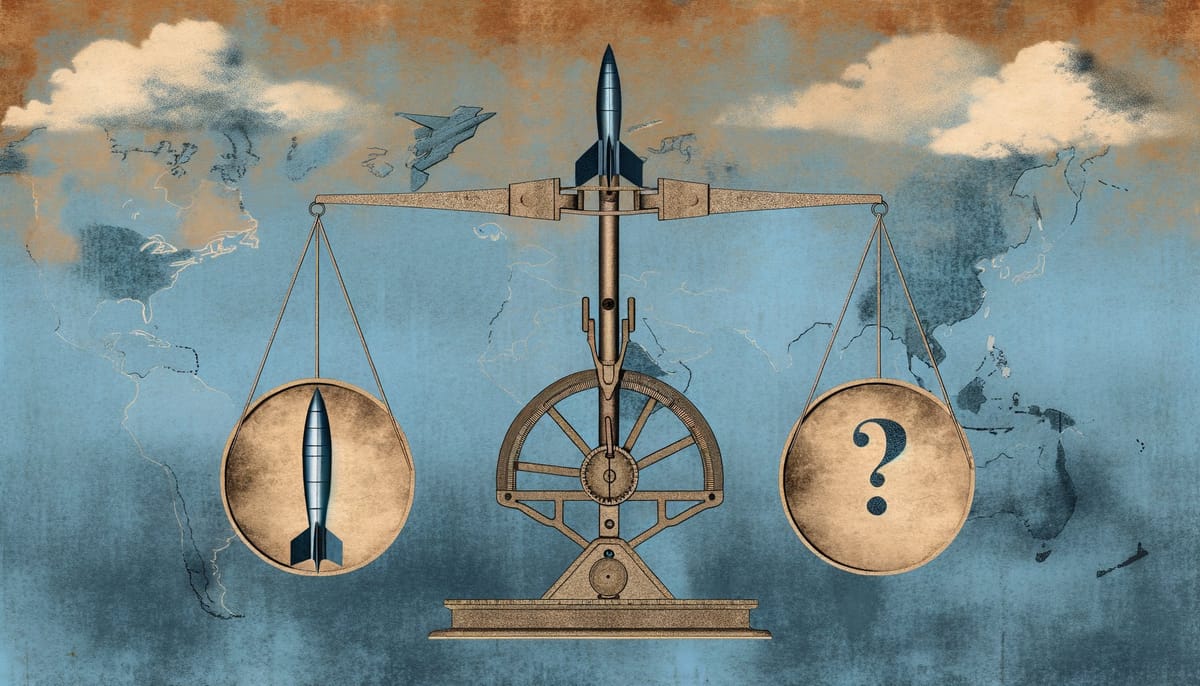
The question now is whether this crossing stabilizes the region or sets it ablaze. The answer, frustratingly, is both. Japan’s hypersonic program simultaneously strengthens deterrence and accelerates an arms race already underway. The distinction between these outcomes exists only in diplomatic communiqués. In the physics of strategic competition, they are the same thing.
Constitutional Superposition
Article 9 of Japan’s constitution renounces war and prohibits the maintenance of “war potential.” For decades, this language was interpreted to mean Japan could defend itself but never strike first. Hypersonic weapons collapse that distinction.
A boost-glide weapon launched from Kyushu can reach Shanghai in under fifteen minutes. Whether that capability is “defensive” depends entirely on who is describing it. Japan’s Ministry of Defense frames the HVGP as enabling “counterstrike” against enemy bases that have already launched attacks—a reactive, therefore defensive, use. China’s Foreign Ministry frames the same weapon as an offensive threat to the Chinese mainland. Both descriptions are technically accurate. Neither captures the strategic reality.
The reality is that Article 9 now exists in a state of quantum superposition, simultaneously permitting defensive retaliation and prohibiting offensive first-strike capabilities. The waveform collapses only when the weapons are actually used—at which point constitutional interpretation becomes irrelevant. This ambiguity is not accidental. It allows Tokyo to modernize its military while maintaining the legal fiction of pacifism. It also allows Beijing to treat every Japanese capability upgrade as evidence of remilitarization.
Prime Minister Shigeru Ishiba inherits this contradiction. His career has been defined by advocating for Japanese strategic autonomy—including, controversially, a proposed “Asian NATO” that would reduce dependence on bilateral American guarantees. Ishiba believes Japan must achieve equal partnership with the United States rather than subordinate alliance. Hypersonic weapons are the hardware expression of that belief. They give Japan independent strike capability, reducing reliance on American extended deterrence.
But independence cuts both ways. The more Japan can act alone, the more China must treat it as a standalone threat rather than an American appendage. This is the trap Ishiba has not publicly acknowledged: strategic autonomy and regional stability may be mutually exclusive.
The Geometry of Response
China’s DF-17 hypersonic glide vehicle became operational in 2019. North Korea has conducted multiple hypersonic tests since 2021. South Korea’s HyCore program is advancing. Australia, through AUKUS, is developing hypersonic capabilities with American and British partners. Japan’s program does not exist in isolation. It is one node in a regional network of hypersonic proliferation that was expanding before Tokyo decided to join.
This context matters for understanding Chinese reactions. When Beijing condemns Japan’s hypersonic development, it is not responding to a unilateral provocation. It is responding to the latest move in a game it has been playing—and winning—for years. China’s hypersonic arsenal is larger, more diverse, and more operationally mature than anything Japan will field this decade. The DF-17 can strike American bases in Guam. The DF-27, reportedly in development, may reach Hawaii.
Japan’s HVGP does not change this balance. What it changes is Japan’s role in the balance.
The Nansei Islands—the chain stretching from Kyushu toward Taiwan—are the geographic hinge of any Taiwan contingency. A Chinese invasion of Taiwan would require either neutralizing Japanese bases on these islands or accepting that Japanese and American forces could interdict supply lines from the rear. Japan’s hypersonic program is explicitly designed for this scenario. Block 1 of the HVGP, with a range of several hundred kilometers, can threaten Chinese naval vessels approaching the island chain. Block 2, with extended range, can reach targets on the Chinese coast.
This is what deterrence looks like in practice: making the cost of invasion prohibitively high. But it is also what provocation looks like from Beijing’s perspective: forward-deployed weapons capable of striking the Chinese mainland, hosted by a former colonial power with unresolved historical grievances.
The People’s Liberation Army does not distinguish between these interpretations. PLA planning documents, according to analysts who study Chinese military doctrine, treat Japan’s strike capabilities as a threat to be neutralized early in any conflict. The logic is coldly symmetrical. If Japan can use hypersonic weapons to interdict a Taiwan invasion, China must destroy those weapons before they can be used. This creates pressure for preemption on both sides—the classic instability spiral that arms control theorists have warned about since the Cold War.
The Alliance Holobiont
Japan’s hypersonic program cannot be understood apart from the U.S.-Japan alliance. In May 2024, the two countries signed an agreement to co-develop the Glide Phase Interceptor, a defensive system designed to shoot down hypersonic missiles. Japan will contribute approximately $1 billion and lead development of rocket motors and propulsion components. The United States will handle overall integration.
This arrangement reveals the deeper architecture of the alliance. Japan is not simply buying American weapons. It is becoming a co-producer of alliance capabilities, with industrial equities that bind the two countries together at the level of supply chains and engineering teams. The term “alliance holobiont”—borrowed from biology, where it describes symbiotic organisms that function as a single unit—captures this integration. The U.S. and Japan are evolving together in response to China’s rise, developing shared capabilities that neither could field alone.
The implications extend beyond hardware. Sensor fusion between American and Japanese systems is becoming increasingly seamless. Japan’s ground-based radars, while vulnerable to Chinese missile attack, feed data into a combined picture that includes American space-based sensors and Aegis-equipped destroyers. The HVGP’s effectiveness depends on this integrated targeting architecture. Without American intelligence, Japan’s hypersonic missiles would be firing semi-blind.
This dependency cuts both ways. American forward-deployed forces in Japan—some 54,000 personnel across dozens of installations—depend on Japanese host-nation support and, increasingly, on Japanese defensive capabilities. The alliance is no longer a one-way guarantee. It is a mutual entanglement in which neither party can fight effectively without the other.
For Beijing, this integration is the real threat. A Japan that operates as an extension of American power projection is more dangerous than a Japan with independent capabilities. The alliance holobiont can bring resources to bear that dwarf anything Japan could muster alone. China’s strategic response, therefore, targets the seams of the alliance rather than Japanese capabilities per se. Information operations emphasize historical grievances between Tokyo and Washington. Economic pressure exploits Japan’s dependence on Chinese supply chains, particularly rare earth elements critical to advanced manufacturing.
China’s 2010 rare earth export restrictions, imposed during a dispute over the Senkaku Islands, taught Japan a lesson it has not forgotten. The country has since diversified supply chains and invested in overseas mining, but vulnerabilities remain. A future conflict could see China weaponizing these dependencies to fracture the alliance at its weakest points.
Okinawa’s Veto
The hypersonic program’s most significant constraint may not be Chinese countermeasures or alliance politics. It may be Okinawa.
The prefecture hosts approximately 70% of U.S. military facilities in Japan despite comprising less than 1% of the country’s land area. Okinawans have long resented this burden, and their political representatives have repeatedly challenged both Tokyo and Washington over base expansion. The deployment of HVGP launchers in the Nansei Islands—essential for their effectiveness against Chinese naval forces—requires Okinawan acquiescence that cannot be assumed.
Local opposition has blocked or delayed military projects before. Governor Denny Tamaki, elected on an anti-base platform, represents a constituency that views itself as bearing disproportionate risk for mainland Japan’s security. Hypersonic weapons intensify this perception. Launchers deployed on Okinawan territory become priority targets for Chinese missiles. The islands that host them become the front line of a war that Okinawans did not choose.
This dynamic gives Okinawa effective veto power over alliance contingencies. If local governments refuse to cooperate with deployments, or if popular protests make base operations politically untenable, Japan’s hypersonic deterrent loses its geographic foundation. The weapons exist, but they cannot be positioned where they matter.
Tokyo has historically overridden Okinawan objections through a combination of financial inducements and legal maneuvers. Whether this approach remains viable in a crisis is uncertain. The prefecture’s leverage increases precisely when the stakes are highest—when Japan most needs its cooperation and Okinawans most fear becoming targets.
The Temporal Compression
Hypersonic weapons do not merely add capability. They subtract time. A conventional missile attack provides minutes for decision-makers to assess the threat, consult allies, and authorize response. A hypersonic attack provides seconds.
This compression has consequences that extend beyond military operations. Democratic deliberation requires time. The consultations between Tokyo and Washington that would precede any use of force—required by alliance protocols and Japanese law—assume a tempo of decision-making that hypersonic weapons may not permit. If a Chinese hypersonic strike is inbound, does Japan wait for American concurrence before launching a counterstrike? If Japanese hypersonic missiles are ready to fire, does Washington have time to object?
These questions have no good answers. The alliance operates on the assumption of shared decision-making, but the physics of hypersonic warfare may make shared decision-making impossible. Pre-delegation of launch authority—giving military commanders the ability to fire without political approval—solves the timing problem but creates others. It removes civilian control at precisely the moment when civilian judgment matters most.
Japan’s strategic culture compounds the difficulty. The country’s emphasis on consensus and procedural correctness sits uneasily with the split-second decisions that hypersonic warfare demands. China, with its centralized command structure and lack of democratic constraints, faces no equivalent tension. Xi Jinping can authorize strikes without consulting a legislature or coordinating with allies. This asymmetry in decision-making speed may matter more than any asymmetry in hardware.
The Arms Race That Already Exists
The framing of Japan’s hypersonic program as potentially “triggering” an arms race misunderstands the regional dynamic. The arms race is not a future possibility. It is a present reality.
China has been expanding its nuclear arsenal and conventional missile forces for two decades. North Korea has developed nuclear weapons and the means to deliver them despite international sanctions. South Korea is pursuing indigenous strike capabilities partly in response to doubts about American extended deterrence. Australia’s AUKUS partnership represents a generational commitment to military modernization driven by China concerns.
Japan’s hypersonic program is a response to this environment, not a cause of it. The question is not whether an arms race will occur but whether Japan’s participation changes its character.
One argument holds that Japanese capabilities restore stability by closing a gap that had opened in China’s favor. Deterrence works when both sides believe the costs of aggression exceed the benefits. If China could neutralize Japanese bases with impunity, the temptation to do so in a Taiwan scenario increases. Japanese hypersonic weapons raise the cost of that neutralization, making Chinese planners think twice.
The counter-argument holds that Japanese capabilities trigger a security dilemma in which Chinese countermeasures beget Japanese counter-countermeasures in an escalating spiral. China responds to HVGP by deploying additional DF-17s. Japan responds by accelerating Block 2 development. China responds by targeting Japanese early warning radars. Each side’s defensive measures appear offensive to the other.
Both arguments are correct. Deterrence and arms racing are not opposites. They are the same phenomenon viewed from different angles. Japan’s hypersonic program makes conflict less likely by making it more costly. It also makes conflict more dangerous by compressing decision timelines and multiplying the systems that could malfunction or be misinterpreted.
The Default Trajectory
Absent dramatic changes in Chinese behavior or American commitment, Japan’s hypersonic program will proceed on schedule. Block 1 HVGP deployment in 2026 will provide initial capability against naval targets. Block 2, with extended range, will follow in the late 2020s. The Hypersonic Cruise Missile, a separate system optimized for different target sets, is projected for the 2030s.
Each milestone will produce Chinese condemnations and PLA countermeasures. Each countermeasure will validate the program’s necessity in Tokyo. The spiral continues.
Regional states will draw their own conclusions. South Korea, already ambivalent about cooperation with Japan due to historical grievances, may accelerate indigenous programs rather than rely on alliance frameworks. Taiwan will welcome any capability that complicates Chinese invasion planning but lacks the industrial base to develop comparable systems. ASEAN states, caught between great power competition, will hedge.
The most likely outcome is a regional security architecture defined by overlapping hypersonic capabilities, compressed decision timelines, and alliance structures that may not survive the stress of actual conflict. This is not stability. But it may be the best available alternative to instability.
What Could Change
Three factors could alter the trajectory.
First, a breakthrough in hypersonic defense. The U.S.-Japan Glide Phase Interceptor program aims to develop the ability to shoot down hypersonic missiles. If successful, this technology could restore the offense-defense balance that hypersonic weapons have disrupted. Attackers would no longer enjoy guaranteed penetration. The compressed decision timelines that make hypersonic weapons destabilizing would be partially reversed.
The technical challenges are immense. Hypersonic glide vehicles maneuver unpredictably. Intercepting them requires sensors that can track erratic flight paths and kill vehicles that can match their speed. Current missile defense systems are not designed for this mission. Development timelines stretch into the 2030s, and success is not guaranteed.
Second, arms control agreements. The Missile Technology Control Regime restricts proliferation of missile systems but does not limit development by its members. No treaty governs hypersonic weapons specifically. Negotiating such a treaty would require cooperation between the United States and China—cooperation that current relations do not support.
Even if negotiations began, verification would be difficult. Hypersonic weapons share components with space launch vehicles and conventional missiles. Distinguishing permitted from prohibited activities requires intrusive inspections that neither Beijing nor Washington would likely accept.
Third, a change in Chinese behavior that reduces the perceived threat. If China moderated its military buildup, ceased threatening Taiwan, and resolved territorial disputes through negotiation, Japan’s rationale for hypersonic weapons would weaken. This scenario is not impossible, but nothing in Xi Jinping’s track record suggests it is likely.
The most probable future, therefore, is continuation of current trends: Japanese capability development, Chinese countermeasures, regional proliferation, and an uneasy stability maintained by mutual fear rather than mutual trust.
Frequently Asked Questions
Q: Can Japan’s hypersonic missiles actually hit targets in China? A: Block 2 of the HVGP, expected in the late 2020s, will have sufficient range to strike coastal targets on the Chinese mainland. Block 1, deploying in 2026, is primarily designed for anti-ship missions within several hundred kilometers.
Q: Does Japan’s hypersonic program violate its pacifist constitution? A: The government argues that “counterstrike capabilities” used in response to an attack are constitutionally permissible as self-defense. Critics contend this interpretation stretches Article 9 beyond recognition. The ambiguity is deliberate and unlikely to be resolved until the weapons are actually used.
Q: How does China view Japan’s hypersonic development? A: Chinese Foreign Ministry statements consistently frame it as evidence of Japanese remilitarization and a threat to regional peace. Internal PLA assessments, according to analysts, are more technical and less alarmist, focusing on operational implications rather than historical grievances.
Q: Could the U.S. and Japan shoot down Chinese hypersonic missiles? A: Not with current systems. The Glide Phase Interceptor being co-developed is specifically designed for this mission but will not be operational until the 2030s at earliest. Success is not guaranteed.
The Chrysanthemum and the Sword, Revisited
Ruth Benedict’s wartime study of Japanese culture identified a society organized around contradictions: aesthetic refinement and martial ferocity, rigid hierarchy and situational flexibility, shame and honor existing in productive tension. Japan’s hypersonic program embodies a contemporary version of this duality.
The weapons are simultaneously defensive and offensive, stabilizing and destabilizing, constitutional and unconstitutional. They restore deterrence by threatening escalation. They prevent war by preparing for it. Every justification contains its own refutation.
This is not hypocrisy. It is strategy in a world where clean categories do not apply. Japan cannot defend itself without acquiring capabilities that appear offensive to its adversaries. It cannot deter China without accelerating the arms competition it seeks to avoid. It cannot maintain alliance credibility without developing the autonomy that makes alliance less necessary.
The HVGP will deploy on schedule. Chinese condemnations will follow. The region will become marginally more dangerous and marginally more stable at the same time. And the paradox at the heart of Japanese security policy will remain unresolved, because it cannot be resolved—only managed, day by day, missile by missile, until the waveform finally collapses.
Sources & Further Reading
The analysis in this article draws on research and reporting from:
- Japan’s 2022 National Security Strategy - Primary document establishing Japan’s counterstrike capability doctrine
- Congressional Research Service Report on Hypersonic Weapons - Technical definitions and proliferation analysis
- NBR Report on China’s Military Decision-Making - Analysis of PLA planning and crisis response
- Defense News coverage of HVGP test launch - Program timeline and technical details
- U.S. Department of Defense statement on GPI agreement - Alliance co-development framework
- Japan Ministry of Defense policy overview - Defense buildup program details
- Air University paper on hypersonic weapons - Strategic implications analysis