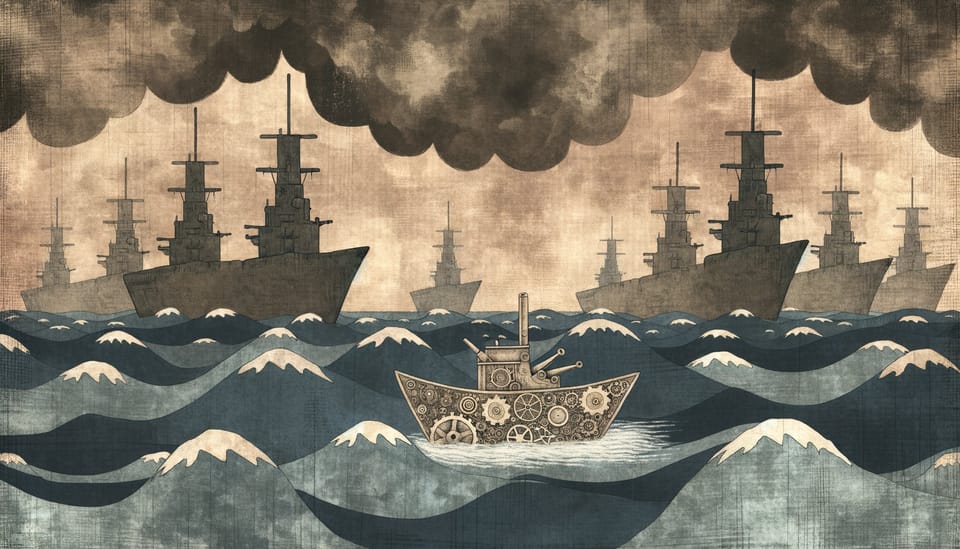
Japan's $58 Billion Defence Budget: The Power of Useful Ambiguity
Japan's record military spending buys missiles and command integration with American forces. What it cannot buy is constitutional clarity. That ambiguity may be the alliance's most valuable asset—a deterrent that works precisely because no one knows its limits.

The Rehearsal That Never Ends
Every year, Japanese and American forces stage elaborate war games in the Pacific. Keen Sword tests their ability to fight together. Keen Edge tests their ability to plan together. Neither tests the moment that matters most: when a Japanese prime minister must decide whether constitutional constraints permit firing the first shot.
Japan’s record ¥9.04 trillion ($58 billion) defence budget buys missiles, ships, and a command structure designed for war alongside America. What it cannot buy is legal clarity. The country now possesses counterstrike capabilities it may never be constitutionally authorised to use first—a deterrent that exists in a state of permanent ambiguity, simultaneously threatening and constrained.
This is not a bug in the alliance. It may be its most valuable feature.
Constitutional Superposition
Article 9 of Japan’s Constitution renounces war and prohibits “war potential.” Yet Japan maintains the world’s fifth-largest military budget and fields destroyers, submarines, and soon Tomahawk cruise missiles capable of striking targets deep in adversary territory. The contradiction is not accidental. It is load-bearing.
The standard narrative treats constitutional ambiguity as a problem awaiting resolution—a relic of American occupation that hamstrings Japan’s deterrent value. This misreads how the ambiguity actually functions. Like Schrödinger’s cat, Japan’s offensive capability exists in superposition: neither clearly permitted nor clearly prohibited until a crisis forces observation.
Consider the 2015 Legislation for Peace and Security, which codified Japan’s reinterpretation of Article 9 to allow limited collective self-defence. The law permits Japan to use force when an attack on a close ally “threatens Japan’s survival and poses clear danger to citizens’ fundamental rights.” This language is deliberately imprecise. What constitutes a threat to survival? When does danger become clear? The answers depend on who is asking—and when.
For China, this ambiguity creates planning nightmares. Beijing cannot know whether Japan will intervene in a Taiwan contingency until the moment arrives. The constitutional constraint that appears to limit Japanese action simultaneously multiplies the scenarios Chinese planners must prepare for. A Japan that might act is more dangerous than a Japan that definitely won’t.
For the United States, the ambiguity provides cover. Washington gains the benefits of Japanese military capability without the entrapment risks that come with a fully committed ally. Japan’s constitutional limitations function as what game theorists call a commitment device—making it difficult for Tokyo to drag America into conflicts of Japan’s choosing.
The 2024 Security Consultative Committee statement announced a “historic decision to modernise U.S. and Japanese command and control frameworks, including the reconstitution of U.S. Forces Japan to a Joint Force Headquarters.” This integration sounds impressive. But joint command structures cannot resolve the fundamental asymmetry: American commanders operate under presidential authority with broad war powers, while Japanese commanders operate under constitutional constraints that require cabinet deliberation and parliamentary oversight.
The gap is not bureaucratic. It is ontological.
What $58 Billion Actually Buys
Japan’s defence budget has grown for fourteen consecutive years. The fiscal 2026 allocation represents a 9.4% increase from the previous year, pushing Japan toward its target of 2% of GDP by 2027. On paper, this positions Japan as the world’s third-largest defence spender, behind only the United States and China.
The headline figure obscures as much as it reveals. Japan’s supplementary budget allocates 1.1 trillion yen to the Japan Coast Guard and other agencies with defence functions—spending that doesn’t appear in the Ministry of Defence’s books. The true security expenditure is higher than advertised, though harder to track.
More troubling is what the money must cover. Japan’s Self-Defence Forces face a metabolic crisis: operations and maintenance consume 78% of the defence budget, compared to 38% for the United States. This isn’t inefficiency. It’s the cost of maintaining an aging force structure while simultaneously modernising. Every yen spent keeping existing systems functional is a yen not spent on new capabilities.
The 2022 National Security Strategy introduced “counterstrike capabilities” as essential for “disrupting and defeating invasions much earlier and at a further distance.” Japan is acquiring Tomahawk cruise missiles from the United States, developing its own Type 12 extended-range missiles, and building the targeting infrastructure to employ them. By 2028, the SHIELD hypersonic missile system should be operational. By 2035, the GCAP sixth-generation fighter—developed jointly with Britain and Italy—should enter service.
These timelines create a transparency paradox. Publishing multi-year capability deployment schedules signals alliance commitment to Washington and deterrent intent to Beijing. It also provides adversaries with precisely mapped vulnerability windows. China knows that Japan’s counterstrike capability remains nascent until Tomahawk deliveries begin in 2025, incomplete until Type 12 production scales in 2027, and immature until operators gain proficiency by 2030.
The question is whether Japan can close these windows faster than threats emerge.
The Recruitment Arithmetic
Numbers tell a story the budget cannot. The Self-Defence Forces employ 5,000 recruiters to secure 14,000 annual hires—a ratio of 0.36 recruiters per new member. This intensity reflects not just demographic headwinds but cultural incompatibility.
Japan’s population is aging and shrinking. The cohort of military-age citizens contracts each year. But the recruitment crisis runs deeper than demography. An estimated 1.46 million Japanese—roughly 2% of the potential workforce—are classified as hikikomori, withdrawn from social participation in ways that make military service inconceivable. The traditional recruitment substrate has changed.
Worse, the SDF competes for the same shrinking pool of young people as every other employer in a labour-scarce economy. Defence work offers modest pay, demanding conditions, and—for many Japanese—lingering social stigma. The pacifist identity that Article 9 enshrines is not merely constitutional text. It is lived culture.
This creates a structural constraint no budget can solve. Japan can buy missiles. It cannot buy the people to operate them. The defence industrial base faces parallel challenges: precision manufacturing culture excels at low-volume, high-complexity systems like Aegis destroyers, but struggles with the economies of scale required for munitions production. Japan fires practice rounds it cannot quickly replace.
The United States faces its own production bottlenecks—American arsenals were depleted supporting Ukraine—but possesses the industrial base to surge. Japan’s defence industry, shaped by decades of export restrictions and domestic-only production, lacks this capacity. The 2024 export control relaxation allowing transfers to fifteen countries may eventually build production scale. Eventually is not now.
Decision Velocity and Constitutional Friction
Modern warfare compresses decision cycles. Hypersonic missiles arrive in minutes. Cyber attacks unfold in seconds. Autonomous systems operate faster than human cognition permits.
Japan’s constitutional framework was designed for human deliberation timescales—hours to days of cabinet discussion, parliamentary consultation, careful legal interpretation. The mismatch is not bureaucratic friction. It is structural incompatibility between the speed of contemporary conflict and the pace of democratic authorisation.
American presidential command follows a tree topology: clear hierarchical delegation converging on the commander-in-chief, who possesses broad authority to order military action. Japanese decision-making follows a network topology: proposals circulate horizontally through nemawashi (consensus-building) before vertical approval. The ringi-sho system ensures broad buy-in at the cost of speed.
In a Taiwan contingency, this asymmetry becomes acute. American forces could begin operations within hours of presidential authorisation. Japanese forces would require cabinet decisions, potentially Diet consultation, and careful legal determination that the situation meets the threshold for collective self-defence. The constitutional constraint that prevents Japan from acting precipitously also prevents Japan from acting quickly.
Joint exercises rehearse tactical coordination. They do not rehearse the legal decision points where Japanese constitutional constraints would require actual deliberation. Keen Edge command post exercises systematically avoid testing the moments where ambiguity would demand resolution.
This is not oversight. It is design. Testing constitutional rupture points in peacetime would force clarity that both allies prefer to avoid.
The Audience Problem
Japan’s $58 billion defence budget is not a single signal. It is a performance for multiple audiences who must believe different things.
The United States must believe Japan is a committed ally willing to fight. China must believe Japan might act unpredictably. North Korea must believe Japanese retaliation would be devastating. The Japanese public must believe constitutional constraints remain meaningful. The Komeito coalition partner—backed by the Buddhist organisation Soka Gakkai, whose women’s networks form Japan’s most effective vote-gathering bloc—must believe pacifist principles are not being abandoned.
Audience cost theory reveals that signalling effectiveness depends on maintaining distinct belief updating across different observers. Japan must project strength to adversaries while projecting restraint to domestic constituencies. The constitutional ambiguity that frustrates American military planners is precisely what makes this multi-audience performance possible.
Prime Minister Sanae Takaichi represents a test of this equilibrium. Her political identity is built on constitutional revision and confrontation with China. She believes Japan’s post-war constitution is an imposed document requiring replacement to restore national sovereignty. Her instinct is to double down when challenged rather than to compromise.
Yet even Takaichi operates within constraints. Constitutional revision requires two-thirds majorities in both houses of the Diet and a public referendum. Polling shows 53-63% support for revision in the abstract, but this support fragments when specific changes are proposed. The biological substrate of opposition—direct war survivors and hibakusha atomic bomb survivors—is aging out of the electorate. But the cultural inheritance of pacifism persists.
The performative balance may be shifting. It has not yet shifted.
What Credibility Actually Requires
The question of whether Japan is a “credible” military partner assumes credibility is binary. It is not. Credibility is scenario-specific, audience-dependent, and time-variant.
In a limited grey-zone contingency—Chinese coast guard vessels challenging Japanese control of the Senkaku Islands—Japan’s credibility is high. The Self-Defence Forces have clear authority to defend sovereign territory. Command structures are integrated. Exercises have rehearsed these scenarios extensively.
In a full-scale Taiwan contingency, credibility becomes murkier. Japan’s legal authorities to participate remain contested. The 2015 legislation permits collective self-defence when Japan’s survival is threatened, but whether a Chinese attack on Taiwan meets this threshold is genuinely uncertain. It depends on how the attack unfolds, what American forces are targeted, and how Japanese courts and public opinion interpret the situation.
In a nuclear scenario, credibility inverts entirely. Japan’s constitutional constraints may actually enhance deterrence by making escalation less predictable. An adversary cannot assume Japan will follow American escalation decisions. The uncertainty cuts both ways.
The 2024 Active Cyberdefense Law illustrates the incremental approach. Japan now permits offensive cyber operations—a significant expansion of authorities achieved through legislation rather than constitutional amendment. The pattern is consistent: capability expansion through reinterpretation, maintaining the fiction of constitutional continuity while hollowing out its constraints.
This approach works until it doesn’t. Each reinterpretation erodes the credibility of remaining constraints. If Article 9 can be interpreted to permit counterstrike missiles and offensive cyber operations, what exactly does it prohibit? The answer is increasingly unclear—which may be precisely the point.
The Default Trajectory
Without intervention, current dynamics produce a Japan that is simultaneously more capable and more constrained.
Capability growth continues. The 2027 target of 2% GDP spending will likely be met. Tomahawk missiles will arrive. Type 12 production will scale. Command structures will integrate further with American forces. On paper, Japan becomes a formidable military power.
Constitutional ambiguity persists. Formal revision remains politically impossible absent a crisis that forces the question. Reinterpretation continues to expand authorities incrementally, but each expansion makes the remaining constraints more brittle. The gap between capability and legal clarity widens.
Recruitment shortfalls compound. The demographic arithmetic is unforgiving. Japan cannot conscript its way out of the problem without destroying the political consensus that enables defence spending. It cannot pay its way out without salaries that the budget cannot sustain. Automation and AI may eventually compensate, but not within the timeline that matters.
The result is a deterrent that works—until tested. Japanese capabilities are real. Japanese willingness to use them remains genuinely uncertain. For deterrence purposes, this uncertainty is valuable. For warfighting purposes, it is dangerous.
Three Leverage Points
The trajectory is not fixed. Three intervention points could alter it.
Scenario-specific legal clarity. Japan could pre-authorise specific responses to specific contingencies without amending the constitution. Legislation declaring that a Chinese attack on American forces operating from Japanese bases constitutes a threat to Japan’s survival would collapse ambiguity in that scenario while preserving it elsewhere. The political cost is making the commitment explicit. The benefit is eliminating decision-time friction when speed matters.
Asymmetric capability investment. Rather than building a smaller version of American forces, Japan could invest in capabilities the United States lacks—mine warfare, coastal defence, cyber operations, undersea surveillance. This approach accepts constitutional constraints on offensive operations while maximising deterrence within permitted domains. It requires abandoning prestige platforms in favour of less glamorous but more useful capabilities.
Industrial base integration. Japan’s defence production capacity cannot scale in isolation. Deep integration with American, Australian, and European supply chains would build surge capacity that domestic production alone cannot achieve. The 2024 export relaxation is a start. Full integration requires treating Japanese defence industry as part of an allied ecosystem rather than a national capability.
Each option has costs. Legal clarity sacrifices the ambiguity that enables multi-audience signalling. Asymmetric investment requires abandoning the vision of Japan as a “normal” military power. Industrial integration creates dependencies that nationalist politicians will resist.
The most likely outcome is none of these. Japan will continue incremental capability growth, incremental reinterpretation, and incremental integration—always approaching but never reaching the threshold of clarity that would force a reckoning with Article 9.
This may be enough. Deterrence does not require certainty. It requires doubt in the adversary’s mind about whether aggression will succeed. Japan’s constitutional ambiguity creates precisely this doubt—not despite its constraints, but because of them.
FAQ: Key Questions Answered
Q: Can Japan legally strike targets in China or North Korea? A: Under current interpretations, Japan can conduct “counterstrike” operations against enemy bases if an attack on Japan is imminent or underway and no other means exist to prevent it. This authority derives from the 2022 National Security Strategy, but has never been tested in practice. The legal threshold remains deliberately vague.
Q: Why doesn’t Japan simply amend its constitution? A: Constitutional revision requires two-thirds majorities in both houses of the Diet and a successful public referendum. While abstract support for revision polls at 53-63%, specific proposals fragment this consensus. The Komeito party, essential to governing coalitions, opposes revision. The political arithmetic has never aligned.
Q: How does Japan’s defence spending compare to other major powers? A: At $58 billion, Japan’s 2026 defence budget positions it as the world’s third-largest military spender after the United States and China. However, purchasing power differences and the high cost of operations and maintenance mean Japan’s effective capability is smaller than raw numbers suggest.
Q: What happens if China attacks Taiwan—would Japan fight? A: Uncertain by design. Japan’s legal authorities to participate in a Taiwan contingency depend on whether the attack threatens Japan’s survival under the 2015 collective self-defence legislation. American forces operating from Japanese bases would almost certainly be targeted, potentially triggering Japanese involvement. But the decision would require cabinet deliberation in real time.
The Useful Ambiguity
Japan’s defence transformation is real. The $58 billion budget represents genuine capability growth. Command integration with American forces has reached unprecedented depth. Counterstrike weapons are arriving.
Yet the constitutional question remains unresolved—and may be unresolvable without the crisis that would force it. This is not failure. It is equilibrium.
Deterrence theorists distinguish between deterrence by denial (making aggression infeasible) and deterrence by punishment (threatening unacceptable costs). Japan’s constitutional ambiguity creates a third category: deterrence by uncertainty. Adversaries cannot calculate Japanese responses because Japan itself does not know what it will do until the moment arrives.
The rehearsals continue. Keen Sword. Keen Edge. Ever more sophisticated exercises testing ever more integrated operations. But the final act—the decision that determines whether Japan fights—remains unscripted.
Perhaps that is the point. A script can be read by adversaries. Ambiguity cannot.
Sources & Further Reading
The analysis in this article draws on research and reporting from:
- Japan’s 2022 National Security Strategy - Primary document outlining Japan’s counterstrike capability and defence buildup plans
- 2024 US-Japan Security Consultative Committee Statement - Official announcement of command structure modernisation
- Japan’s Evolving Position on Collective Self-Defense (Lawfare) - Analysis of the 2015 legislation’s legal framework
- Japan’s Active Cyberdefense Law (The Record) - Coverage of Japan’s new offensive cyber authorities
- Fundamental Reinforcement of Japan’s Defense Capabilities (Ministry of Defense) - Official overview of capability development plans
- Japan Approves Record Defense Budget (Al Jazeera) - Reporting on the fiscal 2026 budget approval
- Article 9 of the Constitution of Japan (Wikipedia) - Constitutional text and interpretation history
- Japan’s Reinterpretation of Article 9 (Iowa Law Review) - Legal analysis of constitutional reinterpretation