Japan's $58 Billion Bet: Deterrence or Target Practice?
Tokyo's record defence budget buys genuine capabilities that will complicate Chinese military planning. But constitutional constraints, industrial limitations, and alliance dependencies mean the billions purchase time and options—not security guarantees. The honest answer: Japan is creating both...
The Seventy-Billion-Dollar Question
Japan’s Cabinet approved a record ¥9 trillion ($58 billion) defence budget on December 26, 2025—the fourth consecutive year of aggressive military expansion. By 2027, Tokyo will spend 2% of GDP on defence, a figure that would have been politically unthinkable a decade ago. The stated purpose: deter China. The unstated anxiety: whether these billions buy security or simply paint targets on Japanese soil.
The question admits no comfortable answer. Japan is acquiring genuine capabilities that will complicate Chinese military planning. Tomahawk cruise missiles arriving in 2025-27. Indigenous Type-12 standoff missiles with extended range. Aegis destroyers integrated into a layered air and missile defence architecture. These are not ceremonial purchases. Yet China fields approximately 1,000 medium-range ballistic missiles capable of reaching every Japanese military installation from the mainland. The DF-21 covers 1,700-2,000 kilometres. The DF-26 reaches 3,500-4,000. Mathematics alone cannot resolve whether Japan’s investments create deterrence or vulnerability—but mathematics frames the stakes.
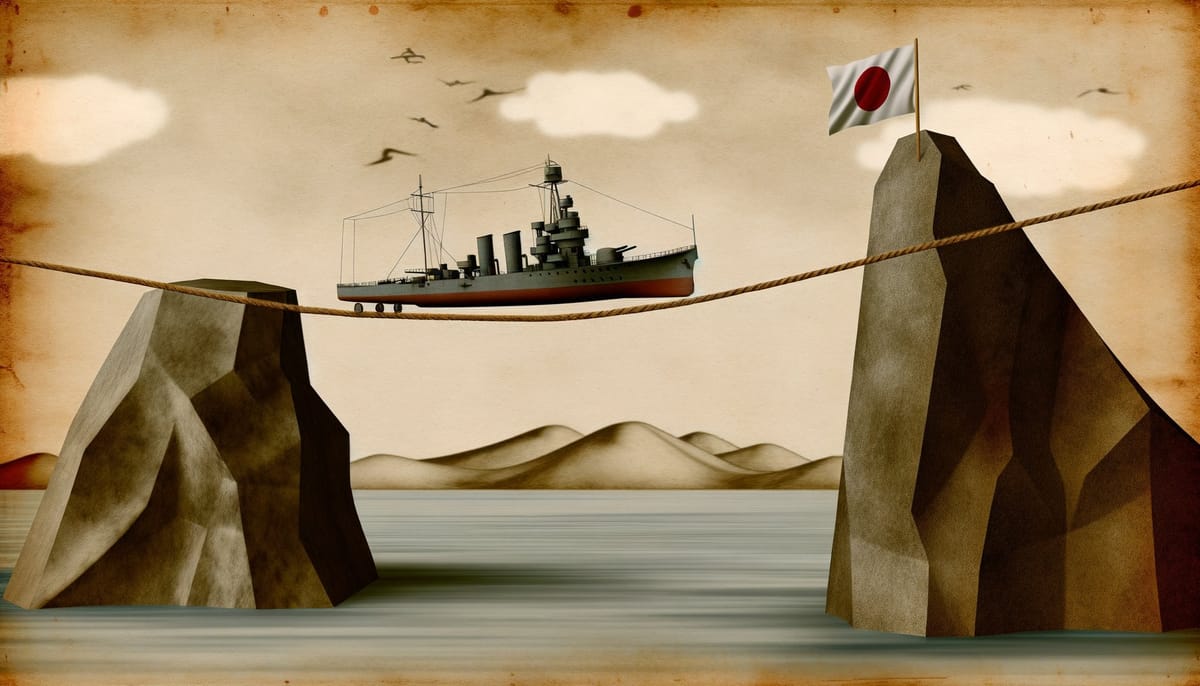
The conventional framing presents a binary: either Japan’s spending deters China, or it provokes an arms race that leaves Japan worse off. This framing is wrong. The actual dynamic is more subtle and more troubling. Japan is constructing a deterrence architecture that depends on capabilities it cannot fully use, constrained by a constitution it cannot openly amend, integrated with an ally whose commitment it cannot entirely verify. The $58 billion buys not security but a particular kind of strategic ambiguity—one that may prove either invaluable or catastrophic, depending on decisions that lie outside Japanese control.
Constitutional Origami
Article 9 of Japan’s constitution renounces war and prohibits the maintenance of “war potential.” The Self-Defence Forces exist anyway. This contradiction has been managed through seven decades of creative reinterpretation, each iteration stretching the text further without changing a word. The 2014 Cabinet reinterpretation authorising collective self-defence drew massive protests. The 2022 National Security Strategy’s embrace of “counterstrike capabilities” passed with less resistance—not because Japanese society has abandoned pacifism, but because the threat environment has shifted the boundaries of the permissible.
The constitutional constraints are real but not where casual observers assume. Japan can legally acquire Tomahawk missiles. It can develop indigenous standoff weapons. It can integrate these into targeting networks with the United States. What it cannot do—and this is the binding constraint—is use them preemptively. Japan’s armed-attack-initiation doctrine explicitly forbids striking first. Counterstrike capability is authorised only after “an armed attack against Japan has been initiated.”
This creates a temporal paradox that no procurement budget can resolve. The legal authority to strike requires proof that Japan faces an existential threat. That proof becomes judicially demonstrable only after missiles are already inbound. The sword-draw of Japanese strategic culture—iaijutsu nukitsuke, where survival depends on first-strike speed—is constitutionally prohibited. Japan is building a counterstrike capability it can deploy only after absorbing the first blow.
For deterrence theory, this matters enormously. Deterrence by denial—reducing an adversary’s expected benefits through active defence—functions regardless of who strikes first. Japan’s integrated air and missile defence can intercept incoming weapons whether or not Tokyo has authorised offensive action. Deterrence by cost imposition—threatening retaliatory punishment—requires credible commitment to actually retaliate. Here the constitutional constraint bites. China’s military planners must assess not just whether Japan can strike back, but whether Japan’s legal and political system will authorise strikes in the fog of an actual attack.
The answer is genuinely uncertain, and that uncertainty is itself strategic. Active Self-Defence Force officers have stated they are “not particularly eager” for constitutional amendment. Ambiguity serves operational interests. Clear constitutional language would force explicit limitations; the current superposition allows incremental expansion. Japan’s defence surge purchases capabilities while preserving the constructive vagueness that has sustained the post-war settlement.
What the Money Actually Buys
The ¥9 trillion breaks down into seven capability pillars, each addressing specific gaps in Japan’s defensive posture. Standoff defence receives ¥970 billion—Tomahawk acquisitions, extended-range Type-12 missiles, hypersonic weapons development. Integrated air and missile defence claims ¥537 billion—Aegis vessels, PAC-3 batteries, the JADGE command network. Unmanned systems get ¥103 billion. The remainder distributes across command and control, cross-domain operations, mobile deployment, and sustainability.
These are serious investments in serious capabilities. The Tomahawk gives Japan the ability to strike targets on the Chinese mainland—a capability it has never possessed. The Type-12’s range extension transforms a coastal defence missile into a genuine standoff weapon. Integration with American sensor networks means Japanese platforms can receive targeting data from US satellites and reconnaissance aircraft. The Ministry of Defence’s budget documents describe an architecture designed to impose costs on any attacker across multiple domains simultaneously.
But capability is not capacity. Japan’s defence industrial base was designed for peacetime maintenance, not wartime production. The Shikinen Sengu—the twenty-year cycle of Shinto shrine destruction and rebuilding—offers an unexpectedly apt metaphor. Japanese manufacturing systems are structurally optimised for cyclical renewal rather than continuous output. The industrial base mirrors the shrine: built to be rebuilt, not to sustain indefinite production runs.
This creates a fundamental asymmetry. China’s command economy has increased artillery shell production by 200-300% since 2022. Japan’s defence industrial base cannot surge production without structural transformation that would take years. In a prolonged conflict, Japan’s precision munitions would exhaust faster than they could be replaced. The $58 billion buys a finite stock of sophisticated weapons, not the industrial depth to sustain extended operations.
The cost-exchange problem compounds this asymmetry. A Standard Missile-2 interceptor costs approximately $2 million. A mass-produced drone costs perhaps $2,000. The ratio is 1,000:1. Even if Japan’s missile defence achieves a 90% intercept rate against drones, the arithmetic favours the attacker. Chinese strategists understand this. The PLA Rocket Force has invested heavily in both precision ballistic missiles and cheap saturation weapons. Japan’s layered defence must succeed against both categories simultaneously.
Analysts at the Center for Strategic and International Studies have argued that focusing primarily on cost-exchange ratios is “penny-wise and pound-foolish.” A successful intercept that saves a $4 billion destroyer or prevents civilian casualties has value far exceeding the interceptor’s price. This is true. But it does not eliminate the magazine-depth problem. Japan can purchase only so many interceptors. China can manufacture missiles faster than Japan can buy defences.
The Alliance Dependency
Japan’s defence surge makes sense only within the context of the US-Japan alliance. The capabilities being acquired are designed for integration, not independence. Japanese Aegis destroyers will share data with American systems. Tomahawk missiles will receive targeting information from US intelligence networks. The entire architecture assumes American participation in any conflict.
This is simultaneously Japan’s greatest strategic asset and its most profound vulnerability. American extended deterrence—the commitment to defend Japan with all available means, including nuclear weapons—provides a security guarantee that no amount of indigenous spending could replicate. The US Seventh Fleet, based in Yokosuka, represents more combat power than Japan could field independently at any plausible budget level.
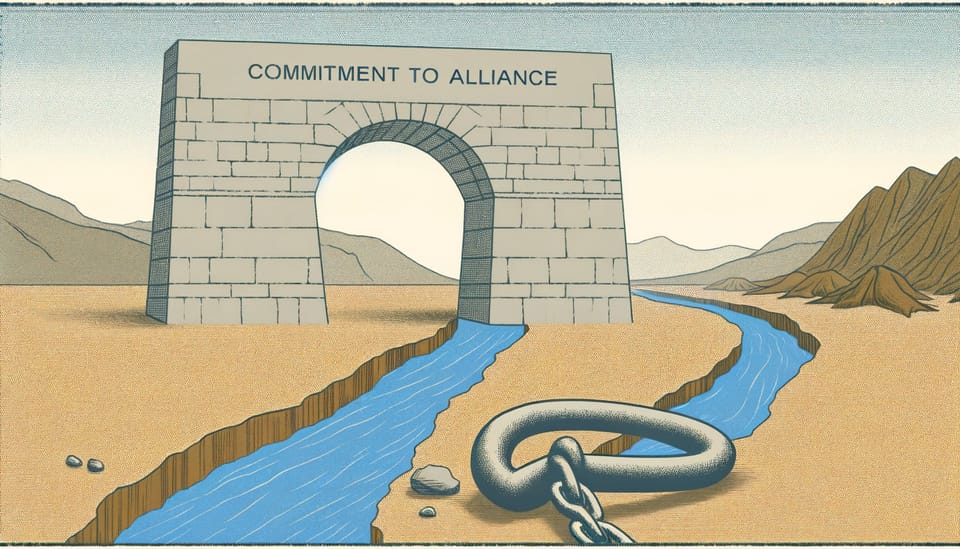
But extended deterrence requires credibility, and credibility requires belief. China must believe that the United States would actually fight for Japan. American voters must believe that defending Japan is worth American lives. Japanese planners must believe that Washington will not abandon them in a crisis. Each of these beliefs is contestable.
The $58 billion functions partly as a credibility signal within this alliance structure. Japan’s spending demonstrates commitment to burden-sharing, addressing longstanding American complaints about free-riding allies. It creates military assets that the United States would have strong incentives to protect—expensive platforms whose destruction would represent American as well as Japanese losses. In the logic of hostage theory, Japan is deliberately creating valuable targets whose vulnerability binds American interests to Japanese survival.
This logic has uncomfortable implications. If Japan’s defence investments function as hostages that force American commitment, then their vulnerability is a feature, not a bug. Expensive targets that might be destroyed are more effective at binding allies than cheap systems that adversaries would ignore. The $58 billion may buy deterrence precisely because it creates assets worth defending—and worth attacking.
Japan’s position as America’s largest foreign creditor adds another layer of complexity. Tokyo holds over $1 trillion in US Treasury securities. Japan is financing the fiscal capacity of the nation providing its security guarantee while simultaneously spending to reduce reliance on that guarantee. The financial and military relationships are intertwined in ways that neither ally fully controls.
What China Sees
Beijing’s interpretation of Japan’s defence surge matters as much as Tokyo’s intentions. China’s 2022 National Security Strategy names Japan as facing “the greatest strategic challenge” from China. The reverse perspective is equally stark. Chinese strategists view Japan’s military expansion through the lens of historical grievance and contemporary threat.
Confucian hierarchical thinking—still influential in Chinese strategic culture—defines threat not by material capability alone but by relational propriety. A junior power possessing counterstrike capability against a senior power constitutes aggression by definition, regardless of defensive framing. Japan’s acquisition of weapons that can reach Chinese territory is inherently provocative in this framework, whatever Tokyo’s stated intentions.
China’s narrative warfare exploits this perception asymmetry. Georgetown’s analysis of Chinese information operations documents systematic efforts to frame Japanese defence spending as militarist revival. The Rashomon effect—multiple incompatible but internally coherent narratives about the same events—creates strategic space for Chinese propaganda. There is no objective ground truth about whether Japan’s spending is “defensive” or “aggressive.” The characterisation depends on the framework applied.
This matters for deterrence stability. If China perceives Japan’s capabilities as offensive threats rather than defensive preparations, the security dilemma intensifies. Chinese military planners may conclude that striking Japanese bases early in a conflict is necessary to eliminate counterstrike threats. Japan’s investment in survivability and dispersal—hardening facilities, distributing assets, developing mobile systems—becomes essential not just for warfighting but for crisis stability.
The PLA’s missile inventory creates specific targeting challenges for Japanese planners. Approximately 1,000 medium-range ballistic missiles can reach Japan from mainland China. These weapons can be launched with minimal warning time. Japan’s air and missile defence systems—however sophisticated—cannot guarantee interception of a saturation attack. The physical reality is that Chinese missiles can destroy Japanese military infrastructure faster than Japan can defend or replace it.
This does not mean Japan’s spending is futile. Deterrence does not require invulnerability. It requires imposing sufficient costs that an adversary concludes aggression is not worthwhile. If Japan’s counterstrike capability threatens damage to Chinese military assets, ports, or command infrastructure, Beijing must factor those costs into any decision to attack. The question is whether the threatened costs are high enough to outweigh the benefits China might gain from military action.
The Demographic Constraint
Japan’s median age is 49. The Self-Defence Forces struggle to meet recruitment targets. These facts constrain military options more tightly than any budget allocation.
Technology can substitute for manpower to a degree. Unmanned systems, autonomous sensors, artificial intelligence—Japan’s defence budget includes substantial investments in all three. The ¥103 billion allocated to unmanned capabilities reflects recognition that Japan cannot field a military requiring large numbers of young personnel. Robots do not age, do not require pensions, and do not vote against governments that send them into danger.
But technology substitution has limits. Maintenance requires skilled technicians. Command decisions require human judgment. Logistics require physical labour. South Korea’s experience—defence spending up 43% while active personnel fell 8.5% between 2010 and 2020—illustrates the pattern. Money cannot fully compensate for missing people.
The temporal dimension compounds the demographic challenge. Defence assets have thirty- to forty-year lifecycles. Japan’s median voter age means the political coalition purchasing F-35s and Aegis destroyers will be statistically deceased before those systems reach operational maturity. The voters authorising today’s spending will not experience its consequences. This creates a peculiar form of intergenerational arbitrage: current taxpayers fund systems that will defend future generations, while current retirees consume resources that might otherwise support military investment.
Japan’s negative interest rate policy (2016-2024) enabled a form of temporal arbitrage that has now closed. Under NIRP, Japan could borrow at negative real rates to fund defence procurement—effectively being paid to take on debt. The Bank of Japan’s March 2024 policy shift ended this anomaly. Future defence spending must compete with other fiscal priorities at positive interest rates. The window for cheap military expansion has narrowed.
Scenarios
Three trajectories emerge from the current dynamics.
Deterrence holds. China concludes that military action against Japan would be too costly, given the combination of Japanese capabilities, American commitment, and regional solidarity. Japan’s spending succeeds not by winning a war but by preventing one. The $58 billion functions as insurance that never pays out—expensive but worthwhile. This scenario requires sustained American commitment, continued Japanese investment, and Chinese strategic patience. It is the best outcome and the least certain.
Crisis escalation. A Taiwan contingency, a maritime incident, or a miscalculation triggers conflict. Japan’s counterstrike capabilities are activated under the armed-attack-initiation doctrine. Chinese missiles strike Japanese bases. American forces engage. The scenario that deterrence was supposed to prevent occurs. In this case, Japan’s investments are tested operationally. The outcome depends on factors—American political will, Chinese escalation choices, third-party intervention—that no Japanese budget can control.
Strategic drift. Neither deterrence nor conflict, but gradual erosion of the regional order. China expands influence through economic pressure and grey-zone operations. Japan’s military capabilities prove irrelevant to the actual competition. The $58 billion buys weapons optimised for a war that never comes while China wins without fighting. This scenario reflects the possibility that Japan is preparing for the wrong threat—investing in kinetic capabilities while losing a contest fought through trade, technology, and diplomacy.
The most likely trajectory combines elements of all three. Deterrence holds in the near term. Crises occur but are managed. Strategic competition continues through non-military channels. Japan’s defence spending provides insurance against worst-case scenarios while failing to address the more probable challenges of economic coercion and political influence.
The Honest Assessment
Japan’s $58 billion defence surge creates genuine deterrent value. The capabilities being acquired will complicate Chinese military planning, raise the costs of aggression, and strengthen the US-Japan alliance. These are not trivial achievements. A Japan that can strike back is more secure than a Japan that cannot.
But the spending does not resolve the fundamental vulnerabilities in Japan’s strategic position. Constitutional constraints limit when and how capabilities can be used. Industrial base limitations constrain sustainability in extended conflict. Demographic decline restricts the human capital available for military service. Alliance dependency means Japan’s security ultimately rests on American decisions that Tokyo cannot control.
The $58 billion buys time and options, not solutions. It purchases a more defensible position from which to negotiate, deter, and if necessary fight. It does not purchase invulnerability, independence, or guaranteed security. No amount of spending could.
Whether this represents “genuine deterrence” or “expensive targets” depends on Chinese perceptions, American reliability, and contingencies that cannot be predicted. Japan is making a rational bet under uncertainty—investing in capabilities that improve its position across most plausible scenarios while accepting that no investment eliminates risk entirely.
The honest answer to the question posed is: both. Japan’s defence surge creates genuine deterrence and expensive targets. The two are not mutually exclusive. Deterrence requires assets valuable enough to defend. Valuable assets are, by definition, worth attacking. Japan is betting that the former effect dominates—that China will be deterred rather than tempted. It is a reasonable bet. It is not a certain one.
Frequently Asked Questions
Q: Can Japan’s missile defence actually stop a Chinese attack? A: Japan’s integrated air and missile defence can intercept some incoming weapons but cannot guarantee protection against a saturation attack. The system is designed to reduce damage, not eliminate it. Against a full-scale Chinese missile barrage, significant strikes would likely penetrate.
Q: Does Japan’s counterstrike capability violate its pacifist constitution? A: The Japanese government interprets counterstrike capability as constitutional when used only after an armed attack has been initiated against Japan. This interpretation is contested domestically but has not been overturned by courts. Japan explicitly rejects preemptive strikes.
Q: How does Japan’s defence spending compare to other regional powers? A: At 2% of GDP, Japan will spend roughly $100 billion annually by 2027—third globally after the United States and China. South Korea spends approximately 2.8% of GDP on defence. China’s official budget is around $230 billion, though actual spending is likely higher.
Q: Would the United States actually defend Japan in a war with China? A: The US-Japan Security Treaty obligates American defence of Japan, but treaty obligations require political will to enforce. American commitment has been consistent across administrations, though the specific circumstances of any conflict would shape the response. Uncertainty about American reliability is itself a factor in regional stability.
Sources & Further Reading
The analysis in this article draws on research and reporting from:
- Japan’s National Security Strategy (2022) - The foundational document establishing Japan’s strategic posture and defence spending commitments
- Ministry of Defence FY2025 Budget Overview - Detailed breakdown of capability investments across seven pillars
- Lawfare: Japan’s Armed Attack Initiation Doctrine - Legal analysis of constitutional constraints on Japanese military action
- CSIS: Cost and Value of Air and Missile Defense - Framework for evaluating defensive investments beyond simple cost-exchange ratios
- Georgetown Security Studies Review: China’s Narrative Warfare - Analysis of Chinese information operations in the region
- Brookings: Constitutional Revision and Article 9 - Historical context for Japan’s constitutional debates
- Ministry of Defence: Integrated Air and Missile Defense - Official description of Japan’s layered defence architecture