India's Southeast Asia Defence Gambit: Useful Partner, Limited Constraint
New Delhi's Act East Policy has delivered joint exercises, BrahMos sales, and maritime cooperation across Southeast Asia. But ASEAN's hedging strategies ensure these partnerships diversify options rather than constrain Beijing—a feature, not a bug, of regional security architecture.
The Limits of Leverage
India’s defence partnerships in Southeast Asia operate under a fundamental constraint that no amount of BrahMos missiles or joint naval exercises can overcome: ASEAN nations do not want to be saved from China. They want options.
This distinction matters more than any capability gap or interoperability challenge. When Indian strategists speak of “constraining” Chinese influence, they imagine a regional architecture where New Delhi’s security contributions gradually shift the balance of power. When ASEAN officials hear the same phrase, they reach for their hedging playbook—the same one they use with Washington, Tokyo, and Beijing itself.
The result is a partnership that functions precisely as designed by its weaker party. India provides just enough military cooperation to keep China guessing, while Southeast Asian states preserve the strategic ambiguity that protects them from choosing sides. This is not a bug in the India-ASEAN relationship. It is the entire point.
What India Actually Offers
India’s defence toolkit in Southeast Asia looks impressive on paper. The Act East Policy, launched in 2014, elevated security cooperation from afterthought to strategic pillar. Joint exercises now span air, land, and sea. The inaugural ASEAN-India Maritime Exercise in 2023 brought warships from nine nations into coordinated manoeuvres. BrahMos cruise missiles have found their first export customer in the Philippines. And the Information Fusion Centre in Singapore—where India stations liaison officers alongside partners from 25 countries—provides real-time maritime domain awareness across the Indo-Pacific.
Beneath the surface, the picture grows murkier. India’s defence exports to ASEAN remain modest. The BrahMos sale to Manila, celebrated in New Delhi as a breakthrough, involved deliberately degraded missiles—290-kilometre range rather than the 800-kilometre variants India keeps for itself, a constraint imposed by Missile Technology Control Regime membership. The weapon functions primarily as a geopolitical signifier rather than a capability equaliser.
More revealing is where India’s comparative advantage actually lies. Not in high-end platforms, where China outspends and outproduces. Not in maritime presence, where the Indian Navy struggles to sustain operations far from home waters. Rather, India’s most competitive offering is operational knowledge of prolonged counterinsurgency in ethnically and religiously distinct regions—directly transferable to Thailand’s southern insurgency, the Philippines’ Mindanao challenges, and Myanmar’s endless civil wars.
This is not the kind of partnership that constrains great-power influence. It is the kind that builds quiet relationships between military professionals, accumulating trust in increments too small to trigger Chinese retaliation.
The Hedging Imperative
ASEAN’s approach to external powers follows a logic that frustrates alliance-builders in every capital. The strategy has a name—hedging—but the term obscures more than it reveals. What looks like strategic ambiguity from Washington or New Delhi is actually a sophisticated risk-management system refined over decades.
The core principle: never align so closely with any power that you cannot realign if circumstances change. China is ASEAN’s largest trade partner, with bilateral trade exceeding $1 trillion annually—double the volume with the United States. Belt and Road infrastructure projects have created dependencies that run deeper than trade statistics suggest. Chinese hydropower financing in the Mekong basin doesn’t just generate electricity; it shapes the entire agrarian political economy of Cambodia, Laos, and Myanmar.
Against this backdrop, India offers diversification, not replacement. The 2024 ASEAN-India Joint Statement captures this perfectly: it welcomes India’s Act East Policy while committing to cooperation in “maritime security, counter-terrorism, cybersecurity, military medicine, transnational crime, defence industry, HADR, peacekeeping, demining, and confidence-building measures.” The list is comprehensive. It is also deliberately non-threatening to Beijing.
ASEAN’s consensus requirement compounds the constraint. The organisation’s charter mandates that decisions require agreement among all ten members. This transforms each nation into a structural veto point. The maximum achievable defence cooperation between India and ASEAN is constrained not by the most willing partners—Singapore and Vietnam—but by the least willing: Cambodia, which hosts Chinese naval facilities at Ream and whose constitutional neutrality provisions prohibit military alliances outright.
One analyst’s assessment cuts to the heart of the matter: ASEAN’s hedging operates like an Asian option in financial markets, deriving value from averaging positions over time rather than committing to any single strike price. The strategy creates natural insurance against volatility. It also ensures that no external partner—India included—can ever claim exclusive influence.
The Architecture of Constraint
If India cannot reshape ASEAN’s strategic calculus, can it at least complicate China’s? The honest answer is: marginally.
The mechanisms are real but limited. India’s hydrographic surveys in the Indian Ocean systematically map thermoclines and salinity gradients, transforming waters that once provided acoustic cover for submarines into transparent hunting grounds. The Information Fusion Centre—detailed in its 2024 annual report—enables real-time tracking of vessel movements that China would prefer went unobserved. Joint exercises build interoperability that could matter in a crisis.
But these contributions operate at the margins of a competition China dominates through sheer mass. Beijing’s defence research and development budget runs to $44 billion annually—15% of military spending, compared to India’s 3.35%. This asymmetry functions as pre-export subsidisation: development costs absorbed by state modernisation budgets allow weapons systems to be exported at marginal production costs rather than full lifecycle prices. India cannot match this arithmetic.
More fundamentally, India lacks the forward presence that would make its security commitments credible. The U.S. Navy, with treaty allies and established bases across the Pacific, now requires presidential approval for routine South China Sea operations—a measure of how thoroughly Chinese militarisation has raised the stakes. India, without permanent basing rights anywhere in Southeast Asia, cannot offer the sustained presence that would genuinely constrain Chinese freedom of action.
The temporal dimension matters too. China’s 99-year port leases at facilities like Kyaukpyu and Hambantota create multi-generational lock-in that outlasts regime changes and political realignments. India’s concession periods run 15 to 30 years. The legal duration of infrastructure agreements functions as a hidden constraint on strategic autonomy—and China has mastered the long game.
Where the Partnerships Actually Work
The value of India-ASEAN defence cooperation lies not in constraining China but in providing what strategists call “strategic remanence”—the residual alignment that persists after formal agreements expire.
Consider Vietnam. India’s $100 million defence credit line, extended in 2014, created dependencies that operate through interoperability rather than alliance. Weapons systems require decades of maintenance, training, and spare parts. Once a military standardises on Indian equipment, switching costs create structural lock-in that no diplomatic statement can match. This is not the dramatic constraint that strategic planners imagine. It is something more durable: a quiet accumulation of shared interests.
The same logic applies to maritime domain awareness. The Information Fusion Centre’s architecture—where sensor deployment remains distributed and national while sense-making infrastructure concentrates at hub nodes—creates information asymmetries that benefit participating states. India gains visibility into Chinese naval movements. ASEAN states gain early warning without formal alliance commitments. Everyone preserves deniability.
Training relationships offer similar benefits. India’s surplus of military labour, combined with decades of counterinsurgency experience, fills a gap that Southeast Asian militaries cannot close on their own. The exchanges build relationships between mid-career officers who will shape their nations’ security policies for decades. This is influence measured in generations, not election cycles.
The Limits of Leverage
The strategic question—can India’s partnerships constrain China?—contains a category error. Constraint implies the ability to prevent actions that would otherwise occur. India lacks this capability, and ASEAN nations would refuse to participate in any framework designed to provide it.
What India can do is raise costs. Every BrahMos battery in the Philippines forces PLA planners to account for additional threats. Every joint exercise demonstrates interoperability that could complicate Chinese operations in a crisis. Every liaison officer at the Information Fusion Centre adds a node to surveillance networks that reduce China’s freedom of manoeuvre.
But cost imposition is not constraint. China’s willingness to absorb costs—measured in diplomatic friction, economic retaliation, and military countermeasures—vastly exceeds India’s capacity to impose them. The asymmetry is structural, not temporary.
ASEAN’s hedging strategies amplify this limitation. By design, Southeast Asian states calibrate their security partnerships to avoid triggering Chinese retaliation. The Philippines’ BrahMos purchase came with careful diplomatic signalling to Beijing. Vietnam’s defence cooperation with India remains carefully bounded. Even Singapore, the most enthusiastic partner, maintains economic ties with China that dwarf its security relationship with India.
The result is a ceiling on ambition. India can participate in ASEAN’s hedging architecture. It cannot transcend it.
What Comes Next
The trajectory is clear: incremental deepening without strategic breakthrough.
India will continue expanding defence cooperation across Southeast Asia. More joint exercises, more training programmes, more modest arms sales. The comprehensive strategic partnership announced in 2022 will generate additional working groups, memoranda of understanding, and ministerial meetings. None of this will fundamentally alter the regional balance.
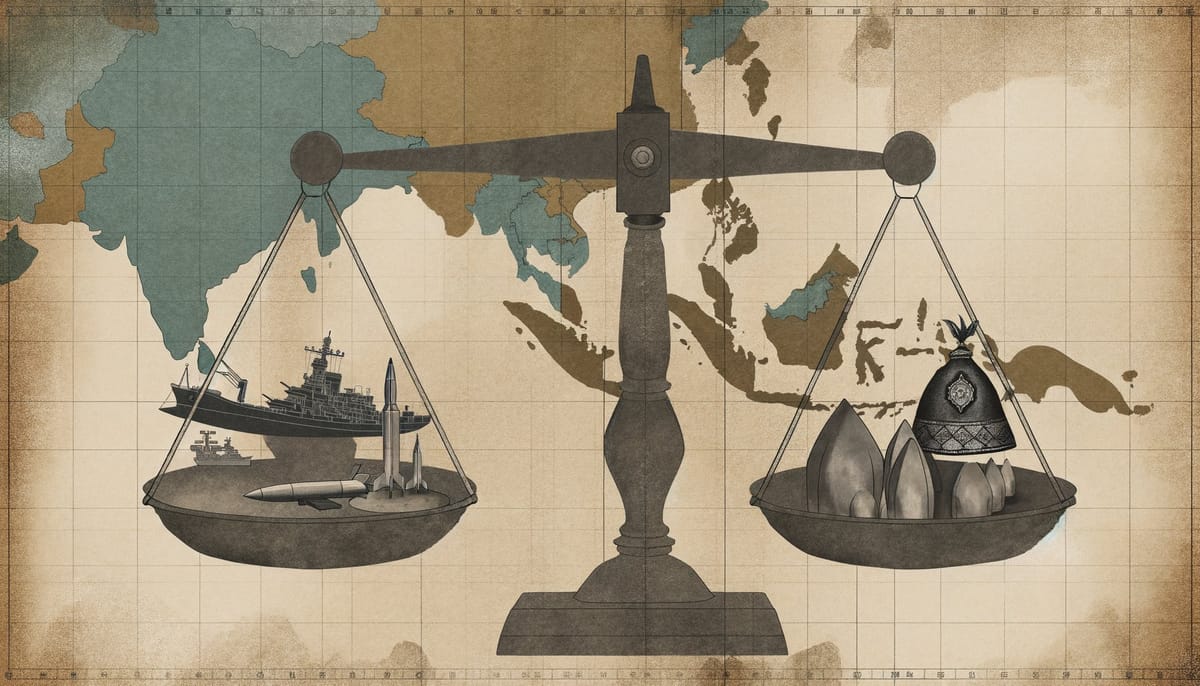
ASEAN states will continue welcoming Indian engagement while carefully limiting its scope. They need India as a counterweight—not to constrain China, but to preserve bargaining leverage in their own relationships with Beijing. The distinction is crucial. A counterweight that becomes too heavy is as dangerous as no counterweight at all.
China will continue its multi-vector approach: economic integration, infrastructure investment, diplomatic pressure, and military assertiveness in carefully calibrated doses. Beijing understands that ASEAN’s hedging creates opportunities as well as constraints. Every partnership that stops short of alliance leaves space for Chinese influence to operate.
The honest assessment: India’s Southeast Asia defence partnerships provide value to all participants. They do not and cannot constrain Chinese regional influence in any meaningful sense. ASEAN’s hedging strategies are not a bug to be fixed but a feature to be accepted.
For New Delhi, the implication is uncomfortable but clear. The Act East Policy succeeds on its own terms—building relationships, expanding presence, creating options. It fails on the terms that strategic planners prefer—reshaping regional architecture, constraining Chinese behaviour, establishing India as a decisive security provider.
The gap between ambition and achievement will persist. India lacks the economic weight, military reach, and political will to offer ASEAN what it would need to abandon hedging. And ASEAN lacks any interest in abandoning a strategy that has served it well for decades.
This is not failure. It is the natural limit of what partnerships can achieve when one party seeks influence and the other seeks insurance.
Frequently Asked Questions
Q: Has India sold BrahMos missiles to any Southeast Asian country? A: Yes. The Philippines became the first export customer for BrahMos missiles, though the exported variants have reduced range (290 kilometres versus 800 kilometres for domestic versions) due to India’s Missile Technology Control Regime commitments.
Q: What is ASEAN’s hedging strategy? A: ASEAN hedging involves balancing deep economic ties with China against diversified security partnerships with India, the United States, Japan, and others—while avoiding formal alignment with any single power bloc. The approach prioritises strategic autonomy and issue-based cooperation over military alliances.
Q: Why can’t ASEAN agree on stronger defence ties with India? A: ASEAN’s consensus-based decision-making requires agreement from all ten member states. This means defence cooperation is constrained not by the most willing partners (Singapore, Vietnam) but by the least willing (Cambodia), which maintains close ties with China and constitutional provisions against military alliances.
Q: How does China’s economic influence in Southeast Asia compare to India’s? A: China is ASEAN’s largest trade partner with bilateral trade exceeding $1 trillion annually—roughly double the volume with the United States. India’s economic footprint in the region remains significantly smaller, limiting its leverage in security discussions.
The Quiet Calculus
A senior ASEAN diplomat, speaking on condition of anonymity, once offered a metaphor that captures the region’s strategic logic: “We are not choosing between suitors. We are managing a portfolio.”
The portfolio approach explains why India’s defence partnerships will continue expanding even as they fail to constrain China. Each relationship adds diversification. Each exercise builds optionality. Each arms sale creates dependencies that might matter someday.
But portfolios are designed to manage risk, not to win wars. ASEAN’s hedging architecture is optimised for survival in a world where great powers compete for influence. It is not optimised for any particular great power’s victory.
India has earned a place in that portfolio. It has not earned—and ASEAN has no intention of granting—the kind of exclusive relationship that would genuinely constrain Chinese behaviour. The partnership’s value lies precisely in its limitations: substantial enough to matter, bounded enough to preserve options.
For strategists seeking dramatic realignment, this is disappointing. For those who understand how small states navigate great-power competition, it is exactly right.
Sources & Further Reading
The analysis in this article draws on research and reporting from:
- Information Fusion Centre 2024 Annual Report - Primary documentation of maritime domain awareness architecture and international participation
- ASEAN-India Joint Statement October 2024 - Official framework for comprehensive strategic partnership
- US-China Economic and Security Review Commission Report 2024 - Assessment of Chinese strategic objectives in Southeast Asia
- Georgetown Journal of International Affairs: Southeast Asia’s Grand Strategy - Analysis of ASEAN hedging behaviour and economic dependencies
- Asian Military Review: Regional MRO Capability - Technical assessment of defence industrial capacity gaps
- DKI APCSS: Maritime Domain Awareness Initiatives - Evaluation of regional surveillance cooperation frameworks
- The Diplomat: Russia’s Military Facility in Vietnam - Context for great-power military presence in Southeast Asia
- Breaking Defense: China’s Newest Military Base - Reporting on Ream Naval Base development