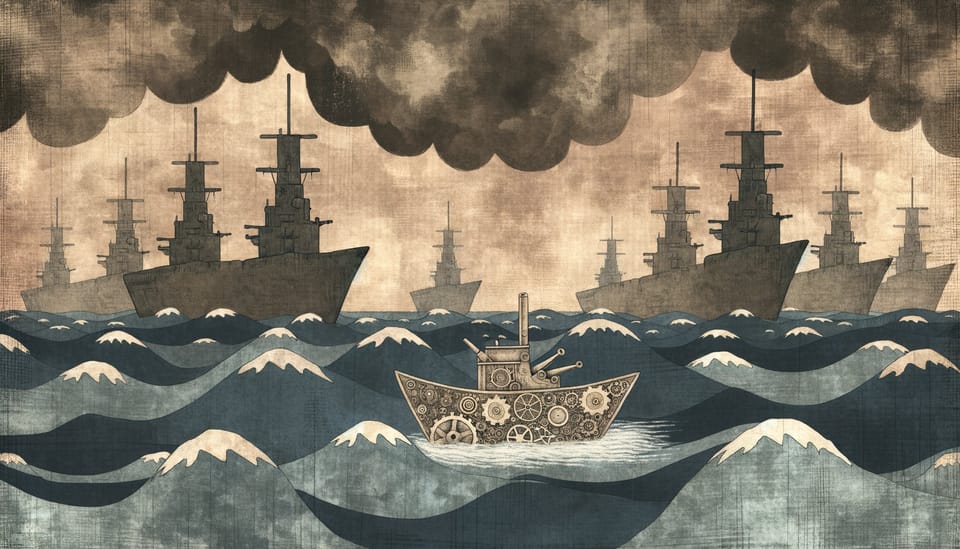
Does moving US submarines to Western Australia actually deter China—or just create a new target?
AUKUS will rotate nuclear-powered submarines through HMAS Stirling from 2027, betting that distance from Chinese missiles buys strategic advantage. But dispersal without defence, logistics, and diplomacy is only half a strategy.

Sanctuary or Bullseye
Perth’s property market tells a story that defence planners prefer to ignore. Suburbs near HMAS Stirling—Rockingham, Kwinana, Henderson—are experiencing a construction and price boom fuelled by up to A$70 billion in anticipated defence spending. Young families are buying houses within the blast radius of what Australia’s own strategic documents acknowledge will become one of China’s highest-priority targets in the Indo-Pacific. The same investment that promises jobs and security generates the vulnerability it was meant to prevent.
This is not a paradox confined to real estate. It sits at the heart of America’s most ambitious force-posture shift in the Pacific since the Cold War. Beginning as early as 2027, one British and up to four American nuclear-powered submarines will rotate through HMAS Stirling under AUKUS Pillar I. The logic is seductive: disperse assets beyond the reach of China’s missiles, complicate Beijing’s targeting, and give the alliance a second axis of undersea operations spanning the Indian and Pacific oceans. Whether dispersal actually achieves these aims—or merely extends the target list southward—depends on variables that politicians in Canberra, Washington, and London have not yet confronted honestly.
The Geometry Beijing Must Solve
Concentration is the original sin of American force posture in the western Pacific. Guam, Okinawa, and a handful of Japanese ports host the bulk of forward-deployed naval power. The People’s Liberation Army Rocket Force maintains roughly 500 conventional intermediate-range ballistic missiles, including the DF-26—nicknamed the “Guam killer”—with a range of approximately 4,000 kilometres. A saturating salvo against two or three fixed bases could, in theory, neutralise much of America’s Pacific striking power before a single submarine slips its berth.
Stirling changes the equation. Garden Island lies roughly 60 kilometres south of Perth, on Australia’s Indian Ocean coast—more than 5,500 kilometres from the nearest Chinese missile base with confirmed conventional reach. The DF-26 falls short. China’s forthcoming H-20 stealth bomber, with an anticipated range exceeding 10,000 kilometres, could close the gap—but not before the early 2030s at the soonest, and only if it can penetrate defended airspace without tanker support or forward basing that does not currently exist. Hypersonic weapons on naval platforms offer another theoretical vector, but deploying a surface action group south of the Indonesian archipelago to threaten Western Australia would expose it to the very submarines Stirling is designed to harbour.
Distance, in short, buys time. It does not buy invulnerability.
China’s intelligence, surveillance, and reconnaissance constellation has swollen to more than 510 satellites, including electro-optical and synthetic-aperture-radar platforms capable of tracking large naval vessels in open water. A submarine alongside at Stirling is visible from orbit. One that has dived into the Indian Ocean is not—or at least not until China’s underwater surveillance capabilities mature. The strategic value of Stirling lies less in protecting submarines while they are pierside than in generating uncertainty about where they go once they leave. Four Virginia-class boats rotating through Western Australia could be transiting the Lombok Strait toward the South China Sea, patrolling the Malacca approaches, or lurking in the eastern Indian Ocean. Beijing must plan for all possibilities simultaneously.
This is what the U.S. Navy’s concept of Distributed Maritime Operations means in practice: dispersing the fleet while concentrating effects. The goal is not to make each node impregnable. It is to force an adversary to divide attention, multiply targeting solutions, and accept that some platforms will survive any first strike.
The question is whether China’s targeting calculus actually bends the way Western planners assume.
Kill Chains, Real and Imagined
Complicating an adversary’s targeting requires more than geographic distance. It demands a gap between detection and destruction—what strategists sometimes call the sensor-to-shooter timeline—wide enough that the target can move before the weapon arrives. For submarines, this gap is inherently generous. A nuclear-powered boat at speed can transit hundreds of nautical miles in the time it takes a ballistic missile to fly from mainland China to any plausible Indian Ocean datum.
The trouble begins at the pier. Submarines in port are fixed targets. Their maintenance schedules are observable. Crew rotations follow patterns. The berthing infrastructure itself—wharves, drydocks, weapons-loading facilities—cannot relocate. Stirling’s priority infrastructure works alone carry an estimated price tag of A$738.1 million, with broader base expansion potentially reaching A$8 billion over a decade. That investment creates a gravitational pull: the more Australia spends on Stirling, the harder it becomes to treat the base as expendable.
And Stirling lacks something Guam possesses, however imperfectly: layered air and missile defence. Western Australia hosts no Patriot batteries. No THAAD. No integrated air and missile defence architecture capable of engaging the kinds of weapons China is fielding. A base that is beyond missile range today but within bomber range by the early 2030s is not a sanctuary. It is a sanctuary on a lease whose expiry date is written in Beijing’s procurement timelines.
The conventional response—harden the base, dig in, build blast-resistant shelters—carries its own costs. Hardening works for airfields and command bunkers. It works less well for submarine wharves, which must remain accessible to the sea. A submarine trapped in a damaged port is worse than useless; it is a liability consuming repair resources that could sustain operational boats elsewhere.
Here is where the logic of distributed lethality encounters friction. Dispersal multiplies the number of nodes an adversary must strike. But each node must be independently viable—capable of sustaining operations, repairing battle damage, and regenerating combat power without depending on a single supply chain. Stirling, connected to industrial Australia by a single rail corridor and a handful of roads through some of the most sparsely populated terrain on earth, is not independently viable in the way that Guam, for all its vulnerabilities, remains integrated into a broader Pacific logistics network. The U.S. Navy’s existing maintenance backlog already strains four dedicated submarine shipyards on the American mainland. Adding a fifth node at the far end of an 8,000-nautical-mile supply chain does not automatically multiply capacity. It may simply dilute it.
The Indonesian Funnel
Geography gives Stirling its distance advantage. Geography also constrains how submarines based there reach the fight.
Any boat departing Garden Island for the western Pacific must transit the Indonesian archipelago. The Lombok Strait, the Sunda Strait, the Ombai-Wetar passages—each is a chokepoint. Each is narrow enough to be monitored by fixed acoustic arrays, satellite observation, or surface-ship patrols. Indonesia controls these sea lanes under the archipelagic state doctrine, and Jakarta’s willingness to permit discreet submarine transit during peacetime says little about what it would tolerate in a crisis with China—its largest trading partner.
The straits are simultaneously a stealth corridor and a potential kill funnel. In peacetime, a Virginia-class boat can transit submerged with confidence that no adversary possesses the acoustic sensitivity to track it reliably through the thermal layers and biological noise of equatorial waters. In wartime, China could seed the approaches with undersea sensors, position intelligence-collection ships at the northern exits, or pressure Indonesia into restricting passage. None of these countermeasures would be decisive individually. Together, they would erode the operational advantage of a southern basing concept designed to generate unpredictability.
Transit time compounds the problem. A submarine departing Stirling for the South China Sea faces a journey of roughly 3,500 nautical miles through the Lombok Strait—perhaps eight to ten days at economical speed. A boat departing Guam covers the same distance in three. In a short, high-intensity conflict over Taiwan, those lost days matter enormously. Stirling-based submarines contribute most to scenarios that develop slowly or persist beyond the initial exchange—precisely the kind of protracted war that neither side’s political leadership wants to contemplate.
This creates an uncomfortable strategic asymmetry. Stirling is most valuable in conflicts long enough for its distance to become irrelevant. It is least valuable in the sharp, decisive clashes that dominate Pentagon planning scenarios.
The Alliance Wager
For Australia, hosting American submarines is not merely a military calculation. It is a bet on the durability of the AUKUS partnership—and, by extension, on the proposition that Washington will treat Australian security as coterminous with its own.
The ANZUS alliance has always contained a structural tension between abandonment and entrapment. Canberra fears that Washington might, in a crisis, decide that defending Australia is not worth the cost. Washington fears that Canberra might drag it into a regional dispute it prefers to avoid. Stirling intensifies both risks. By hosting rotational submarines, Australia embeds itself more deeply into American war plans, reducing the probability of abandonment but increasing the probability of entrapment. If American boats operating from Stirling strike Chinese targets, Australia becomes a co-belligerent whether or not the Australian government has authorised the operation. The longstanding bipartisan policy of “no foreign bases on Australian soil” persists as legal fiction: the submarines rotate rather than reside, but the distinction would not survive the first missile impact.
China understands this dynamic and will exploit it. Beijing’s information operations already frame AUKUS as evidence that Australia has surrendered sovereignty to Washington. As Stirling becomes a symbolically charged site in Chinese strategic narratives, PLA planners face institutional incentives to develop credible strike options against it—not because attacking Australia is militarily efficient, but because demonstrating the capability disciplines Canberra’s willingness to participate in a coalition.
The deterrence logic cuts in the opposite direction too. An attack on Stirling would be an attack on Australian sovereign territory, triggering ANZUS obligations and converting a regional conflict into a global one. Beijing must weigh whether the military benefit of neutralising a submarine base justifies the political cost of bringing Australia—and through it, potentially the United Kingdom—fully into a war. That calculus favours restraint, provided Australia maintains the credibility of its conventional deterrent and avoids becoming so dependent on American platforms that it has no independent capacity to impose costs.
Here lies the knife: Australia risks becoming a forward operating base that cannot operate without its tenant, defending a sovereignty it has already conditionally ceded.
What Would Make Stirling Work
Dispersal is not inherently foolish. But it demands investment in capabilities that no AUKUS partner has yet funded at the required scale.
First, Stirling needs air and missile defence. Not the modest point-defence systems appropriate for peacetime port protection, but the kind of layered architecture—long-range surveillance radars, ballistic-missile interceptors, cruise-missile defence—that could blunt a determined strike package. Australia’s current force structure lacks this capability. Acquiring it means diverting funds from other priorities: surface combatants, strike aircraft, or the submarines themselves. The Department of Defence should commit to a layered defence plan for Stirling within 18 months, with initial operating capability before the first American boats arrive.
Second, the Henderson shipyard complex south of Stirling requires dry-dock capacity sufficient to sustain Virginia-class boats without cannibalising Australia’s already thin pool of nuclear-qualified engineers and technicians. The announced large-vessel dry dock is a start. It is not enough. Without a workforce pipeline producing several hundred additional skilled workers annually, Stirling becomes a parking lot, not a sustainment hub.
Third, the Indonesian chokepoint problem demands diplomatic investment. Canberra must deepen its strategic dialogue with Jakarta—not merely about submarine transit rights, but about shared interests in maintaining freedom of navigation through the archipelago. This is delicate work. Indonesia does not wish to be seen as facilitating American power projection. But it also does not wish Chinese naval dominance of the waters between its own islands. Australia’s diplomats should exploit this alignment quietly, building practical cooperation on maritime domain awareness—including hydroacoustic sensor arrays that serve both nations’ interests—rather than seeking formal agreements that would provoke Beijing.
Each of these investments carries opportunity costs. Every dollar spent hardening Stirling is a dollar not spent on long-range strike, autonomous systems, or the kind of expendable mass that modern warfare increasingly demands. Every diplomatic hour spent reassuring Jakarta is an hour not spent courting New Delhi or Tokyo. The AUKUS partners must decide whether Stirling is a complement to Pacific forward posture or a hedge against its collapse. It cannot efficiently serve as both.
Frequently Asked Questions
Q: Can China’s missiles currently reach HMAS Stirling? A: No. The DF-26, China’s longest-range conventional land-based missile capable of striking naval targets, has a range of roughly 4,000 kilometres—well short of Western Australia. The H-20 stealth bomber, with an anticipated range exceeding 10,000 kilometres, could close this gap but is not expected to enter service before the early 2030s.
Q: Will U.S. submarines be permanently based in Australia? A: Under AUKUS, submarines will rotate through HMAS Stirling beginning as early as 2027, but they will not be permanently stationed there. This preserves Australia’s policy of hosting no foreign military bases, though critics argue the practical distinction is thin.
Q: How does Stirling compare to Guam as a submarine base? A: Guam is roughly 3,000 kilometres closer to the Taiwan Strait but sits within range of Chinese ballistic missiles. Stirling offers greater distance from Chinese strike capabilities but requires submarines to transit Indonesian chokepoints, adding eight to ten days to western Pacific deployments.
Q: What is Australia spending on Stirling’s expansion? A: Priority infrastructure works are estimated at A$738.1 million, with broader base and shipyard expansion potentially reaching A$8 billion over a decade. This includes wharves, weapons-handling facilities, crew accommodation, and the Henderson dry-dock complex.
The Lease on Sanctuary
Dispersal buys time. It does not buy safety. The window during which Stirling sits beyond China’s effective strike envelope is measured in years, not decades—bounded on one side by the H-20’s development timeline and on the other by advances in submarine-detection technology that could erode the Indian Ocean’s acoustic opacity.
What Stirling can do, if properly supported, is force Beijing to confront a problem it would prefer to avoid: a conflict that cannot be won with a single devastating blow against concentrated targets, that instead metastasises across two oceans and draws in allies who might otherwise stand aside. That is deterrence worth paying for. But it demands that the AUKUS partners treat Stirling not as a solution but as a wager—one that requires continuous reinvestment, honest assessment of its limitations, and the institutional humility to admit that dispersing vulnerability is only half a strategy. The other half is ensuring that what you disperse can fight.
Sources & Further Reading
The analysis in this article draws on research and reporting from:
- AUKUS Submarine Rotational Force–West — Official details on submarine rotation timelines and basing arrangements
- DoD Annual Report on Chinese Military Power 2024 — PLA missile inventories and force structure data
- DoD Annual Report on Chinese Military Power 2025 — H-20 bomber programme and ISR satellite constellation details
- CRS Report on Distributed Maritime Operations — U.S. Navy’s operational concept for fleet dispersal
- Distributed Lethality, U.S. Naval Institute Proceedings — Foundational articulation of dispersal doctrine
- Distributed Lethality and Ship Repair, The Strategy Bridge — Maintenance and sustainment challenges of distributed posture
- Hypersonic Missiles and Joint Warfighting, NDU Press — Missile defence and targeting analysis
- SRF-West Infrastructure Project, Parliament of Australia — Cost estimates and infrastructure scope
- China’s ISR Fleet, SatNews — Satellite reconnaissance capabilities
- $70 Billion Development Spend, The West Australian — Local economic and property market impacts