China's phantom fleet: Why chasing shadows in Latin America weakens Pacific deterrence
Beijing's Western Hemisphere presence consists of hospital ships and container ports, not warships. Yet American strategic culture struggles to ignore it, risking the very deterrence it claims to protect.
🎧 Listen to this article
The Phantom Fleet
In the sterile corridors of US Southern Command headquarters in Doral, Florida, a peculiar obsession has taken hold. Analysts pore over satellite imagery of Chancay, Peru, where a Chinese-operated megaport opened in November 2024. They track the movements of the Ark Silk Road, a hospital ship that docked in Nicaragua with military honors. They catalogue every Chinese-manufactured crane installed at ports from Buenos Aires to Long Beach. What they rarely find is what they’re ostensibly looking for: warships.
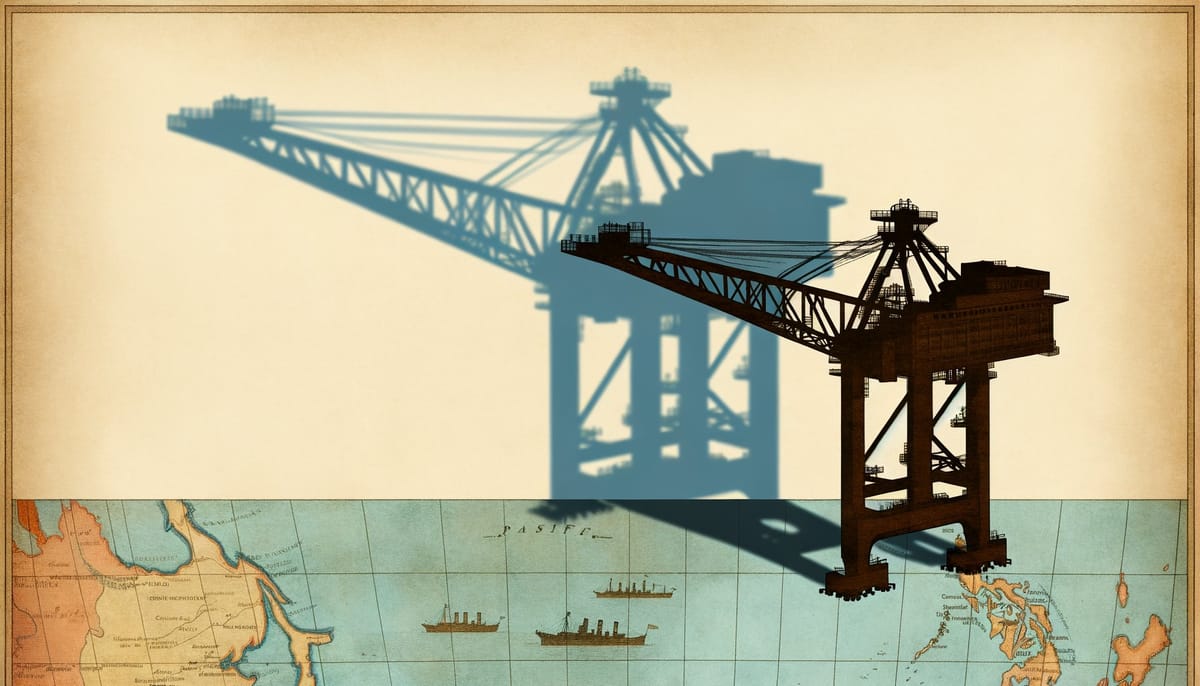
China’s naval presence in the Western Hemisphere is less a fleet than a shadow—port infrastructure, diplomatic missions, commercial shipping, and the occasional goodwill tour by a floating hospital. Yet this shadow has become the justification for a strategic debate that threatens to undermine the very deterrence it claims to protect. The question consuming Pentagon planners is whether this presence, however tenuous, forces the United States to divert Pacific assets westward, weakening the posture that actually matters against China.
The answer reveals more about American strategic culture than Chinese naval capability.
The Presence That Isn’t
Start with what actually exists. According to research compiled from open sources, there is “no documented information about PLAN naval presence, port visits, or exercises in the Western Hemisphere during 2020-2024” for traditional combat operations. The Chinese navy’s Western Hemisphere activities consist primarily of humanitarian missions and port calls. The Ark Silk Road conducted medical diplomacy across Latin America and the Caribbean. A PLAN task group visited Brazil in 2024 for what the Atlantic Council described as routine naval diplomacy. These are not the makings of a second front.
What China has built is infrastructure. The Chancay port in Peru, developed by COSCO Shipping, can handle the largest container vessels in the Pacific. Chinese-manufactured ZPMC cranes now dominate American ports, with congressional investigators finding unexplained cellular modems installed in equipment that could theoretically be used for surveillance or sabotage. Chinese technology increasingly underpins port management systems across South America. This is presence, but it is commercial and informational rather than military.
Admiral Alvin Holsey, commander of US Southern Command, assessed in February 2025 that China’s “long-term global campaign to become the dominant global power” poses challenges to regional stability. Note the framing: long-term, global, campaign. Not immediate, not military, not presence. The threat is potential, not kinetic.
This distinction matters enormously. The US Navy operates approximately 200 ships and submarines in the Pacific Fleet, with roughly 150,000 military and civilian personnel. The total battle force stands at 295-296 ships globally. Every vessel diverted to shadow a Chinese hospital ship in Managua is a vessel not conducting freedom of navigation operations in the South China Sea.
The Allocation Fallacy
The conventional wisdom holds that Chinese activity in the Western Hemisphere creates a two-front problem requiring two-front resources. This reasoning contains a fundamental error: it assumes naval allocation operates like a household budget, where spending in one category automatically reduces spending in another.
The reality is more complex and less alarming. The US Navy’s Global Force Management Allocation Plan (GFMAP) enables what the Pentagon calls “Dynamic Force Employment”—the ability to surge forces unpredictably rather than maintain static forward presence everywhere. As the Navy Times reported, this approach “creates uncertainty for adversaries” while allowing more efficient use of limited assets.
The December 2024 fleet tracker showed USS Abraham Lincoln operating in the South China Sea while USS Carl Vinson patrolled the Philippine Sea. Neither carrier was diverted to the Western Hemisphere despite ongoing Chinese commercial expansion there. The Pacific deterrence mission continued uninterrupted.
This is not to say allocation decisions don’t involve trade-offs. They do. But the trade-offs occur within the Pacific theater, not between the Pacific and Western Hemisphere. The real constraint is not Chinese activity in Latin America but shipyard maintenance capacity, crew retention, and industrial production limits. The Navy struggles to maintain its existing fleet, let alone expand it. Diverting a destroyer to Caribbean patrol doesn’t meaningfully change this calculus.
The bureaucratic politics of threat assessment creates its own distortions. SOUTHCOM must justify its budget and mission. Identifying China as a regional threat serves institutional interests regardless of operational reality. INDOPACOM, meanwhile, guards its resources jealously. The result is dueling threat narratives that can inflate the apparent demand for naval assets beyond what strategic logic requires.
The Infrastructure Gambit
If China isn’t building a Western Hemisphere fleet, what is it building? The answer lies in the dual-use nature of port infrastructure and the long-term logic of great power competition.
Chancay represents the most significant Chinese maritime investment in the Americas. Located 80 kilometers north of Lima, the deep-water port can accommodate vessels too large for the Panama Canal. It creates a direct Pacific shipping route between South America and Asia, bypassing traditional chokepoints. The strategic implications are real but subtle.
A port is not a naval base. But a port can become a naval base under crisis conditions. Chinese-operated facilities could theoretically provide logistics support, intelligence collection, and denial capabilities that would complicate American operations in a Taiwan contingency. The key word is “theoretically.” No evidence suggests China is converting commercial ports into military facilities or that host nations would permit such conversion.
The more immediate concern involves information rather than warships. Chinese port management systems, telecommunications infrastructure, and logistics platforms like LOGINK create data collection opportunities that analysts have linked to Beijing’s broader intelligence apparatus. Knowing what ships carry what cargo to which destinations has commercial and strategic value. This is espionage infrastructure, not power projection infrastructure.
The crane controversy illustrates the challenge. Chinese-manufactured container cranes dominate global markets because they’re cheaper and better than alternatives. American ports adopted them for economic reasons, not geopolitical naivety. Replacing them would cost billions and take years. The vulnerability is real, but the remedy is industrial policy, not naval redeployment.
The Deterrence Equation
The 2022 National Defense Strategy identifies China as “the pacing challenge for the Department” and prioritizes “deterring aggression, while being prepared to prevail in conflict when necessary—prioritizing the PRC challenge in the Indo-Pacific region.” This language is unambiguous. The Pacific comes first.
What does deterrence require? The Pacific Deterrence Initiative received $10 billion in FY2026 funding to enhance capabilities against China. These resources fund missile defense, logistics infrastructure, and forward basing arrangements across the First and Second Island Chains. The First Island Chain runs from the Kuril Islands through Japan, the Ryukyu Islands, Taiwan, and the northern Philippines to Borneo. The Second extends from Japan through Guam to New Guinea.
Admiral Samuel Paparo, commander of Indo-Pacific Command, has consistently emphasized that deterrence depends on credible combat power in the theater where conflict might occur. His formative experience as a carrier aviator—6,000 flight hours, 1,100 carrier landings—shaped a worldview centered on preparation and presence. Pacific primacy is not negotiable.
The deterrence logic is straightforward. China’s navy, the world’s largest with over 370 platforms, operates primarily in waters adjacent to the Chinese mainland. A Taiwan contingency would unfold in the Taiwan Strait and surrounding seas. American forces must be positioned to respond within hours, not days. Every asset stationed elsewhere is an asset that arrives late.
The “Davidson Window”—named for former INDOPACOM commander Philip Davidson’s 2021 warning that China could move against Taiwan by 2027—creates temporal urgency. If conflict is possible within years rather than decades, the time to position deterrent forces is now. Diverting resources to chase phantoms in the Caribbean is strategic malpractice.
The Opportunity Cost Calculation
Consider what Western Hemisphere deployments actually accomplish versus what Pacific deployments prevent.
A destroyer patrolling the Caribbean demonstrates American presence to regional partners, conducts counter-narcotics operations, and provides humanitarian assistance capability. These are valuable missions. They do not deter China from invading Taiwan.
The same destroyer operating in the Philippine Sea conducts freedom of navigation operations that challenge Chinese territorial claims, exercises with allied navies, and positions itself to respond to crisis. These missions directly contribute to deterrence.
The opportunity cost is not abstract. The Navy faces a surface warfare officer retention crisis severe enough that it unveiled new retention bonuses in 2024. Crew fatigue from excessive deployments degrades readiness. Maintenance backlogs accumulate when ships cannot return to port. Every unnecessary deployment compounds these problems.
Allied contributions could theoretically offset American resource constraints. Japan, Australia, South Korea, and the Philippines all field capable navies. Canada and France maintain Pacific presence. In the Western Hemisphere, Brazil operates the region’s most capable navy, and Colombia maintains close defense ties with Washington. But allied navies cannot substitute for American power projection in a Taiwan scenario. They can, however, handle routine presence missions that free American assets for higher-priority tasks.
The logic points toward division of labor, not duplication. Let regional partners handle regional presence while the United States concentrates on the deterrence mission that only it can perform.
The Political Trap
If the strategic logic is clear, why does the debate persist? Because strategy does not operate in a political vacuum.
American strategic culture struggles with prioritization. The Monroe Doctrine’s ghost haunts policy discussions, creating an instinctive resistance to any foreign presence in the Western Hemisphere. When Chinese ships dock in Havana or Managua, domestic political pressure to “respond” intensifies regardless of military significance. Members of Congress demand action. Cable news demands footage. The Navy must be seen doing something.
This creates a dangerous feedback loop. Symbolic deployments to the Western Hemisphere generate media coverage that validates threat perceptions, which generates political pressure for more deployments. The actual Chinese naval presence—minimal to nonexistent—becomes irrelevant. The perception of presence drives resource allocation.
China understands this dynamic and exploits it. A hospital ship visit costs Beijing relatively little but consumes disproportionate American attention. Port investments generate economic returns while creating strategic ambiguity that American planners must account for. The shadow does more work than any fleet could.
The asymmetry is striking. China concentrates its naval power where it matters most—the Taiwan Strait and South China Sea—while dispersing American attention across the globe through low-cost presence operations. This is strategic judo, using the opponent’s weight against him.
What Actually Threatens Deterrence
The real threats to Pacific deterrence have nothing to do with Chinese activity in the Western Hemisphere.
Shipyard capacity constrains fleet size more than allocation decisions. American shipyards cannot build or maintain ships fast enough to meet stated requirements. The Navy’s 30-year shipbuilding plan assumes industrial capacity that does not exist.
Crew retention determines how many ships can actually deploy. The surface warfare community hemorrhages experienced officers. Bonuses help at the margins but cannot compensate for operational tempo that destroys work-life balance.
Munitions production limits what forces can actually do in combat. American industry produced 240,000 artillery shells annually before the Ukraine war—barely 40 days of Ukrainian consumption. Precision munitions stockpiles would deplete rapidly in a high-intensity conflict.
Allied coordination determines whether the United States fights alone or with partners. Japan’s Self-Defense Forces, Australia’s military, and other allied capabilities multiply American power but require interoperability investments and diplomatic maintenance.
None of these constraints are solved by keeping destroyers in the Pacific rather than the Caribbean. But all of them are worsened by strategic distraction that diverts attention and resources from the industrial and institutional foundations of military power.
The Path Forward
Three principles should guide American naval allocation.
First, accept that Chinese commercial presence in the Western Hemisphere is not a military threat requiring military response. Port investments and hospital ship visits warrant monitoring, not matching. Intelligence and economic tools address these challenges better than warships.
Second, concentrate naval power where it generates deterrence. The Pacific Fleet should operate at maximum sustainable tempo in the Indo-Pacific. Western Hemisphere presence missions should fall to Coast Guard assets, allied navies, and occasional rotational deployments rather than permanent force allocation.
Third, invest in the foundations of military power rather than the symbols of it. Shipyard expansion, workforce development, munitions production, and allied interoperability generate more deterrence than any individual deployment decision.
These principles require political courage. They mean accepting that some Chinese activities will go “unanswered” in the traditional sense. They mean explaining to Congress and the public that not every foreign presence demands an American response. They mean prioritizing substance over symbolism.
The alternative is strategic dissipation—spreading forces thin to address every perceived threat while concentrating nowhere. This is how great powers decline: not through dramatic defeat but through gradual overextension.
FAQ: Key Questions Answered
Q: Does China have naval bases in Latin America? A: No. China operates no military bases in the Western Hemisphere. Its presence consists of commercial port investments, occasional ship visits for diplomatic purposes, and humanitarian missions. The distinction between commercial infrastructure and military capability matters enormously for threat assessment.
Q: Could Chinese-operated ports become military facilities in a crisis? A: Theoretically, but significant obstacles exist. Host nations would need to consent, which would damage their relations with the United States. Converting commercial facilities to military use requires time and specialized equipment. The scenario is worth monitoring but does not justify treating commercial ports as current military threats.
Q: How many US Navy ships operate in the Pacific versus other regions? A: The Pacific Fleet comprises approximately 200 ships and submarines with 150,000 personnel. The total battle force of 295-296 ships serves global commitments. Precise allocation varies based on operational requirements and the Dynamic Force Employment concept that allows flexible surging rather than static positioning.
Q: What is the Pacific Deterrence Initiative? A: The PDI is a congressionally-mandated funding mechanism to enhance American military posture in the Indo-Pacific. It received $10 billion in FY2026 for missile defense, logistics infrastructure, and forward basing improvements designed to deter Chinese aggression, particularly regarding Taiwan.
The Shadow’s Lesson
China’s Western Hemisphere presence reveals more about American strategic psychology than Chinese military capability. The shadow fleet that doesn’t exist has become a test of whether the United States can distinguish real threats from perceived ones, concentrate resources where they matter, and resist the political temptation to respond to every provocation with military symbolism.
The Pacific is where deterrence succeeds or fails. Every asset, every dollar, every ounce of strategic attention diverted elsewhere is a gift to Beijing. The shadow is doing its work. The question is whether Washington will recognize the trick before it’s too late.
Sources & Further Reading
The analysis in this article draws on research and reporting from:
- 2022 National Defense Strategy - Foundational Pentagon document establishing China as the “pacing challenge” and Indo-Pacific prioritization
- SOUTHCOM 2025 Posture Statement - Admiral Holsey’s assessment of China’s Western Hemisphere activities
- Atlantic Council analysis on China’s naval moves - Coverage of PLAN task group visit to Brazil
- USNI Fleet and Marine Tracker - Real-time tracking of US naval deployments
- CNN investigation on Chinese cranes - Congressional findings on communications equipment in port infrastructure
- Navy Times on SWO retention - Coverage of surface warfare officer retention challenges
- Global Americans on Chancay Port - Strategic analysis of Chinese port investment in Peru
- USNI on Dynamic Force Employment - Navy leadership explaining flexible deployment concepts