China's Nine-Carrier Cathedral: Monument or Miscalculation?
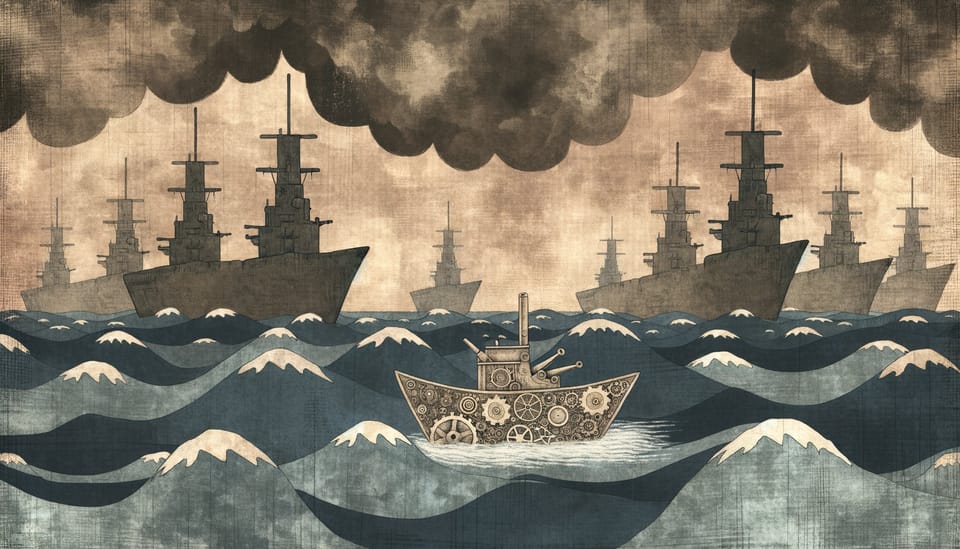
The Pentagon says China will field nine aircraft carriers by 2035—the largest Indo-Pacific carrier buildup since World War II. But building ships optimized for blue-water prestige while Taiwan sits 100 miles from the mainland reveals a strategic culture at war with strategic geography.
The Shipyard as Cathedral
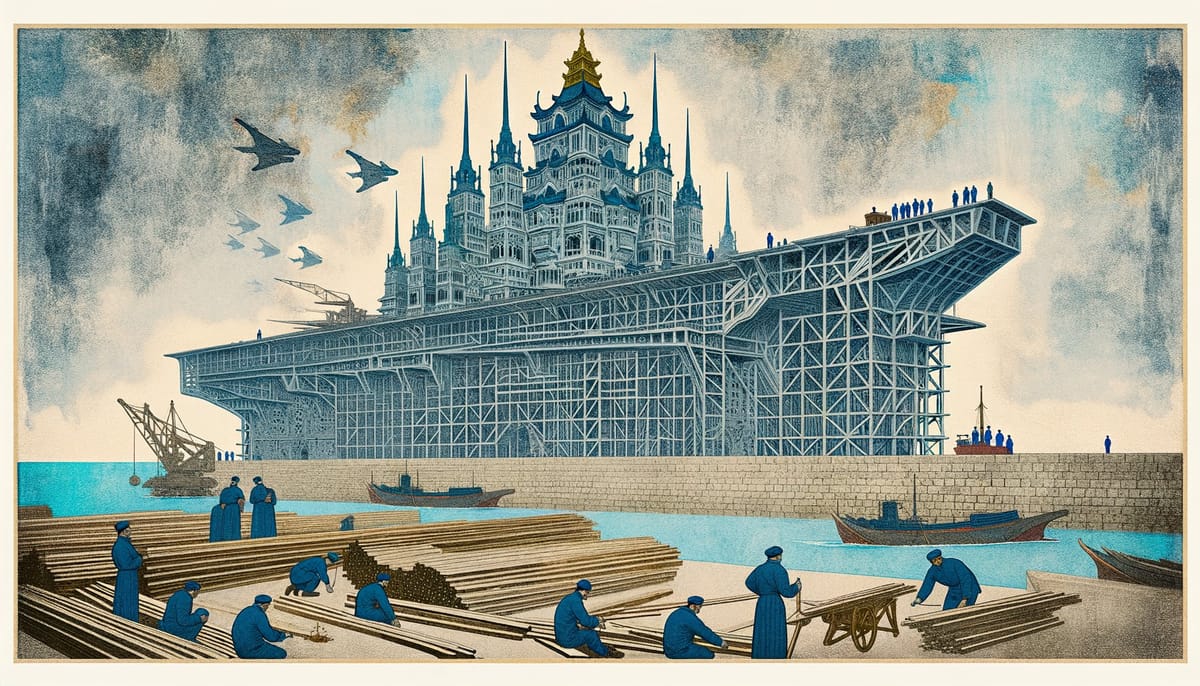
China builds aircraft carriers the way medieval Europe built cathedrals: as monuments to faith whose completion will outlast the patrons who commissioned them. The comparison illuminates more than it flatters. Cathedrals took generations because their builders lacked industrial capacity. China’s nine-carrier program stretches to 2035 because the capability gap it purports to close may have already closed behind it.
The Pentagon’s 2024 China Military Power Report describes this ambition as “the largest carrier build-up effort in the Indo-Pacific since World War II.” The framing invites awe. It should invite scrutiny. Nine carriers by 2035 would give China a fleet rivaling America’s—in platform count, if nothing else. But platform count measures inputs, not outputs. The harder question: what problem do nine carriers solve that three cannot?
Taiwan sits 100 miles from the Chinese mainland. Missiles reach it in minutes. Submarines lurk in waters too shallow for carrier operations. Amphibious forces train for the crossing. In this geography, carriers are not force multipliers. They are targets.
Yet construction continues at Dalian and Jiangnan shipyards. The Fujian commissioned in November 2025. A nuclear-powered Type 004 rises on the slipway. The program proceeds with a momentum that suggests purpose beyond military logic. Understanding that purpose requires looking past the flight decks to the forces that built them.
The Inheritance of Humiliation
Chinese strategic culture operates on timescales that confound Western analysts. The “Century of Humiliation” (1839-1949) remains a living memory, invoked in official discourse with a frequency that would seem pathological if applied to events a century past in any Western democracy. This is not propaganda. It is grammar—the syntax through which Chinese leaders parse threats and opportunities.
The 1996 Taiwan Strait Crisis crystallized this grammar into naval doctrine. When President Lee Teng-hui visited Cornell University, China fired missiles into waters near Taiwan’s ports. President Clinton dispatched two carrier battle groups. They arrived. China retreated. The lesson embedded itself: carriers are the currency of great-power intervention, and China had none.
What followed was not merely naval modernization but something closer to civilizational therapy. The Liaoning, commissioned in 2012, began life as a Soviet hulk purchased from Ukraine under the pretense of conversion to a floating casino. The Shandong, commissioned in 2019, replicated the design with Chinese characteristics. The Fujian introduced electromagnetic catapults, signaling technological ambition. Each vessel represented less a military capability than a ritual repudiation of past weakness.
This explains the program’s persistence despite strategic incoherence. Carriers do not optimize for Taiwan scenarios. They optimize for the psychological architecture of Chinese leadership. The nine-carrier goal functions as what Confucian philosophy calls zhengming—the rectification of names. China cannot be a great maritime power without great ships. The ships make the claim true by existing.
The problem with ritual logic is that adversaries operate on different calendars.
The Geometry of Vulnerability
Taiwan scenarios divide into three categories: blockade, bombardment, and invasion. Carriers contribute meaningfully to none.
A blockade requires sustained presence around the island, interdicting commercial shipping while avoiding escalation to full combat. The Congressional Research Service notes that China’s navy now exceeds 370 platforms—“by far the largest of any country in East Asia.” Surface combatants, submarines, and coast guard vessels can enforce a blockade without exposing $10 billion carriers to shore-based missiles. During Joint Sword exercises, the Liaoning positioned “east of Taiwan” in a symbolic role while actual interdiction work fell to destroyers and frigates.
Bombardment requires precision strike capacity. China possesses this in abundance through land-based missiles, which face no range constraints when targeting an island 100 miles offshore. The DF-21D “carrier killer” and its successors can reach American carriers operating 1,000 miles distant. Taiwanese defenses are closer and denser. A carrier launching J-15s against Taiwan would do so from within range of missiles it cannot outrun and air defenses it cannot suppress.
Invasion requires amphibious lift. China has invested heavily in landing ships, roll-on/roll-off ferries, and helicopter carriers optimized for troop delivery. Aircraft carriers provide air cover, but land-based aviation from Fujian Province can sustain higher sortie rates with better logistics. The carrier’s mobility advantage disappears when the objective is stationary and nearby.
Each scenario reveals the same structural problem: carriers are optimized for power projection across oceanic distances, not for operations in the confined waters of the Taiwan Strait. The nine-carrier program prepares China for wars it will not fight while consuming resources needed for wars it might.
The Opportunity Cost Nobody Calculates
Defense budgets are zero-sum. Every yuan spent on carriers is a yuan not spent on submarines, missiles, or amphibious capacity. China’s official defense spending figures obscure internal allocations, but external indicators suggest the trade-offs are substantial.
Consider submarines. Taiwan’s military has publicly stated that twelve additional diesel-electric submarines would fundamentally alter the cross-strait balance. Export pricing for Chinese submarines provides a benchmark: Thailand paid $390 million for an S26T; Pakistan’s eight-boat deal averaged approximately $625 million per hull. A carrier costs $10-15 billion. The arithmetic is brutal: one carrier buys fifteen to twenty submarines.
Submarines operate in the shallow, contested waters where Taiwan scenarios unfold. They threaten amphibious transports. They complicate blockade-running. They survive in environments where surface ships become debris. The choice to build carriers instead of submarines is not strategically neutral. It is strategically perverse—unless the carriers serve purposes beyond Taiwan.
The same logic applies to missile forces. The DF-26 intermediate-range ballistic missile can strike Guam, threatening American power projection at its forward edge. Each missile costs a fraction of a carrier’s price. Each missile survives in hardened silos or mobile launchers. Each missile complicates American planning without offering a target for retaliation. Carriers, by contrast, are the most targetable platforms in modern warfare: large, slow, radiating electromagnetic signatures, and requiring escorts that multiply the target set.
China’s shipbuilding capacity is not the constraint. The country dominates global commercial shipbuilding, with state subsidies estimated at $231 billion creating overcapacity that could absorb military orders indefinitely. The constraint is skilled labor for advanced systems—nuclear propulsion, electromagnetic catapults, integrated combat networks—and the institutional knowledge to operate them. Every engineer working on carrier propulsion is an engineer not working on submarine quieting or hypersonic guidance.
The program’s defenders argue that carriers provide capabilities submarines and missiles cannot: visible presence, diplomatic signaling, humanitarian response, and protection of sea lines of communication. These arguments have merit for a navy operating globally. They have less merit for a navy whose primary contingency lies within sight of its own coastline.
The Priesthood Problem
Nuclear-powered carriers require nuclear engineers. Not just any engineers—a specialized caste trained in reactor operation, maintenance, and safety protocols that takes decades to develop. The United States created the Naval Nuclear Propulsion Program in 1948; it operates today as a joint Department of Energy-Navy organization with institutional continuity spanning eight decades. China commissioned its first nuclear submarine in 1974 but has never operated a nuclear-powered surface combatant.
The Type 004 under construction at Dalian will be China’s first nuclear carrier. The timeline for operational capability depends not on hull construction—China builds hulls faster than anyone—but on developing what might be called a nuclear priesthood: officers and enlisted personnel who understand reactor systems at the level required for combat operations.
This priesthood cannot be purchased or accelerated. The Naval Nuclear Propulsion Program’s institutional structure reflects decades of accumulated tacit knowledge—the kind absorbed through trial and error, not transmitted through manuals. China’s carrier aviators are learning to land on pitching decks. Its reactor operators must learn to run nuclear plants in combat conditions. The learning curves do not run in parallel. They compound.
Evidence suggests China is compressing timelines in ways that create hidden risks. PLAN conducted dual-carrier operations in the Western Pacific in 2025 with pilots who cannot yet have the ten-plus years of post-qualification experience traditionally required to train the next generation of instructors. The program is operationalizing platforms before developing the human capital to sustain them.
This creates a fragile system. Carriers require not just crews but training pipelines, maintenance infrastructure, and the accumulated wisdom of thousands of at-sea hours. The U.S. Navy has been operating carriers continuously since 1922. China has been operating them since 2012. Thirteen years of experience cannot substitute for a century.
The Fleet That Waits
There is another possibility, one that Western analysts often dismiss but Chinese strategists may embrace: the fleet-in-being.
The concept originates with the German High Seas Fleet in World War I. Tirpitz and its sister ships rarely sortied, yet they tied down the Royal Navy’s Grand Fleet in home waters, forcing Britain to maintain a massive force to counter a threat that never materialized. The ship’s value came from potential, not action. It was worth more in port than at sea.
Nine Chinese carriers that remain near home waters, conducting occasional exercises but never engaging in combat, could function similarly. They would force the United States to maintain carrier presence in the Pacific, diverting resources from other theaters. They would complicate planning for Taiwan contingencies by introducing uncertainty about Chinese intentions. They would signal capability without incurring the risks of demonstration.
This interpretation reframes apparent operational deficiencies as strategic features. Low sortie rates become deliberate ambiguity. Limited blue-water deployments become prudent risk management. The carriers’ primary function is not to fight but to exist—to be counted in force structure comparisons, to appear in satellite imagery, to occupy American strategic bandwidth.
The fleet-in-being theory has limits. It works only if the adversary believes the fleet could sortie effectively. The German High Seas Fleet had proven itself at Jutland; its threat was credible. Chinese carriers have proven nothing in combat. Their deterrent value depends on assessments of capability that grow more skeptical with each passing year of limited operations.
The Domestic Audience
If carriers make limited sense as military instruments, they make considerable sense as political ones.
China’s youth unemployment rate reached 18.9% in 2024, the highest in years. The property sector, which once absorbed surplus labor and household savings, has contracted. The implicit bargain of the post-Mao era—political quiescence in exchange for rising prosperity—strains under economic deceleration. The Communist Party requires new sources of legitimacy.
Carrier construction provides one. Each vessel employs thousands of workers directly and tens of thousands indirectly through supply chains. The program creates visible, prestigious employment that state media can celebrate. It demonstrates technological prowess. It satisfies nationalist sentiment. It offers something the property sector once provided: a sense of forward motion.
The nine-carrier timeline—completion by 2035—coincides with the centenary of the end of World War II and positions China for the 2049 centenary of the People’s Republic. These are not arbitrary dates. They are ritual moments in the Communist Party’s calendar, occasions for demonstrating that the Century of Humiliation has definitively ended. Nine carriers in 2035 would be an offering to history.
This logic operates independently of military utility. The carriers serve a legitimation function that submarines and missiles cannot. You cannot parade a submarine through Tiananmen Square. You cannot invite foreign dignitaries aboard a missile battery. Carriers are cathedrals: their purpose is partly to be seen.
The danger is that ritual logic can override strategic logic. A program justified by domestic legitimacy needs may persist even when military circumstances change. The sunk costs—financial, political, institutional—create their own momentum. The carriers become unkillable not because they are survivable in combat but because killing the program would require admitting error.
What the Satellites See
Technology is not waiting for China’s carriers to mature.
On-satellite AI processing has achieved efficiency gains of 2,500 times over ground-based analysis, collapsing the detection-to-decision timeline from hours to minutes. Satellites are becoming autonomous hunters, capable of identifying and tracking carriers without human intervention. The ocean’s vastness, which once protected surface fleets, shrinks with each improvement in synthetic aperture radar and machine learning.
Hypersonic missiles compound the problem. A carrier traveling at 30 knots covers 15 nautical miles per hour. A hypersonic missile covers 15 nautical miles in under a minute. The geometry of evasion becomes impossible. Carriers can no longer outrun the weapons designed to kill them.
These developments do not render carriers obsolete for all purposes. Against adversaries lacking advanced reconnaissance and precision strike, carriers remain formidable. But China’s primary adversary possesses both in abundance. American satellites track Chinese carriers continuously. American missiles can reach them from distances that make interception improbable. The platform that symbolizes American power projection is precisely the platform most vulnerable to American capabilities.
China is building carriers optimized for a threat environment that existed in 1996. The 2035 fleet will enter service into a world where the assumptions underlying carrier warfare have fundamentally changed. This is not strategic miscalculation in the conventional sense—choosing the wrong option from available alternatives. It is temporal miscalculation: building for the past while the future arrives.
The Path of Least Resistance
What would a Taiwan-optimized force structure look like?
It would emphasize submarines—diesel-electric boats for littoral operations, nuclear attack submarines for interdicting American reinforcements. It would expand missile forces, both ballistic and cruise, capable of saturating Taiwanese defenses and threatening American bases in Japan and Guam. It would invest in amphibious lift, the mundane but essential capacity to move troops and equipment across 100 miles of water. It would develop mine warfare capabilities, both offensive and defensive. It would build the logistics infrastructure for sustained operations: fuel depots, ammunition stockpiles, repair facilities.
None of these investments offer the prestige of carriers. All of them offer greater military utility for Taiwan scenarios.
The choice China faces is not binary. It can build carriers and submarines, missiles and amphibious ships. But resources are finite, and every allocation decision forecloses alternatives. The nine-carrier program represents a bet that blue-water power projection matters more than regional dominance—or that the symbolic value of carriers justifies their military limitations.
This bet may prove correct if China’s ambitions extend beyond Taiwan to the Indian Ocean, the Persian Gulf, and the sea lines of communication that carry Middle Eastern oil to Chinese ports. Carriers provide presence that submarines cannot. They enable humanitarian operations and peacekeeping missions. They project power in ways that matter for diplomacy even when they matter less for combat.
But Taiwan is not a diplomatic problem. It is a military one. And for military problems, military solutions matter.
The Verdict
China’s nine-carrier ambition is both genuine and miscalculated—genuine in its expression of great-power aspiration, miscalculated in its allocation of resources against actual threats.
The program reflects strategic culture more than strategic analysis. It responds to the trauma of 1996, the imperatives of domestic legitimacy, and the ritual requirements of a rising power. These are real forces that shape real decisions. Dismissing them as irrational misses the point: states pursue goals that exceed narrow military optimization.
But the costs are also real. Every carrier represents submarines not built, missiles not deployed, amphibious capacity not developed. The Taiwan Strait does not care about great-power symbolism. It cares about what platforms can operate in its waters, what weapons can reach its shores, what forces can cross its width.
China is building a navy for the world while its most pressing contingency lies next door. This is not strategic wisdom. It is strategic vanity—the conviction that appearing powerful matters as much as being powerful. History suggests otherwise. Appearance without substance invites the tests that reveal the gap.
The carriers will be built. The question is what they will be worth when the moment of decision arrives.
Frequently Asked Questions
Q: How many aircraft carriers does China currently operate? A: China operates three carriers: the Liaoning (commissioned 2012), the Shandong (2019), and the Fujian (commissioned November 2025). A fourth nuclear-powered carrier, the Type 004, is under construction at Dalian Shipyard.
Q: Why does China want nine aircraft carriers by 2035? A: The nine-carrier goal reflects multiple objectives: matching U.S. naval prestige, projecting power beyond the first island chain, protecting sea lines of communication to the Middle East, and satisfying domestic nationalist expectations. Military utility for Taiwan scenarios is arguably the weakest justification.
Q: Could Chinese carriers be used in a Taiwan invasion? A: Carriers have participated in Joint Sword exercises simulating Taiwan blockades, but their role has been primarily symbolic. The confined waters of the Taiwan Strait, combined with Taiwan’s shore-based missiles and dense air defenses, make carriers more vulnerable than useful in actual combat scenarios.
Q: What is the biggest weakness of China’s carrier program? A: Human capital. Operating nuclear-powered carriers requires a specialized workforce developed over decades. China’s carrier aviation and reactor operation programs are compressed timelines that create hidden risks. Platforms can be built faster than the institutional knowledge to operate them effectively.
Sources & Further Reading
The analysis in this article draws on research and reporting from:
- Pentagon China Military Power Report 2024 - Primary source for the nine-carrier timeline and Joint Sword exercise analysis
- Congressional Research Service: China Naval Modernization - Comprehensive assessment of PLAN force structure and capabilities
- Naval Nuclear Propulsion Program Structure - Institutional framework for nuclear carrier operations
- SCMP: PLA Blockade Drills Around Taiwan - Reporting on Joint Sword exercises and carrier deployment patterns
- China Youth Unemployment Data - Economic context for domestic legitimacy pressures
- Type 901 Fast Combat Support Ship - Logistics infrastructure for carrier operations