Can $45 million in US aid compete with China's infrastructure billions in mainland Southeast Asia?
America pledges millions for regional stability while China deploys billions in railways and ports. But Southeast Asian states are not choosing between patrons—they are reviving an ancient political technology that extracts benefits from both while committing to neither.
🎧 Listen to this article
The Mandala Returns
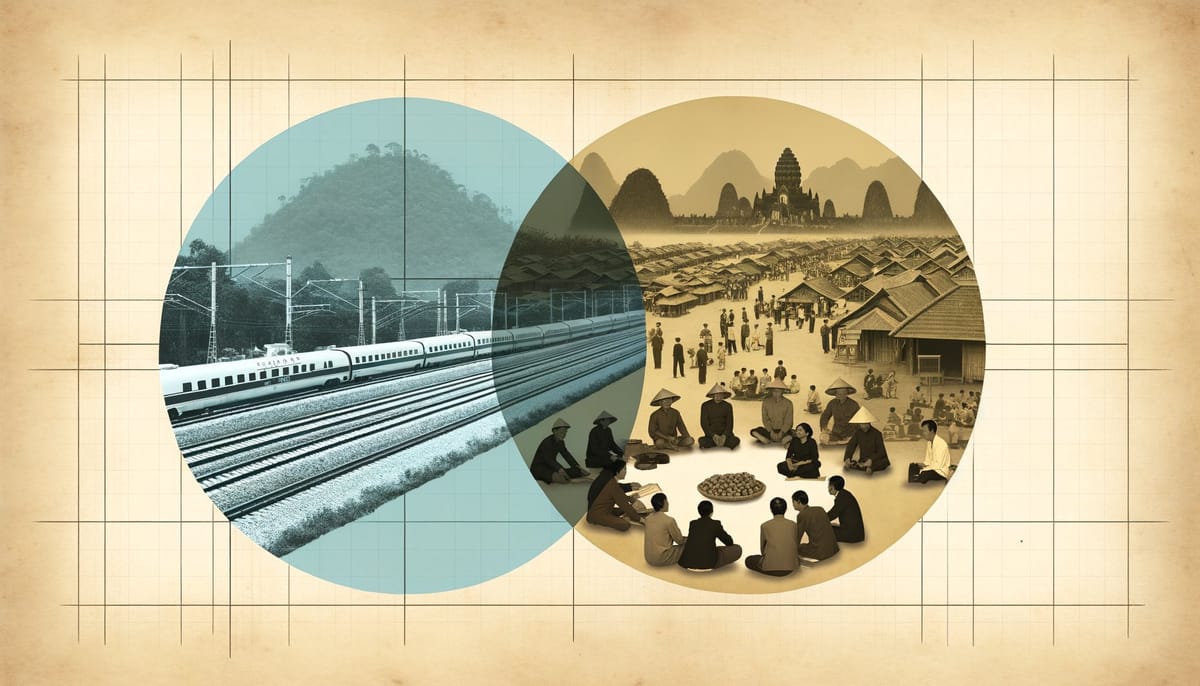
In Vientiane, a Chinese-built railway station gleams beside a rutted road that USAID helped pave two decades ago. The contrast captures something more than infrastructure inequality. It reveals how two powers conceive of influence itself—one through concrete and steel, the other through workshops and training sessions. The $45 million America recently pledged to Thailand and Cambodia for regional stability would fund roughly four days of Chinese construction activity in Southeast Asia at current rates.
Yet the question of whether dollars can compete with yuan misses the strategic architecture entirely. Mainland Southeast Asia’s five nations—Thailand, Vietnam, Cambodia, Laos, and Myanmar—do not experience great power competition as a choice between patrons. They experience it as an opportunity to extract maximum benefit from both while committing to neither. This is not hedging born of weakness. It is the revival of an ancient political technology that predates Westphalian sovereignty by centuries.
The mandala system that governed pre-colonial Southeast Asia assumed overlapping spheres of influence as normal. Rulers maintained simultaneous loyalties to multiple centers of power, calibrating tribute and deference based on proximity and circumstance. Today’s regional elites have rediscovered this logic. The question is not whether American aid can match Chinese infrastructure. The question is whether either power understands the game being played.
Asymmetries of Scale and Kind
The numerical disparity is stark. China’s Belt and Road Initiative has deployed $1.3 trillion globally since 2013, with Southeast Asia receiving $11.3 billion in Chinese investment in the first half of 2025 alone, according to the Griffith Asia Institute. USAID allocated $837 million to ASEAN member states in fiscal year 2024—substantial, but operating in a different register entirely.
The instruments differ as fundamentally as the amounts. Chinese engagement comes primarily as loans for physical infrastructure: railways, dams, power plants, ports. American assistance arrives as grants for governance, civil society, health systems, and military training. One builds monuments. The other builds institutions—or tries to.
This distinction matters less than it appears. Infrastructure creates visibility and employment during construction. It generates ribbon-cutting ceremonies that politicians can photograph. But it also creates debt and maintenance dependencies that persist for decades. The Laos-China Railway, completed in 2021, now contributes to a national debt exceeding GDP. Laos pays China roughly $1.3 billion annually in debt service—more than its entire health and education budgets combined.
American aid creates no such monuments. A USAID governance program produces no gleaming station. But it also produces no debt trap. The $45 million for Thailand and Cambodia targets transnational crime networks, particularly the scam compounds that have proliferated along border regions. This addresses a genuine regional concern. It does not, however, compete for the same influence space that infrastructure occupies.
The comparison itself may be the error. Asking whether $45 million can compete with billions assumes both powers are playing the same game. They are not.
What Influence Actually Buys
The ISEAS-Yusof Ishak Institute’s 2024 survey of Southeast Asian elites recorded a milestone: for the first time, more respondents (50.5%) said they would choose China over America if forced to pick sides. The shift from 2023, when only 38.9% preferred China, appears dramatic.
Appearances deceive. The same survey shows that when asked which power inspires more confidence to “do the right thing,” respondents still favor America. When asked which power poses a greater threat to regional stability, they name China. The preference for China as an ally reflects not affection but calculation: China is present, proximate, and cannot be avoided. America is distant, distracted, and increasingly unreliable.
This is the influence that infrastructure billions actually purchase: the grudging acknowledgment that China must be accommodated. It is not loyalty. It is not even preference in any meaningful sense. It is the recognition that a creditor who has built your railway and holds your debt cannot be ignored.
American influence operates differently. The International Military Education and Training program has brought Thai officers to West Point since 1930—only 25 graduates total, with three currently enrolled. This trickle creates networks, not dependencies. The Leahy Law’s requirement to vet individual military units for human rights compliance before providing assistance treats recipient states as non-unitary actors whose internal command structures can be selectively engaged. This fragments sovereignty in ways that Chinese assistance does not.
Both approaches generate resentment. Chinese loans create debt burdens that constrain policy autonomy. American conditions create compliance burdens that constrain political autonomy. Southeast Asian elites prefer neither. They prefer both—extracting infrastructure from one and legitimacy from the other while committing to neither.
The Absorption Problem
Money is not the binding constraint. Institutional capacity is.
The World Bank’s research on aid absorption identifies “public financial management competencies” and “government capacity for macroeconomic management, planning and budgeting” as the primary bottlenecks. A country can receive more aid than it can spend effectively. Beyond a threshold, additional dollars produce diminishing returns or active harm—funding corruption, distorting local markets, or creating parallel systems that undermine state capacity.
This dynamic affects American aid more than Chinese infrastructure. A railway requires engineering capacity, not governance capacity. A USAID democracy program requires functioning institutions to reform. The irony is precise: American aid designed to build institutions cannot be absorbed by countries lacking institutions.
Chinese infrastructure faces different absorption limits. The Jakarta-Bandung high-speed railway, funded by Chinese loans, was announced in 2015 and completed in 2023—eight years for 142 kilometers. Delays stemmed from land acquisition disputes, regulatory complications, and coordination failures between Chinese contractors and Indonesian authorities. The project eventually succeeded, but at costs far exceeding initial estimates.
Both powers encounter the same underlying reality: mainland Southeast Asian states have limited capacity to process external engagement, whether that engagement comes as aid or investment. The difference is that Chinese delays result in late infrastructure, while American delays result in no visible product at all.
The Maintenance Trap
Infrastructure’s influence extends beyond construction. It extends into maintenance, spare parts, and technical dependency.
The Laos-China Railway requires Chinese engineers for maintenance, Chinese suppliers for components, and Chinese systems for operations. This creates a relationship that outlives the original financing. The debt can theoretically be repaid. The technical dependency cannot. Laos will require Chinese expertise to operate its railway for as long as the railway exists.
This pattern replicates across Chinese infrastructure projects. Huawei’s “Safe City” surveillance systems in multiple Southeast Asian capitals require Huawei maintenance and Huawei software updates. Chinese-built power plants require Chinese turbine parts. The initial investment creates the relationship. The maintenance requirement makes it permanent.
American aid creates no equivalent dependency—which is both its virtue and its limitation. A USAID-trained civil society organization can continue operating after American funding ends. It can also collapse. A Chinese-built railway cannot collapse. It can only be maintained by Chinese engineers.
The maintenance trap reveals infrastructure’s true influence mechanism. It is not the debt, though the debt matters. It is the permanent presence of Chinese technical capacity embedded in national systems. Every maintenance visit, every spare part shipment, every software update reinforces the relationship. American governance programs create no such recurring touchpoints.
Hedging as Strategy, Not Weakness
The mandala system’s revival is visible in every regional capital’s diplomatic calendar. Vietnam hosts American aircraft carriers and signs comprehensive strategic partnerships with China in the same year. Thailand conducts Cobra Gold exercises with American forces while purchasing Chinese submarines. Cambodia, often described as Beijing’s client state, still accepts American demining assistance and health programs.
This is not incoherence. It is strategy.
The mandala political model that governed pre-colonial Southeast Asia assumed that smaller polities would maintain relationships with multiple larger powers simultaneously. Exclusive allegiance was the exception, not the rule. Tribute flowed in multiple directions. Loyalty was calibrated, not absolute.
Modern Southeast Asian hedging reproduces this logic within Westphalian institutional forms. ASEAN’s consensus requirement—every member can veto any collective action—preserves each state’s ability to maintain contradictory relationships. The organization’s famous “non-interference” principle prevents any external power from claiming exclusive jurisdiction over a member state.
This architecture frustrates both Washington and Beijing. American policymakers want allies who share values and commit to partnerships. Chinese policymakers want clients who accept hierarchical relationships. Southeast Asian states want neither. They want options.
The $45 million question assumes that influence is purchased through transactions. Mandala logic suggests influence is negotiated through relationships—and that the most successful negotiators are those who maintain multiple relationships simultaneously without fully committing to any.
The Visibility Gap
Chinese infrastructure is visible. American aid is not.
A railway station exists in physical space. Citizens see it, use it, photograph it. A governance program exists in institutional space. Citizens do not see workshops. They do not use training sessions. They experience, at best, marginally improved government services whose connection to foreign assistance remains invisible.
This visibility gap shapes public perception more than dollar amounts. The State of Southeast Asia survey captures elite opinion, not public opinion. Elites understand that American assistance funds health systems and civil society. Publics see Chinese trains.
The gap creates a political economy problem for American influence. Politicians who accept American governance aid cannot claim credit for visible improvements. Politicians who accept Chinese infrastructure can cut ribbons. The incentive structure favors Chinese engagement regardless of long-term costs.
American attempts to close the visibility gap have failed. The Blue Dot Network, launched in 2019 to certify high-quality infrastructure projects, has certified almost nothing. The Build Back Better World initiative, announced in 2021, has deployed minimal capital. The Indo-Pacific Economic Framework, launched in 2022, offers no market access—the one thing Southeast Asian states actually want from America.
The pattern reveals a structural limitation. American political economy cannot mobilize infrastructure capital at Chinese scale. Private capital requires returns. Public capital requires congressional appropriation. Neither mechanism can match a system where state-owned enterprises deploy state-directed capital without commercial return requirements.
The Debt Sustainability Paradox
International financial institutions assess debt sustainability through standardized frameworks. The IMF’s Debt Sustainability Analysis classifies countries by risk level. Cambodia consistently receives “low risk” ratings. Laos is classified as in “debt distress.”
These classifications create paradoxical effects. Cambodia’s low-risk rating makes Chinese lending invisible to Western monitoring systems. The debt appears sustainable, so no alarm sounds. Laos’s distress classification triggers international attention—but also reduces Laos’s leverage, since creditors know Vientiane has no alternatives.
The karmic debt relationships embedded in Theravada Buddhist societies complicate these calculations further. Merit-making through collective action—including infrastructure construction—carries spiritual significance that economic frameworks cannot capture. A dam that disrupts sacred landscapes may be economically rational and spiritually catastrophic. A monastery renovation that generates merit may be economically trivial and politically transformative.
Chinese infrastructure projects increasingly incorporate merit-generating elements. Temple renovations accompany railway construction. Monastery donations accompany dam projects. This is not cynical manipulation. It is cultural competence—understanding that influence in Buddhist societies requires spiritual as well as material investment.
American aid rarely engages this dimension. USAID’s secular institutional focus produces programs that are culturally neutral and therefore culturally invisible. The neutrality is principled. It is also strategically limiting.
What Changes the Calculus
Three developments could shift the current equilibrium.
First, Chinese economic deceleration. BRI lending has already declined from its 2016-2018 peak as Chinese banks face domestic pressures. If Chinese infrastructure investment continues falling, the visibility gap narrows. Southeast Asian states would have less Chinese concrete to weigh against American programs.
Second, American market access. The one thing Southeast Asian states want from America—preferential trade access—remains politically impossible in Washington. Both parties have abandoned trade liberalization. If this changed, American influence would increase dramatically without any increase in aid spending.
Third, regional crisis. A Taiwan contingency, a South China Sea conflict, or a major humanitarian emergency would force choices that hedging cannot accommodate. The mandala system works in peacetime. It collapses when powers demand exclusive commitment.
None of these developments is likely in the near term. Chinese investment continues, if at reduced levels. American trade policy remains protectionist. Regional tensions simmer without boiling.
The default trajectory therefore continues: China builds infrastructure, America funds programs, and Southeast Asian states extract benefits from both while committing to neither. The $45 million matters less than the strategic architecture it operates within.
FAQ: Key Questions Answered
Q: Is China actually “buying” Southeast Asian loyalty through infrastructure investment? A: Not exactly. The 2024 ISEAS survey shows that while more Southeast Asian elites would choose China if forced to pick sides, they simultaneously view China as a greater threat to regional stability. Infrastructure creates accommodation, not loyalty—states accept Chinese presence because they cannot avoid it, not because they prefer it.
Q: Why doesn’t the US simply match Chinese infrastructure spending? A: American political economy cannot mobilize capital at Chinese scale. Private investors require commercial returns that infrastructure in developing countries rarely provides. Congressional appropriations face domestic political constraints. China’s state-owned enterprises operate under different incentive structures that enable non-commercial deployment.
Q: What happens to countries that become too dependent on Chinese debt? A: Laos provides the clearest example: debt service now exceeds health and education spending combined, and technical dependency on Chinese maintenance ensures the relationship persists beyond any debt restructuring. However, outright asset seizures (the “debt trap” narrative) remain rare—China typically prefers renegotiation to confrontation.
Q: Can Southeast Asian countries actually play both powers against each other indefinitely? A: In peacetime, yes. The mandala-style hedging currently practiced by most regional states extracts benefits from both powers while avoiding commitment to either. This strategy fails only when crisis forces binary choices—a Taiwan conflict, for instance, would require responses that hedging cannot accommodate.
The Long Game
The $45 million will fund counter-trafficking programs, train border security forces, and support civil society organizations. It will not build railways. It will not reshape regional infrastructure. It will not compete with Chinese billions on Chinese terms.
This is not necessarily failure. American influence in Southeast Asia has never depended primarily on infrastructure. It has depended on security guarantees, market access, and the appeal of American institutions and education. The first remains credible if untested. The second has been abandoned. The third persists but faces competition from Chinese alternatives.
The mandala system’s revival suggests that neither power will achieve the exclusive influence it seeks. Southeast Asian states have learned, over centuries, how to navigate between larger powers. They will continue extracting Chinese infrastructure and American programs while committing to neither patron.
The question is not whether $45 million can compete with billions. The question is whether either power understands that competition itself may be the wrong frame. In the mandala, there are no winners and losers. There are only relationships—calibrated, negotiated, and never quite resolved.
Beijing builds railways. Washington funds workshops. And in Vientiane, Vietnamese, Thai, Cambodian, and Myanmar officials watch both, calculate carefully, and commit to nothing at all.
Sources & Further Reading
The analysis in this article draws on research and reporting from:
- ISEAS State of Southeast Asia 2024 Survey - Primary source for elite preference data across ASEAN member states
- Griffith Asia Institute BRI Investment Report 2025 - Comprehensive tracking of Chinese infrastructure investment flows
- Wikipedia: Mandala Political Model - Historical context for pre-colonial Southeast Asian governance systems
- RTI International: Absorptive Capacity - Research on institutional constraints affecting aid effectiveness
- Asia Pacific Foundation: Laos Hydropower and Chinese Debt - Analysis of debt sustainability in Chinese infrastructure financing
- CSIS: Assessing US and Chinese Influence - Comparative framework for understanding influence mechanisms
- Lowy Institute: The Jagged Sphere - Regional analysis of mainland versus maritime Southeast Asia dynamics
- Foreign Affairs: How China Carved Up Myanmar - Case study of Chinese engagement in contested spaces